Tuesday, July 07, 2026

How Every Painting Is Built, Part 2 of 2: Line, Tone, Colour

Last week, we looked at the choice of medium in painting – why it matters, what the main options are, and how the properties of each shape the kind of image an artist can make. This week, we turn to the three elements that lie at the heart of the painted image: line, tone, and color. Together with the handling of detail and distance, these form the complete visual vocabulary that every artist draws on, whatever his tradition or period.

Using Line and Tone to Represent Form
When we look out of a window and take in a view, we distinguish one object from another through visual contrast in their shapes. A person standing in a beam of light against a dark background is clearly visible; the three-dimensional form of his face is legible because of the variations in light and shadow across its surface – a bulbous nose, sunken cheeks, the curve of the jaw, and so on. An artist can represent this contrast in two ways. The first is to represent the boundary between a light shape and a dark shape as a line.
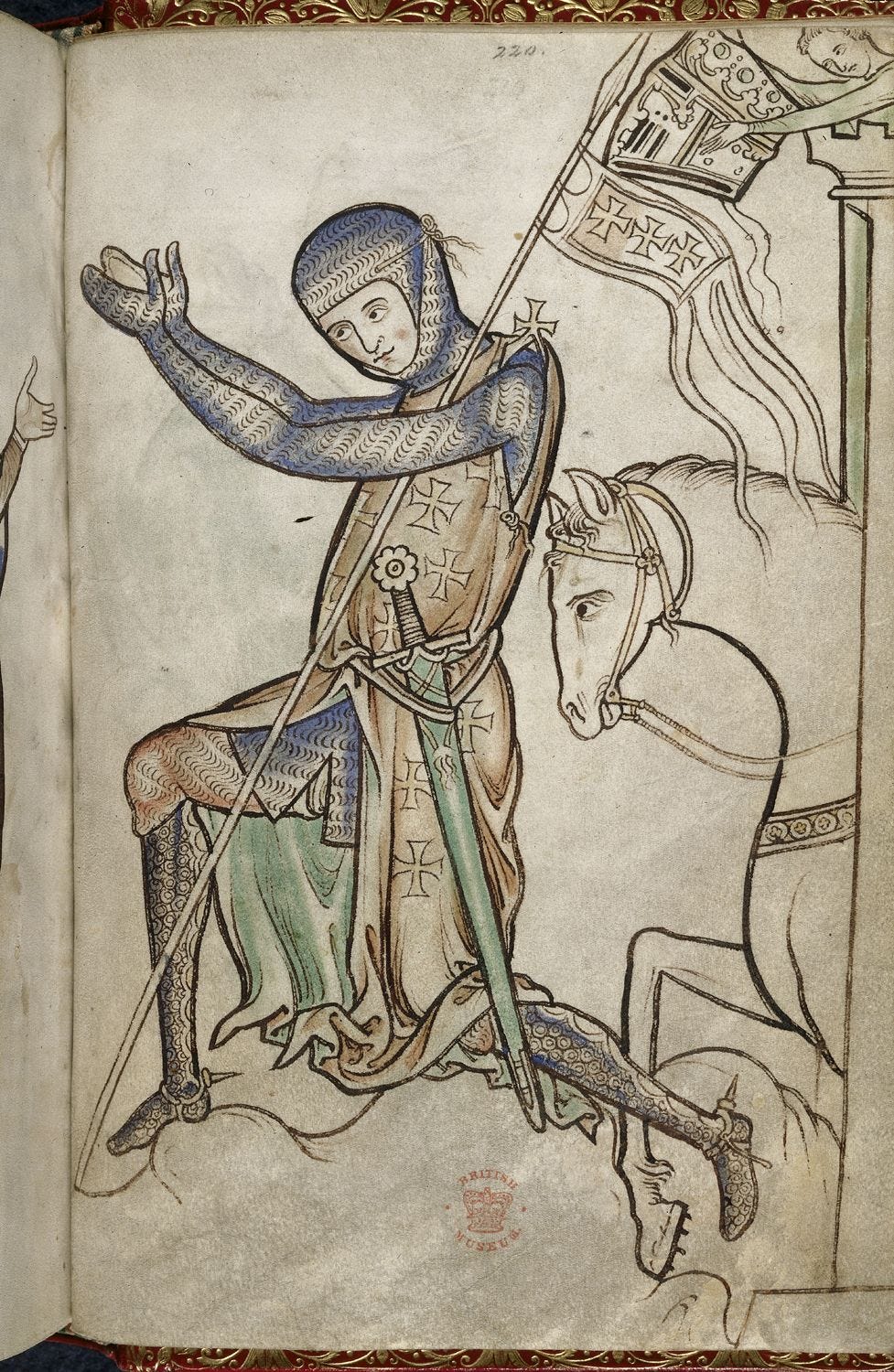
In this portrayal of a knight by the English monk Matthew Paris, from the 13th-century Westminster Psalter, we see a skilled use of line to depict form. Paris controls his line with enough assurance to give it a graceful, flowing quality, a beauty comparable to fine calligraphy. Notice also how he varies the width and darkness of his lines. He does this for two purposes: first, to direct the viewer’s eye toward the parts of the composition he considers most important, since a thicker, darker line draws attention more strongly; and second, to indicate the degree of contrast between an object and its background. Where a light shape sits against a much darker one, the contrast is high, and a bold line is appropriate; where a pale shape sits against a slightly darker background, the contrast is low, and only a thin, pale line is used. Where there is effectively no contrast at all, the skilled artist will allow the line to disappear entirely, even though he knows the edge of an object is there. The less skilled artist tends to put the line in anyway, because he knows intellectually that the edge exists, and this will overrule what his eyes are actually telling him. Line drawing is easy to do poorly – it is how most children begin – but demands genuine subtlety to handle well.

Where line represents contrast by marking a boundary, the second approach represents it by painting tonal values directly, as the eye sees them. This is harder than it sounds. Most people must be trained to observe what the eye actually sees rather than what the mind constructs after processing visual information, and what the mind constructs is always conditioned by memory and prior knowledge of the object. Consider this self-portrait by Rembrandt:
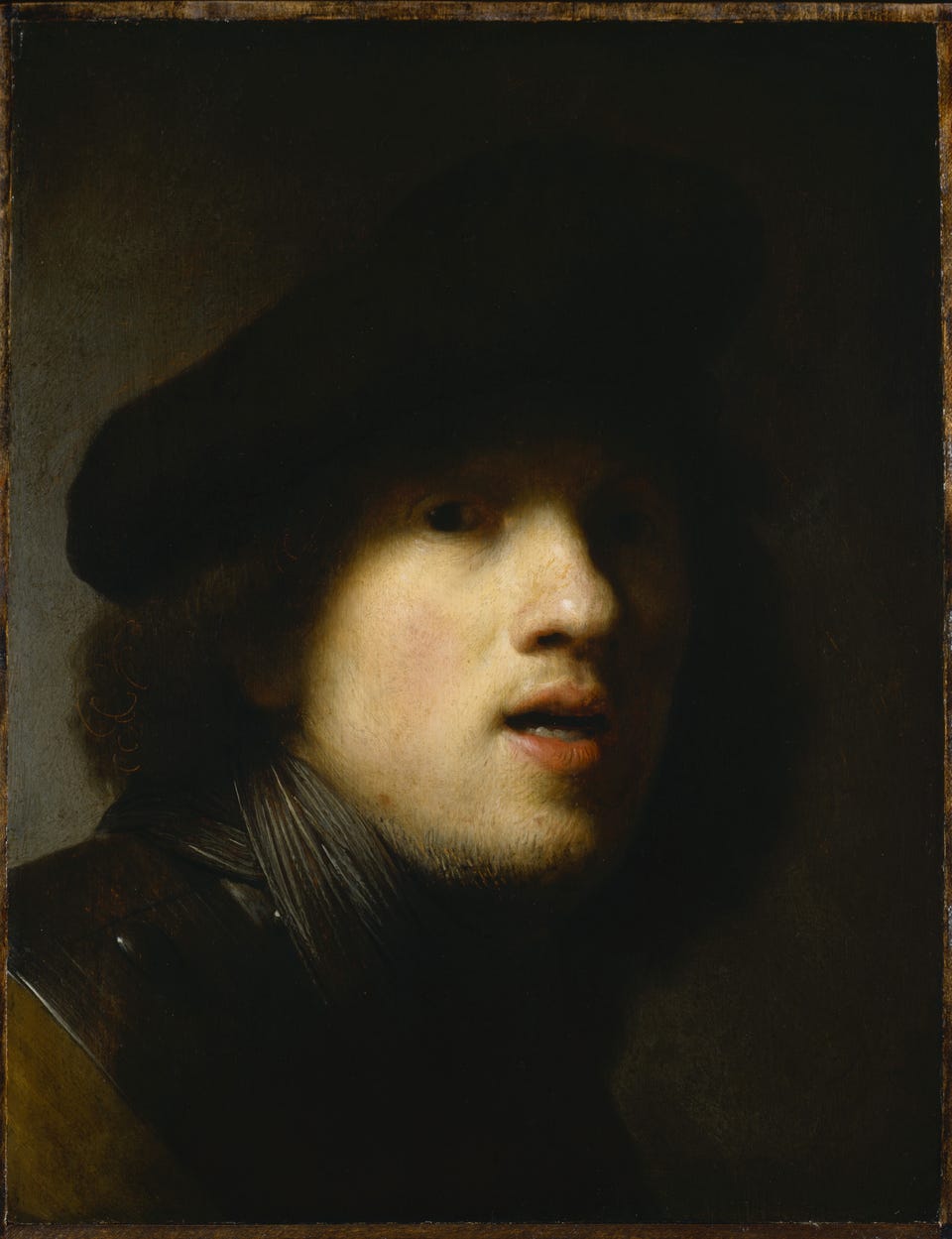
Here, there are no lines at all. Everything is a tonal value, and any apparent edge is simply the junction of a lighter and a darker area. This allows Rembrandt to convey the shape of the face without an outline. He is also willing to let edges dissolve where the tonal contrast is low: the right side of the figure here is barely distinguishable from the background. This points to a deeper distinction between the two approaches. Line tends to show edges and discontinuities; tonal painting can express the gradually changing internal variations of a three-dimensional surface, which is why it lends itself more to high naturalism.

In practice, most artists combine the two approaches, with one playing a supporting role to the other. Matthew Paris is a good example: predominantly linear, but with enough internal tonal variation to suggest the three-dimensional character of the forms. Having considered line and tone, we can turn to the third element – color – which brings its own particular difficulties.

Color
Color can also be used to describe form, but it is the most difficult of the three elements to handle well, for reasons that are easy to overlook.

Consider a grayscale image of something colored in nature. Red and yellow can generally be distinguished, since red tends toward a darker tonal value in monochrome, but red and blue are much harder to tell apart. I can remember watching Liverpool and Everton soccer matches on a black-and-white television in the 1960s: Liverpool in deep red, Everton in deep blue, indistinguishable from the waist up. Fortunately, Everton wore white shorts and Liverpool red, which settled the question. (I am a Liverpool supporter, incidentally.)

The reason this matters to the painter lies in how the eye works. The human eye reads both monochrome and color simultaneously, using different receptor cells (rods and cones) in the retina, and the brain can assess three-dimensional form from tonal and color variation in combination. But while the mind processes this information with ease, it is extremely difficult for the artist to represent it faithfully. Colors do not simply become darker or lighter in shadow. They may shift toward blue in shade, or toward yellow and green in bright sunlight, even though the actual color of the object has not changed. This means that to paint color accurately, the artist must observe what his eye receives rather than what his intellect tells him the color ought to be.

There is a further complication: colors shift not only with light and shadow, but also with distance, through what is called color perspective. The green of leaves becomes progressively bluer the further away they are, which is why mountain ranges always appear blue on the horizon - hence the song about the Blue Ridge Mountains of Virginia. Tonal contrast also decreases with distance, so that those blue mountains become not only bluer but lighter the further away they are. The skilled naturalistic artist must hold all of these variables in balance simultaneously, and few manage to do so well.

Here is one who did:
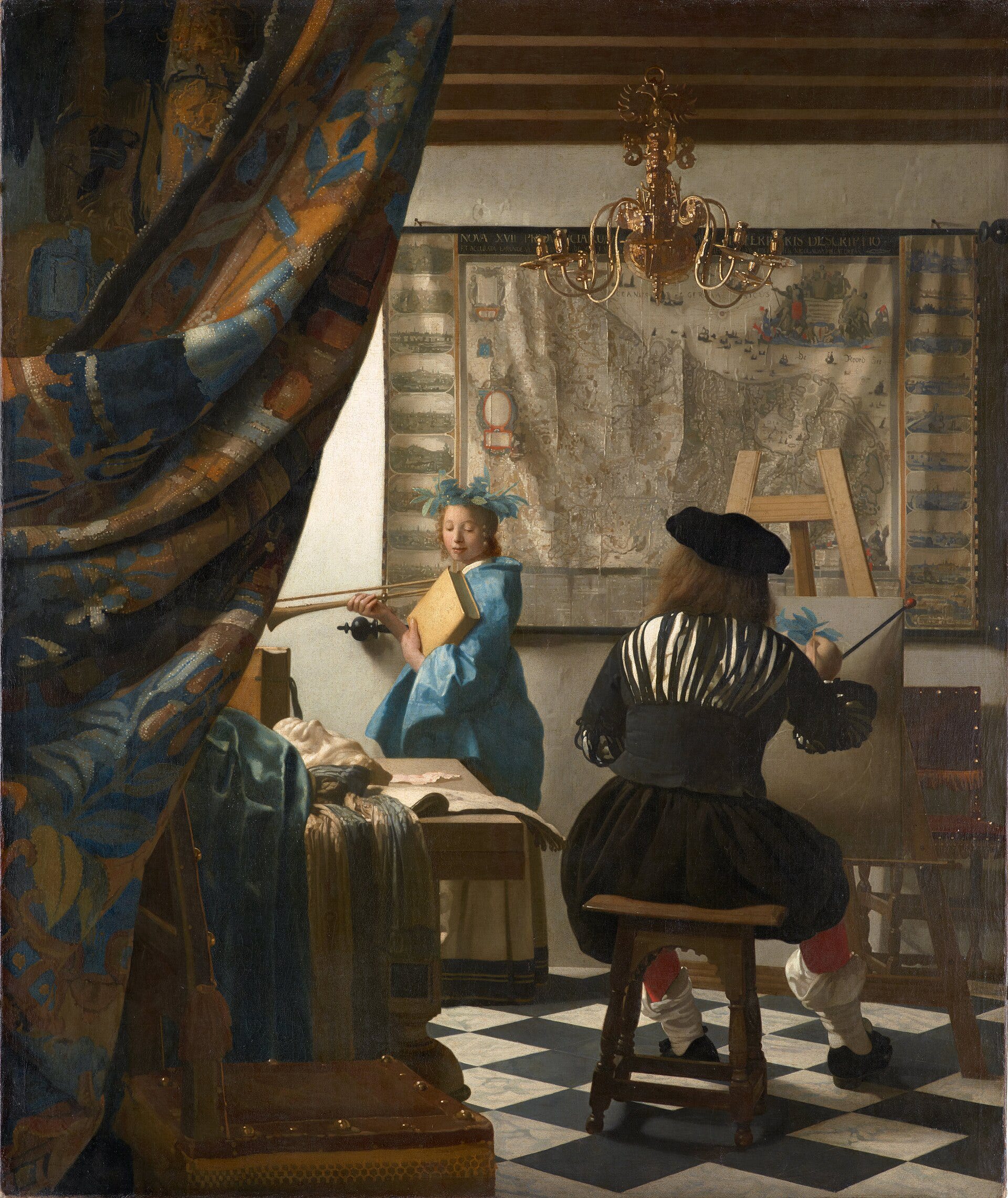
In Vermeer’s The Art of Painting (c. 1666), notice the large draped curtain pulled to one side. We judge the actual color of its pattern by looking at the mid-tones, the areas neither bleached by direct light nor lost in deep shadow. Vermeer has shifted the colors so that what is blue in full light becomes reddish in the shadow, and vice versa; yet the eye reads the fabric as a consistently colored pattern, because the brain automatically compensates for exactly this kind of variation. To do this in paint, Vermeer had to observe the colors as his eye received them, rather than as his intellect classified them, suppressing the very interpretive process by which we normally make sense of what we see. This capacity is rare. Most Baroque masters simplified the problem by concentrating on tonal variation and applying Vermeer’s kind of color sensitivity only at the main focal points.

Closely related to the handling of color and tone is the question of how the artist represents distance itself - not just the color shift of distant objects, but the whole problem of conveying size and space on a flat surface.

Judging Distance and Size
If we see a figure in a painting, we may estimate his height by comparing him to familiar objects nearby - a door, a table, another figure. But we also judge distance by the resolution of detail: when something is far away, we cannot distinguish its finer features as clearly as when it is close. A good artist knows this and uses it. One of the most common errors of beginners is to paint distant objects with as much detail as near ones - every leaf on a distant tree painstakingly rendered. This creates an image that is somehow mentally exhausting, overloaded with information the eye would never actually receive at that distance. Both the Pre-Raphaelites and the modern photorealists can be guilty of this, and in different ways the results share a quality of incongruity: the painting is the product of technical accomplishment, but somehow we sense, even if we do not know why, that something is visually wrong.

Yet this same principle, once understood, can be turned to deliberate and powerful effect. Artists who consciously heighten detail at apparent distances and, in doing so, deliberately override natural perception can imbue their images with a symbolic or heavenly quality. In heaven, to behold something fully is to know it fully; heightened detail across an entire picture plane suggests a mode of seeing that is not bound by natural distance. Gothic painters such as Duccio and Van Eyck, and iconographic painters such as Andrei Rublev, understood this and used it consistently. Their images carry a sense of participation in a different order of reality - one where the ordinary limits of perception do not apply. There is a skill in using this as a visual tool: for the break from naturalism to work, everything else present in the painting must support the idea that we are looking at heaven, so that the heightened level of detail no longer strikes the viewer as incongruous.
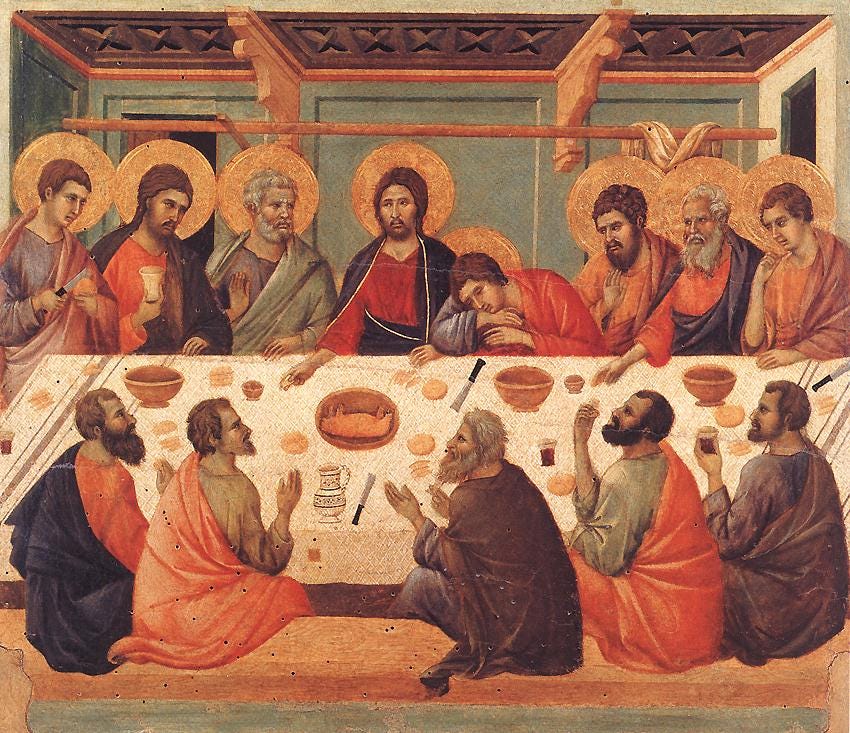
The Last Supper by Duccio, Italian early 14th century, egg tempera on wooden panel
Putting It All Together
The artist composes his picture as a whole by weighing and combining these elements - line, tone, color, detail - in different proportions and with different emphases. The resulting balance between naturalism and abstraction, between depicting the visible world as it appears and representing realities that transcend it, characterizes the style of a given work and the tradition to which it belongs.

It is commonly said that a good artist knows the rules, and a great artist knows when to break them. I do not think this is quite right. These are not arbitrary rules but principles grounded in how images actually work, and the genuinely skilled artist does not break them - he applies them differently depending on what he is trying to represent. The same principle of detail and distance is applied one way when painting the natural world, where detail diminishes with distance, and another way when painting heavenly subjects, where it does not. What looks like rule-breaking is usually the consistent application of a different set of governing assumptions about the nature of the subject. The failure of the Pre-Raphaelites and photorealists is not that they broke the rules but that they applied naturalistic conventions to subject matter and compositions that would have been better served by something else, producing an incongruity they did not recognize and could not resolve. 
Perhaps a distinction in motivation should be made here between the Pre-Raphaelites and the Photorealists. The Pre-Raphaelites were generally Christian in motivation and sought to reestablish the late-Gothic style of artists such as Van Eyck, who preceded the Italian Renaissance exemplified by Raphael. This is was part of the broad Victorian neo-Gothic movement that was connected with Anglican and Catholic Christianity in England in the 19th century. What was a very successful movement architecturally was, in my opinion, less successful artistically for the reason I gave above. However, even with this handicap, many examples of their art can still be striking and beautiful and are redeemed in my eyes because the symbolism and choice of subject are handled well and otherwise in harmony with a Christian worldview. Certainly, it is preferable to much contemporary art! 
The Photorealists, however, are materialists who deliberately pack their images with detail in order to reflect their false assertion, from a Christian point of view, that what they represent has no meaning or significance, and they reject the idea that a man is anything more significant than a collection of atoms that we happen to call a man. For them, the collection of atoms we call a man has no more significance than the collection of atoms we recognize as a cigarette butt on the floor.
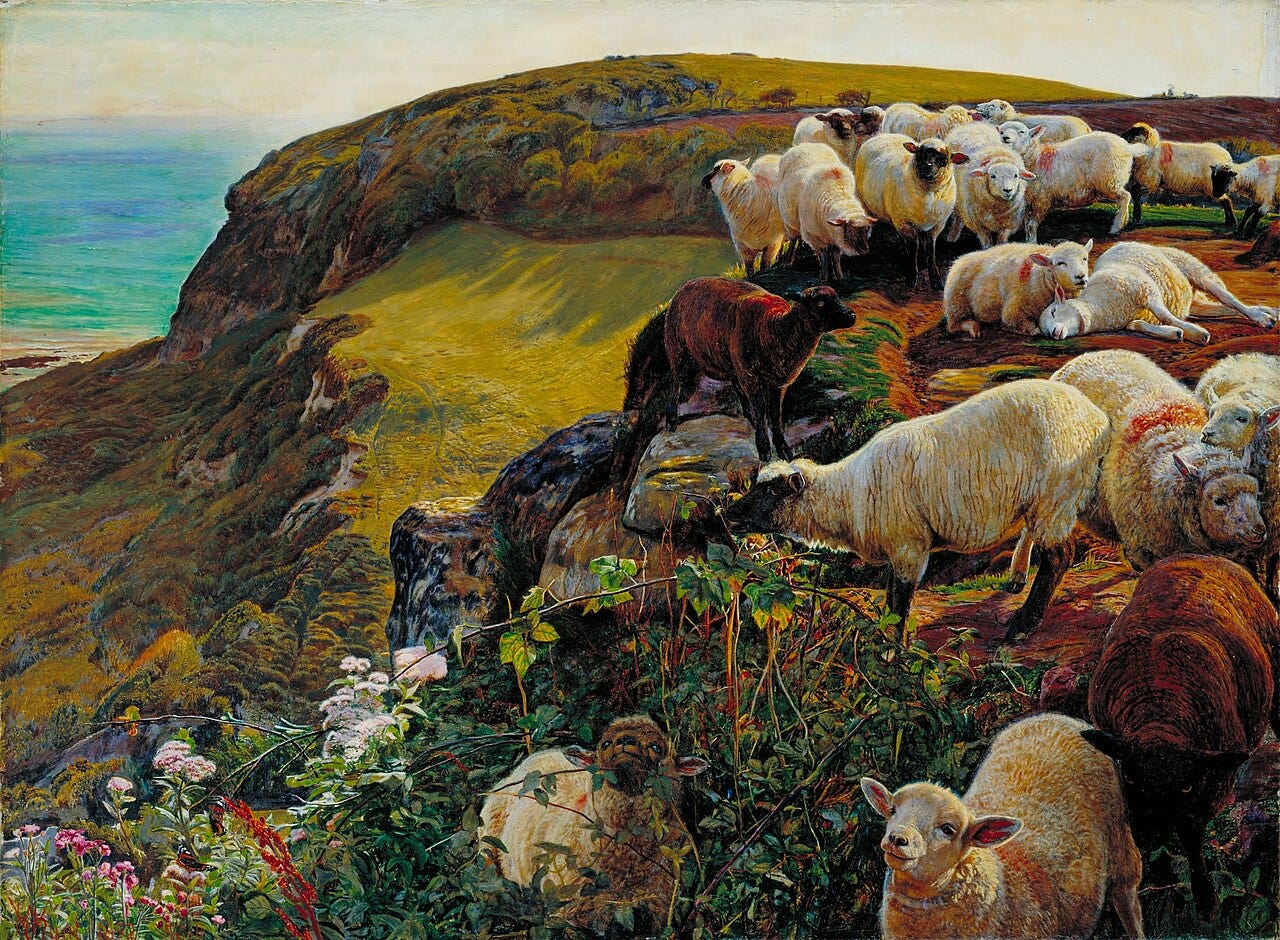
Our English Coasts or Strayed Sheep, William Holman Hunt, Pre-Raphaelite tradition, English, 19th century; oil on canvas
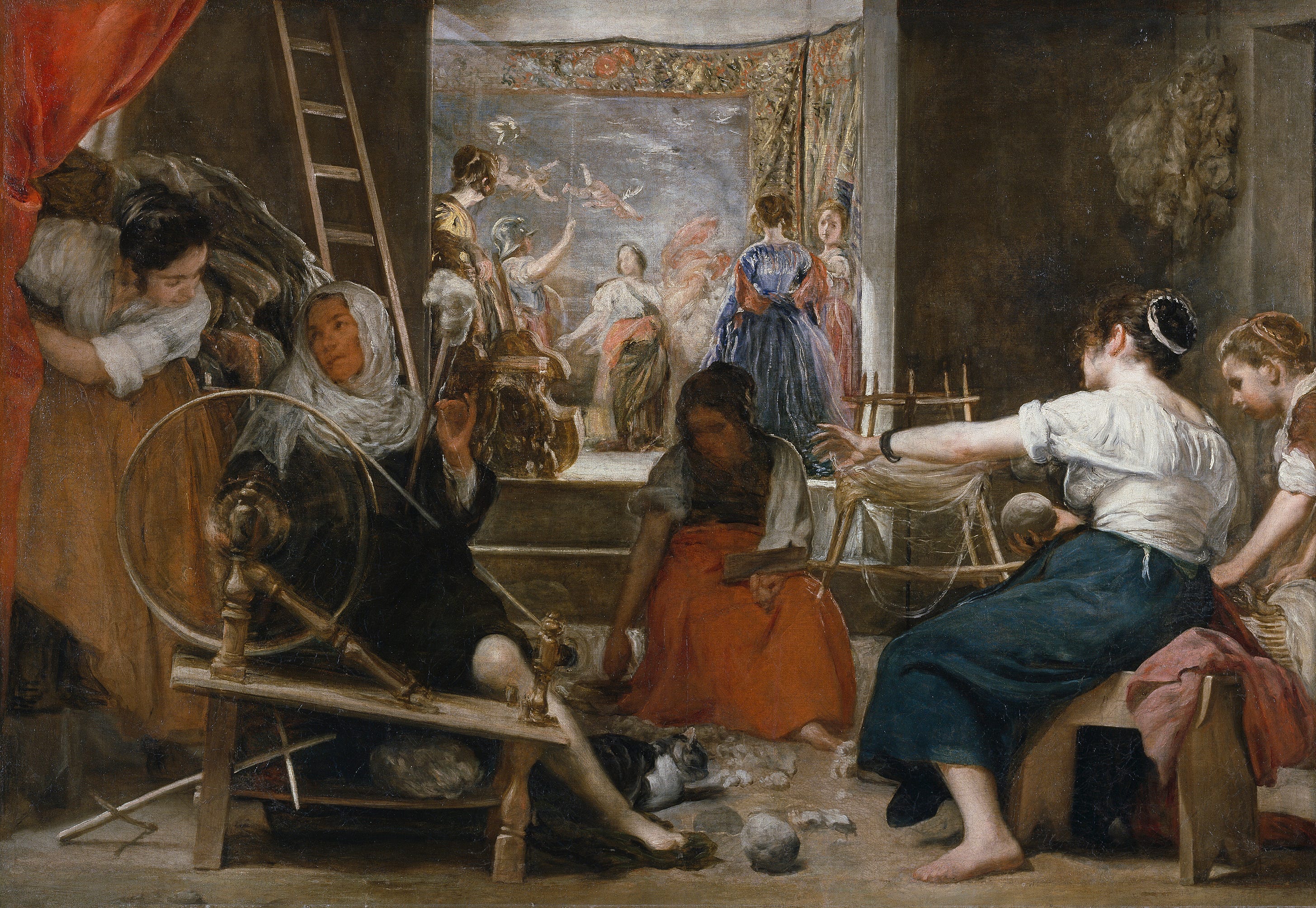
This framework - line, tone, color, medium, and the handling of detail and distance - is the vocabulary that all visual artists share. The three great traditions I will be exploring in subsequent posts, the iconographic, the Gothic, and the Baroque, each represent a coherent and internally consistent way of deploying that vocabulary. An artist working within one of those traditions handles the elements in broadly the ways characteristic of that tradition, and this is what makes the tradition recognizable. At the same time, the greatest artists within a tradition are recognizable as individuals: Velázquez, for instance, is unmistakably a Baroque painter, yet equally unmistakably himself. Some elements of his handling - his way with tone, his restraint with line, his management of color perspective - are shared with other Baroque painters; others are distinctively his own. Understanding the vocabulary makes it possible to see both things at once.

The Spinners by Diego Velázquez, Spanish, 17th century, oil on canvas. Manages color and tone, and varies the focus and detail impeccably. My teacher in Florence, Charles Cecil, told me that he was the first to show the spokes of a turning wheel invisible to indicate its motion.

Sunday, September 14, 2025

The Legend of the True Cross, by Agnolo Gaddi

Around the year 1385, the Florentine painter Agnolo Gaddi completed a cycle of paintings in the choir of the Franciscan basilica of the Holy Cross in his native city. These frescoes, which are very well preserved, are the earliest surviving Italian example of a cycle dedicated to the Legend of the True Cross, based on the stories collected in Bl. Jacopo da Voragine’s Golden Legend. Gaddi’s work is not as refined as that of the most famous version of this cycle, the one by Piero della Francesca in the basilica of St Francis in Arezzo. In a manner typical of the elaborately decorative International Gothic style, he tends to put too many figures into too small a space, which makes it difficult to read the story, especially in such a tall space. (The vault of the choir is almost 40m above the floor.) His work has also been overshadowed by some of the church’s many other artistic treasures, a few of which will be mentioned below. The eight panels are arranged in chronological order, first down the right wall, then down the left.

At the top of the first panel, Adam’s son Seth receives from the Archangel Michael a branch from the Tree of Life which grows in the Garden of Paradise; in the lower part, he plants the branch in the mouth of his dead father, who lies in his grave, with Eve mourning to the right. From this branch grows the tree which will become the wood of the Cross; the depiction of a skull at the base of Christ’s Cross derives from this legend. (In Gaddi’s time, the principles of one-point linear perspective had yet to be worked out; this is why Seth appears to be so much larger in the background than in the foreground, which should of course be done the other way around.)

Second panel – The tree lives until the time of Solomon, when it is cut down and part of it used to make a bridge. When the Queen of Sheba comes to visit Solomon, she “sees in the Spirit that the Savior of the world will be hung upon this wood”; she therefore refuses to step on it, but kneels in adoration. She then tells Solomon that someone will be hung on that wood, by whose death the kingdom of the Jews will be destroyed; the king therefore has it buried deep in the earth. (One version of the story adds that the queen had webbed feet, which were made normal by touching the wood.)

Third panel – The pool called Probatica which is mentioned in John 5, 2 is built on the place where the wood is buried; shortly before the time of Christ’s passion, the wood floats to the surface, and is used to make a cross, the one which will become His. In the background in the upper left are seen the sick people waiting for their chance to descend into the pool.

In the fourth panel, the narration switches direction, moving from right to left. The Empress Helena, mother of Constantine, discovers three crosses buried on the site of Mt Calvary; in order to determine which one is that of Christ, a dying woman is brought to the site, and completely healed at the touch of the third one. (The basilica of the Holy Cross was officially founded on May 3, 1294, the feast of the Finding of the Cross.)

Fifth panel, uppermost on the left side of the choir – St Helena brings the relics of the Cross into the newly constructed basilica of the Anastasis, which is usually called the Holy Sepulcher in the West. (The absence of linear perspective is especially notable in the improbably crooked buildings in the background.)

Wednesday, August 13, 2025

New Painting Commemorates First Holy Mass in Wyoming, Offered by Pierre-Jean De Smet in 1840

I am pleased to share this information on a recent commission of religious art that will be of interest to lovers of the history of missionary work and the evangelization of Native Americans with the traditional Catholic faith. All images are copyright Goretti Fine Art and used here with permission. The artists have told me that some of what they needed to know for the painting they learned from reading past articles at NLM. - PAK

Goretti Fine Art and the Museum of the Mountain Man have announced the unveiling of La Prairie de la Messe, a major new painting depicting the Jesuit missionary Pierre-Jean De Smet celebrating the first public Mass in present-day Wyoming on July 5, 1840.

The unveiling coincides with the 185th anniversary of the historic event as well as with the release of Volume 19 of the Rocky Mountain Fur Trade Journal at the Green River Rendezvous Days celebration in Pinedale, July 10-13. This year’s issue of the journal features a peer-reviewed article about the painting, the process behind its creation, and its historical significance.

The 31x50” panel was produced by George Capps and Polly Capps Paule, a brother-sister team of professional artists and the founders of Goretti Fine Art, a studio dedicated to creating figurative artwork in the Baroque and Academic Realist traditions. The depiction contains twelve portraits of individuals present at the 1840 event, features a meticulous reconstruction of a period portable Mass kit, and showcases the cultural diversity that characterized the Rendezvous era (1824-1840) of the Rocky Mountain fur trade.

The original oil painting was completed in December 2024 and resides in a private collection. The Museum of the Mountain Man has acquired a full-scale replica for a feature exhibit showcasing the intersection between fine art and faithful historical representation.

“It is rare to find a high-quality painting that has rigorous historical accuracy,” said Clint Gilchrist, Executive Director of the Museum of the Mountain Man. “La Prairie de la Messe stands out even among the best and was a must-have for the Museum of the Mountain Man collection.”

La Prairie de la Messe combines artistic excellence with cutting-edge research that makes a genuine contribution to fur-trade scholarship,” said Jim Hardee, Editor of the Rocky Mountain Fur Trade Journal. “We are thrilled to publish George and Polly’s findings in a format that will make this information available to future researchers seeking to represent the era with historical integrity.”

“The opportunity to lead the execution phase of this commission has been among the most rewarding experiences of my artistic career,” said Polly Capps Paule. “The painting was the result of a productive collaboration between Goretti Fine Art and a committed patron who provided the support necessary to bring this complex project to fruition.”
 
“Our hope is that La Prairie de la Messe will foster a renewed appreciation for De Smet’s contribution to the spread of Catholicism in the American West,” said George Capps. “We are grateful to the staff of the Museum of the Mountain Man for their assistance with the background research and honored to have our work included in the Museum’s world-class collection of Western art and artifacts.”

Fr. Pierre-Jean De Smet (1801-1873) was a Flemish Jesuit best known for his work with the Indigenous peoples of the American West. In 1840, De Smet’s superiors assigned him to investigate the possibility of establishing a missionary presence in the Rocky Mountains. His preparatory tour of the region launched a transformative phase of his career, one that would ultimately catapult him to acclaim as the century’s foremost missionary to the North American Indians. It was during this journey that he offered Mass at the final Green River Rendezvous, before an immense throng of trappers and Eastern Shoshone people, on a plateau overlooking present-day Daniel, Wyo. Since then, the site has been known as “la Prairie de la Messe” (the Prairie of the Mass).

Goretti Fine Art is a Defiance, Mo.-based studio founded by internationally recognized fine artists George Capps and Polly Capps Paule and dedicated to creating original sacred, religious, and historical artwork in the classical tradition for churches, educational institutions, and private homes. Its mission is to nourish the human spirit and to glorify God through beautiful, inspiring, and innovative imagery that is grounded in a sacramental worldview and builds upon the rich heritage of Western Christian art.

Those who would like to contact Goretti Fine Art should write to George Capps, george (at) gorettifineart.com.

Friday, August 16, 2024

The Legend of St Joachim in Giotto’s Scrovegni Chapel

In the year 1303, a Paduan money-lender named Enrico Scrovegni commissioned the painter Giotto to cover the whole interior of his family’s chapel with frescoes. The program, which required two years of work to complete, contains almost forty scenes of the Lives of Christ and the Virgin Mary, plus a large Last Judgment on the back wall, a series of monochromes of the Virtues and Vices, and a blue vault with stars. The cycle also includes the traditional account of the Virgin’s conception as given in the Protoevangelium of St James, an apocryphal Gospel of the mid-2nd century which is the first source for the names of Her parents, Joachim, whose feast is kept today, and Anne, whose feast is on July 26th. Here I have abbreviated the text, which is taken from the first five chapters, and slightly modified the translation.

In the histories of the twelve tribes of Israel was Joachim, a man rich exceedingly; and he brought his offerings double, saying, “All the people shall have of my superabundance, and there shall be the offering to the Lord for forgiveness as a propitiation for me.” For the great day of the Lord was at hand, and the sons of Israel were bringing their offerings. And there stood over against him Rubim, saying, “It is not meet for you to bring your offerings first, because you have not made an offspring in Israel.” ...

The Expulsion of Joachim from the Temple
And Joachim was exceedingly grieved, and did not come into the presence of his wife; but he retired to the desert, and there pitched his tent, and fasted forty days and forty nights, saying to himself, “I will not go down either for food or for drink until the Lord my God shall look upon me, and prayer shall be my food and drink.”

Joachim Among the Shepherds in the Desert
And his wife Anna mourned in two mournings, and lamented in two lamentations, saying: I shall bewail my widowhood; I shall bewail my childlessness. ... And she saw a laurel, and sat under it, and prayed to the Lord, saying, “O God of our fathers, bless me and hear my prayer, as You blessed the womb of Sarah, and gave her a son Isaac.” ... And, behold, an angel of the Lord stood by, saying, “Anna, Anna, the Lord has heard your prayer, and you shall conceive, and shall bring forth; and your seed shall be spoken of in all the world.” And Anna said, “As the Lord my God lives, if I beget either male or female, I will bring it as a gift to the Lord my God; and it shall minister to Him in holy things all the days of its life.”

The Annunciation to Anne
And, behold, two angels came, saying to her, “Behold, Joachim your husband is coming with his flocks.” For an angel of the Lord went down to him, saying, “Joachim, Joachim, the Lord God has heard your prayer. Go down hence; for, behold, your wife Anna shall conceive.”

The Dream of Joachim. (The Protoevangelium does not explicitly state that it was in a dream that the Angel spoke to him, as recounted above.)
And Joachim went down and called his shepherds, saying, “Bring me hither ten she-lambs without spot or blemish, and they shall be for the Lord my God; and bring me twelve tender calves, and they shall be for the priests and the elders; and a hundred goats for all the people.” And, behold, Joachim came with his flocks; and Anna stood by the gate, and saw Joachim coming, and she ran and hung upon his neck, saying, “Now I know that the Lord God has blessed me exceedingly; for, behold the widow no longer a widow, and I the childless shall conceive.” And Joachim rested the first day in his house.

The Meeting of Ss Joachim and Anne at the Golden Gate
And on the following day he brought his offerings, saying in himself, “If the Lord God has been rendered gracious to me, the plate on the priest’s forehead will make it manifest to me.” And Joachim brought his offerings, and observed attentively the priest’s plate when he went up to the altar of the Lord, and he saw no sin in himself. And Joachim said, “Now I know that the Lord has been gracious unto me, and has remitted all my sins.” And he went down from the temple of the Lord justified, and departed to his own house.

Joachim’s Offering
And her months were fulfilled, and in the ninth month Anna gave birth. And she said to the midwife, “What have I brought forth?” And she said, “A girl.” And Anna said, “My soul has been magnified this day.” ... And the days having been fulfilled, Anna was purified, and gave the breast to the child, and called her name Mary.

The Birth of the Virgin Mary

Monday, December 19, 2022

Leaving Church: Who Would Have Thought This Would Be Such a Popular Artistic Subject?

Those who enjoy looking at the wealth of religious paintings from past centuries will find an almost endless array of paintings of the sacred liturgy, the churches in which it takes place, and the people who come and go there.

Sometimes we see a vast cathedral with a Mass taking place at a side altar. Other times we see a solemn Mass at the high altar surrounded by dignitaries of Church and State. Still other scenes might show processions, first communions, weddings, exequies, coronations, professions, consecrations, troops being blessed before combat. The number and variety of such works of art remind us of the centrality of divine worship in the history of the West and its eminent aesthetic appeal.

As I was searching once for a particular image, I stumbled across a painting of layfolk leaving a church building on a sunny Sunday, and thought: "How quaint!" And then I saw another... and another... and another! Further searching revealed that the moment of leaving church after Mass (or some analogous religious service) is among the most popular artistic subjects, especially in the nineteenth century.

One might speculate about why this should be the case. Was it that, as rationalist, materialist, skeptical perspectives gained ground, churchgoing itself began to be more noticed and more appealing as a distinctive subject, perhaps for reasons of nostalgia or from an appreciation of a dimension of life in danger of slipping away? It seems plausible that in an age when churchgoing was taken for granted, artists would turn their attention elsewhere. Could it be something more superficial, like the painter's delight in portraying lovely ladies and dapper gentlemen dressed in their "Sunday best"? Sometimes there seems to be a social statement, as when exiting worshipers are shown interacting with (or failing to interact with) beggars.

Whatever the explanation might be, I decided to collect a portfolio of such paintings and share them here in one place, as I have not found anything like that elsewhere. I realized, once I began the project, that there would be far too many to include, so I have picked a representative selection, including both very famous painters (Sargent, Alma-Tadema, Van Gogh, Picasso) and some utterly obscure minor figures. Most of the images are from Catholic countries; a few show Protestants; and a couple of them show Eastern Orthodox.

I cannot help asking myself: If we had painters who were interested in a humble human subject like this, what would they find if they stood outside churches today and painted the emerging congregation? Would a modern congregation wearing sweatpants or jeans, T-shirts, sneakers, ponchos, hoodies, etc., be worth painting? Would it make a difference if our imaginary painter set up his easel over at an Institute of Christ the King parish? Should he perhaps paint shuttered churches where no faithful gather? How about the gymnasium or unmarked chapel to which the TLM has been banished by Francis? Or maybe the main steps of Chicago's cathedral would offer a dramatic scene.

Well, let us not get lost in such mental byways. In the midst of wintry desolation, enjoy the riot of color and shape offered to us by these wonderful paintings. (Click on any image to see it enlarged.)

Jose Benlliure Ortiz (1884-1916), “La salida de misa en Rocafort”

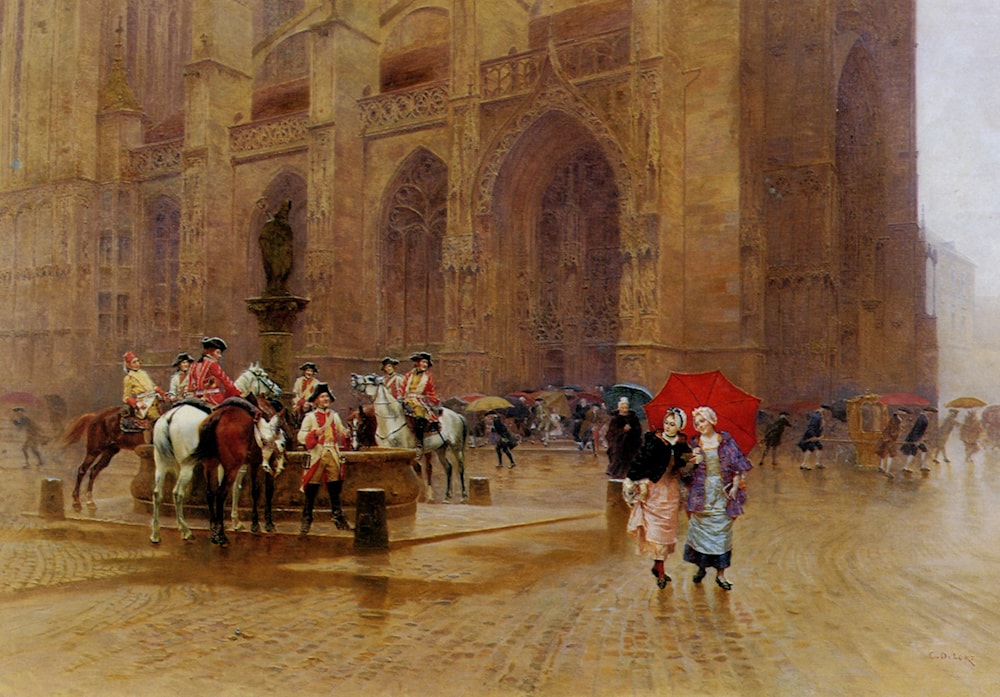
Charles Edouard Edmond Delort (1841-1895), “La Sortie de la Messe”

Enrico Gamba (Italian, 1831–1883), “L’uscita dalla messa”

Francisco Gras (b. 1878-?), “The Return from Mass, Valencia, Spain” (1920)

Wednesday, September 14, 2022

The Legend of the True Cross, by Agnolo Gaddi

Around the year 1385, the Florentine painter Agnolo Gaddi completed a cycle of paintings in the choir of the Franciscan basilica of the Holy Cross in his native city. These frescoes, which are very well preserved, are the earliest surviving Italian example of a cycle dedicated to the Legend of the True Cross, based on the stories collected in Bl. Jacopo da Voragine’s Golden Legend. Gaddi’s work is not as refined as that of the most famous version of this cycle, the one by Piero della Francesca in the basilica of St Francis in Arezzo. In a manner typical of the elaborately decorative International Gothic style, he tends to put too many figures into too small a space, which makes it difficult to read the story, especially in such a tall space. (The vault of the choir is almost 40m above the floor.) His work has also been overshadowed by some of the church’s many other artistic treasures, a few of which will be mentioned below. The eight panels are arranged in chronological order, first down the right wall, then down the left.

At the top of the first panel, Adam’s son Seth receives from the Archangel Michael a branch from the Tree of Life which grows in the Garden of Paradise; in the lower part, he plants the branch in the mouth of his dead father, who lies in his grave, with Eve mourning to the right. From this branch grows the tree which will become the wood of the Cross; the depiction of a skull at the base of Christ’s Cross derives from this legend. (In Gaddi’s time, the principles of one-point linear perspective had yet to be worked out; this is why Seth appears to be so much larger in the background than in the foreground, which should of course be done the other way around.)

Second panel – The tree lives until the time of Solomon, when it is cut down and part of it used to make a bridge. When the Queen of Sheba comes to visit Solomon, she “sees in the Spirit that the Savior of the world will be hung upon this wood”; she therefore refuses to step on it, but kneels in adoration. She then tells Solomon that someone will be hung on that wood, by whose death the kingdom of the Jews will be destroyed; the king therefore has it buried deep in the earth. (One version of the story adds that the queen had webbed feet, which were made normal by touching the wood.)

Third panel – The pool called Probatica which is mentioned in John 5, 2 is built on the place where the wood is buried; shortly before the time of Christ’s passion, the wood floats to the surface, and is used to make a cross, the one which will become His. In the background in the upper left are seen the sick people waiting for their chance to descend into the pool.

In the fourth panel, the narration switches direction, moving from right to left. The Empress Helena, mother of Constantine, discovers three crosses buried on the site of Mt Calvary; in order to determine which one is that of Christ, a dying woman is brought to the site, and completely healed at the touch of the third one. (The basilica of the Holy Cross was officially founded on May 3, 1294, the feast of the Finding of the Cross.)

Fifth panel, uppermost on the left side of the choir – St Helena brings the relics of the Cross into the newly constructed basilica of the Anastasis, which is usually called the Holy Sepulcher in the West. (The absence of linear perspective is especially notable in the improbably crooked buildings in the background.)

Friday, March 25, 2022

A Modern French Painter in Love with Our Lady: Maurice Denis’ Remarkable Annunciation Paintings

Annunciation (1912)
Until a couple of years ago I had never heard of the painter Maurice Denis (1870–1943). The beautiful autobiography of the painter and, later, Benedictine monk Jan Verkade (Dom Willibrord, 1868–1946) introduced me to him. Here is a brief description from The Art Story website:

Maurice Denis is perhaps unique amongst avant-garde French painters of the late-nineteenth century in combining a strong commitment to formal and stylistic innovation with an equally profound sense of the significance of tradition: in art, culture, and, perhaps above all else, religion. His boldly colored, vibrant paintings, like those of the artists with whom he is generally grouped together - Paul Sérusier, Pierre Bonnard - express a commitment to abstraction, and to relaying the inner life of the soul, which is, at one level, quintessentially modern. But unlike his peers, the soul which Denis sought to express was integrally shaped by his religious faith which can already be sensed from his earliest paintings as a member of the Nabi group which he co-founded in 1888, and which would lead him, later in life, to activities such as church renovation and altarpiece design. By the end of his life, Denis was also renowned as an art critic, having produced a series of influential essays on aesthetics and spirituality.
There is much one could say about his life and art, so thoroughly integrated with his Catholic faith and with a happy marriage and family—such unusual traits, it sadly seems, in the annals of famous artists. As another website, Sacred Art Pilgrim, explains:
There is a feeling of great intimacy in Denis’ religious art. A devoted husband and father, the artist often used his beloved first wife, Marthe, and their six children as models, placing sacred figures in settings from his daily life in Saint-Germain-en-Laye, the Breton seacoast, where the family spent their summers, or an Italian villa they had visited in Fiesole, near Florence. Denis was especially drawn to maternal images of the Virgin Mary, making paintings and prints of the Annunciation and the Madonna and Child in multiple variations… French Dominican Friar Marie-Alain Couturier, a onetime student and leading proponent of Modernist sacred art, offered what is, perhaps, the most fitting epithet for his former mentor. Denis was, in his words, the painter of “the sweet presence of God in our life.”
Today, in honor of the great Marian feast we are celebrating, I wish to share a few of the vast number of strikingly original depictions of the Annunciation that Denis painted over his fruitful career. He seems to have had a particular fascination for this biblical subject over all the decades of his output. The titles are linked to the online sources from which the images were taken. (N.B.: If anyone has access to better images, please send them to me by email so that I can swap them in.)

May this gallery be like a bouquet of flowers to the Blessed Virgin Mary on Lady Day.

In the first image, we see a theme to which Denis will return again and again: the depiction of the Archangel Gabriel as a deacon bearing a book, almost as if Our Lady is the priest at Solemn Mass to whom the book is carried for her to kiss. In this very early depiction, painted when the artist was 19, he has even included a couple of acolytes bearing tapers.

Le mystère catholique (1889)
We see something similar in this depiction from ca. 1914, except that here the deacon-angel bows his head and raises his arms in a gesture of homage, while Our Lady bows her head in a reciprocal greeting. She is dressed as a bride.

Annunciation at Assisi (c. 1914)
As mentioned above, Denis loved Fiesole, where Fra Angelico used to live, and painted many religious paintings there. St Gabriel is looking especially diaconal in this 1919 depiction. Once again the Virgin is dressed in white as a bride, and the Holy Ghost is imaged as a dove with rays from the upper right corner stretching to Mary’s womb.

Anunciación en Fiesole (1919)
In another version, Denis switches the roles, and has the Virgin kneeling near vessels (of water? wine? an allusion to the Cana yet to come?), on a rug, while the angel stands monumentally above her with hands outstretched in a priestly gesture.

Annonciation à Nazareth (1929)
In the very different medium of a monochrome lithograph, Denis has the angel kneeling but with the same outspread hand gesture, while Our Lady stands with serenity, almost looking beyond the scene at a future vista. Is it meant to capture the moment before she is fully aware of her visitor?

The Annunciation (no date given)
Denis’ love of the Italian landscape around Fiesole was such that it sometimes becomes the main subject of the painting. Perhaps he is attempting to set the great mystery against everyday surroundings, to emphasize the penetration of the divine into the human and natural? Our Lady herself, it seems, was engaged in some menial task such as watering or cutting flowers...

The Annunciation in Fiesole (no date given)
One of my favorites is a depiction in which we see the familiar deacon-archangel holding a Gospel book, accompanied by the candlebearing acolytes, approaching the Blessed Virgin on what appears to be a rooftop terrace, with the sun streaming behind her (which is somewhat unconventional; usually the beam of light comes across the scene from the other direction). The sublimity of the setting and its vertiginous perspective hint at the lofty grandeur of the miraculous conception. (How I wish I could find a better graphic than this!)

The Annunciation at Fiesole (no date given)
Here is a Denis looking more fauvist and cubist than usual. For whatever reason he has decided to give Gabriel a chasuble this time rather than a dalmatic, and no book, but something more like a priestly orans gesture. The servers, too, do not bear candles, but simply walk ahead. The haloes are more pronounced.

Annunciation at the Window in Prayer (no date given)
The whole series thus far have been landscape-oriented; here we have an unusual portrait-oriented setting, which allows for ample attention to the wonderful arches and their almost Boethian musical-ratio relationships. The plants exercise a prominent role, with one growing on top of the wall, the potted lily, another flower pot at the front right, and, most strikingly, the “burning bush” directly behind Our Lady. St. Gabriel here is almost timid, afraid to disturb the Virgin’s reverie.

The Annunciation under the Arch with Lilies (no date given)
The tenth and last that I found online seems to be only a portion of a larger whole that I have not had success in locating.

It is usually my colleague David Clayton who provides us with in-depth analysis of modern sacred art (and I hope he will enjoy this post!), but my concluding thought is simply this: if Maurice Denis could return again and again to a great mystery of the Christian Faith and find inexhaustible inspiration and joy in looking at it from every angle his imagination suggested, why cannot our artists today do the same? No subjects for painting can be greater, richer, nobler, more evocative, dynamic, or rewarding. May God grant us more painters like this, through the prayers of His most holy Mother.

Saturday, February 13, 2021

An Inappropriate Allegory (The Answer to Yesterday’s Quiz)

The answer to yesterday’s quiz, like the painting which was the subject of it, is rather complicated. Let’s start with the simplest part, which was not necessary to state for a correct answer. The Saint depicted is Caterina de’ Ricci, a Dominican nun who was born in 1522. She entered the Order’s convent at Prato, a small city 12 miles to the northwest of her native Florence, when she was 13, and died there on February 2nd, 1590. When she was beatified in 1732 by a fellow Florentine, Pope Clement XII Corsini, her feast was assigned to today on the Dominican calendar (where it remains in the EF), the first day on which her Office would have both Vespers. She was canonized in 1746 by Pope Benedict XIV, who as cardinal, had been the “promotor fidei”, more commonly known as “the devil’s advocate”, for her cause; as Pope, he announced his decision in favor of her canonization on the feast of St Philip Neri, another Florentine, to whom she had once miraculously appeared in Rome without physically going there. (The two Saints also exchanged a number of letters.) In the OF Dominican calendar, she has been moved closer to the date of her death, on February 4th.
The painting is variously attributed to Alessandro Allori, Battista Naldini, or Giovanni Maria Butteri (all Florentines), and was apparently made shortly before the Saint’s death. The depiction of a halo on a living person is very unusual, but Catherine was the recipient of extraordinary mystical graces throughout her life, and a person whose eventual canonization could reasonably be foreseen.

Now for the more complicated part. The title of the painting is “St Catherine de’ Ricci dashes down the children of Babylon.” Several commenters correctly identified it as an allusion to the last words of Psalm 136, which the Psalmist addresses to the “wretched daughter of Babylon”: “Blessed be he that shall take and dash thy little ones against the rock.” However, a crucial point is that the quote has been altered to “Blessed be he that dasheth (present tense) his own (‘suos’ rather than ‘tuos’) little ones on the rock.” The children do indeed symbolize the vices (as explained below), specifically, nascent vices; St Catherine, a model religious for over 50 years, is presented as a person from whom one may learn to overcome vices before they take root and become habits. The rock is hewn into an imperfect square, rather than in a natural state, as an allusion to Christ’s explanation of Psalm 117, 22, “The stone which the builders rejected has become the corner-stone”, as a reference to Himself.
The purely allegorical intent of the painting is demonstrated by the lack of blood on the stone, and the fact that the children in the background are seen to be dead from the color of their skin, but are not otherwise visibly damaged.
Already by the later second century, a pagan writer against Christianity called Celsus had used this Psalm verse as an example of the bad morality supposedly taught by the Church. To this, the great Biblical scholar Origen replied in his Apology against Celsus (7.22) that the passage was to be understood allegorically. “(T)he little ones of Babylon (which signifies ‘confusion’) are those troublesome sinful thoughts which arise in the soul, and he who subdues them by striking, as it were, their heads against the firm and solid strength of reason and truth, is the man who dashes the little ones against the stones; and he is therefore truly blessed. God may therefore have commanded men to destroy all their vices utterly, even at their birth, without having enjoined anything contrary to the teaching of Christ.” This interpretation was accepted and made the standard by many other early Christian writers, starting with St Hilary of Poitiers, who also very naturally associated the rock against which the little ones are dashed with St Paul’s words in 1 Corinthians 10, 4, “and the rock was Christ.” Several commentators correctly gave one or more of these points in their answers.
The award for Best Wildly Incorrect Answer is given to Christoph Hagen, who suggested that it represents “the Blessed Virgin sav(ing) a child, which is falling down from a window of a tower or another high building.” I did say in proposing the quiz that all of the details in the foreground were relevant, and this explanation would not account for the several other children whom Our Lady would have thus failed to save. The Best Humorous Answer, as determined by myself and by the voting in the combox, comes from Michael R.: “Susan from the parish council takes it upon herself to quiet down the cry room at church.”
As a final note, this painting was made in the artistic period known as Mannerism, an intermediate phase between the Renaissance and the Baroque. Mannerist painters were much given to complex allegories and learned allusions, and far too often, not much concerned with decorum; nudity is fairly common in their works, even those on religious subjects. (Mannerists also tend to make extremely busy paintings, although this is not the case here. The most classic example of all these trends within the style is a work by Agnolo Bronzino known as “Venus, Cupid, Folly and Time, or The Exposure of Luxury.” Bronzino was the teacher of Allori, one of the artists to whom the painting of St Catherine is attributed.)
For this reason, treatises on painting written for the artists of the Counter-Reformation, such as those of Gabriele Palleotti, the first archbishop of Bologna (1582), and the painter Giovanni Bellori (1672), insisted that religious art must not only be beautiful, but also clear and decorous. Their concern was that paintings like this one were too weighted with learned references to be easily understood, and that their lack of basic decorum (e.g., the inclusion of a heap of dead babies) made them ineffective in conveying the more important religious meaning they were supposed to convey.
An Allegory of the Sense of Sight, by Jan Brueghel the Elder 1618; a typically overly busy Mannerist allegorical painting.

Saturday, January 16, 2021

The Cathedral of Siena (Part 12): Paintings and Sculptures in the Cathedral Museum

The remaining three parts of our series on the cathedral of Siena (which began two months ago!) will all be about items now in the church’s museum. This first part will cover major artworks which were formerly in the cathedral (apart from the most important, the Maestà of Duccio di Buoninsegna, which already had its own post), the second liturgical objects, and the third vestments. Our thanks once again to Nicola for sharing these photos with us.
The Crevole Madonna, by Duccio, ca. 1284, one of his very earliest works, named for a small town about 12 miles to the south of Siena where it was originally displayed. The Byzantine influence on the artist, who was then about 30 years old, is particularly evident in the use of gold lines to create the sense of depth in the Virgin’s robes. By the time he painted the Maestà, about 25 years later, he had shifted, very much under the influence of Giotto, towards one of the key techniques of Renaissance painting, omitting the lines and creating the sense of depth with different shades of color.
Part of an altarpiece by another Sienese native, and one of the best painters of the generation after Duccio, Ambrogio Lorenzetti (1290 ca. – 1348), a real master of optical perspective; ca. 1320-30. From left to right: St Benedict in the white habit of the Olivetan Benedictines, who were founded by a native of Siena, St Bernard Tolomei; St Catherine of Alexandria; St Mary Magdelene; St Francis. In the cuspids, left to right, St Peter, St John the Evangelist, St John the Baptist, and St Paul. Note how the variation in shades within the white of St Benedict’s robe, the pink of St Catherine’s etc., create the volume of their figures.

Sano di Pietro (1406-81) another Sienese native, (“Sano” is a nickname for “Ansano”, from St Ansanus, the evangelizer of Siena), The Preaching of St Bernardine of Siena, 1440s. The incomplete façade of the church in the background has black and white stripes, reminiscent of the “balzana”, the city’s official banner and shield, which is white above and black below. St Bernardine, who died in 1444, was a great promoter of devotion to the Holy Name, a subject on which he preached through the length and breadth of Italy, bringing peace to its many faction-torn cities. He was such an effective and renowned preacher that the crowds which came to hear him were very often too great to fit into even the largest churches, and had to gather in the piazzas instead, despite the fact that (as is clearly seen in many early depictions of him) he had no teeth. (Notice also that the crowd is separated into a men’s and women’s section.)

An image of the Virgin and Child known as “The Madonna of the Large Eyes”, painted in the second quarter of the 13th century by an anonymous artist known as the Master of Tressa. This was the first image of the Virgin Mary to be venerated on the main altar of the cathedral, the one before which the Podestà (chief magistrate) of Siena, Bonaguida Lucari, at the head of all the city’s leaders and a large crowd of the citizenry, made the vow dedicating their city to the Virgin before the crucial battle of Montaperti in 1260. At the time, the panel was almost certainly incorporated into a much larger reredos, and surrounded by smaller images (now lost) of the principle episodes of the Virgin’s life.

St Paul Enthroned, with scenes of his conversion to the left and beheading to the right; ca. 1516, by Domenico Beccafumi (1486 – 1551), who also worked in the cathedral itself. The artist was born at Montaperti, where Siena had so signally defeated her rival Florence in 1260; it is an interesting irony that a native of that place should be the last painter of the Sienese School as a truly separate artistic current of the Renaissance. Four years after his death, Siena was conquered by Florence, by then long the dominant power in Tuscany, and became thenceforth to a large degree culturally dependent on it. It is also the case that by the mid-16th century, the Italian Renaissance had run its course and shifted to Mannerism, the prelude to the Baroque, while the elderly Michelangelo (also a Tuscan), working on the rebuilding of St Peter’s Basilica, and the forces of the Counter-Reformation had made Rome the new artistic capital of Italy.

More recent articles:

For more articles, see the NLM archives: