Friday, June 19, 2026

Per omnia saecula saeculorum and The Great Amen

Lost in Translation #162

Five words remain in the Roman Canon for us to examine.

Per omnia saecula saeculorum
The priest concludes the Canon’s doxology (the Per ipsum) by saying or intoning aloud, per omnia saecula saeculorum, or “unto ages of ages.” This Latin expression has an impressive biblical pedigree. It appears in various forms nineteen times in the Vulgate translation of the New Testament as a translation of the Greek eis tous aiōnas tōn aiōnōn. In most of these instances, the phrase is followed by the word “Amen,” suggesting that it already had a place in the worship of the early Church even before it was committed to writing by the authors of the New Testament.
The phrase requires some explanation, as it might conjure up an image of God passing through an infinite succession of temporal moments. And yet we know that eternity is not time ad infinitum but rather all of time (past, present, and future) as present in one single and complete “Now.” In the words of Boethius: “The flowing now makes time, the abiding now makes eternity.” For Boethius (and Aquinas), eternity is thus “the simultaneously whole and perfect possession of unending life.” [1] The talk of God living forever and ever or unto endless ages is therefore metaphorical, just like the corporeal descriptions of God in the Old Testament as having an arm or a hand. [2]
The Roman Missal uses the plural “ages of ages” (saecula saeculorum), but some passages in the New Testament (and other Christian prayers) instead have “age of ages” (saeculum saeculorum). According to St. Anselm, both point to God’s eternity but have different connotations: the singular “age of ages” bespeaks an indivisible unit (eternity as a single now?) while “ages of ages” in the plural conures up the notion of an unending immensity. [3] One can see why the latter is used in doxologies, which focus on God’s greatness.
The utterance of per omnia saecula saeculorum breaks a silence that has lasted the entire Canon (the priest’s audible Nobis quoque peccatoribus barely counts as an exception). It is common in apostolic liturgies to end silent prayers in this manner. This device, called an ecphonesis, [4] serves several purposes. First, it reconnects the priest with the congregation. In silent prayer, the priest prays to God one-to-one, as if he had entered into a cloud, “remaining hidden from them.” With the ecphonesis, he reunites “himself with the faithful in prayer,” [5] like Moses come down from the mountain. Second, the ecphonesis alerts the faithful that a new part of the Mass is about to begin. Third, it invites the faithful to affirm the priest’s petitions or activities with a response—in this case, with “The Great Amen.” As Nicholas Gihr writes:
By this majestic and overpowering conclusion, recited aloud or sung, the mystic and solemn silence of the Canon is broken, in order that the people, by answering Amen, may make known their assent to and approval of all that the priest alone with God praying and offering in the holy cloud has performed. [6]
And if the Canon makes present the Sacrifice of the Cross, it is not unreasonable to think of the end of the Canon as the end of Christ’s life on the Cross. We have already seen how the rubrics of the Per ipsum were interpreted as signs of Christ’s death. Similarly, the ecphonesis of per omnia saecula saeculorum was taken to signify Our Lord’s crying out in a loud voice before He gave up the ghost (Matt. 27, 50) while the “Amen” signified the centurion’s declaration “Indeed this was the Son of God” (Matt. 27, 54) as well as the lamentations of the women at the tomb. [7]
The Great Amen
The Great Amen, as we have seen, broadcasts the assent of the faithful to the Sacrifice that has just been made. Dionysius of Alexandria (d. 264-265) lists it as one of the three privileges granted to the laity at Mass, the other two being listening to the Eucharistic Prayer and receiving the sacred food. [8] The privilege was not taken lightly. The practice, at least as old as St. Justin Marty (ca. 150), was once observed with gusto. St. Jerome describes the Christians in Rome shouting the response:
Where else does “Amen” reverberate like thunderclaps in the sky, and where else are the empty shrines of false gods shaken to the core? [9]

The response is simple but powerful. “Amen” is one of the few Hebrew loanwords in Christian life and liturgy. Although it is often translated as “so be it” (as with the French ainsi-soit-il), it is an adverb that means “truly” or “verily.” Erasmus’ expansive definition is:
Asserting in a manner of having believed in and continuing with utter trust to believe in the truthfulness and certainty of what has just been disclosed. [10]
And yet the Church deigns to leave “Amen” untranslated, perhaps for the sake of keeping a connection with the first Jewish converts to the Faith or perhaps out of fear that something might be lost in translation. Jerome cites Origen on the subject:
Owing to the native peculiarity of each language, [loanwords] cannot be expressed in the same way in another country as they have been uttered in their own country, and it is much better to cite them untranslated rather than to enfeeble their force by translation. [11]
What is enfeebled in this case, as Craig Toth writes, may be that sense of “a movingly heartfelt, confidently emphatic confirmation of what had just been prayed.” [12]
In any event, since the Great Amen is “the most important Amen in the entire Mass” [13] as well as “the people’s signature,” [14] we sympathize with those liturgists who advise the laity not to delegate this response to the ministers or the choir alone. It is an honor and a privilege to say to the newly confected Sacrament on the altar “Truly this is the Son of God” in the language of the Gospel’s first recipients.
Michael Foley is the author of Lost in Translation: Meditating on the Orations of the Traditional Roman Rite (Angelico Press, 2023).
Notes
[1] St. Thomas Aquinas, Summa Theologiae I.10.1.
[2] Ibid., I.10.1.ad 4.
[3] St. Anselm, Proslogion 21.
[4] Adrian Fortescue, The Mass: A Study of the Roman Liturgy (London: Longmans, Green, and Co., 1912), 360.
[5] Pius Parsch, The Liturgy of the Mass, trans. Frederic C. Eckhoff (St. Louis, Missouri: Herder, 1940), 255.
[6] Nicholas Gihr, The Holy Sacrifice of the Mass: Dogmatically, Liturgically and Ascetically Explained, 6th ed. (St. Louis, Missouri: Herder, 1902), 694.
[7] William Durandus, Rationale Divinorum Officionorum IV.46.21.
[8] Quoted in Eusebius, Ecclesiastical History VII.9 (PG 20, 656).
[9] St. Jerome, Commentary on Galatians, trans. Andrew Cain (Washington, DC: Catholic University of America Press, 2010), 131-32.
[10] Quoted in Craig Toth and Louis Tofari, The Roman Canon: An Interlinear Translation (Romanitas Press, 2023), 232.
[11] Ibid., 232.
[12] Ibid., 232.
[13] John M. Cunningham, O.P., It is Right and Just: Responses of the Roman Missal (Pine Beach, NJ: Newman House Press, 2016), 45.
[14] Josef Jungmann, S.J., The Mass of the Roman Rite: Its Origins and Development, vol. 2, trans. Rev. Francis A. Brunner, C. SS. R. (New York: Benzinger Brothers, 1951), 273.

Friday, June 12, 2026

The Rubrics of the Per ipsum

Lost in Translation #161

We gratefully resume our series on the Latin of the Ordinary of the traditional Mass. In our last essay on the subject, we examined the language of the concluding doxology of the Roman Canon, the Per ipsum. Here, we examine the rubrics accompanying the prayer.

After saying the Per quem, the priest takes the Host with his right hand, and with his left he holds the knob of the chalice. He makes the sign of the cross with the Host over the chalice three times, saying: Per ipsum , et cum ipso , et in ipso ; then, still holding the chalice in the same manner, he makes the sign of the cross with the Host between himself and the chalice as he says est tibi Deo Patri omnipotenti, in unitate Spiritus Sancti. He then holds the Host over the chalice upright and elevates the Host and chalice together a few inches above the altar as he says omnis honor et gloria.
Although the story of how these rubrics came to be is a long and complicated one, [1] the end result is an example of what Rudolf Otto calls a mysterium fascinans – a fascinating mystery that piques our interest and draws us into a reality greater than ourselves. What do all these gestures mean?
According to Fr. Nicholas Gihr, “The accompanying rite harmonizes magnificently with the text of the prayer.” [2] The first three signs of the cross are about Jesus Christ, and hence it is appropriate that the Host is placed over the Precious Blood. The next two signs of the cross are made in reference to the Father and the Holy Spirit, and hence it is appropriate that they be made outside the chalice, for it was Christ and Christ alone who suffered and shed His Blood for us. [3] Finally, the elevation of the Host and chalice are made appropriately at the words “all honor and glory,” for honor and glory are elevated things, so to speak: as we saw in an earlier post, glory is especially linked to Heaven. 
The actions are also ripe for allegorical interpretation. St. Thomas Aquinas contends that while the three signs of the cross made at the Per quem signify the three prayers that Christ made on the Cross, [4] the three signs of the cross here signify His three hours on the Cross while the two signs of the Cross made over the corporal represent the separation of Christ’s soul from His body. [5] William Durandus sees an additional meaning in making these signs of the Cross from the edges of the chalice to the edge of the altar, as an allusion to Christ extending His arms on the Cross. [6] Durandus also construes the uncovering of the chalice at the beginning of the rite as a type for the Temple veil rending in two when Our Lord gave up the ghost; [7] while St. Peter Damien interprets the covering of the chalice at the end of the rite as a symbol of the great stone that covered the entrance to the tomb.
Progressive liturgists were not pleased with the rubrics of the Per ipsum. For Father H.A. Reinhold, author of Bringing the Mass to the People, the introduction of the Major Elevation after the consecration of the Host and Precious Blood had the unfortunate effect of dwarfing the Minor Elevation. According to him, the Major Elevation is the product of a debate among scholastics at the University of Paris in the thirteenth century as to whether the bread becomes the Body of Christ after the words “This is My Body” or whether it becomes so only after both species have been consecrated. The double elevation, he alleges, was instituted to show that each species is transubstantiated immediately after the relevant words are said over it. “The twofold elevation,” Reinhold concludes,
is therefore a remnant of a controversy long settled [read: and no longer necessary]. Its retention is an illustration of a French proverb: Ce n’est que le provisoire qui reste (“What is of temporary value stubbornly stays on”). [8]
Reinhold also does not like that the twofold elevation encourages devotion among the congregants. Eucharistic devotion, he opines, is better confined to the feast of Corpus Christi, Exposition, Adoration, and in processions, but not during the Canon. [9]
Reinhold recommends omitting the Major Elevation altogether “or, if retained, ring[ing] [the] bell only once, at the actual elevations.” [10] As for the Minor Elevation, it should be restored to “the ancient and more traditional Great Doxology,” namely, raising both species so they can “be seen by the ministers and the congregation.” [11] This claim about an “ancient” elevation that was meant to be seen by the faithful was a common assumption at the time Reinhold was writing, but as we shall see shortly, it is dubious.
Among the liturgists who agreed with Fr. Reinhold was Fr. Pius Parsch, who called the Minor Elevation “much more appropriate” than the Major and who even urged “his fellow-priests not to let this elevation remain the mere suggestion, which it now is, but to make it higher and slower, and thus also more impressive,” even though the rubrics at the time stated that the Host and chalice should only be elevated “a little bit” (aliquantulum). [12]
The more eminent liturgical scholar Josef Jungmann, on the hand, has a different assessment. For Jungmann, it is only natural that the faithful should adore their Lord the moment after He becomes sacramentally present on the altar. In the East, this adoration takes the form of a profession of Faith (like the “Memorial Acclamations” inserted into all the Eucharistic Prayers of the Novus Ordo). In comparison with the Eastern Rites, Jungmann states, “we must confess that the Roman liturgy of the first millenary lacked the impulse to direct the attention at once to the completion of the sacramental process, or to draw ritual deductions from it.” [13]
But beginning in the eleventh century, “an increased care for everything connected with the Sacrament” began to emerge; at the Abbey of Cluny, for example, the priests began observing the custom of canonical digits. And in the twelfth century, “the people entered to dominate the scene,” seeking “to look at the sacred species with their bodily eyes” as soon as possible. [14] In 1210, the Bishop of Paris ordered that the priest should lift the consecrated Host high enough to be seen by all, the first known rubric of its kind. The custom then spread rapidly across Europe.
The elevation of the chalice took longer to develop. There was concern that the Precious Blood might be spilled, and it was logistically more difficult, for in the Middle Ages, “the chalice used to be covered with the back part of the corporal folded up over it.” [15] Most of all, it was objected that one does not actually see the Precious Blood but only the chalice that contains it. Consequently, not even the Roman Missals of 1500, 1507, and 1526 mention it. Nevertheless, the 1570 Missal of Pope St. Pius V includes this second elevation.
Josef Andres Jungmann, S.J.
As for the Minor or “Little” Elevation, Jungmann rejects the idea that it is “the remnant of a larger one,” for the intention was never to show the holy gifts to the people but to offer them to God as an oblation. [16] Father Adrian Fortescue also notes that the wording of the prayer, est tibi . . . omnis honor et gloria, “suggests lifting the holy things to God rather than showing them to the people.” [17] And in his recent study of the Mass, Michael Fiedrowicz concludes that “the consecrated offerings… are not shown here for the veneration of the people but are rather raised up for the glorification of God.” [18]
Perhaps the modern temptation to read the Minor Elevation as a “showing to the people” comes from a comparison with Eastern Rites, which do have an elevation that shows the sacred species to the people at the words, “The holy things for the holy.” But the purpose of the Eastern elevation is to prepare the faithful for Holy Communion, which happens almost immediately after. Thus, the Roman equivalent of the Eastern elevation is not the Minor Elevation at the end of the Canon but the presentation of the Host at the Domine non sum dignus.
Despite being a consultor for the Consilium that created the Novus Ordo, Jungmann’s view was eclipsed, at least partially, by those of Reinhold and company.
Annibale Bugnini reports that in 1967, when the Consilium was creating new Eucharistic Prayers, it also wanted to introduce “the Alexandrian anaphora of St. Basil into the Roman liturgy.” [19] One way to do that was to replace the Minor Elevation with the Major Elevation. The study group was asked to vote on the following resolution:
2. Where is the elevation to be placed?
Response: It would be best to locate the showing and adoring of the sacred species at the end of the Eucharistic Prayer, because in the anaphoras of this Eastern tradition the full expression of the Church’s intention in using the words of Christ is not complete until that point…. The location of the elevation at the end would make it clearer that the intention of the Church in using Christ’s words (the same words it uses in the Roman Canon) is expressed in the total prayer of which the words of consecration are an inseparable part. [20]
Because the resolution barely failed to garner the necessary votes, the decision was left to the Holy Father. Apparently, Pope St. Paul VI decided on a compromise: the Major Elevation would stay, and the Minor Elevation would become, for lack of a better formulation, less minor. But the details regarding the latter’s promotion are surprisingly thin. The 2002 GIRM merely states:
At the end of the Eucharistic Prayer, the priest takes the paten with the host and the chalice and elevates them both while alone singing or saying the doxology, Per ipsum (Through him). No. 151.
Note that the height of the elevation is not stipulated, nor the position of the Host and chalice, that is, whether the Host should be above the chalice as before or held at the same altitude. Possibly because of this paucity of instruction, “many priests,” observes Fr. Dennis Smolarski, “are still under the impression the height formerly prescribed in the Tridentine Missal (a few inches) should be continued now.” But, Smolarski is quick to add, “the contrary is true,” for “evidence suggests that the doxology is the time for the grand gesture of lifting high the gifts towards heaven for all to see.” [21] Unfortunately, the author does not tell us what evidence he has in mind.
In his monumental Ceremonies of the Modern Roman Rite, then-Monsignor Peter J. Elliott offers the following advice:
The celebrant raises the chalice in his right hand, the paten in his left hand. He does not rest a Host upright on the paten, as this gesture is meant to signify sacrificial offering rather than “showing” to the assembly. It seems preferable to hold the vessels out directly over the corporal rather than separating them widely. They should be raised high, at least above eye-level, so that the gesture is strong and significant. [22]
Yi Wang, “Bishop Elliott and Lady Jacqueline”
In making these recommendations, Elliott is teasing out the implications of the changes to the rite and possibly drawing from the pre-conciliar arguments of figures like Reinhold and Parsch. Still, it bears mention that this “showing to the assembly” and this rejection of “sacrificial offering” is a novelty in the Roman liturgical tradition, as Jungmann had already demonstrated in 1948. In that tradition, the Minor Elevation beautifully completes the holy oblation, when the priest offers to God what is already His. Regardless of whether the congregation can see it or not, this gesture to me seems to be the stronger and more significant.

Michael Foley is the author of Lost in Translation: Meditating on the Orations of the Traditional Roman Rite (Angelico Press, 2023).
Notes
[1] Josef Jungmann, S.J., The Mass of the Roman Rite: Its Origins and Development, vol. 2 (New York: Benzinger Brothers, 1951), 266-270.
[2] Nicholas Gihr, The Holy Sacrifice of the Mass: Dogmatically, Liturgically and Ascetically Explained, 5th ed., (St. Louis, Missouri: Herder, 1918), 692.
[3] Pope Benedict XIV, De Sacrosancta Missae Sacrificio (Mainz: Franz Kirkheim, 1879), L.ii.c.xviii.n. 15.
[4] They are: “Father, forgive them”; “My God, My God, why hast Thou forsaken Me?” and “Father, into Thy hands I commend My spirit.”
[5] Summa Theologiae III.83.5.ad 3.
[6] William Durandus, Rationale Divinorum Officionorum IV.46.15.
[7] Ibid., IV.46.10.
[8] H.A. Reinhold, Bringing the Mass to the People (Baltimore: Helicon Press, 1950), 67.
[9] Ibid., 69.
[10] Ibid., 65.
[11] Ibid., 70-71.
[12] Pius Parsch, The Liturgy of the Mass, trans. Frederic C. Eckhoff (St. Louis, Missouri: Herder, 1940), 255.
[13] Jungmann, 205. In other words, according to this logic, the Major Elevation has the same function as a Memorial Acclamation, and therefore a Memorial Acclamation in the Roman Rite is redundant.
[14] Ibid., 206.
[15] Ibid., 208.
[16] Ibid., 266.
[17] Adrian Fortescue, The Mass: A Study of the Roman Liturgy (London: Longmans, Green, and Co., 1912), 360.
[18] Michael Fiedrowicz, The Traditional Mass: History, Form, & Theology of the Classical Roman Rite, trans. Rose Pfeifer (Brooklyn: Angelico Press, 2020), 106.
[19] Annibale Bugnini, The Reform of the Roman Liturgy: 1948-1975, trans. Matthew J. O’Connell (Collegeville, MN: Liturgical Press, 1990), 458.
[20] Ibid., 460.
[21] Dennis C. Smolarski, SJ, How Not to Say Mass: A Guidebook on Liturgical Principles and the Roman Missal, Revised Edition (Paulist Press, 2003), 87-88.
[22] Peter J. Elliott, Ceremonies of the Modern Roman Rite (San Francisco: Ignatius Press, 2005), no. 318.

Wednesday, March 04, 2026

On the Roman Mass, Don’t Take Your Cue from Fortescue

Separated by over 100 years, with the advantage going to Fiedrowicz

This article is a combined effort of Gregory’s and mine. - PAK

Undoubtedly Adrian Fortescue is a fascinating figure, rather eccentric in some ways (see Aidan Nichols’ biography) – a biting critic of Pius X, e.g., whom he called “an Italian lunatic” – but it must be borne in mind that his liturgical scholarship is somewhat out of date, and actually wrong in certain respects. It is thus a source of near daily frustration to find well-intentioned people online citing his book The Mass: A Study of the Roman Liturgy from 1912 as if it were the final word on the topic, when in fact there are much better resources that have appeared in the last 114 (!) years.

The internet promised to give everyone access to all information, but interestingly, I have noticed that it actually tends in a different direction: it encourages access to what is old because it’s in the public domain, and thus promotes an odd kind of time-trapped referentiality, at least in areas where genuine progress has occurred. Recent books are copyrighted and have to be bought and studied; they can’t be downloaded and searched quite as readily, so they are neglected or not even recognized. Our cutting-edge technology has, in fact, made us lazy regurgitators of low-hanging information.
 
Image courtesy of Corpus Christi Watershed

Fortescue’s gravest error – and the one that would cause the greatest mischief later – is an assumption he shares with many other scholars of his time: namely, that the “original” text and order of the Roman Canon was wildly disturbed over the course of time by any number of omissions, transpositions, rewrites, etc. deliberate or accidental. This simply flies in the face of everything that is attested in all the ancient manuscripts of the Canon, which are astonishingly consistent from one to another, and fundamentally very similar to what we find in the Gelasian Sacramentary, and thenceforth in all pertinent liturgical books of the Roman Rite.

Behind that lies the equally false and equally pernicious assumption that in ancient times, the various major churches (not just Rome) routinely trashed their older, and hence “more authentic” tradition in favor of novelties, feeding into the narrative that this is a routine occurrence and a normal procedure. It is certainly not.

Then, we have the problem that scholars assumed that X, Y, or Z thing which is attested in all the pertinent liturgical books as far back as we have them nevertheless does not represent the “original” (and hence “more authentic”) tradition. They will then be only too delighted to reconstruct that “original” and hence “more authentic” tradition on the basis of various theories. So, e.g., since the Eastern rites make a great deal of the pneumatic epiclesis, but the Roman Rite doesn’t have one, the Roman Rite must “originally” have had one and somehow lost it at some point.

(The late, great, and much-missed Fr John Hunwicke wrote a fine series on that specific topic; you can find all the links in “Reforming the Canon of the Mass: Some Considerations from Fr Hunwicke.”)

In a similar vein, we have the assumption that the Roman Mass must have had two readings before the Gospel, because some of the Eastern rites do (that is false, and there is no evidence for it), and similar extrapolations from the false premise that all rites are descended from a single early and primitive rite; therefore, what one has and another doesn’t must have “fallen out of” the other.

So the whole section in Fortescue on the “liturgical uniformity” of the first three centuries basically needs to be torn out and discarded; it is the opposite of the truth. The historical trajectory is that liturgies begin very varied and diverse, and over time, gradually assimilate to the forms of the nearest dominant see.

He accepts the error, very common in his time, that the Leonine Sacramentary is a sacramentary. It isn’t; it’s a private compilation of libelli Missarum, the Masses composed by the priests of the churches of Rome. Basically, everything they thought they knew about the so-called Apostolic Constitutions in the early twentieth century is wrong.

St. Hippolytus

Anything he says anywhere about “Hippolytus” has to be dismissed if he says it in reference to Rome. The whole Hippolytus construct completely collapsed when Margarita Guarducci presented a key piece of evidence at a conference held in Rome in 1974 that demonstrated the falsity of everything patristic scholars had built up over him before then. Even a figure as progressivist as Fr. John Baldovin candidly admits that there is nothing to the Hippolytus legend on the basis of which the Second Eucharistic Prayer was cobbled together.

When it comes to evidence drawn from the Fathers, one has to check and see if the sermon that is being quoted is authentic. This is an especially big problem with St. Augustine. If a sermon of his witnesses to a particular reading in the Mozarabic liturgy, one needs to check if the sermon was actually written by him, or passed off under his name after that reading had been fixed in the Mozarabic tradition.

Having said all this, I am not arguing that Fortescue’s book on the liturgy is without value; I am simply saying that one must consult more recent and better studies, such as Fr. Uwe Michael Lang’s 2022 book from Cambridge University Press, The Roman Mass: From Early Christian Origins to Tridentine Reform, which covers in superb academic detail all that is known about the development of the Roman rite from antiquity to the Tridentine reform (i.e., AD 33 to 1570). (The original hardcover was very pricey but a paperback edition has finally come out.) Fr. Lang also published A Short History of the Roman Mass in 2024. These works, in their own quiet way, do more to sweep away the misconceptions held by modern liturgical reformers than Fortescue, who never lived to see the awful things done by liturgists after him.


A very accessible one-volume work that accomplishes less in historical detail than Lang, but more in terms of an overall assessment of the “rightness” of the traditional Roman Rite against its attempted replacement, is Patristic scholar Dr. Michael Fiedrowicz’s The Traditional Mass: History, Form, and Theology of the Classical Roman Rite, published in English translation in 2020 by Angelico Press. This is the book I always recommend to people who are looking for a scholarly introduction.

(It bears mentioning that Fortescue’s book The Orthodox Eastern Church, which has been reprinted in a newly typeset edition, remains one of the finest historical, patristic, and ecclesiological investigations of the vexed relationship between Eastern and Western Christianity, and has much to contribute to the newly volcanic apologetics world that has sprouted up online. Unlike his book on the Roman Mass, The Orthodox Eastern Church is out of date only in a charming way, namely, its description of the early 20th-century Orthodox churches, countries, and peoples, which have changed a lot since then.)

Friday, February 13, 2026

The Per ipsum

Lost in Translation #160

After the Per quem haec omnia, the priest concludes the Canon with:

Per ipsum, et cum ipso, et in ipso, est tibi Deo Patri omnipotenti, in unitáte Spíritus Sancti, omnis honor et gloria… per omnia saecula sæculórum. ℟. Amen.
Which I translate as:
Through His very self and with His very self and in His very self, all honor and glory belongs to You, God the Father Almighty, in the unity of the Holy Spirit, through all ages of ages. ℟. Amen.
The phrasing of the Per ipsum is inspired by Romans 11, 36:
Quis enim cognovit sensum Domini? aut quis consiliarius ejus fuit?
aut quis prior dedit illi, et retribuetur ei?
Quoniam ex ipso, et per ipsum, et in ipso sunt omnia: ipsi gloria in saecula. Amen(Rom. 11, 34-36)
Which the Douay-Rheims translates as:
For who hath known the mind of the Lord? Or who hath been His counsellor?
Or who hath first given to Him, and recompense shall be made Him?
For of Him, and by Him, and in Him, are all things: to Him be glory for ever. Amen.
In this passage, St. Paul is concluding a theologically dense reflection on salvation history and the cryptic role that Israel plays in it. He ends by stating that since God is the Creator of all (and we cannot say the same about ourselves), we should resign ourselves to the fact that He knows what He is doing even though we cannot fully understand His plan, and that we should glorify him. The triple expression – ;“of Him,” etc. – is primarily in reference to the Father (with a possible Trinitarian echo) and to the beginning, middle, and end of creation. All things have their origin in God; all things continue to exist by virtue of God; and all things have God as their end (the original Greek eis auton or “unto Him” more clearly expresses this idea than the Vulgate’s in ipso).
Although the Per ipsum also has creation in mind (because of the way that it follows the Per quem), it is different in a number of respects, not least of which is that the triple expression is in reference to the Son rather than the Father. We may therefore consider the prayer an example of spiritual eructation; but in this case it is not so much the content that is the object of rumination but a kind of grammar of ascent, a mode of thinking about the transcendent mysteries. [1]
Let us now turn to the different parts of the prayer. (We shall leave the very end and the Minor Elevation for another day.)
Per ipsum, et cum ipso, et in ipso
The prayer refers to the Son of God with the demonstrative pronoun ipse rather than is. Whereas the latter simply means “he,” the former is more emphatic and can be translated as “he himself,” “he the very one,” “he in person,” etc. And by making the sign of the cross each time he says ipse with the Host over the Precious Blood (as the rubrics instruct him to do), the priest adds an actual demonstration to a demonstrative word, almost literally pointing to the Person about whom he is speaking.
The prepositions are also telling. For Fr. Pius Parsch, the three expressions are not “mere amplifications but serve to reveal our most intimate relationship with Christ.” “Through” reminds us that He is our Mediator; “with” that He is the Person to whom we must unite as His mystical body; and “in” that we unite with Him “by the living union of grace.” [2] Fr. Jacques Olier has a beautiful reflection on the theme of unity in this prayer. “It is not enough,” he writes,
to pray with Jesus Christ and in His company…. it is necessary actually to be in unity with Jesus Christ, and to act before God in the power and in the grace of His Spirit, which cannot exist in us separately from His love. It is necessary, as Our Lord says, that we should be in Him, as He is in His Father. [3]
While Parsch and Olier think of the prepositions in relation to us, Fr. Nicholas Gihr stays closer to the original meaning of the text and views the prepositions in relation to the Father and the Holy Spirit. The First and Third Divine persons are honored through the Second “inasmuch as the God-man offers Himself on the altar.” The Father and the Holy Spirit also receive all honor and glory along with the Son, and they also receive it in the Son, for “all three Divine Persons by reason of the unity of their essence are eternally in each other, and, consequently, the veneration of one is not to be separated from the veneration of the other two.” [4]
Est tibi Deo Patri…glória
In Latin, there are three ways to indicate possession: a possessive pronoun (“It is His honor”), a genitive of possession (“The honor of God”), and a dative of possession (“To God is the honor”). The first two emphasize the possessor while the third emphasizes the fact of possession. If I say “it is His honor” or if I am speaking about “the honor of God,” I am saying that the honor is God’s and no one else’s. But if I say “To God is the honor,” I am saying that it is His and that He has other things as well.
Another difference between the genitive of possession and the dative of possession is that the former can sometimes indicate mere legal possession while the latter is more robust, implying a more personal relationship with or enjoyment of the thing possessed. Subsequently, it is sometimes called the “sympathetic dative.”
With these considerations in mind, we speculate that the Per ipsum suggests that all honor and glory belong to God the Father in a special way insofar as He has a unique relationship with them, and that He possesses many other things besides.
Pius Parsch views this ending as fraught with eschatology, and given that every Mass is a foretaste of the Wedding Feast of the Lamb, it is difficult to disagree:
This doxology is a presage of a scene that may take place at the end of time….Christ our Lord comes into the presence of His heavenly Father to announce that the work of the redemption has been accomplished: “My Father, the redemption of the human race has been consummated. The breach between Thee and mankind has been closed. Through Me, and with Me, and in Me, is unto Thee, Father, in the unity of the Holy Ghost, all honor and glory”…. It will be one of those magnificent liturgical moments, such as St. John pictures in the Apocalypse ; it will be the closing scene in the drama of salvation. [5]
But there is one problem. As we have seen with the Greater Doxology (the Gloria in excelsis), and as one can see with the Minor Doxology (the Gloria Patri), most doxologies are in the subjunctive mood: that is, they proclaim that glory should be given to God, not assert that glory already belongs to God. The Per ipsum, on the other hand, is in the indicative rather than the subjunctive: All honor and glory belongs to God right now and not just at the end of time. In the words of Fr. Josef Jungmann:
It is not by chance that this encomium… has the indicative form (est) instead of the subjunctive or “wishing” form. Here, where the Church is gathered, right in front of the altar on which the Sacrament reposes, gathered indeed to offer the Body and Blood of Christ in reverence – here God does actually receive all honor and glory. [6]
Perhaps the best way to reconcile these differing viewpoints is to recall the New Testament distinction between chronos (regular, sequential time) and Kairos, the time when God acts. Like all liturgy, the Eucharistic action is a moment not within chronos but Kairos, and as such there is no past or future but only present. In Kairos, the end is not nigh; the end is now.
Notes
[1] “Ascent” is not a typo. Although I am alluding to Newman’s grammar of assent, I am referring to a way of thinking by which we more easily ascend from quotidian realities up to the divine mysteries.
[2] Pius Parsch, The Liturgy of the Mass, trans. Frederic C. Eckhoff (St. Louis, Missouri: Herder, 1940), 254.
[3] Jean-Jacques Olier, The Mystical Meaning of the Ceremonies of the Mass, trans. David J. Critchley (Brooklyn: Angelico Press, 2024), 108.
[4] Nicholas Gihr, The Holy Sacrifice of the Mass: Dogmatically, Liturgically and Ascetically Explained, 5th ed., (St. Louis, Missouri: Herder, 1918), 692.
[5] Parsch, 254.
[6] Josef Jungmann, S.J., The Mass of the Roman Rite: Its Origins and Development, vol. 2 (New York: Benzinger Brothers, 1951), 266.

Friday, November 14, 2025

The Nobis quoque peccatoribus

Lost in Translation #148

After the Memento and Ipsis, Domine, the priest prays:

Nobis quoque peccatóribus fámulis tuis, de multitúdine miseratiónum tuárum sperántibus, partem áliquam et societátem donáre dignéris, cum tuis sanctis Apóstolis et Martýribus: cum Joanne, Stéphano, Matthía, Bárnaba, Ignatio, Alexandro, Marcellíno, Petro, Felicitáte, Perpetua, Agatha, Lucia, Agnéte, Caecilia, Anastasia, et ómnibus Sanctis tuis: intra quorum nos consortium, non aestimátor mériti, sed veniae, quaesumus, largítor admitte. Per Christum Dóminum nostrum.
Which I translate as:
To us sinners as well, Thy servants hoping in the multitude of Thy mercies, deign to grant some part and fellowship with Thy holy Apostles and Martyrs: with John, Stephen, Matthias, Barnabas, Ignatius, Alexander, Marcellinus, Peter, Felicity, Perpetua, Agatha, Lucy, Agnes, Cecilia, Anastasia, and with all Thy Saints, into whose company, we beseech, admit us, not as an Assessor of merit but as a generous Bestower of pardon. Through Christ our Lord.
Having prayed for all other members of the Church Militant and the Church Suffering, the priest prays lastly for himself and for the other liturgical ministers, the servants of God’s house (famuli). [1] The 2011 ICEL translation renders the opening words “To us, also, your servants, who, though sinners…” but the Latin places the primary emphasis on their status as sinners: “To us sinners also, your servants…” The only time that the priest breaks the silence of the Canon besides the ending per omnia saecula saeculorum is to utter aloud the words nobis quoque peccatoribus as he strikes his breast. The historical reason for this anomaly is that the subdeacon formerly remained bowed down during the Canon; at the words nobis quoque peccatoribus, he straightened up and prepared for the fraction rite. When the Canon came to be recited silently, these three words needed to remain audible so that subdeacon could hear his prompt. [2]
But as with so many other elements of the Roman Rite, the historical or literal cause of a thing providentially yields a rich symbolic or allegorical meaning. In this case, the elevated volume and contrite gesture amplify and elucidate the prayer’s meaning. As with his Confiteor at the beginning of Mass, the priest leads his flock, in part, by public contrition. The medieval liturgist William Durandus sees even more. The elevated voice, he opines, calls to mind the confession of the centurion at the foot of the Cross (“Truly this was the Son of God”) as well as the contrition and confession of the Good Thief who was crucified at the same time as Our Lord. [3]
The Nobis quoque peccatoribus marks the second time in the Canon that a group of Saints is listed. In the Communicantes (which is also preceded by a Memento prayer), the Saints are organized in such a way as to stress the hierarchical nature of the Church, beginning with the Blessed Virgin Mary and descending from there according to ecclesiastical rank. In the Nobis quoque peccatoribus, the Saints are organized in such a way as to stress the charismatic nature of the Church, beginning with St. John the Baptist, who never held an ecclesiastical position but certainly had a charism as the prophet of the Most High, and continuing with seven male and seven female martyrs. [4]
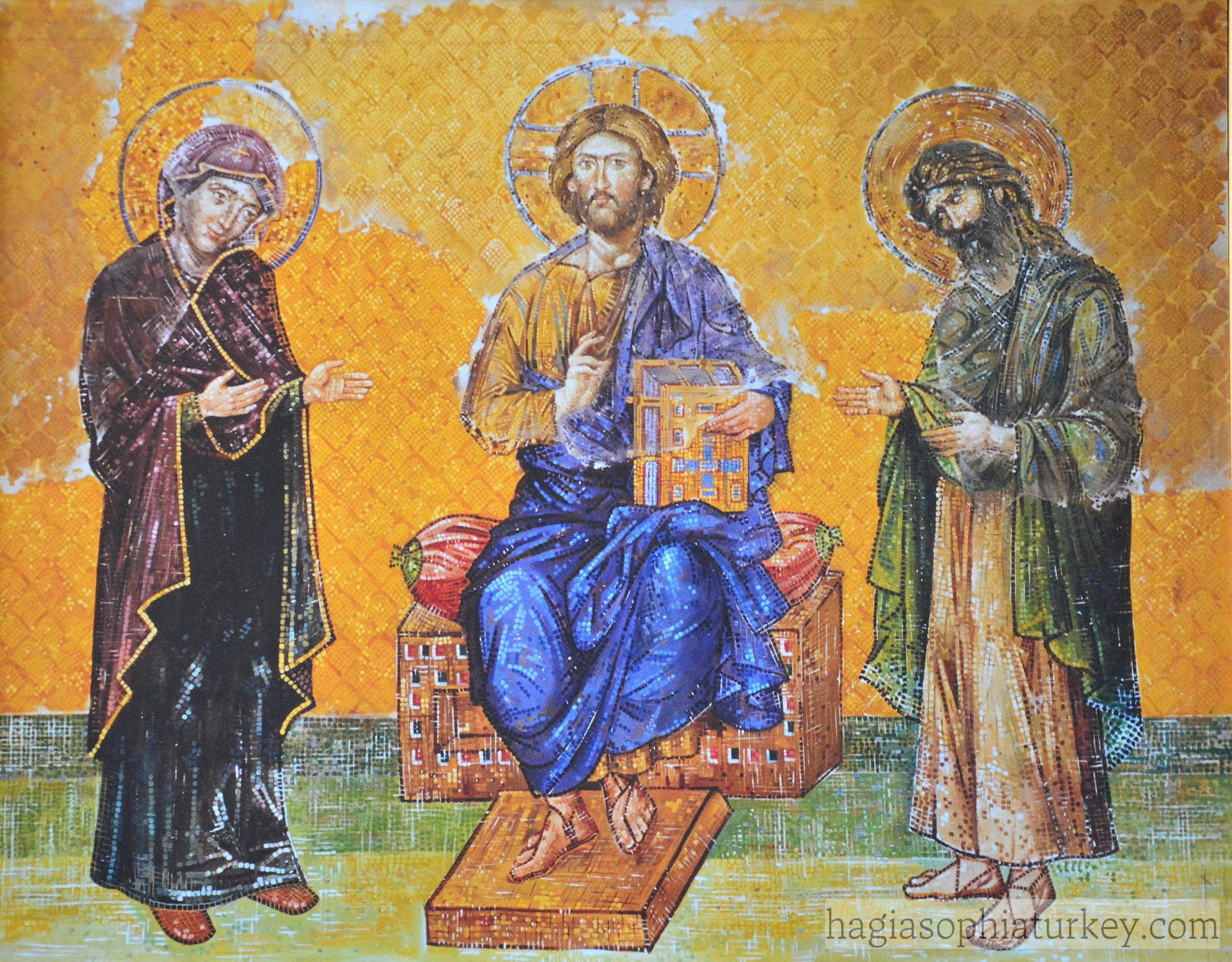
The numbering is also significant. The Communicantes begins with the Blessed Virgin Mary and, before the insertion of St. Joseph’s name in 1962, continues with twelve Apostles and twelve martyrs, i.e., 1 + 12 + 12. The Nobis quoque peccatoribus begins with St. John the Baptist, followed by seven male martyrs and seven female, i.e., 1 + 7 + 7. [5] And, as Fr. Neil Roy observes, the placement of the Theotokos and the Precursor of the Lord at the head of each list (and on either side of the Consecration) creates a literary “deesis,” a triptych that depicts Christ flanked by His mother and His cousin. [6]
Deesis, Hagia Sophia
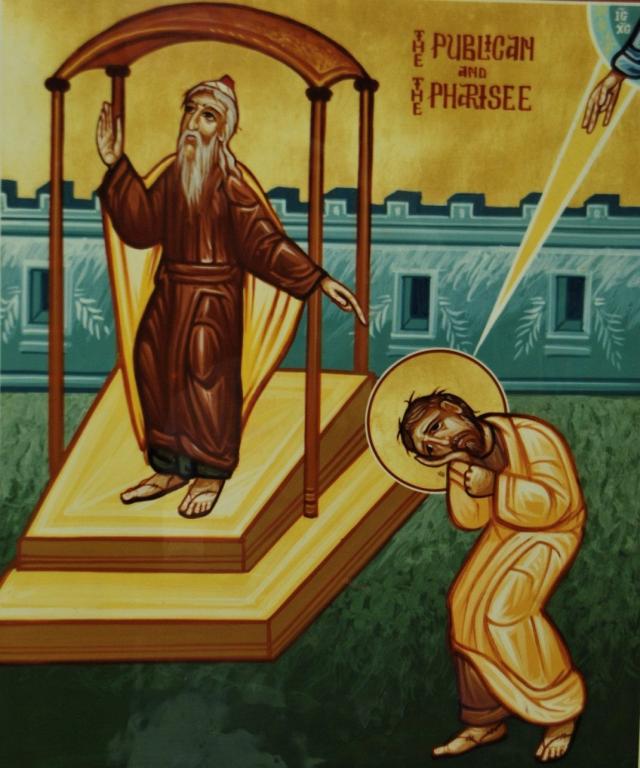
There are other differences as well. In the Communicantes, the priest describes “all here present” (omnes circumstantes) as communicating with (communicantes) the Saints before asking that their merits and prayers bring the help of God’s protection. In the Nobis quoque peccatoribus, the priest asks for communion with the Saints: first he asks for “some part and fellowship” with them, and then for their “company.” Some translations render communicantes in the first prayer as “in union with,” but if we are already in union with the Saints, why do we ask for fellowship with them here? (Unless, perhaps, it is another example of the liturgical stammer). I suspect, however, that the first prayer merely states that we are in touch with the Saints through our prayers, and that the second asks that we may enjoy their company for all eternity. But a note of humility and unworthiness pervades the petition. As Fr. Pius Parsch notes, in asking for “some part” of their company, the prayer essentially asks for “some obscure place in the realm of glory.” [7] The scene is redolent of the Publican who strikes his breast saying, “O God, be merciful to me a sinner.” (Luke 18, 9-14)
As for the order of the Saints, the male martyrs are organized according to rank while the women are organized according to vocation and region. For the men, the Apostles Stephen, Matthias, and Barnabas are followed by Ignatius the bishop, Alexander (who was a bishop or priest), Marcellinus the priest, and Peter the exorcist. 
For the women, there are two possibilities for Felicity and Perpetua. The first is that they are the famous Carthaginian martyrs Perpetua and Felicity, the former a well-educated noblewoman and mother of an infant son, the latter her slave who was pregnant when they were both fed to the beasts in A.D. 203. The only problem with this option is that it is more common to list the nobleman before the slave, whereas in the Nobis quoque peccatoribus Felicity comes first. The second possibility is that Felicity is a Roman matron and possible mother of the Seven Holy Brothers (July 10) who was martyred in A.D. 165 and who is here followed in the list by the Carthaginian martyr Perpetua. [8]
The next five are virgin martyrs (the same number as the five wise virgins in the Parable, Matthew 25, 1-13). Agatha and Lucy are from Sicily, Agnes and Cecilia are from Rome, and Anastasia of Sirmium, who has a station church in Rome once used for the Christmas dawn Mass and on Pentecost Tuesday, is from modern-day Serbia. The Roman Rite, as we have seen before, is steeped in the history of the Eternal City, but it is not insular, and so it honors Saints outside its borders.
In preconciliar hand Missals, as in the 2011 ICEL translation, the clause non aestimator meriti, sed veniae, quaesumus, largitor is usually translated with verbs, e.g., “not weighing our merits but granting us your pardon.” The Latin, however, uses two nouns, aestimator and largitor (a liberal giver). The difference is between doing and being. In this prayer, the priest goes further than petitioning God to do or not do something; he asks Him not to be the kind of Person who measures our value (which we know is wanting) and instead to be the kind of Person who is generous to a fault. And we already know that God is a Liberal Giver of Pardon because elsewhere we address Him with that title [9] along with “Liberal Giver of all goods” (omnium largitor bonorum) [10] and “Liberal Giver of indulgences” (largitor indulgentiae) [11]
Notes
[1] As Fr. Josef Jungmann explains, it was common for the clergy to designate themselves as sinners. They even signed their signatures in this manner. See The Mass of the Roman Rite: Its Origins and Development, vol. 2 (New York: Benzinger Brothers, 1951), pp. 249-50.
[2] See Jungmann, vol. 1, p. 72.
[3] See William Durandus, Rationale Divinorum Officionorum IV.35.11, IV.46.1, resp.
[4] See Rev. Neil J. Roy, “The Roman Canon: deëis in euchological form,” in Benedict XVI and the Sacred Liturgy, eds. Neil J. Roy and Janet E. Rutherford (Four Courts Press, 2008), pp. 181-199.
[5] Pius Parsch, The Liturgy of the Mass, trans. Frederic C. Eckhoff (St. Louis, Missouri: Herder, 1940), p. 187.
[6] See Roy. pp. 191-92.
[7] See Parsch, pp. 249-50.
[8] See Roy.
[9] The Collect Deus, veniae largitor et humanae salutis amator for All Souls’ Day, Office of Prime, and in the Office for the Dead.
[10] See the Collects for St. Bibiana (December 2) and St. Rose of Lima (August 30).
[11] The Lauds hymn Rex gloriose Martyrum for Several Martyrs.

Friday, November 07, 2025

The Prayer Memento and Ipsis, Domine

From a Roman Missal printed in Venice in 1520. 
Lost in Translation #147

After the Supplices te rogamus, the priest prays:

Memento etiam, Dómine, famulórum famularumque tuárum N. et N. qui nos praecessérunt cum signo fídei, et dormiunt in somno pacis.
Ipsis, Dómine, et ómnibus in Christo quiescéntibus, locum refrigerii, lucis et pacis, ut indúlgeas, deprecámur. Per eundem Christum Dóminum nostrum. Amen.
Which I translate as:
Remember also, O Lord, Thy servants and handmaids N. et N., who are gone before us with the sign of Faith and rest in the sleep of peace.
We beg that You indulge these, O Lord, and all who rest in Christ, with a place of refreshment, light, and peace. Through the same Christ our Lord. Amen.
The language mirrors that which is in the standard Catholic prayer for the faithful departed: “Eternal rest grant unto them, O Lord, and let perpetual light shine upon them. May they rest in peace.” What the Ipsis, Domine in particular adds is the notion of refreshment or refrigerium, a word upon which we dwell in this essay at some length.
The Ipsis, Domine is of special interest to those who are curious about what is lost in translation since one of its expressions was used by the liturgical reformers of the 1960s as a reason to reject literal translations of the sacred liturgy, and to embrace what would come to be called “dynamic equivalence.” On January 25, 1969, the Consilium for Implementing the Constitution on the Sacred Liturgy issued “Comme le Prevoit – On the Translation of Liturgical Texts for Celebrations with a Congregation.” The document, which argues that translations should be “suited to the greater number of the faithful who speak it in everyday use, even ‘children and persons of small education’” (15a) (might we dare say “baby talk”?) includes the following clause:
The metaphors must be changed to keep the true sense, as in locum refrigerii in northern regions. (23b)
The authors are referring to the fact that refrigerium literally refers to a “cooling” since it is from the verb refrigero, “to cool off” (hence the name for our modern appliance, the refrigerator). Their assumption is that the idea of a cool space only appeals to people in hot climates, and so the metaphor needs to be changed for colder parts of the globe. [1]
Whether that assumption is valid is debatable. When describing the “small but richly diverse world” of his character Virginia Troy, who lives in the northern regions of England and Scotland, Evelyn Waugh writes approvingly that it “was one of coolness, light and peace”—an obvious allusion to this prayer. [2] A locum refrigerii can also refer not to the temperature of a room but to a place that provides a cool, refreshing drink, which appeals to anyone who has been working outside and develops a hot thirst, even in the coldest of weather (see illustration below).

According to Comme le Prevoit, he should not be enjoying that.

There are four other problems as well with Comme le Prevoit 23b. First, refrigerium does not only mean coolness and therefore does not require a radical reinterpretation based on climate. Second, even if it did, every Apostolic liturgy, in imitation of the Incarnation itself, has some “scandal of particularity.” Third, the particular “scandal” of refrigerium is that it is ideally suited to designate the remedy for the souls in Purgatory. Fourth, a locum refrigerii is not, as the authors of Comme le Prevoit presume, a metaphor at all but another “scandalously” particular allusion.
1. The Christian Meaning of Refrigerium
It is true that refrigerium denotes coolness. In the devilishly godly humor of (Eastern Orthodox believer) Jason Peters, locum refrigerii is code for the kitchen – “whence all sickness, sorrow, and sighing have fled” – in part because it is where “Mr. Freezer” gets to meet “Mr. Martini glass.” [3] Peters even makes full use of the Ipsis, Domine, albeit in a way its pious author(s) never intended:
You ignore [Walker Percy’s essay] on bourbon at your own peril. One thing you’ll miss out on is Uncle Will’s mint julep recipe, to say nothing of Percy on the topic of college girls and nurses, where he’s without rival among the writers of the century he graced and helped make bearable. Ipsis, Domine, et Walker Percy et omnibus in Christo quiescentibus, locum refrigerii, lucis, pacis et bourbon, ut indulgeas, deprecamur. Per eumdem Christum Dominum nostrum. Amen. [4]
But as this citation illustrates, locum refrigerii can also mean a place of refreshment and consolation, and indeed it has had this usage in ecclesiastical Latin since the days of Tertullian. In his Apologeticus, Tertullian even uses the word in the same way as the Ipsis, Dominine, that is, as a description of the Beatific Vision. Christian beliefs about the afterlife, he writes,
make all who believe them better men and women, under the fear of eternal punishment and the hope of eternal refreshment [refrigerium].[5]
The Vulgate translation of the Bible also employs the broader definition of refrigerium:
Thou hast set men over our heads. We have passed through fire and water, and thou hast brought us out into a refreshment [refrigerium]. (Psalm 65, 12)
For they have said, reasoning with themselves, but not right: ‘The time of our life is short and tedious, and in the end of a man there is no remedy [refrigerium], and no man hath been known to have returned from Hell.’ (Wisdom 2, 1)
To whom he said: ‘This is my rest, refresh the weary, and this is my refreshing [refrigerium].’ And they would not hear. (Isaiah 28, 12)
The Lord give mercy to the house of Onesiphorus: because he hath often refreshed [refrigeravit] me, and hath not been ashamed of my chain. (2 Timothy 1, 16)
Curiously, the Consilium that issued Comme le Prevoit seems entirely unaware of the Christian usage of the word, fixating only on its original, pagan meaning. Other Catholics, however, were aware of the word’s deeper meaning. Evelyn Waugh includes a breathtaking description of a skydive in his Sword of Honour trilogy:
Guy jumped. For a second, as the rush of air hit him, he lost consciousness. Then he came to himself, his senses purged of the noise and smell and throb of the machine. The hazy November sun enveloped him in golden light. His solitude was absolute. He experienced rapture, something as near as his earthbound soul could reach to a foretaste of paradise, locum refrigerii, lucis et pacis. The aeroplane seemed as far distant as will, at the moment of death, the spinning earth. As though he had cast the constraining bonds of flesh and muscle and nerve, he found himself floating free… He was a free spirit in an element as fresh as on the day of its creation. [6]
Several (though not all) official translations of the Mass also evince a greater awareness of the Christian meaning of refrigerium. The 2011 English translation has “a place of refreshment, light, and peace,” replacing the earlier translation inspired by Comme le Prevoit: “May these…find in your presence light, happiness, and peace.” [7] The Missal in use in Mexico is similar to the improved 2011 English edition: concédeles el lugar del consuelo, de la luz y de la paz.[8]
2. Scandal of Particularity
A second point to be considered is that Christianity, and Judaism before it, radiates outward from what theologians call the “scandal of the particular.” [9] In the Old Testament, the Lord God chose Abraham and his seed out of all other nations to be His Chosen People. In the New, the eternal Word of God chose to take flesh in the Person of Jesus Christ, the foster son of a carpenter in the “fly over” town of Nazareth at a particular historical epoch, when the Romans had conquered much of the known world.
Apostolic liturgies followed suit, reveling in the cultural context in which they first received the Gospel. In the Byzantine Rite, homage is paid to St. John Chrysostom, the patriarch of their liturgy. In the Armenian Rite, it is St. Gregory the Illuminator. In the Roman Rite, it is the new founders of Christian Rome, Saints Peter and Paul, as one sees in the Confiteor and elsewhere. Apostolic liturgies do not abstract from the particular hands that bequeathed them the universal Gospel (itself a product of particular Revelation) but add them to the narrative, thereby providing a concrete link between our current age and that of the Apostles. As Pope Benedict XVI writes in his memoirs:
It was becoming more and more clear to me that here I was encountering a reality that no one had simply thought up, a reality that no official authority or great individual had created. This mysterious fabric of texts and actions had grown from the faith of the Church over the centuries. It bore the whole weight of history within itself, and yet, at the same time, it was much more than the product of human history. [10]
The traditional Roman Rite bears the whole weight of its Roman history, which is why it contains “metaphors” of coolness coming from a hot climate, and which is why it metaphorically conceives of the North as the realm of heathenism (the Germans!) when it points the celebrant northward to proclaim the Gospel, towards the barbarians on the other side of the Alps. Such particularity is not to be disdained but honored in an incarnational religion.
3. Souls in Purgatory
A third consideration is that the Ipsis, Domine is a prayer for the poor souls in Purgatory, and a petition to grant them a place of refreshment is a suitable remedy for their condition. As Fr. Martin Jugie writes in his classic Purgatory and the Means to Avoid It, the Magisterium has never formally defined Purgatory as a realm of fire, but it is by far the most common way to imagine it. [11] Western Christian art most often depicts Purgatory as such, and so does private revelation. In every vision that Saint Faustina had of Purgatory or of a soul in it, flames were involved. Indeed, Faustina describes Purgatory in her journal as “a misty place full of fire.” And if Purgatory is a misty place full of fire, then the antidote, so to speak, is a lightsome and peaceful place of refreshment. Appropriately, when Salvian of Marseilles (d. 480) discusses the Parable of the Rich Man and Lazarus, when the damned Dives asks for Lazarus to “dip the tip of his finger in water, to cool [his] tongue, for [he is] tormented in this flame,” (Luke 16, 24) he calls it a petition for a “drop of refreshment” (gutta refrigerii). [12]

Souls in the flames of Purgatory, 15th century Missal
4. Not a Metaphor
Finally, the Consilium authors assume that locum refrigerii is a metaphor when in fact it is an allusion to a historic location.
During the Roman persecutions of Christianity, the sacred sites where Saints were martyred or buried and the places where the faithful gathered to celebrate Mass were not one and the same. And when the persecutions ceased, this custom of maintaining separate places continued for a while. At martyrs’ shrines like Saint Lawrence Outside the Walls and Saint Agnes in Rome, there were two buildings: a smaller basilica ad corpus where the bones of the martyr were kept and a larger basilica major or coemeterium, a roofed cemetery where Christians were either interred  in the ground or in mausolea. The basilica major was occasionally used for the celebration of Mass, but its main function was to house funerary banquets. Despite the protests of some Church Fathers like Saints Ambrose and Augustine, these banquets were enormously popular among early Christians. And the name of these banquets? A refrigerium. [13] There is, then, an actual historical locum refrigerii: it is the basilica major or coemeterium. The Ipsis, Domine, then, is essentially praying that the souls of the faithful departed may rest as peacefully as their bodies do in the places where funerary banquets are held, surrounded by joy and confidence.
Saint Lawrence Outside the Walls in the fourth century.
Conclusion
The Consilium’s disregard of the aforementioned considerations calls to mind an additional scriptural verse containing the word we have been tracing:
Thus saith the Lord: ‘Stand ye on the ways, and see and ask for the old paths which is the good way, and walk ye in it, and you shall find refreshment for your souls.’ And they said: ‘We will not walk.’ (Jeremiah 6, 16)
Notes
[1] Some readers may wish to forgive the Northern-Hemisphere bias of this statement, which ignores the cold southernmost regions of the Southern Hemisphere, e.g., Chile, Argentina, Australia, etc.
[2] Evelyn Waugh, Unconditional Surrender (London: Methuen, 1986), 75.
[3] Jason Peters, The Culinary Plagiarist: (Mis)Adventures of a Lusty, Thieving, God-Fearing Gourmand (Eugene, Oregon: Front Porch Republic Books, 2020), 209; see also 203.
[4] Peters, 234.
[5] Apologeticus 49.2. See 39.16, where Tertullian uses the word to describe the post-liturgical agape meal designed to refresh the poor.
[6] Evelyn Waugh, 102.
[7] For the 1985 Missal, see The Roman Missal (New York: Catholic Book Publishing, 1985), p. 547; for the 2011 Missal, see The Roman Missal, 3rd ed. (Washington, DC: USCCB Publishing, 2011), p. 642. The French and Italian translations are similar to the 1985 English Missal even though as southern regions they should not have to “change the metaphor”: Qu’ils demeurent dans la joie, lumière et la paix. (Missel Romain, 3rd. ed. [MAME Desclée, 2001], p. 473, no. 95) and la beatitudine, la luce e la pace (Messale Romano, 3rd ed. [Fond.ne di Religione San Francesco d’Assisi E Ca, 2020], p. 627), resp.
[8] Misal Romano (2017), p. 92, no. 95.
[9] See Peter Kwasniewski, The Once and Future Roman Rite, (Gastonia, NC: TAN Books, 2023), p. 228, n. 15.
[10] Joseph Ratzinger, Milestones: Memoirs 1927–1977, trans. Erasmo Leiva- Merikakis (San Francisco: Ignatius Press, 1998), 20.
[11] Purgatory and the Means to Avoid It (Fortin Collins, Colorado: Roman Catholic Books, 2022),15. Nor has the Church weighed in on whether this fire is to be taken literally or as an ardent pain.
[12] Salvianus Massiliensis, Adversus avaritiam 3.11.
[13] See Kelsey Anne Bell, “The Use of Sacred Space in Hellenistic, Roman, and Christian Religious Sites” (Baylor University Honors Thesis, May 2015), pp. 30-49.

Friday, October 31, 2025

The Supplices te rogamus

Lost in Translation #146

After the Supra quæ propitio, the priest prays:

Súpplices te rogámus, omnípotens Deus, jube hæc perférri per manus sancti Angeli tui in sublíme altáre tuum, in conspéctu divínæ majestátis tuæ: ut quotquot ex hac altáris participatióne sacrosánctum Fílii tui Corpus et Sánguinem sumpsérimus, omni benedictióne cælésti et grátia repleámur. Per eúndem Christum Dóminum nostrum. Amen.
Which I translate as:
Suppliant we ask Thee, almighty God: command these to be borne all the way up by the hands of Thy holy angel to Thine altar borne on high, in the sight of Thy divine Majesty, so that as many of us as shall have consumed the sacrosanct Body and Blood of Thy Son by this partaking of the altar may be filled with every heavenly blessing and grace. Through the same Christ our Lord. Amen.
Most translations have “humbly” or “in humble prayer” (2011 ICEL) for supplices. Supplex does indeed betoken humility, but it also connotes prostration: sub-plico means to fold down or under. I suspect that this word was chosen over others like it because this connotation helps increase the distance in the prayer, so to speak, between us and God’s altar in Heaven. Folded over, we ask an Angel to go all the way up to Heaven on our behalf. This image is reinforced by the comportment of the celebrant, who is bowing down as he says these words, literally suppliant.
Two other words emphasize the distance between us and the heavenly altar. I have translated perferri as “to be borne all the way up” to reflect the fact that perfero, with its muscular prefix per, is more intense than fero, the verb to bear or carry. And I suspect that there is a subtle pairing of perfero and sublimis, the adjective used to describe God’s altar, for sublimis does not simply refer to being lofty or on high but especially has the meaning of being “borne aloft, uplifted, elevated, raised” (the word possibly comes from sub-limen, “up to the lintel”). [1] The sacrificial offerings must travel afar, being borne all the way up to something that is borne on high.
And the prayer asks that the carrier of these offerings be the hands of God’s Holy Angel. The inspiration for this petition may be Revelation 8, 3-4, which describes an angel offering with his hand the prayers of the saints to God on His altar:
And another angel came, and stood before the altar, having a golden censer; and there was given to him much incense, that he should offer of the prayers of all saints upon the golden altar, which is before the throne of God. And the smoke of the incense of the prayers of the saints ascended up before God from the hand of the angel.
A second possibility is that the Holy Angel is Christ Himself, whom St. Paul calls the Messenger of God (angelos Theou) in Galatians 4, 14. Although it is true that every Mass is offered to the Father through the Son (and with the Holy Spirit), I am of the opinion that the Angel referenced here is a celestial spirit and not the Second Person of the Holy Trinity, for the Son of God is mentioned in the second half of the prayer as being here on the altar and not journeying away from it to Heaven. The imagery would be confusing if we were asking Christ to be in two different places at the same time, even though He is, of course, present to all places at all times. Another consideration is that in the Book of Tobias the Archangel Raphael tells the elder Tobias that he himself offered all of Tobias’ prayers and good works to the Lord (see 12, 12). If that is true of all prayer, namely, that angels play a role in communicating our prayers to God, and if the Mass is the greatest prayer that can be offered to God, it stands to reason that a Holy Angel plays a role in that offering.
The first half of the Supplices te rogamus, as we have argued, increases the distance between us and God’s altar, but only so that the second half may close it. The main petition of the prayer is for every communicant at this Mass to be filled with every heavenly grace and blessing. Heavenly graces and blessings are not just in the Heaven borne on high; they are present here through a participation in this Mass. And the lynchpin is the sacro-sanct Body and Blood of Jesus Christ, now present on the altar. The adjective is significant: the Eucharist is both holy (sanctus) and sacred (sacer): holy because it is the living Christ, who is holy; and sacred because it is forever set apart from profane use. Just as the holy and sacred unite in the sacramental Body and Blood of Our Lord, so too Heaven and earth unite at this altar during this sacrifice.
Yet despite our reflections, we must in the end agree with the medieval deacon Florus of Lyons (d. 860) about the Supplices te rogamus: “These words of mystery are so profound, so wonderful and stupendous, who is able to comprehend them? Who would say anything worthy? They are more to be revered and feared than discussed.”
Note
[1] Lewis and Short Latin Dictionary, “Sublimis,” I.B.

Friday, October 24, 2025

The Supra quae propitio

Lost in Translation #145

After the Unde et Memores, the priest prays:

Supra quæ propitio ac seréno vultu respícere dignéris: et accepta habére, sícuti accepta habére dignátus es múnera púeri tui justi Abel, et sacrificium Patriarchae nostri Abrahae: et quod tibi óbtulit summus sacerdos tuus Melchísedech, sanctum sacrificium, immaculátam hostiam.
And which I translate as:
Upon these [the Host and Chalice], may You deign to look with a favorable and serene countenance, and to have them accepted, as You deigned to have accepted the offerings of Your just servant Abel, and the sacrifice of our patriarch Abraham, and that which Your high priest Melchizedek offered to You, a holy Sacrifice, an unspotted Victim.
The prayer could have used the more direct “to accept,” but instead it uses circumlocution with “to have accepted” twice. This literary device creates a certain distance between the human and the divine at the same time that it invites a space into which we can enter.
A marvelous aspect of this prayer is that it recapitulates, in a way, all of sacred history, and enfolds this narrative into the Paschal mystery. Somehow, the Passion of the Christ builds on and consummates all of the good sacrifices made before Him from the beginning of time to the present day. We, in turn, like dwarves on the shoulders of giants, benefit from this last and perfect and ongoing sacrifice.
Three figures are named from this sacred history: Abel, Abraham, and Melchizedek.
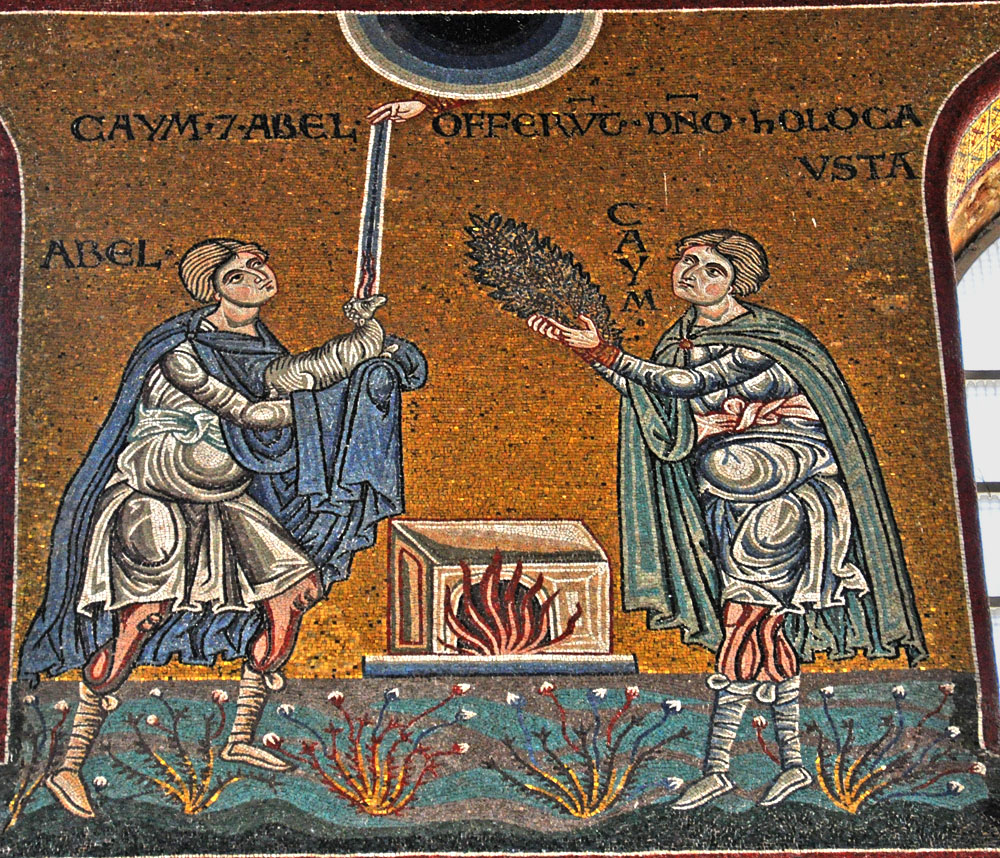
The sacrifice of Cain and Abel
Fr. Dieter Böhler, S.J. notices that even though Abel made a genuine sacrifice by immolating a lamb, his offering is called munera (offerings) and not sacrificium. “Abel,” Böhler observes, “is not an Israelite, but a representative of all humanity…. Thus, his sacrifice is an act of natural religion.” [1] The Lord accepts Abel’s offerings, even though Abel has acted only in response to a natural impulse rather than any divine revelation.
Melchizedek is not an Israelite either, but even as a pagan he somehow worships the true “God Most High, the Creator of heaven and earth.” (Gen. 14, 19) Moreover, he is designated as both a king and a priest, and his offering of bread and wine clearly foreshadows the Eucharist. Hence, even though unbloody offerings in the Old Testament (such as grains and vegetables) are not called sacrifices or victims, the Supra quae propitio elaborately refers to Melchizedek’s offering as “that which he offered to You… a holy sacrifice, an unspotted victim.”
Together, the sacrifices of Abel and Melchizedek point to the Eucharist: Israel’s liturgy and the aspirations of all human reverence towards the divine are thus taken up and fulfilled in the Eucharistic sacrifice. The sacrificial matter of Abel (the lamb) and of Melchizedek (bread and wine) lend themselves to this interpretation, since the Eucharistic sacrifice of bread and wine makes present the sacrificed Lamb (see Rev. 5, 6) [2]
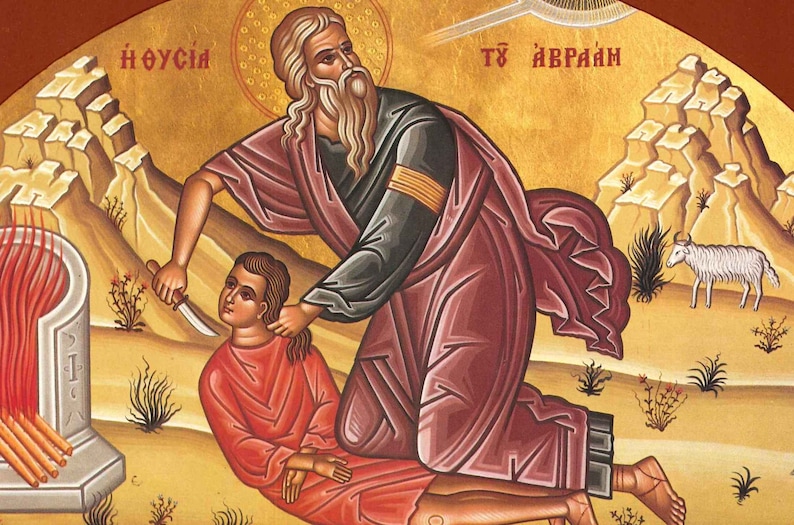
But the real mystery is the sacrifice of Abraham. Böhler first establishes that the sacrifice of Isaac was designed by God to be a test not of Abraham’s obedience but of his faith. Specifically, Abraham had to have faith that God would fulfill His promise to make Abraham’s descendants a great nation through Isaac, even though Isaac was to be killed before he could sire any offspring. This meant only one thing: Abraham had to believe in the resurrection of the dead, in this case, the resurrection of his ostensibly-soon-to-be dead son Isaac. That is why Abraham remains our Patriarch, even if we do not share his bloodline; he is a towering figure of great faith in the key doctrine of Christianity.
The sacrifice of Abraham
And his sacrifice? It was not Isaac, who was spared. And for Böhler, it was not really the ram that Abraham substituted for Isaac. Böhler notes that rams had only one meaning in the Levitical sacrifices: “they were the classic sacrificial animal of cult inauguration,” [3] such as initiating priestly ordination. The cult inauguration here on Mount Moriah is an anticipation of the cult that David and Solomon would inaugurate centuries later in the same location (later renamed Mount Zion) and the new cultus that Our Lord would inaugurate again in the same location in the Upper Room on Holy Thursday. Rather, for Böhler, “The sacrifice of Abraham was a sacrifice of himself by himself. He surrendered himself will all his hopes, his love, his faith, into the dark night of God’s will. It was a self-offering.” [4] It is indeed fitting that this knight of Faith be remembered in the Canon.
Patriarchy Properly Understood
A long side-note is in order on why the 2011 ICEL’s translation of Patriarchæ nostri Abrahae as “Abraham, our father in faith” is ill-advised. [5] “Patriarch” and “patriarchy” are, of course, dirty words today, thanks to the influence of feminism, which uses the term to denote men’s systemic oppression of women. [6] Strictly speaking, however, patriarchy denotes not male rule or misrule in general but a specific form of male authority found only in the Judeo-Christian tradition. The word itself is a biblical neologism, appearing first in the Septuagint translation of the Old Testament in reference to: 1) the heads of the twelve tribes of Israel (1 Chronicles 27, 22); 2) the heads of families within a tribe of Israel (2 Chronicles 19, 8; 26, 12); and 3) Abraham, Isaac, and Jacob. (4 Maccabees 7, 19; 16, 25)
In the New Testament, St. Stephen confirms this convention by referring to the sons of Jacob as the “twelve patriarchs” (Acts 7, 9) and St. Peter, while preaching during the Church’s first Pentecost, develops it further by also calling King David a patriarch. (Acts 2, 29) Later Christian usage expands the patriarchal franchise to include pre-Abrahamic figures such as Adam, Abel, and Noah (the so-called “antediluvian patriarchs”) and to post-biblical bishops presiding over the chief sees of the early Church, e.g., Alexandria, Antioch, Jerusalem, and Constantinople. Today, a number of prelates in the Catholic, Eastern Orthodox, and Oriental Orthodox churches continue to bear the ecclesiastical title of Patriarch. The word was not used outside of Christian circles, and it was not secularized until the eighteenth century to signify any kind of male rule.
All of which is to say is that patriarchy in its true sense is a specific model of fatherly authority tied to Divine Revelation, and anchored in a covenantal bond between God and man that – judging from how the term is used biblically and ecclesiastically – is essentially positive and beneficial. As Jesus admonishes His apostles:
You know that the princes of the Gentiles lord it over them; and they that are the greater, exercise power upon them. It shall not be so among you: but whosoever will be the greater among you, let him be your minister: And he that will be first among you, shall be your servant. Even as the Son of man is not come to be ministered unto, but to minister, and to give his life a redemption for many. (Matthew 20, 25-28)
Here “lord it over them” signifies not rule per se but exploitative rule, a wielding of power for the sake of selfish gain. Christian rule, by contrast, may involve an exercise of power, but that exercise is directed exclusively to the betterment of the ruled even if it is at the expense of the ruler. The greatest example of this self-emptying and altruistic mode of rule is that of Jesus Christ, who “loved the Church and delivered himself up for it.” (Ephesians 5, 25)
In other words, if generic patriarchy is the problem, Christian patriarchy is the solution. And if Christian patriarchy is the solution, we need to take back the word and not be ashamed to call Abraham our patriarch. [7]
Previous Sacrificers
And as for the rest of the prayer, it is out of chronological order. Historically, Abel came first, then Melchizedek, then Abraham. But the order of the prayer is Abel, Abraham, and Melchizedek. Why? Because Abel offered a bloody sacrifice, Abraham offered an almost-bloody sacrifice, and Melchizedek offer an unbloody sacrifice, a build-up to the unbloody sacrifice of Our Lord Jesus Christ in the Holy Sacrifice of the Mass. As the Divine Liturgy of St. John Chrysostom prays:
You became man, unchanged and unchanging. You were appointed our High Priest, and, as Master of all, handed down to us the priestly ministry of this liturgical and unbloody sacrifice. [8]
The sacrifice of Melchizedek
I believe this is the reason why that the Supra quæ propitio dwells on the sacrifice of Melchizedek in such a loving way, not going directly to his offering but lingering in a beguiling way on “that which Your high priest Melchizedek offered to You,” and then elaborating with “a holy Sacrifice, an unspotted Victim.” For Jesus Christ is a priest according to the order of Melchizedek, as the Bible insists (see Ps. 109, 4; Hebr. 5, 6; 5, 10; 6, 20; 7, 11) and so is every priest validly ordained celebrating this Holy Sacrifice of the Mass.
Notes
[1] Fr. Dieter Böhler, S.J., “Sacrificium Patriarchae nostri Abrahae: The Aqedah in the Bible and the Canon of the Mass,” in The Sacrifice of the Mass, ed. Matthew Hazell (Smenos Publications, 2024), 25.
[2] Ibid, 26.
3] Ibid, 34.
[4] Ibid, 32.
[5] 2011 Roman Missal, 641.
[6] As Iris Marion Young puts it, “The system of male domination, most often called ‘patriarchy’, produces the specific gender oppression of women,” in Throwing Like a Girl and Other Essays in Feminist Philosophy and Social Theory (Bloomington, IN: Indiana University Press, 1990), 21, emphasis added. Bell Hooks explains that “patriarchy” has replaced “male chauvinism” and “sexism” as the preferred term for the male oppression of women in “Understanding Patriarchy,” in The Will to Change: Men, Masculinity, and Love (New York: Washington Square Press, 2004), 17–25.
[7] ICEL, on the other hand, is correct in identifying Abraham as our father in faith even though the original Latin makes no mention of this fact. Citing St. Paul, Peter Kwasniewski writes: “Not by descent of blood but by imitation of faith, Abraham is our patriarch, the patriarch of orthodox Christians—not the patriarch of the Jewish people as an ethnic or religious group... Abraham is the patriarch of all who have faith in Christ—of the Hebrews, like himself, who longed for the Messiah and who were delivered by Him from the limbo of the fathers, as well as of the Jews and Gentiles from the time of Christ down to the present who have been baptized into Christ.” (Once and Future Roman Rite, 242)
[8] After the Cherubic Hymn.

More recent articles:

For more articles, see the NLM archives: