Friday, September 13, 2024

Oremus and Oratio


Lost in Translation #104

After the priest says Dominus vobiscum and hears the reply Et cum spiritu tuo, he bows his head towards the altar cross, extends and joins his hands, and says Oremus or “Let us pray.” The priest’s actions highlight the nature of prayer. Bowing, as we noted earlier, is customary when offering a gift, and prayer is a gift to God, be it of adoration, petition, contrition, or thanksgiving. Bowing is also an expression of humility: when the priest bows to the cross, he is humbly acknowledging His crucified Lord. As for the motion of the priest’s hands, Fr. Nicholas Gihr writes:

The extending of the hands expresses the ardent longing and the earnest desire of the priest, that the blessing he invokes may be bestowed; the joining of the hands signifies that the priest humbly mistrusts his own strength and confidently abandons himself to the Lord. [1]
It makes sense that the priest uses the verb orare to call the people to prayer, for what follows the word Oremus is an Oratio (in this case, the Collect), one of the proper prayers of the Mass. The Roman Missal uses Oratio for the Collect, Secreta for the Secret, and Postcommunio for the Postcommunion Prayer, but all three are also generically referred to as orations.
What is more difficult to understand is the use of orare and oratio for prayer in the first place, since in classical Latin these words have no denotation or connotation of speech addressed to God. Oratio can mean any mode of discourse or a particular language, but it is usually used to signify “formal language, artificial discourse, [a] set speech” as opposed to ordinary speech or conversational language, which is indicated by the word sermo [2]. And of course, orare and oratio are associated with oratory and law; an oratio perpetua, for example, was not an interminable prayer but a continuous disquisition common in court trials. And the great Roman orators were known for their moving speeches to an audience, not their imprecations to God.
A Roman Orator
Nevertheless, the Vulgate often uses oratio for prayer [3], and so did the early Church. One theory for this choice is that the word “had almost disappeared from the common language” and could thus be more easily repurposed for Christian use [4]. But this theory does not explain how there was a perceived need to repurpose it all since Latin has other words for praying like precor and obsecro, and Christians had no qualms in using these as well.
Dirigatur oratio mea sicut incensum in conspectu tuo (Ps. 140, 2)
Perhaps the Latin Church liked two aspects of the classical sense of oratio: its formality and its public nature. Although an oration can be extemporaneous (as in the case of an oratio subita), it is more often associated with a fixed or prepared speech, and this association aligns well with the Church’s transition in her liturgy from impromptu to formulaic prayer. The orations of the Roman Rite are indeed examples of oratio accurata et polita—of meticulous and polished oratory. [5]
Second, both oratory and liturgy are public affairs (even when a Mass is celebrated privately), and the orations are especially ordered towards the public, that is, the congregation. As Gihr writes,
The Collect is is not merely a private prayer of the priest, but a liturgical one, that is, a public prayer which the celebrant recites in the name and by the commission, as well as according to the ordinance of the Church, and with a special intention for the welfare of the whole Christian people. [6]
Indeed, we may go so far as to suggest that the Christian co-opting of oratio is analogous to the Christian co-opting of “liturgy.” Leitourgia in classical Greek refers to a public office performed by a designated official on behalf of the populace, but Christian authors stole it from the polis and transferred it to the Church. And just as an office of the body politic was applied to the Church’s worship, so too was the polis’ main organ of persuasion (oratory) applied to the Church’s liturgical prayer. The language of the earthly city has been taken up by the city of God to demonstrate which city is more important.
Finally, at least judging from later commentators, Christians appreciated the possible etymology of orare and oratio. St. Thomas Aquinas quotes with approval Cassiodorus’ claim that “prayer [oratio] is said to be a kind of oral reasoning [oris ratio].” [7] Cassiodorus was probably drawing from a long tradition of speculation that links the word oration with the Latin word for mouth: Oro ab ore, writes Varro, “I orate from the mouth.” [8] But for Aquinas, the ratio in oratio is especially significant, for it means that prayer is an intelligent activity rather than something that dumb or superstitious people do. And this perfectly rational activity is also at one and the same time “properly an act of religion” (oratio est proprie religionis actus) [9]. Intelligent minds recognize the need to pray, and so they do.
Notes
[1] Rev. Nicholas Gihr, The Holy Sacrifice of the Mass: Dogmatically, Liturgically and Ascetically Explained (Herder, 1902), 411.
[2] “Oratio, orationis,” II, Lewis and Short Latin Dictionary (Clarendon Press, 1879), 1275.
[3] See 3 Kings 8,28; 2 Macc. 10,16; Luke 6,12; Acts 1,14; Col. 4,2.
[4] Sr. Mary Pierre Ellebracht, Remarks on the Vocabulary of the Ancient Orations in the Missale Romanum (Dekker & Van de Vegt, 1963), 117.
[5] See Cicero, Brutus 95.326.
[6] Gihr, 409.
[7] Summa Theologiae II-II.83.1.
[8] Varro, De lingua latina 6, § 76 Müller.
[9] Summa Theologiae II-II.83.3. 

Monday, November 13, 2023

The Incomparable Latinity of the Church’s Prayer: Two Newly-Released Books

It is characteristic of our strange in-between times that, while officialdom in the Church frowns severely upon all manifestations of tradition, be it in the wearing of cassocks and lace or the use of a bimillennial liturgy or the defense of the decalogue, “on the ground” there is a never-ending stream of indications that tradition is seeping in everywhere and saturating the rising generations who still believe in Christ. Nowhere is this more apparent than in the world of publishing, where nine out of ten books appearing on liturgy, sacraments, spirituality, and the like are either markedly conservative or defiantly traditional in approach.

Today I am pleased to announce the nearly simultaneous release of two books—the one by a living writer familiar to all NLM readers, namely, Dr. Michael Foley; the other a reprint, after many decades, of a valuable preconciliar work by Fr. C.C. Martindale—that have, in their distinctive ways, very similar concerns. Both are written to expound and exult in the enormous riches, the world of subtlety, the colorful details, of the Church’s specifically Latin orations, which no vernacular language can convey or capture.

The New Book


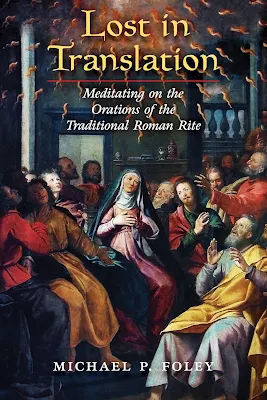
Michael P. Foley. Lost in Translation: Meditating on the Orations of the Traditional Roman Rite. Brooklyn: Angelico Press, 2023. 302 pages. Paper $21.95; Cloth $32.
Publisher’s Description: At every celebration of the traditional Latin Mass, one of the greatest achievements of Christian culture passes by virtually unnoticed. The orations of the Roman Rite—the Collect, Secret, and Postcommunion—are literary masterpieces: a unique species of rhetoric, they ingeniously combine tight structure, poetic rhythm, literary order, succinct imagery, and a panoply of human experience. These brilliant gems are underappreciated because much of their splendor comes from their deft exploitation of Latin, which, like any other language, has its own ecosystem and way of doing things. As a result, even the best translations will leave something out.

Lost in Translation was written to introduce readers to these gems even if they do not know Latin. In its pages Michael Foley explains one or more orations for every Sunday of the Church year and for a number of Saints’ feast days, unearthing the subtle nuances and vivid images that make these prayers such a delight. The result is a new portal into the beauty of sacred liturgy and the mystery of our redemption.
Praise for “Lost in Translation
“The orations of the classical Roman Rite are rich and illuminating, especially when placed in their proper context: the days and seasons of the liturgical year. Acting as missal mystagogue, Michael Foley takes us on a delightful tour from Advent to Apocalypse, unpacking the prayers’ dense content, reveling in their linguistic finesse, and applying their lessons to our spiritual life hic et nunc. Food for prayer and kindling for homilies, Lost in Translation is guaranteed to intensify the reader’s astonishment at the treasure-chest of tradition, with the orations as its diamonds, emeralds, and rubies.” —PETER A. KWASNIEWSKI

“In this excellent book, Michael Foley skillfully guides us through the liturgical year using the Collects, Secrets and Postcommunions of the traditional Roman Rite. These liturgical prayers of the Church are crammed full of theological, biblical, and patristic insights as well as poetry, imagery, and wordplay, all of which can often be overlooked in vernacular translations. Dr. Foley’s valuable insights are sure to prove spiritually fruitful for laity and clergy alike, and will no doubt be a source of fresh inspiration for those entering into the Church’s traditional liturgy.” —MATTHEW P. HAZELL

“In clear, conversational prose, Michael Foley attentively studies the orations of select Masses of the 1962 Roman Missal in their context. His meditations foster personal inner appropriation of the Church’s common prayer and teach us how the prayers school our desires. Foley’s work is pleasantly enriched by the pertinent inclusion of words from Fathers and Doctors of the Church and of historical facts and customs that tell us about a feast’s celebration or highlight theological and spiritual truths presented in its Mass texts.” —LAUREN PRISTAS

Available directly from the publisher here or from Amazon (here, or at any other country’s site).

The Reprint


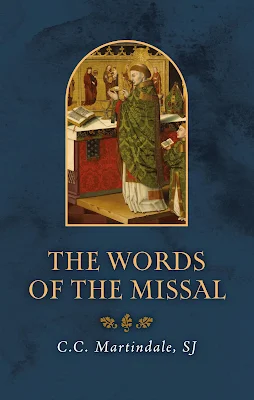
C.C. Martindale, SJ. The Words of the Missal. Lincoln, NE: Os Justi Press, 2023 (originally published by the Macmillan Company in 1932). 226 pages. Paperback $17.95.
For those unfamiliar with him, Cyril Charlie Martindale (1879–1963) was a Catholic priest, scholar, and writer, who, with fellow Jesuit Martin D’Arcy, was among England’s foremost Catholics of the first half of the twentieth century. He kept up a correspondence with such figures as Ronald Knox, Evelyn Waugh, and Graham Greene. In 1931, Fr Martindale wrote a fine and accessible study of key Latin words in the Missale Romanum, with this admirable goal: “All I want is that this book may help people to pray still better, and to love the Missal still better, so that what is old and familiar shall reveal new beauty and lovableness.”

The resulting book, accurately (if not excitingly) entitled The Words of the Missal, long out of print, has now been reprinted by Os Justi. Here are some words from the Introduction:
If you read St. John or St. Paul, you are almost sure to love their works, or at least some parts of them. But if you take real trouble to find out what exactly their words mean—Faith, for example; Justice; Fulness; Spirit; Light—their value begins to glow forth from within, and the page becomes transfigured and quite different from what it was before you took the pains to pause, compare, ponder, and to catch all manner of elusive shades and depths of meaning in such words. When you re-read those writers you will not any more have to spend time over such details, nor find yourself pulled up or committed to any complicated work, but the flow and the glory of the inspired pages will be a new thing for you.
          Something similar can be done with the Roman Missal. The Latin words in the Missal at times float and waver, and require care before they perfectly yield up their sense. Others have so definitely "Latin" a flavour that it is very difficult to translate them exactly into English; still, the attempt should be made, along with a little explanation. Others may seem so ordinary that we might take them for granted and not notice some of the richer meaning that is theirs.
          The method of this book, then, is quite simply to take a few of the words which come often in the Missal so as to be in a certain sense “favourite” words in the Liturgy, or else, other words that we might not notice; to collect several instances of their use (for isolated instances prove little; many exercise a cumulative effect); and then, to “worry” them until a kind of valuable juice of meaning is crushed out of them. Certainly no reader would be expected to attend to such details during Mass itself; but, having done it outside of Mass, he will find that Mass becomes full of added delight.
The Table of Contents:

Introduction
1 “Rejoice in the Lord”
2 Human Fragility
3 The Divine Initiative
4 God’s Hand of Power
5 God’s Largesse
6 Man’s Transformation
7 Drastic Discipline
8 How the Church Speaks to God and How We Should Think of Him
9 The Wording of Our Payers
10 The Mysticism of the Missal
11 The Light of Life
12 Newness of Life
13 Charity, Unity, Peace
14 Lights and Shades of Meaning
15 Delicacies of Meaning
Appendix: Latin and English
Postscript

Available directly from the publisher here or from Amazon (here, or at any other country's site).

Although Fr. Martindale speaks generally of “the missal,” in fact nearly all of his examples are drawn from the orations. That makes the Foley book and the Martindale book wonderfully complementary to each other, as each covers different parts of this vast territory and by different methods: Foley looking one by one at particular days or feasts in the Church calendar, Martindale exploring themes across the entire missal.

May books like these restore among eager Catholics the knowledge, appreciation, and savor of the wisdom of our inherited tradition—and may they help to bury, once and for all, the folly of those who claim that all of the Latin Church’s tradition of prayer can be effectively conveyed in vernacular. It cannot be, and these books demonstrate it with atomic force.

Monday, July 24, 2023

Doing Without the Prayers of the Saints

In the modern missal of Paul VI, first issued in 1969, an entire celebration of the Holy Mass, using licit options, can take place without even once directly asking the saints to pray for us or without asking the Lord to grant us that the saints would pray for us. If, however, the “Confiteor” is used, and the Roman Canon, then at least twice we do ask for the help of their prayers, or directly ask them to pray for us. But it is very rare for the “Confiteor” and the Roman Canon to be chosen in the same situation, and either of them may not be very common either, depending on the celebrant’s habits.

Here is a synthesis of some of the teaching, in the Ordinary of the modern missal, on the intercession of the Saints: By their intercession, we receive sure support. Their fervent prayers sustain us in that all we rightly do. Their merits and prayers can gain us the constant help and protection of God. We rely on their constant intercession in the presence of the Lord for unfailing help. [1] So the postconciliar missal recognizes the great help that can be obtained by the People of God through the intercession of the saints. And yet it very often, according to the options made use of, does not ask for this intercession.

In Eucharistic Prayer II it says:
Have mercy on us all, we pray, that with the blessed Virgin Mary, Mother of God, with the blessed Apostles, and all the Saints who have pleased you throughout the ages, we may merit to be co-heirs to eternal life, and may praise and glorify you...
The mercy requested is that we, the faithful, would merit to be with the Saints in eternal life. But their intercession is not asked for.

In Eucharistic Prayer III it says:
May he make of us an eternal offering to you, so that we may obtain an inheritance with your elect, especially with the most blessed Virgin Mary, Mother of God, with your blessed Apostles and glorious Martyrs and with all the Saints, on whose constant intercession in your presence we rely for unfailing help.
The intercession of the Saints is not explicitly requested, although it is praised.

It is an important thing in the “economy of salvation,” the Lord’s household arrangement (so to speak), that we ask. “Whoever asks receives,” Our Lord taught us. This implies that whoever does not ask, does not receive—or at least, does not receive as much as he might.

The saints are constantly interceding for us. Their merits and prayers are efficacious and operative in the flow of divine grace to us, in the communion of saints. But they can do so much more for us if only we were to ask for their intercession and help.

Here we can see one of the ways in which the traditional Roman missal is superior to the postconciliar one, as regards both the welfare of the Church militant and the salvation of the entire world. In the traditional Ordo Missae, the intercession of the saints is requested seven times. In a very common and perfectly licit variation of the modern Mass, the intercession of the Saints is requested zero times.

What difference might this make in the life of the Church on earth?

But that is only the first level of the issue. As my friend Hilary White likes to say, one reaches what one thinks is the bottom, and then a trap door opens and one realizes that the bottom is further down. “Have we hit rock bottom yet?” is, in liturgical discussions, by no means a frivolous question.

So, when we discover that even the 1962 missal, as much better as it is, is vastly inferior to the practices of the pre-55 missal as regards precisely this point—the intercession of the saints—we realize that the Novus Ordo was not a sudden departure but rather a continuation of a process of denudation, evisceration, suppression, that was already under way prior to the Council, and which appeared to legitimize the direction in which the Consilium acted.

As I discuss in the last chapter of my book The Once and Future Roman Rite, for centuries it was the custom for priests to say or to sing more than one set of orations (Collect, Secret, Postcommunion) at Mass. The rubrics told the priest which additional prayers to use. For example, in Advent, from the first Sunday, the Missal prescribed the addition of a second Collect of the Blessed Virgin Mary and a third Collect either for the Church or for the pope, although if there were saints to be commemorated, their prayers would be used instead.

Here, for example, are the orations that were added “To implore the intercession of the saints,” appointed for the time between Purification and Ash Wednesday and during the Time after Pentecost (translation from the St. Andrew Daily Missal, 1945 edition, p. 1712):
Collect. Defend us, we beseech Thee, O Lord, from all dangers of mind and body; that through the intercession of the blessed and glorious ever Virgin Mary, Mother of God, together with blessed Joseph, Thy blessed apostles Peter and Paul, blessed N. [titular saint of the church], and all the saints, mercifully grant us safety and peace, that all adversities and errors being overcome, Thy Church may serve Thee in security and freedom. Through the same Lord Jesus Christ Thy Son…
          Secret. Graciously hear us, O God our Savior, and by the virtue of this sacrament protect us from all enemies of soul and body, bestowing on us both grace in this life and glory hereafter. Through our Lord Jesus Christ…
          Postcommunion. May the oblation of this divine Sacrament both cleanse and defend us, we beseech Thee, O Lord, through the intercession of the blessed Virgin Mary, Mother of God, with blessed Joseph, Thy blessed apostles, Peter and Paul, blessed N. [titular saint of the church], and all the saints, render us at once purified from all perversities and freed from all adversities. Through our Lord Jesus Christ…

A large number of the required additional orations had precisely this character of invoking the intercession of the saints. Ask, and you shall receive.

On Sundays, too, saints would be commemorated instead of simply ignored. In late June it would be quite possible to have a situation where the Third Sunday after Pentecost fell within the Octave of the Sacred Heart and of the birth of Saint John the Baptist. The priest at Mass would say or sing Sunday’s oration, followed by those of the Sacred Heart and of Saint John the Baptist. Ask, and you shall receive, grace upon grace.

Prior to 1955, the maximum number of Orations at a low Mass on simple days was five or seven (depending on circumstances). In 1955, this number was reduced to three, and mandatory prayers of the season were abolished. In 1960, the possibility of additional orations was reduced still further, and, for most Sundays of the year, done away with altogether. Do not ask; do not receive.

Think about this: thousands of priests were praying for these intentions daily at the altar, in the voice of the Church, in the name of Christ, the prayer most pleasing, most acceptable, most heard… and then suddenly: GONE.

If we believe in the power of prayer—if we believe that liturgical prayer is the highest form of it—then wouldn’t this have some consequences? Is it possible to believe that the sudden abandonment of thousands of Masses in which the pope was being prayed for with quite specific and “demanding” intentions, or in which the Virgin Mary, local patron saints, even all of the saints were being called upon, could have no effect in the spiritual order? Is it possible to believe this and still be a believer?

It is not fanciful to think that there is at least some connection between the official abandonment of liturgical prayer asking for the intercession of the saints and the grievous afflictions of the Church on earth since about the time when these orations began to be systematically canceled.

NOTE

[1] Exact phrases: “By their intercession, sure support” (Preface I of the Saints); “their fervent prayers sustain us in all we do” (Preface II of the Saints); “their merits and prayers [can] gain us [God’s] constant help and protection” (Eucharistic Prayer I); “[the] constant intercession in your presence [of the saints] [can give us] unfailing help” (Eucharistic Prayer III).

Saturday, January 28, 2023

“Enrichment” by Impoverishment? The Fate of the Propers for the 4th Sunday after Epiphany in the Modern Missale Romanum

The collect, secret and postcommunion in the traditional Roman Rite for this coming Sunday, the 4th after Epiphany, have over a millennium of attested use in the liturgy. It is concerning, therefore, to note that, despite this, neither the collect nor the postcommunion for this Sunday are contained anywhere in the Novus Ordo, a book so often described as an “enrichment” of the Roman Rite, and more recently as containing “all the elements” of it. Let us take a brief look at the history of this Sunday’s prayers, and their fate in the post-Vatican II liturgical reforms.
The 4th Sunday after Epiphany (Dom IIII post Theophaniam), in the
Sacramentarium Triplex, Zürich, Zentralb. Ms. C 43, ff. 35r-35v
Collect (CO 1898)
Deus, qui nos, in tantis perículis constitútos, pro humána scis fragilitáte non posse subsístere: da nobis salútem mentis et córporis; ut ea, quæ pro peccátis nostris pátimur, te adiuvánte vincámus.
O God, who know that our human frailty cannot stand fast against the great dangers that beset us, grant us health of mind and body, that with your help we may overcome what we suffer on account of our sins.
The Corpus orationum tells us that this prayer appears in a total of forty-three manuscripts, dating from the 8th century. In all of these, it is an Epiphanytide collect, and in the vast majority of them (thirty-seven), it is used on the 4th Sunday after Epiphany, just as we find in the 1962 Missale Romanum.
It has completely disappeared from the Novus Ordo. It seems more than likely that the phrase in tantis perículis constitútos, pro humána scis fragilitáte non posse subsístere was deemed not suitable for the new, post-Vatican II “modern mentality”. [1]
Secret (CO 749)
Concéde, quǽsumus, omnípotens Deus: ut huius sacrifícii munus oblatum fragilitátem nostrum ab omni malo purget semper et múniat.
Grant, we pray, almighty God, that what we offer in sacrifice may cleanse us in our frailty from every evil and always grant us your protection.
This prayer has a variety of use in the tradition, the two main groups being:
  • as an Epiphanytide secret, in forty manuscripts from the 8th century onwards (thirty-three of which use it on the 4th Sunday after Epiphany);
  • as a Lenten secret: thirty-one manuscripts, from the 9th century onwards (note that in twenty-five of these, it is also used as an Epiphanytide secret).
The Corpus orationum also gives a third group of ten manuscripts, dating from the 8th century onwards, which use this prayer in diverse ways, with frequent duplication: in Advent (five manuscripts), Lent (three manuscripts), the Proper/Common of Saints (four manuscripts), and Votive Masses (two manuscripts). In one of these manuscripts, this secret/super oblata prayer is actually used as a collect!
In the 1962 Missal, this secret is used on Saturday in Week 3 of Lent as well as the 4th Sunday after Epiphany, and in every one of the thirty-one manuscripts where this prayer occurs in Lent, it is duplicated on the 4th Sunday after Epiphany. As per the policies of Coetus XVIII bis of the Consilium, [2] in the Novus Ordo this duplication is eliminated, in this case by removing the prayer’s (slightly earlier and better-attested!) use in Epiphanytide, and retaining its Lenten use. However, it has been moved to Thursday in Week 4 of Lent, a day on which it is never attested in the manuscript tradition. Of course, the post-Vatican II liturgical reformers couldn’t possibly have retained this prayer on a Sunday – after all, the phrase fragilitátem nostrum ab omni malo purget semper et múniat is obviously much too difficult for most of the faithful!
Postcommunion (CO 3321 b)
Múnera tua nos, Deus, a delectatiónibus terrénis expédiant: et cæléstibus semper instáurent aliméntis.
May your gifts, O God, detach us from earthly pleasures and ever renew us with heavenly nourishment.
The Corpus orationum informs us that there is some limited variation in the use of this prayer: three manuscripts use it in the Proper/Common of Saints, with relevant textual additions. In the vast majority of manuscripts (forty-two), however, it is an Epiphanytide postcommunion, with thirty-five manuscripts using it on the 4th Sunday after Epiphany, as we find in the 1962 Missal.
But, like this Sunday’s collect, this postcommunion is nowhere to be found in the Novus Ordo. And, like the collect, it is highly likely it is the phrase a delectatiónibus terrénis expédiant that was deemed unsuitable for “modern man” and what Fr Carlo Braga called the “new perspective of human values”. [3] The only changes the Consilium was originally going to make to this postcommunion were two minor “restorations” to the text as it is given in the Gelasianum Vetus (n. 1267; cf. CO 3321 a): Múnera tua nos... was to become Mensa tua nos... and instáurent adjusted to instruat. Furthermore, it should be noted that all the prayers for the 4th Sunday after Epiphany were originally going to be kept intact as a set in the reformed Missal on the same Sunday: see Schema 186 (De Missali, 27), 19 September 1966, p. 18. [4]
Schema 186 (De Missali, 27), 19 September 1966, p. 18
So, this coming Sunday provides yet more material in the traditional Roman Rite – prayers used for at least 1,200 years in the Church – that was omitted from the post-Vatican II Missal because it was sifted through the ideological filter of the 1960s “experts” and considered “too difficult”. It is difficult to see this so-called “enrichment” of the Roman Missal as anything but an impoverishment in many respects. As Fr John Hunwicke has aptly put it:
[T]he motives controlling the selections [the Consilium] made, and their editorial alterations, have a consistent mens, videlicet, to enforce a levelling-down: [in the Novus Ordo] we end up with a liturgical culture squeezed everywhere into the straight-jacket of one decade. On the other hand, the Authentic Use, having evolved organically over two millennia, picking up like a glacier diverse materials from every age it passed through, contains within it so much more cultural diversity.
NOTES
[1] See, e.g., Lauren Pristas, “The Orations of the Vatican II Missal: Policies for Revision”, Communio 30 (Winter 2003), pp. 621-653, at p. 633 (quoting a 1971 essay by Dom Antoine Dumas): “In the liturgical renewal, from the beginning the revisers regarded concern for truth and simplicity to be particularly indispensable so that the texts and rites might be perfectly—or at the least much better—accommodated to the modern mentality to which it must give expression while neglecting nothing of the traditional treasury to which it remains the conduit.” Of course, more often than not, for the Consilium “accommodating the modern mentality” took priority over “neglecting nothing of the traditional treasury” of prayers, as the statistics show.
[2] See Schema 186 (De Missali, 27), 19 September 1966, pp. 1-2: Ergo, pro unoquoque textu, pluries in missali occurrente, perpaucis exceptis, usum antiquiorem retinuimus. Pro missis, quae exinde orationibus carent, novas selegimus. I QUAESITUM: Placetne Patribut ut, in missali romano recognito, textus orationum non repetatur? (“Therefore, for every text that frequently occurs in the Missal, its ancient use is to be retained, with very few execptions. For Masses which lack orations after this, new texts are to be selected. QUESTION 1: Does it please the Fathers that, in revising the Roman Missal, the text of orations not be repeated?”) It should be noted that this policy is a direct result of Coetus XVIII bis taking n. 51 of Sacrosanctum Concilium out of its original context, and applying it in a manner which was never envisaged by the Council Fathers: see my article “Continuity or Rupture, Again: An Example of the Consilium’s (Ab)use of the Constitution on the Liturgy”.
[3] See part four (of five) of my translation of Braga’s essay “Il «Proprium de Sanctis»”, Ephemerides Liturgicae 84.6 (1970), pp. 401-431 (at p. 419).
[4] For more on Schema 186, and an arrangement of it in parallel with the 1962 and 1970/2008 Missals, see my book The Proper of Time in the Post-Vatican II Liturgical Reforms (Lectionary Study Press, 2018) (Amazon USA, UK; PDF)

Thursday, October 28, 2021

Change for Change’s Sake? The Orations for Ss Simon and Jude in the Traditional and Reformed Roman Missals

Today’s feast of Saints Simon and Jude, inscribed in both the traditional and reformed Roman calendars on October 28th, provides more insight into the general spirit of the post-Vatican II liturgical reforms, as well as the freedom the members of the Consilium ad exsequendam felt they had when it came to changing the liturgy. In a comparative index of first lines, it would appear as though no changes were made to the prayers of this feast in the course of the reform. However, as we will see, this is far from the case.

The source for today’s Collect in the usus antiquior is as follows: [1]
Deus, qui nos per beatos apostolos tuos
ad cognitionem tui nominis venire tribuisti, 
da nobis eorum gloriam sempiternam
et proficiendo celebrare et celebrando proficere. (CO 1906)
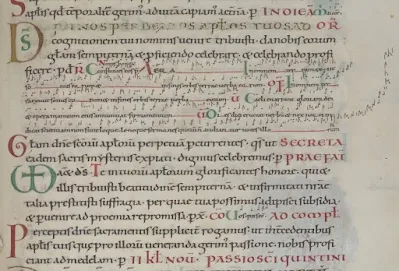
The Mass of Ss Simon and Jude in a Missal produced in the mid-11th century, and long used at the Abbey of St Denis in Paris. This manuscript represents an intermediate stage between the more ancient sacramentaries and the later medieval missals; the Gregorian propers have been integrated into the text alongside the prayers, but the Scriptural lessons have not. Note the interesting way the neume of the Communio strays into the margin. (Bibliothèque nationale de France. Département des Manuscrits. Latin 9436, folio 110r)
This prayer, extant since at least the eighth century, has been used in Masses of the Apostles (seven manuscripts) and, more frequently, specifically for Saints Simon and Jude (thirty-eight manuscripts, twenty-six of which insert Simonem et Iudam after apostolos tuos). [2] Its textual transmission is remarkably stable, with the only recorded variations being as follows:
  • two manuscripts of the seven where this prayer is used in Masses of the Apostles omit the word tuos;
  • one manuscript where this prayer is used for Saints Simon and Jude reads tui sancti nominis instead of tui nominis;
  • twelve manuscripts where this prayer is used for Saints Simon and Jude lack any specific mention of the two apostles.
These are all very minor variations. The text as it appears in the 1962 Missale Romanum also differs in one other very minor way from its source, reading agnitionem in place of cognitionem. This change seems to have been consolidated at the time of the first printed Missals. [3] It should be noted, however, that cognitionem is the better-attested and original reading. So, in the course of a reform of the liturgy that claimed to be a “restoration”, [4] one might have expected agnitionem to be adjusted back to cognitionem. Not only did this not happen, but the prayer was changed by the Consilium in a way unknown in liturgical history. 
As it appears in the 1970/2008 Missale Romanum, the Collect is as follows: 
Deus, qui nos per beátos Apóstolos 
ad agnitiónem tui nóminis veníre tribuísti, 
intercedéntibus sanctis Simóne et Iuda, 
concéde propítius, ut semper augeátur Ecclésia
increméntis in te credéntium populórum.
Far from restoring this particular oration, Coetus XVIII bis of the Consilium decided to completely rewrite the second half of the prayer in an entirely novel way, loosely based on Acts 5:14 (Magis autem augebatur credentium in Domino multitudo virorum ac mulierum…) and also adding the intercession of Saints Simon and Jude, who have been moved to slightly further on in the Collect. Curiously, the Consilium decided to omit tuos, following the Gelasianum Vetus (probably the earliest manuscript to contain this prayer), but did not restore agnitionem back to cognitionem. Like we see in many other places in the reformed Missal, the best textual witnesses have only been half-used.
More curious, perhaps, is the change to the second half of the prayer, where the striking (and rather lovely) chiastic phrase et proficiendo celebrare, et celebrando proficere has been replaced with what is, in my opinion, a substantially less striking paraphrase of Acts 5:14. This changes the Collect’s petition somewhat: in the traditional Missal we ask, in a symbiotic way cooperating with God’s grace, to be made more holy through our own participation as members of the Church in today's feast day. It is perfectly possible – indeed, in order to cultivate a proper balance between ‘private’ devotion and ‘public’ prayer, it is necessary – to interpret this petition in both an individual and corporate sense. In the reformed Missal, on the other hand, everything is subsumed into the wider Church: we ask “that the Church may constantly grow by increase of the peoples who believe in you” (2011 ICEL), but there is now little sense in the revised Collect that this actually requires anything of us as individual Christians. 
Suffice it to say, there is nothing in Sacrosanctum Concilium that justifies the Consilium’s novel changes to this well-attested and textually very stable prayer. In fact, the intention of Coetus XVIII bis, at least to begin with, was to keep the traditional Collect for today’s feast intact, along with its Secret and Postcommunion. [5] 
Schema 287, with the proposal for the unchanged propers
for Saints Simon and Jude highlighted 
Speaking of which, how did these other prayers fare in the reform? Well, the source for the 1962 Missal’s Secret prayer is as follows:
Gloriam, domine, sanctorum apostolorum
perpetuam praecurrentes,
quaesumus, ut eandem, sacris mysteriis expiati,
dignius celebremus. (CO 2711)
This prayer is extant in six manuscripts for Masses of the Apostles, and in forty manuscripts for the Mass of Saints Simon and Jude. [6] In the 1962 Missal, tuorum Simonis et Iudæ has been added (as variously in seventeen manuscripts [7]), praecurrentes has been changed to venerantes (as in twelve manuscripts), and eandem changed to eam (as in seven manuscripts). It should be noted that there is no extant textual variation in this prayer’s concluding clause, sacris mysteriis expiati, dignius celebremus.
In the reformed Missal, the first half of the super oblata is identical to the 1962 Missal, but the second half of the prayer has been changed to read ut vota nostra suscípias et ad sacra mystéria celebránda nos digne perdúcas. We now ask the Lord to “receive our prayers and lead us to worthily celebrate the sacred mysteries” (2011 ICEL), rather than asking to be “purified by these sacred mysteries”. This change, without precedent in the manuscript tradition, was made by the Consilium presumably as part of the general drive to get rid of any “anticipatory” sacrificial language from the offertory. [8]
The source for the Postcommunion in the usus antiquior is as follows:
Perceptis, domine, sacramentis, suppliciter rogamus, 
ut, intercedentibus beatis apostolis tuis, 
quae pro illorum veneranda gerimus passione, 
nobis proficiant ad medelam. (CO 4200 d)
The Corpus orationum records eight different variants of this prayer (CO 4200 a-h). The ultimate source (CO 4200 a) is the Leonine Sacramentary, where it is a postcommunion for the June feast of Saints Peter and Paul. From there, it is used quite widely for Masses of apostles generally and individually, especially Saints Andrew (CO 4200 cA, and 4200 h), and Saints Simon and Jude (CO 4200 dA). It is also attested as being used for St Benedict (CO 4200 g). The variant for Saints Simon and Jude is extant in thirty-three manuscripts, with fifteen of them adding Simone et Iuda after tuis, and six reading exoramus in place of rogamus, as the 1962 Missal also does. There is no attested variation in the end of this prayer (nobis proficiant ad medelam) when used for Saints Simon and Jude; in fact, across all its different variations and uses, this postcommunion ends with either nobis proficiant ad medelam or nobis proficiant ad salutem.
In the post-Vatican II Missal, this postcommunion now reads as follows:
Percéptis, Dómine, sacraméntis,
súpplices in Spíritu Sancto deprecámur,
ut, quæ pro apostolórum Simónis et Iudæ
veneránda gérimus passióne,
nos in tua dilectióne consérvent.
A completely new ending has been given to this prayer: nobis proficiant ad medelam from the 1962 Missal is changed to nos in tua dilectióne consérvent, a change without precedent in its entire manuscript history across its many and varied uses. I am at a loss as to why this particular change has been made; possibly medelam was considered to have ‘negative’ connotations, but this vocabulary is used elsewhere in the reformed Missal [9] (although nowhere near as often as in the 1962 Missal). The new ending could be seen as an exceptionally vague reference to Jude 21 (vosmetipsos in dilectione Dei servate, exspectantes misericordiam Domini nostri Jesu Christi in vitam æternam), though I think this is a bit of a stretch. Mention of the Holy Spirit has also been added, and the intercession of Saints Simon and Jude deleted, both further changes that are completely without precedent in the liturgical tradition.
All this means that today's feast is, sadly, yet another example of questionable, novel changes being made to long-standing prayers, as part of a claimed “restoration” of the Roman Rite that the evidence increasingly points towards being nothing of the sort. It is difficult to avoid the conclusion that what we have for today’s feast is change for change’s sake, something that cannot be justified in any way by the Second Vatican Council’s Constitution on the Sacred Liturgy (see especially n. 23: Innovationes, demum, ne fiant nisi vera et certa utilitas Ecclesiae id exigat…).
NOTES
[1] In what follows, the abbreviation CO refers to E. Moeller, J.M. Clément, B.C. ’t Wallant & L.-M. Couillaud (eds.), Corpus orationum (CCSL 160-160M; Brepols, 1992-2020, 15 vols.).
[2] There is an overlap of three manuscripts where this prayer is used in both of these ways.
[3] See, for example, the 1474 Missale Romanum Mediolani (ed. R. Lippe; HBS 17; London: Harrison & Sons, 1899), which reads agnitionem.
[4] For example, see Schema 186 (De Missali, 27), 19 September 1966, p. 2; English translation from M.P. Hazell, The Proper of Time in the Post-Vatican II Liturgical Reforms (Lectionary Study Press, 2018), pp. 220-227, at p. 222:
Permulti textus, decursu temporum, vitiati sunt.
Non agitur hic de aliquo archaeologismo, quo lectio antiquior, ipso facto melior aestimaretur. Sed quibusdam mutationibus textus antiqui, sub aspectu theologico vel pastorali, reapse imminuti vel corrupti sunt…
Placetne Patribus, ut, sensu quo modo de his locuti sumus, textus orationum recognoscatur, vel in casu, emendetur? 
[Many texts, over the course of time, have become corrupted.
There is no question here of any archeologism, where older readings are considered better by that fact alone. However, certain alterations of ancient texts, carried out for theological or pastoral reasons, are in truth impairments or corruptions…
Does it please the Fathers that, in the way indicated about which we have spoken, the text of orations is to be revised or, in certain cases, amended?]
[5] See Schema 287 (De Missali, 50), 11 April 1968, p. 35.
[6] There is an overlap of two manuscripts where this prayer is used in both ways.
[7] Five manuscripts add only tuorum, another five add only Simonis et Iudæ, and seven add both.
[9] Namely: the Postcommunion for Ash Wednesday; the Collect for Monday in Week 2 of Lent; the super oblata for the Easter Vigil; and the super oblata for Saint Luke (18 October). It also occurs in the second option for the priest’s prayer before Communion in the Order of Mass (Percéptio Córporis et Sánguinis tui, Dómine Iesu Christe…), as well as in the hymn Crux fidelis on Good Friday.

Friday, October 01, 2021

“All the Elements of the Roman Rite”? Mythbusting, Part II

Over the last decade in particular, the figure of 17% has been quoted as the proportion of prayers that survived intact from the traditional Roman Missal into the novus ordo of Paul VI. [1] However, in the wake of Traditionis custodes, with renewed attention being given to the comparison of ‘forms’ of the Roman Rite as well as the canonical and theological controversy over what counts as its lex orandi, [2] it seemed opportune to build on my previous efforts and revisit this percentage through a careful and exhaustive analysis of all the orations. By doing this, not only can we arrive at a definitive number, but we can also now have all the relevant data freely and easily accessible in the public domain, so that everyone can see which prayers were preserved, edited or discarded. [3]

The result of this work not only vindicates the labours of those such as the late Rev Fr Anthony Cekada, but it also shows the figure to be too generous. For the actual number, unbelievably, is only 13%.
Yes, a mere 13% (165) of the 1,273 prayers of the usus antiquior [4] found their way unchanged into the reformed Missal of Paul VI. Another 24.1% (307) were edited in some way before their inclusion. A further 16.2% (206) were centonised with other prayers - effectively combining parts of multiple prayers together into a new oration. Fully 52.6% (669) of the prayers in the traditional Roman Rite have been excised from the modern liturgy, memory-holed by the Consilium ad exsequendam. [5] How has this happened? And how did so few notice at the time?
Figure 1: Orations of the 1951/1962 Missal in the 1970/2008 Missal
(duplicates excluded)
Since its promulgation, the Catholic faithful have frequently been assured by popes and scholars that the post-Vatican II Missale Romanum is an enrichment, enhancement and fulfilment of the Missal that came before it. In addition, it is often claimed that the liturgical reform has faithfully preserved almost all of the preceding tradition, revising and correcting the texts of prayers on the basis of our much-improved knowledge of the sources while only introducing new prayers for modern needs. A few examples, with my emphases:
[I]t has similarly become clear that the formulas of the Roman Missal need both to be somewhat revised and also to be enriched with additions… In this restoration of the Missale Romanum, not only have the three parts We have already mentioned been changed, namely the Eucharistic Prayer, the Order of Mass, and the Order of Readings, but the others in which it consists have been revised and notably modified, that is: the Temporal, the Sanctoral, the Common of Saints, the Ritual Masses, and the Votive Masses, as they are called. Among these, particular care has been taken with the orations, which have not only been increased in number, so that new prayers respond to the new needs of these times, but also the most ancient prayers have been revised to accord with the ancient texts. [Paul VI, Apostolic Constitution Missale Romanum, 3 April 1969]
What has always been true throughout the varied and progressive development of the Roman liturgy, from the ancient sacramentaries to the revered post-Tridentine Missal of St Pius V, is true also of the new Roman Missal. While preserving the treasure of tradition, it has been rearranged and enhanced in consequence of the directives of Vatican Council II. [Jean-Marie Cardinal Villot, Letter to Bishop Carlo Rossi on the occasion of the 22nd National Liturgical Week of Italy, 30 August 1971]
What exactly is the Missal of Paul VI, if not that of St Pius V adapted, enriched, completed? If we were to engage in a line-by-line comparison, we would find in the Missal of Paul VI three-quarters if not nine-tenths of the content of the original Missal of St Pius V. [Dom Guy Oury, La Messe de S. Pie V à Paul VI (Solesmes, 1975), p. 30]
Lest there be any misunderstanding, let me add that as far as its content is concerned (apart from a few criticisms), I am very grateful for the new Missal, for the way it has enriched the treasury of prayers and prefaces, for the new eucharistic prayers and the increased number of texts for use on weekdays, etc., quite apart from the availability of the vernacular. But I do regard it as unfortunate that we have been presented with the idea of a new book rather than with that of continuity within a single liturgical history. In my view, a new edition will need to make it quite clear that the so-called Missal of Paul VI is nothing other than a renewed form of the same Missal to which Pius X, Urban VIII, Pius V and their predecessors have contributed, right from the Church’s earliest history. [Joseph Ratzinger, The Feast of Faith: Approaches to a Theology of the Liturgy (San Francisco, CA: Ignatius Press, 1986), p. 87]
The new Missal has eighty-one prefaces and sixteen hundred prayers, or more than twice as many as in the old Missal. Almost all the texts of the old Missal have been used, revised if need be to harmonize them with the reform and the teaching of Vatican II. [Annibale Bugnini, The Reform of the Liturgy 1948-1975 (Collegeville, MN: Liturgical Press, 1990), p. 398]
While at the Council’s behest further texts were to be added in order to reflect better the riches of the Church's tradition and in response to the needs of the people, and while some existing texts were to be corrected to reflect more accurately the gains of textual scholarship, the lines and substance of the missal of 1970 remain unmistakably those of 1962. The missal of 1970 is the missal of 1962, reinvigorated, enriched, and endowed with new lustre, like a precious stone whose perennial beauty is enhanced by being ensconced in a new setting. [Cuthbert Johnson & Anthony Ward (eds.), Missale Romanum anno 1962 promulgatum (Rome: Centro Liturgico Vincenziano, 1994), p. vi]
[I]t can be noted how the two Roman Missals, although four centuries have intervened, embrace one and the same tradition. Furthermore, if the inner elements of this tradition are reflected upon, it is also understood how outstandingly and felicitously the older Roman Missal is brought to fulfilment in the later one. [General Instruction of the Roman Missal, 3rd edition, 2002, n. 6]
The desire of both the Council Fathers and Saint Paul VI was that the liturgy should be simplified in order to make it more accessible. While the Missal retains the basic structure of that of Saint Pius V, together with ninety percent of the texts of that Missal, it removes a number of repetitions and accretions and simplifies the language and the gestures of the liturgy. At the same time, it uses more sacrificial vocabulary than was the case in the 1570 Missal. Opinions to the contrary are false. [Archbishop Arthur Roche, “The Roman Missal of Saint Paul VI: A witness to unchanging faith and uninterrupted tradition”, Notitiae 597 (2020), pp. 248-258, at p. 251]
Such quotations could quite easily continue to be piled up. However, for the most part, they can be summarised as follows: even if parts of it could be improved, the reformed Missal is one of the major pastoral and scholarly triumphs of the Second Vatican Council. After all, if it is a faithful enrichment of the traditional Roman Rite, preserving almost all of it yet also carefully adapting it for modern times, how could it be anything but a triumph? Indeed, in his accompanying letter to Traditionis custodes (16 July 2021), which itself claims the novus ordo is “the unique expression of the lex orandi of the Roman Rite” (art. 1), Pope Francis describes this liturgical reform as “willed by Vatican Council II”, going as far to say that:
[T]he instrumental use of Missale Romanum of 1962 is often characterized by a rejection not only of the liturgical reform, but of the Vatican Council II itself, claiming, with unfounded and unsustainable assertions, that it betrayed the Tradition and the “true Church”… To doubt the Council is to doubt the intentions of those very Fathers who exercised their collegial power in a solemn manner cum Petro et sub Petro in an ecumenical council, and, in the final analysis, to doubt the Holy Spirit himself who guides the Church… Whoever wishes to celebrate with devotion according to earlier forms of the liturgy can find in the reformed Roman Missal according to Vatican Council II all the elements of the Roman Rite
In a sense, these words of the Pope are the culmination of all the claims made about the reformed Missal – claims which, it should be noted, have rarely if ever been substantiated with any evidence. Dom Hugh Somerville-Knapman refers to this “elephant in the room” of the liturgical reform, asking the question:
[H]ow truly do the current liturgical books conform to Vatican II’s decrees? Rather than blindly accepting, in post hoc ergo propter hoc fashion, that simply because this is what the Consilium ended up producing they must necessarily express the lex orandi articulated by the Council, let this be demonstrated clearly and plainly. If Rome wants people to accept with willing heart the liturgical reform as delivered, let it demonstrate how it expresses the will of the Council. It is not self-evident.
Sadly, post-Traditionis custodes, the likelihood of the Holy See or the Roman Curia doing this is basically nil. Rather, it almost seems in some circles as if any critical examination of the reformed rites is now synonymous with the “rejection” of an ecumenical (and pastoral) Council. Those who have legitimate questions and concerns about the reform are dismissed out of hand as “radical traditionalists”, “quasi-schismatics”, “extremists”, and so forth.
Yet, as Dom Alcuin Reid has reminded us, legal positivism cannot change historical facts. An assertion that is not true cannot just be declared to be true by fiat, even if it is the Pope himself who attempts to do so.
The welcome pack given to each peritus of the Consilium
(artist’s impression)
So, are “all the elements of the Roman Rite” present in the reformed books? Faced with the statistics and data about the prayers in the reformed Missal as compared to its predecessor, it is exceptionally difficult to see how this assertion can possibly be accurate. It is, in truth, an oft-repeated myth about the reform, and one that the Church urgently needs to leave behind. [6] To reiterate:
  • 52.6% (669) of the prayers in the Missal of the usus antiquior do not occur in the Missal of Paul VI at all;
  • 24.1% (307) of them have been used somewhere in the reformed Missal, but edited in some manner - with 86 of these prayers receiving only minor edits;
  • 16.2% (206) have been ‘centonised’: this was the term used by the Consilium to refer to the combining of parts of two or more orations to create what is effectively a newly-composed prayer; [7]
  • only 13% (165) of the prayers of the usus antiquior made it through the process of reform intact.
It should also be stated that these figures, stark as they are, still do not give the full scale of the changes made by the Consilium ad exsequendam in the name of Vatican II. Even for those prayers that have been retained intact, there is often a change in where they are used in the reformed Missal. For example:
  • Br 7: previously the collect for the 23rd Sunday after Pentecost, this prayer was moved to Friday in Week 5 of Lent, as one of two options for the collect;
  • Br 154: previously the collect for the 14th Sunday after Pentecost, this prayer was also moved to a Lenten weekday - this time, Tuesday in Week 2;
  • Br 183: previously the collect for the 17th Sunday after Pentecost, it has been moved to the “Masses and Prayers for Various Needs and Occasions” section of the reformed Missal, acting as one of two options for the third formulary of the Mass “In Any Need” (n. 48);
  • Br 661: previously the collect for the 20th Sunday after Pentecost, this prayer does not occur in the first (1970) or second (1975) editions of the reformed Missal, only appearing in the third edition (2002/08) as the sixth option for the super populum prayers given in the appendix to the ordo Missae;
  • Br 893: previously the secret for the 23rd Sunday after Pentecost, this prayer was moved to the “Masses and Prayers for Various Needs and Occasions” section, becoming the super oblata for the third Mass formulary “For the Priest Himself” (n. 7), which is the one given for use on the anniversary of ordination.
For the prayers edited before their inclusion in the reformed Missal, there are some definite patterns that can be seen, some quite concerning. For example:
  • “Fasting” language is frequently removed from Lenten orations, due to the changes in discipline made by Paul VI in the wake of Vatican II: e.g. ieiunium quadragesimale (Br 143: Monday in Week 1 of Lent) becomes opus quadragesimale in the reformed prayer (used on the same day); Inchoata ieiunia (Br 643: Friday after Ash Wednesday) has been changed to Inchoata poenitentiae opera (used on the same day), etc.
  • The intercession and merits of the saints are often edited out: e.g. angelico pro nobis interveniente suffragio (Br 623: St Michael, 8 May and 29 September) is changed to angelico ministerio in conspectum tuae maiestatis delatas (Ss Michael, Gabriel & Raphael, 29 September); eius intercessione from the pre-1950 postcommunion for the Assumption of the B.V.M. (Br 676) was deleted before this prayer was used on the Vigil of the Assumption in the reformed Missal; the gloriosa merita of St Mary Magdalene (Br 697: 22 July) are omitted amidst the numerous changes to this prayer in the reformed Missal (used on the same day), etc.
  • The word anima is frequently deleted from the prayers used in Masses for the Dead: e.g. animabus patris et matris meae becomes only patri et matri meae in both the collect (Br 407) and postcommunion (Br 106) of the Mass for the priest’s parents; animabus is deleted from the collect for the first Mass on All Souls (Br 567), which the reformers also moved to the fourth formulary in the “Masses for the Dead: Various Commemorations (For Several Deceased)” section of the reformed Missal, etc.
  • Some notable changes have been made to language that could be considered “negative”, whether to eliminate it entirely or soften it in some way: e.g. in tot adversis is deleted from the collect of Monday in Holy Week (Br 192), used on the same day in the reformed Missal; quos perpetuae mortis eripuisti casibus (Br 364: 2nd Sunday after Easter) is changed to quos eripuisti a servitute peccati (14th Sunday per annum); humanis non sinas subiacere periculis, the end of the postcommunion for the 23rd Sunday after Pentecost (Br 947) now reads a te numquam separari permittas (34th Week per annum), etc.
Many more examples are highlighted in the full document. Some edits and changes can be justified when one looks at the manuscript history of the prayer, and to facilitate this research, reference numbers for the Corpus orationum have been given where possible. For example, the change from misericordiam (Br 418: 10th Sunday after Pentecost) to gratiam (26th Sunday per annum, collect) is a restoration of the Gelasianum Vetus text and, in this instance, the majority of manuscripts. However, more often than not, the changes made by the Consilium are entirely novel, with no basis in the manuscript tradition – all of the above examples of changes, for instance, are entirely without precedent!
In an address to the Consilium on 13 October 1966, Paul VI advised its members that:
No predisposition to change everything without reason must govern this investigation [into the liturgy], nor a hastiness, typical of the iconoclast, to emend and revise everything. The guides must be a devout prudence and a reverence combined with wisdom.
Had the post-conciliar liturgical reforms stayed within these bounds, perhaps we would be having very different debates and conversations in the present day. But among themselves, the periti of the Consilium were quite candid about their intentions. For example:
It is often impossible to preserve either orations that are found in the [current] Roman Missal or to borrow suitable orations from the treasury of ancient euchology. Indeed, prayer ought to express the mind of our current age... [Coetus XIII, Schema 306 (De Missali, 52), 9 September 1968, p. 7]
Revising the pre-existing text becomes more delicate when faced with a need to update content of language, and when all this affects not only the form, but also doctrinal reality. This is called for in light of the new view of human values, considered in relation to and as a way to supernatural goods. The Council clearly proposes this, and it was kept in mind when the temporal cycle was revised. It could not have been ignored in the revision of the sanctoral cycle... An entirely new foundation of eucharistic theology has superseded devotional points of view or of a particular way of venerating and invoking the saints. Retouching the text, moreover, was deemed necessary to bring to light new values and new perspectives. [Carlo Braga, “Il ‘Proprium de Sanctis’ ”, Ephemerides Liturgicae 84 (1970), pp. 401-431, at p. 419]
Suffice it to say, this is not the language of continuity, or fulfilment, or even authentic renewal. The data and statistics for the orations in each Missal - which are now possible for any interested party to easily see and compare - do not justify the assertions that the older Missal is substantially contained in the newer one; in fact, if anything, the situation is closer to the opposite.
In conclusion, if only 13% of the orations in the Missal of the traditional Roman Rite have been kept intact with more than half of them completely discarded, it does not seem possible to say in anything approaching a meaningful way that “all the elements of the Roman Rite” are present in the reformed liturgical books, let alone that the lex orandi of this rite has been properly preserved. There are a number of serious issues present and questions that need to be answered about the supposedly “irreversible” liturgical reform, and they cannot continue to be ignored. In the final analysis, as Dom Alcuin Reid reminds us:
Questioning the continuity of the modern liturgical books with liturgical tradition, and with the sound principles laid down by the Council is not denying the Council or its authority. It is, rather, to seek to defend the Council from those who distorted its stated intentions.
NOTES
[1] Rev Fr Anthony Cekada, whose 17% figure has been cited numerous times over the years, was the pioneer in this regard: see The Problems with the Prayers of the Modern Mass (Rockford, IL: TAN Books, 1991) and Work of Human Hands: A Theological Critique of the Mass of Paul VI (West Chester, OH: Philothea Press, 2010), pp. 219-245.
[2] Lists of the many and varied reactions to the motu proprio can be found here and here on NLM.
[3] It should be noted that much of the underlying work, such as compiling lists of sources, examining the prayers of each Missal side-by-side, etc., was done in the 1970s and 1980s, before the Internet, before most people had access to personal computers, and also before vital tools such as the Corpus orationum existed. We are fortunate enough to live in an age where, thanks to the work of many diligent scholars as well as huge improvements in technology, this kind of research is easier than it has ever been before!
[4] The figure of 1,273 orations has been slightly revised and corrected from my previous article. It is made up of all the prayers in the Missale Romanum as it was in 1951 (1,191), plus those orations added between 1951 and 1962 (82). Due to the Holy Week and calendar reforms of 1955 onwards, this number is not exactly representative of the 1962 Missal, but as prayers from some suppressed celebrations were repurposed in the post-Vatican II Missal, it seemed fairer to include them in the overall total. I am also defining “orations” as the collects, secrets/super oblata, postcommunions and super populum, as well as other orationes contained in the Missal (e.g. the solemn intercessions on Good Friday, those that follow the readings at the Easter and Pentecost Vigils, blessings on particular days such as Palm Sunday, Candlemas, etc.). All the prefaces, as well as hymns and sequences, are excluded from this analysis.
[5] These percentages total more than 100% because some orations are duplicated in each category. For example, Br 120 (9th Sunday after Pentecost, Secret) is preserved intact but is also used in a centonisation; Br 235 (Wednesday in Week 2 of Lent, super populum) is preserved intact and also edited for use elsewhere.
[6] In what follows, the abbreviation “Br” refers to the “Bruylants number” of a given prayer. As part of the reference system for his workLes oraisons du Missel Romain: texte et histoire (Louvain: Centre de Documentation et d’Information Liturgiques, 1952, 2 vols.), Dom Placide Bruylants arranged all the prayers of the Missale Romanum in alphabetical order, then progressively numbered them starting from 1. This reference system is still often used by scholars and liturgists. A useful online list and concordance, minus Dom Bruylants’ text-critical and source information, can be found here.
[7] For the purposes of this analysis, I have kept edited and centonised prayers in separate categories, and have made no attempt to examine centonised orations. Though centonisation would count as “using” an oration, the way in which parts of different prayers were stitched together by the reformers can be quite complicated, and deserves its own dedicated analysis in the future.

Wednesday, July 14, 2021

Mythbusting: How Much of the 1962 Missal is Actually Used in the Post-Vatican II Missal?

In a recent article in Notitiae, the new Prefect of the Congregation for Divine Worship and the Discipline of the Sacraments, Archbishop Arthur Roche, made the following claim about the textual relationship between the ‘old’ and ‘new’ Missals:

While the Missal retains the basic structure of that of Saint Pius V, together with ninety percent of the texts of that Missal, it removes a number of repetitions and accretions and simplifies the language and the gestures of the liturgy. At the same time, it uses more sacrificial vocabulary than was the case in the 1570 Missal. Opinions to the contrary are false. [1]
I will not deal here with the question of “more sacrificial vocabulary”, as this requires further detailed examination. [2] It is, rather, Archbishop Roche’s claim about the number of prayers from the 1962 Missal used in the post-Vatican II Missal that struck me as odd and, frankly, scarcely believable.
In fairness, the new Prefect is not the only one to make such a claim: no less a figure than Annibale Bugnini wrote that:
The new Missal has eighty-one prefaces and sixteen hundred prayers, or more than twice as many as in the old Missal. Almost all the texts of the old Missal have been used, revised if need be to harmonize them with the reform and the teaching of Vatican II. [3]
This assertion stuck out to me because I have recently finished my project to detail the sources of every postcommunion oration in the 2008 Missale Romanum, [4] and in the course of that work I found that only about a third of those prayers have the older Missale cited as their direct source in the various published lists. It is, however, true that some prayers where the source is given as, e.g., the Gelasianum Vetus or the Leonianum are also contained in the 1962 Missale Romanum. Some centonised prayers, i.e. those that have been composed using parts of two or more pre-existing prayers, also have the older Missal as at least one of their sources. So, to arrive at the most generous and reliable figure possible, some extra work with the source lists and the ever-helpful Corpus orationum [5] was necessary. 
Some of the tools of Coetus XVIII bis (artist's impression)
With regards to what follows:
  • “Orations” are defined as Collects, Secrets/Prayers over the Offerings, Postcommunions, Prayers over the People, and other prayers such as the Good Friday intercessions. This definition does not include anything from either Ordo Missae (aside from the twenty-eight optional Prayers over the People tucked away right at the end of the OF ordo), and also does not include any Prefaces.
  • The number of unique orations in the OF (1,606) is correct as of July 2021; I have included prayers for those celebrations added to the OF General Roman Calendar since the promulgation of the editio typica tertia emendata (2008).
  • I have calculated the number of unique orations in the EF (1,269) principally with the use of Dom Placide Bruylants, Les oraisons du Missel Romain: texte et histoire (Louvain: Centre de Documentation et d’Information Liturgiques, 1952, 2 vols.), adding in those post-1952 orations contained in the 1962 Missal. This figure is thus not quite accurate for the 1962 Missal, as it includes some feasts and Masses abolished in the 1950s, but as some prayers from these were taken up by the post-conciliar reformers it seemed better to include them in the figures.
  • The definition of “use” is as broad as possible – for instance, even if the reformers only took a small phrase from an oration found in the 1962 Missal and effectively built a newly-composed prayer around it, I have counted that 1962 oration as “used” in the post-conciliar Missal. [6] 
So, with all this in mind, are we anywhere near close to “ninety percent” or “almost all” of the prayers from the 1962 Missal being used in the post-Vatican II Missal?
No. We are, in fact, some considerable distance from that figure.
Of the 1,269 unique orations in the usus antiquior, I calculate that 613 (48.3%) of them are used in some way in the post-Vatican II Missal. 
This figure obviously starts to shrink if centonised prayers are excluded, or if a more substantial threshold is established for what constitutes the “use” of an oration. Readers who wish to examine the data in more detail can download the table using the following link:
Put in a slightly different way, and accounting for centonised prayers, 673 (41.9%) out of the 1,606 unique orations in the 2008 Missale Romanum have the older Missal as their source (or one of their sources). 
I should reiterate that these figures make no distinction between orations from the 1962 Missal that remain intact in the post-Vatican II Missal and those that were edited before their inclusion. Of the prayers from the 1962 Missal that were not changed [7] by Coetus XVIII bis, one source puts the figure of intact orations at only 17%. [8] It will take some further work to verify this figure, but at first glance it seems about right to me; the number of orations edited by Coetus XVIII bis is surprisingly high. [9] 
There are a number of seemingly pervasive myths about the reformed liturgy that, although long since shown to be without any basis in fact, still get bandied about from time to time. For instance, I still hear people say that the reformed lectionary allows ‘the whole Bible to be read in three years at Mass’, something that could only be asserted by people who have never really read the Bible. (When do they think we read the entire book of Proverbs or the entire Jewish Law at Mass, for example?) The claim of Bugnini and Archbishop Roche that “almost all” the prayers of the ‘old’ Missal are used in some way in the ‘new’ one would seem to fall into this same category of myth.
As neither of them provide a citation for their respective figures, I have no idea how this myth came to be. I find it greatly disappointing, however, that the new Prefect of the CDWDS did not bother to check what those of us familiar with both forms of the Roman Rite already knew was a dubious and highly-unlikely figure. Myths and myth-making about the liturgical reform will, ultimately, not serve us well.
NOTES
[1] Arthur Roche, “The Roman Missal of Saint Paul VI: A witness to unchanging faith and uninterrupted tradition”, Notitiae 597 (2020), pp. 248-258, at p. 251, my emphasis.
[2] I will here limit myself to the observation that this is not a question that can be answered with an appeal to raw numbers. If, for instance, the older Missal had 100 out of 1,000 prayers that contained “sacrificial vocabulary”, and the equivalent figure for the newer Missal was 120 out of 1,500 prayers, then although 120 is greater than 100 this would actually end up being a smaller proportion of the whole (8% compared to 10%). In any case, the frequency of such vocabulary and where it is contained in the respective Missals is far more important than the raw numbers.
[3] Annibale Bugnini, The Reform of the Liturgy 1948-1975 (trans. Matthew J. O’Connell; Collegeville, MN: Liturgical Press, 1990), p. 398, my emphasis.
[5] E. Moeller, J.M. Clément & B.C. ’t Wallant (eds.), Corpus Orationum (CCSL 160-160M; Brepols, 1992-2020, 15 vols.)
[6] It should be noted that Dom Antoine Dumas, one of the members of Coetus XVIII bis, did the same thing when compiling his list of sources. See “Les sources du nouveau Missal Romain (1)”, Notitiae 60 (1971), pp. 37-42, at p. 37: “Par souci de simplicité et de rapidité, on n’a pas indiqué si la source mentionnée était reproduite intégralement dans le nouveau Missal, ou bien – c’est le cas le plus fréquent – dans quelle mesure elle avait été restaurée ou adaptée. Parfois même, il ne s’agit que d’une source lointaine ou d’une citation implicite utilisée pour une composition nouvelle.”
[7] By which I mean textual changes; it should be remembered that although the text of a given oration may have remained the same, where it is used in the post-Vatican II Missal may have been changed by the Consilium.
[8] Anthony Cekada, Work of Human Hands: A Theological Critique of the Mass of Paul VI (Philothea Press, 2010), p. 244.
[9] This is something evident to anyone who has read Lauren Pristas, The Collects of the Roman Missals: A Comparative Study of the Sundays in Proper Seasons before and after the Second Vatican Council (London: Bloomsbury T&T Clark, 2013). See also my recent article "The Eastertide Collects in the Post-Vatican II Missal: A Problematic Reform".

Monday, April 12, 2021

Patricentric Purism and the Elimination of Liturgical Prayer Addressed to Christ

Thomas answered and said to Him: ‘My Lord and my God.’ Jesus saith to him: ‘Because thou hast seen Me, Thomas, thou hast believed; blessed are they that have not seen, and have believed” (John 20, 28–29).

These words from the Gospel of Low Sunday, the octave of Easter, present us with a paradox. Thomas confesses the divinity of Christ after having seen His wounds, not because wounds are divine (quite the contrary, the divine nature cannot be wounded), but because they testify that His claim to be God has been vindicated by His resurrection from the dead. In the same way, when Peter had confessed Christ to be the Son of the living God, Jesus said to him, “Blessed art thou, Simon Bar-Jona: because flesh and blood hath not revealed it to thee, but my Father who is in heaven” (Matt. 16, 17). No flesh and blood can present to us directly the divinity of Christ. We must have faith in His word. But how can we have faith in the divinity of Christ unless this revealed truth is preached to us? And where will most Christians encounter the law of their faith, if not in the law of their worship? It is therefore evident that our public worship must present to us, in a clear and unambiguous way, that Christ is “my Lord and my God,” so that even those who have not seen the wounds of the risen One may yet believe.

Readers may remember the dust-up when Bishop Rick Stika tweeted “Mass is not the worship of Jesus.” As the surrounding context showed, he seemed to be saying — in a brusque phrase that could not fail to cause much confusion in the world of sound bites — that Christian prayer is normatively understood as being directed to the Father, through the Son, in the Holy Spirit, without of course denying the deity of all three Persons. Unfortunately, as with every half-truth, it’s only half true, and the Gospel of Low Sunday is here to remind us of that.

The Arian controversy, which called into question the true divinity of Jesus Christ, provoked orthodox Christians to pray liturgically to Christ, as well as to the Father. Even if prayer would be primarily subordinational in structure, it also needed to involve parallel or coordinating doxology: Glory be to the Father and to the Son and to the Holy Spirit. He who is true God and true man is worthy of the same worship, the same adoration, the same address, as His Father and their Spirit. We see this truth displayed above all in the liturgical rites of the East. The Divine Liturgy of St. John Chrysostom offers abundant examples, of which I give only a few:

For You, O Christ, our God, are the enlightenment of our souls and bodies, and to You we render glory, together with Your eternal Father, and with Your all holy, good and life-creating Spirit, now and always, and forever and ever.
     With bowed head, I approach You and implore You, turn not Your face away from me, nor exclude me from among Your children, but allow these gifts to be offered to You by me, Your sinful and unworthy servant; for it is You, O Christ, our God, Who offer and are offered, who receive and are received, and to You we render glory, with Your eternal Father, and Your all-holy, gracious and life-giving Spirit, now and always, and forever and ever. Amen.
     Look down, O Lord Jesus Christ, our God, from Your holy dwelling place and from the throne of glory of Your kingdom, and come to sanctify us, You Who are seated on high with the Father, and dwell here invisibly among us, and deem it proper to impart to us, with Your mighty hand, Your most pure body and precious blood, and through us, to all Your people.
     Glory be to You, O Christ, our God, our Hope: Glory be to You.

Sketch of Arius at the First Council of Nicaea, by V. Surikov (1876)

Therefore, even if we may truthfully say that the primordial and fundamental mode of Christian liturgical prayer is offered ad Patrem, as extant anaphoras and orations of the first millennium show, and that, accordingly, the formula “per Christum Dominum nostrum” or any of its variations underlines Christ’s role as the Mediator between God and man, it remains no less true that Christ — indivisibly one with the Father and the Spirit — is the end as well as the means of our prayer.

The traditional Roman liturgy in its bimillenial heritage teaches this inseparable pair of truths by predominantly praying to the Father through Christ, while regularly praying to Christ as our God. The former mode should be normal, so that we internalize the Trinitarian “flow” or “rhythm” of the liturgy, which begins and ends with the Father, yet the latter mode should be frequent enough to inculcate in us a habit of worshiping Jesus and praying to Him, so that we do not lapse into some half-baked form of adoptionism or subordinationism, which appears to be rife in ecclesiastical circles: Jesus becomes the great moral teacher and example of loving your neighbor, a guru like Confucius or the Buddha, a godly man who shows us how to expend ourselves for others.

As I discuss in chapter 6 of my book Resurgent in the Midst of Crisis, “Offspring of Arius in the Holy of Holies,” one sees an unmistakably disturbing trend in the Novus Ordo Missae: the severe reduction of prayers addressed to Christ, in favor of a unilateral and almost mechanistic Patricentrism. There is a monolithic redistribution and rewriting of prayer texts such that wherever Christ had been prayed to in the traditional liturgy, we now are made to pray to the Father through Christ. (A glowing exception is the Collect for Corpus Christi, which the Consilium did not dare to modify.) In the years since I wrote that chapter, I have noticed more and more examples of the phenomenon. In what follows, I will simply look at Collects, although a similar study could be done for the Secrets and Postcommunions.

In the Feast of the Holy Family, the usus antiquior postcommunion prayer runs as follows:

Make us, O Lord Jesus, whom Thou dost refresh with Thy heavenly sacraments, constantly to imitate the example of Thy holy family, that at the hour of our death the glorious Virgin Mother and blessed Joseph may be near us, and we may be found worthy to be received by Thee into Thy eternal dwellings. Who livest and reignest... [TLM]

Compare this with its replacement:

Bring those you refresh with this heavenly sacrament, most merciful Father, to imitate constantly the example of the holy family, so that, after the trials of this world, we may share their company for ever. Through Christ our Lord... [NOM]

The old prayer fittingly addresses Jesus, the God-man at the center of the holy family (it is, after all, His holy family — it subsists by Him and exists for Him), and the One whose sacrament we have just received, bringing us right into the midst, mystically, of that same family (“Thy family”). It then with Christian realism talks about the hour of death and asks that Mary and Joseph be by our side, at our deathbed, ready to receive us into their eternal dwelling, for which we ask to be found worthy.

A picture-perfect example of how a good idea can be diluted, the new prayer — in keeping with a mechanical insistence on always addressing the first person of the Trinity (because “it’s more ancient”) — comes across as awkward: we ask God the Father to bring us to imitate the example of the holy family so that we may share their company for ever. It’s less intimate, more procedural, and notably makes no explicit mention of death (too scary!), or of Joseph and Mary being by our side at that greatest moment of our life. The worthiness bit is also gone. Obviously have much in common, but the new one is like running the old one through a reverse osmosis filter and removing the tasty minerals.

Another comparison: February 22, the Chair of St. Peter (in olden days, the Chair of St. Peter at Antioch; the old missal uses the same collect for January 18 and February 22).

O God, who, upon blessed Peter, Thine Apostle, didst bestow the pontifical power of binding and loosing, and didst give to him the keys of the kingdom of heaven: grant that his intercession may ensure our deliverance from the bondage of sin. Who livest and reignest with God the Father… [TLM]

Grant, we pray, almighty God, that no tempests may disturb us, for you have set us fast on the rock of the Apostle Peter’s confession of faith. Through our Lord Jesus Christ… [NOM] 

We could do a similar analysis of the interesting conceptual shift that has taken place here, but it would take us away from the main point we are illustrating, namely, whether the prayer is addressed to Christ when it is fitting to do so given the feast or the mystery, or whether it has been forcibly conformed to the subordinational model, even if this results in a prayer of considerably less theological impact or poetic quality.

June 22, St Paulinus of Nola:

O God, Who hast promised to those who leave all in this world for Thee a hundredfold in the world to come and life everlasting, mercifully grant that, following closely in the footsteps of the holy bishop, Paulinus, we may have the grace to despise earthly things and desire only those fromheaven. Who livest and reignest. [TLM]
O God, who made the Bishop Saint Paulinus of Nola outstanding for love of poverty and for pastoral care, graciously grant that, as we celebrate his merits, we may imitate the example of his charity. Through our Lord Jesus Christ… [NOM]

 September 15, the Seven Sorrows of the Blessed Virgin Mary:

O God, at Whose Passion, according to the prophecy of Simeon, a sword of sorrow pierced the most sweet soul of the glorious Virgin and Mother Mary: mercifully grant, that we who with devotion honour her Sorrows, may obtain the happy fruit of Thy Passion: Who livest and reignest. [TLM]

O God, who willed that, when your Son was lifted high on the Cross, his Mother should stand close by and share his suffering, grant that your Church, participating with the Virgin Mary in the Passion of Christ, may merit a share in his Resurrection. Who lives and reigns with you… [NOM] 

October 3, St Thérèse of the Child Jesus:

O Lord, Who hast said: Unless ye become as little children, ye shall not enter into the kingdom of Heaven, grant unto us, we beseech Thee, so to follow the footsteps of Saint Teresa, the Virgin, in lowliness and simplicity of heart that we may gain everlasting rewards: Who livest and reignest. [TLM]
O God, who open your Kingdom to those who are humble and to little ones, lead us to follow trustingly in the little way of Saint Thérèse, so that through her intercession we may see your eternal glory revealed. Through our Lord Jesus Christ… [NOM]

October 16, St Hedwig, Widow:

O God, Who didst teach blessed Hedwig to leave the pomp of the world for the humble following of Thy cross: grant that, through her merits and intercession, we may learn to trample under foot the perishable delights of the world and in the embrace of Thy cross to overcome all things that oppose us. Who livest and reignest… [TLM]

Grant, we pray, almighty God, that the revered intercession of Saint Hedwig may bring us heavenly aid, just as her wonderful life is an example of humility for all. Through our Lord Jesus Christ… [NOM]

October 17, St Margaret Mary Alacoque:

Lord Jesus Christ, Who didst reveal the unsearchable riches of Thy Heart to blessed Margaret, the Virgin, grant us, by her merits and our imitation of her that, loving Thee in all things and above all things, we may deserve to have our continual abode in that same Heart of Thine. Who livest and reignest… [TLM]

Pour out on us, we pray, O Lord, the spirit with which you so remarkably endowed Saint Margaret Mary, so that we may come to know that love of Christ which surpasses all understanding and be utterly filled with your fullness. Through our Lord Jesus Christ… [NOM]

An architectural metaphor: the new, uniform, and ugly covers up the old, irregular, and beautiful.

Then, we have a whole host of feasts with Christ-oriented orations that were simply abolished in the revision of the calendar in 1969, so their prayers were de facto lost to the lex orandi of the reformed liturgy, and thus whatever value they had in terms of the lex credendi was likewise lost. The overall result is a gaping hole in the reformed liturgy where once there had been a vital undercurrent of devotion — a hole of which no one becomes aware unless he plunges himself into the older liturgical tradition, which, on this matter as on so many others, is richer and more variegated, like a mineral water that has a more subtle flavor because it has passed through more layers of rock on its way to the spring. Here are several examples of Collects prayed in from Masses of the old sanctoral cycle but no longer existing in Paul VI’s calendar or missal:

February 12, Seven Holy Founders of the Servite Order:

O Lord Jesus Christ Who, in order to renew the memory of the sorrows of Thy most holy Mother, hast through the seven blessed fathers enriched Thy Church with the new Order of Servites; mercifully grant that we may be so united in their sorrows as to share in their joys: Who livest and reignest.

February 27, St Gabriel of Our Lady of Sorrows:

O God, Who didst teach blessed Gabriel diligently to ponder the sorrows of Thy most sweet Mother, and Who hast gloriously exalted him as a saint and worker of wonders: vouchsafe to be moved by his merits and prayers, and to grant unto us so to mourn with Mary Thy Mother, that her maternal care may ensure our salvation: Who livest and reignest.

March 24, St Gabriel Archangel:

O God, Who from among all the Angels, didst choose the Archangel Gabriel to announce the mystery of Thine Incarnation: grant in Thy mercy that celebrating his feast on earth we may reap the effect of his protection in Heaven. Who livest and reignest.

April 28, St Paul of the Cross:

O Lord Jesus Christ, Who didst endow St. Paul with exceeding charity to preach the mystery of the Cross, and didst will that through him a new family should spring up in Thy Church, grant us, by his intercession, that, constantly venerating Thy passion on earth, we may be worthy to partake of its fruits in heaven. Who livest and reignest.

May 3, the Finding of the Holy Cross (pre-1962):

O God, who in the glorious Finding of the salutiferous Cross didst stir up anew the wonders of Thy Passion: grant us by the price of this living wood to win the palm of eternal life. Who livest...

September 17, the Impression of the Stigmata of St Francis:

Lord Jesus Christ, Who, when the world was growing cold, didst renew the sacred marks of Thy passion in the flesh of the most blessed Francis, to inflame our hearts with the fire of Thy love, graciously grant that by his merits and prayers we may continually bear the cross and bring forth fruits worthy of penance. Who livest and reignest.

October 10, St Francis Borgia:

O Lord Jesus Christ, Who art the pattern of true humility and its reward, we beseech Thee, that, as Thou didst make blessed Francis Thy glorious imitator in contempt of earthly honours, so Thou wouldst grant us to share his imitation and his glory: Who livest and reignest.

There are a number of other Collects addressed to the Second Person of the Blessed Trinity — e.g., March 19, St Joseph; the older feast of St Joseph on the third Wednesday after Easter; May 17, St Paschal Baylon; May 20, St Bernardine of Siena; July 6, the octave of SS Peter and Paul; July 16, Our Lady of Mount Carmel; July 22, St Mary Magdalen; August 14, the vigil of the Assumption; August 29, the beheading of John the Baptist; and several of the Collects for November 2, the Commemoration of All Souls.

Nevertheless, I would not wish to give the wrong impression. The vast majority of orations in the Missal of the usus antiquior are still addressed to God the Father, through Jesus Christ, in the Holy Spirit. The classical Patricentric orientation of prayer is never lost sight of, never marginalized or submerged. It is the familiar recurring norm. However, the Christocentric orations are sufficiently frequent — and striking in tone — to stave off the opposite problem, namely, a loss or marginalizing of liturgical prayer directed to Christ our God, which is much less common in the Western tradition than in the Eastern, and therefore deserves all the more protection. Such prayers create, as it were, a gentle cross-rhythm to the predominant accent, and this, indeed, is how prayer is enriched, diversified, and balanced on itself, so as to reflect the Father-Son polarity of the Trinitarian mystery. “The Father is greater than I” (John 14, 28); “I and the Father are one” (John 10, 30); “Unless you believe that I AM, you shall die in your sins” (John 8, 24).

To return to my opening paragraph, it seems obvious that if Catholics were accustomed to hearing or seeing prayers like the ones given above, they would imbibe the message that Christ is our God; after all, we pray to Him as such, just as we pray to the Father (and, it may be added, to the Holy Spirit from time to time: Veni, Creator Spiritus; Veni, Sancte Spiritus…). It is also likely that if Catholics never or only very rarely hear such a mode of praying in the liturgy, the semi-Arian miasma in which moderns have been groping since roughly the Enlightenment will have an easier time claiming them for its own.

Gebhard Fugel, Herz-Jesu-Darstellung, ca. 1930:
the angels are offering prayers to Christ as God

More recent articles:

For more articles, see the NLM archives: