Tuesday, November 28, 2023

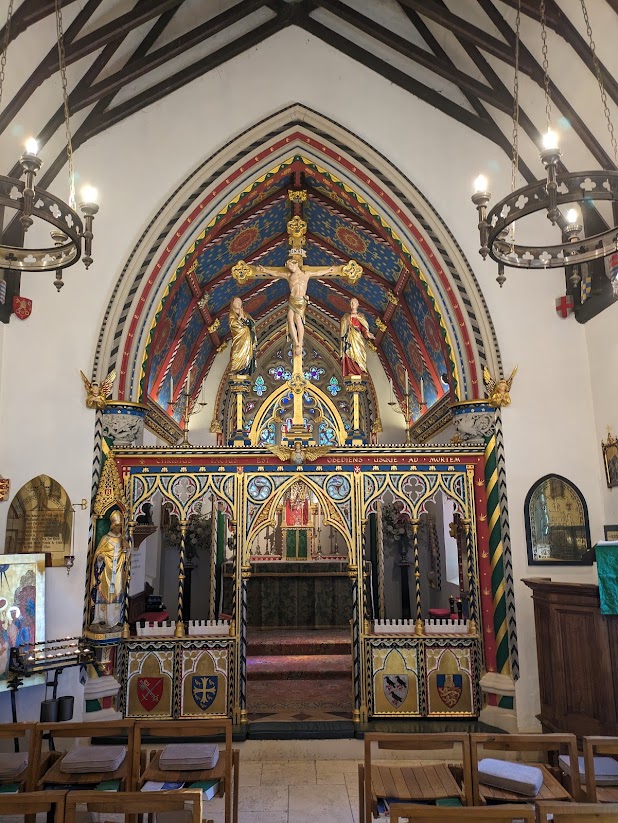
St Birinus Church, Dorchester-on-Thames, Oxfordshire

St Birinus Catholic Church is a tiny architectural jewel set in beautiful English countryside, 15 miles from Oxford, on the banks of the River Thame. The Traditional Latin Mass is celebrated there every Sunday. The choir is exceptional, the art is spectacular, and all works in harmony in a Victorian-era church that was so obviously created to house beautiful liturgy. It is a glimpse of what England might still have been if it hadn’t been for Henry VIII, and an indication of what, despite everything, it might again.

The wall painting was done by a parishioner. Under the guidance of the parish priest, Fr John Osman, this church and parish have become a beacon of light - beautiful art, architecture, and music. It shows what can be done with good taste and conviction.

Press your parish priest to commission work from the artists at the Chichester Workshop of Liturgical Art. Martin Earle, for example, could paint, mosaic, fresco the church and do all the carpentry to build the rood screen. 
St Birinus, by the way, is a little known early saint responsible for the conversion of England in the 7th century. 
Also, it is not a spelling mistake, the confluence of the rivers Thame and Isis occurs just a quarter of a mile away to form the river 'Thame-Isis' otherwise known as the River Thames.

Wednesday, September 01, 2021

Two Medieval Choir Screens

Here is a really enjoyable presentation about two medieval choir screens, one of the early 13th century at the abbey of St Mary in Vezzolano, in the northern Italian Piedmont region, the other of the later 15th century at the church of St Stephen in Breisach am Rhein, Germany. The narrator, Prof. Jacqueline Jung of Yale University, does a really marvelous job of explaining how the faithful would have interacted with the rood screens as part of the whole church, and how the screens themselves interact with the arrangement and decorations of the rest of the building. (h/t to reader Richard Seto for bringing this to my attention.)

Friday, May 22, 2020

A Dutch Renaissance Rood-Screen

One of the highlights of last summer’s pilgrimage to England with the Schola Sainte Cécile for me was a visit to the Victoria and Albert Museum, which among its many collections has a wonderful and very large section dedicated to Medieval and Renaissance art and liturgical objects. One of the most notable items is this rood-screen, which was originally installed in the cathedral of St John in ’s-Hertogenbosch, the Netherlands.
This city, whose name means “the Duke’s Forest”, was part of the diocese of Liège from its founding in 1184 until 1559, when it was made an independent see, partly to counter the rising tide of Protestantism; a collegiate church dedicated to St John the Evangelist was then chosen as the cathedral. In 1566, however, the Netherlands were hit with the Beeldenstorm (“image storm”), a ferocious wave of Calvinist iconoclasm that led to the destruction of countless religious images throughout the region. The newly elevated cathedral of St John was attacked, and the rood screen badly damaged. Starting in 1600, and continuing until 1613, an artist named Conrad van Norenberch and his workshop installed a new screen of Belgian black marble, decorated with several alabaster statues.
Unfortunately, only 16 years later, ’s-Hertogenbosch was taken by Protestant forces; Catholic worship was officially suppressed, and the church turned over to a congregation of the reformed faith, but despite its iconographic program, which is thoroughly in line with the Counter-Reformation, the screen was left mostly undamaged. (Some of the figures in the smaller relief panels were decapitated.) The region remained predominantly Catholic, with the people attending secret churches, until the post-Napoleonic period, when the Calvinist religion was disestablished, and Catholic services openly permitted once again; the church was restored to Catholic worship in 1816. By 1860, the building, long neglected by the Protestants, was badly in need of a restoration, which was done in the neo-Gothic style. At this point, the screen, which blocked the view of the sanctuary, and clashed with the style of the restoration, was sold to an English art dealer named Murray Marks, who in turn sold it to the V&A in 1871.
The statuary program is as follows.
1. Upper left: a female figure bearing a shield, on which were formerly visible the arms of Brabant, the region which includes ’s-Hertogenbosch. (The shields are now blank, but their program is known from the surviving contract between the church and the artist.)
2. Lower left: St Peter
3. Above the arch: Faith, with reliefs of the Wedding at Cana and the Feeding of the Five Thousand to either side.
4. Upper right: a female figure bearing a shield, on which were formerly visible the arms of Godfrey III, Duke of Brabant.
5. The Virgin Mary holding the Christ Child.
6. Inside the lower part of the screen, Justice.
7. Over the central arch: Charity, with reliefs of the Transfiguration and the Betrayal of Christ to either side of her.
8. Upper left: a female figure bearing a shield, on which were formerly visible the arms of Albert of Austria (1559-1621) and Isabella of Spain (1566–1633), the Habsburg rulers of the Spanish Netherlands at the time the screen was built.
9. Lower left: St John the Evangelist, the Patron Saint of the church. According to the website of the V&A, this was done in part by a well-known artist from Amsterdam named Hendrik de Keyser, who was himself a Protestant, and under the patronage of his native city. However, the Protestant religious authorities ordered him to stop working on it, and it was finished in van Norenberch’s workshop.
10. Above the arch: Hope, with the Ecce Homo scene and the Crucifixion to either side.
11. Upper right: a wild-man bearing a shield, on which were formerly visible the arms of ’s-Hertogenbosch.
12. St Paul
13. Inside the lower part of the screen, Peace.
A view of the screen from a distance...
...and from behind.

Friday, April 26, 2019

Two Designs for Notre-Dame de Paris

In the wake of the fire which damaged Notre-Dame de Paris last week, and the subsequent discussion of proposals for its restoration, this drawing has appeared several times on social media.

This comes from the pen of Eugène Viollet-le-Duc (1814-79), who dedicated many years of his life to restoring Notre-Dame after the tremendous damage inflicted on it during the French Revolution, and in the many years of political and social turbulence that followed. It is supposed to represent his ideal way of completing the church, if he had had an unlimited budget; I have seen a few people comment on their relief that he didn’t. Here is another rendering of the same idea, apparently based on the cathedral of Rheims.

While we are on the subject, it should be remembered that well before the Revolution, in the 17th-century, French churches underwent a first wave of vandalism with the destruction of countless rood screens. Here is a drawing of what the sanctuary area of Notre-Dame de Paris looked like before its was taken down at the beginning of the 18th century. Note the two circular structures with staircases inside them at the bottom left and right; these were used to reach the ambos on top of the screen, one in the middle of each side, from which the Epistle and Gospel were sung. (Our friends at Canticum Salomonis published some translations of a interesting treatise in defense of rood screens by Fr Jean-Baptiste Thiers, originally written in 1688.)

Tuesday, November 01, 2016

Postscript - the Anglican Restoration of Medieval Rood Screens

After my last post about rood screens, I was contacted by reader Dr Simon Cotton from England, who wrote as follows:
The Norfolk screen shown in your interesting article is that at Tunstead. For a selection of pictures (not mine), including the saints on the screen, see here.
We know when the screen was made and also when it was painted. Over 35 years ago I turned up a series of late 15th century Norfolk wills containing bequests to this; it was called ‘new’ in a will of 1470, and money was left for its painting between 1474 and 1490.
By the way, no mediaeval rood groups survive in situ in English (or Welsh or Scottish) churches. Any you see today are replacements between the late 19th century and c. 1960 (when they became vieux jeu to church architects). I’ve attached a jpeg of Comper’s [Sir Ninian Comper] restored rood group (c. 1930) to the mediaeval screen (substantially its original colouring and gilding) at Eye in Suffolk. Comper also provided the canopy of honour, in the mediaeval style.
Here are two articles, written in 1987 and 2014, for archeological publications in which he describes the sources for our knowledge on the rood screens. It is interesting to me that so many were made from money left in bequests.

And once again, whether its cathedrals, railway stations, rood screens, telephone boxes, or a charming English village in its familiar pastoral setting, we see that so much that is good in the world has come from the inspiration of the liturgical forms of High Anglicanism. How much more powerful it will be, with the Real Presence at its heart, when the Anglican Ordinariate develops its own cultural voice rooted in its Catholic liturgy.

Some readers pointed out that the medieval screens would probably have had curtains. I’m guessing that the extremely ornately carved High Anglican screens would not have done. I don’t feel they are lacking anything for this. The ornate, almost filigree carving that you see on the screens creates a general image of a gossamer like veil before the altar which I personally find appropriate and appealing.

The final photograph is of a high altar and reredos, also by Sir Ninian Comper at Wymondham Abbey in Norfolk (added by me!).


Tuesday, October 25, 2016

Iconostasis, Rood Screen, Communion Rail...or Shag-Pile Carpeted Step?

The nature of the dividing line between sanctuary and nave in a church has been a hot topic over the years. I raise the subject today not to spill yet more ink in complaining about the removal of altar rails in churches over the last 50 years or so, although it is something I do feel strongly about. Rather, I am interested in trying to establish how, with due regard for tradition, we might encourage in the Roman Rite a renewed engagement with art in the liturgy, in the such a way that it deepens our participation, rather than distracts from it.

One thing that always strikes me when I go to an Eastern Rite Catholic Church, (recently I have been attending St Elias Melkite Church in Los Gatos, California,) is how much more naturally priest, deacon, cantor and congregation engage with the icons during the liturgy. In contrast, in the Roman Rite, even in traditional congregations, apart from perhaps the crucifix and altarpiece, the choice of art seems to be governed more by the priest’s personal devotion than liturgical considerations, and there appears to be very little engagement with it during the liturgy itself. At best, sacred art provides a decorative backdrop that helps set an appropriate mood for the worship of God with direct engagement in the liturgy itself, which is largely a hands-clasped and eyes-closed activity.

First a quick presentation of different options available to us.

According to my research, the original division in both East and West was more like today’s altar rail, with gaps or doors for processing. The typical “transenna” might have looked as this one at Sant’ Apollinarre in Ravenna, which I understand was restored in the 20th century.

Another example from the 12th century, at San Clemente in Rome, which seems to follow the early traditional style.
In time, from perhaps the 9th century onwards, the transenna grew upwards into a screen, as in this 9th century example from Santa Maria in Cosmedin in Rome.
Gradually, we see images being added, as in the Byzantine-Venetian Torcello Cathedral, built in the 7th century, but restored in the 9th and 11th centuries.
This then developed into the Western rood screen, “rood” being an old English word for the cross. The example below is a 15th century screen from Cornwall in England.
The lower portion would originally have had images in it, as in this example below from Norfolk. (The cross is now missing.)

Thursday, September 02, 2010

A New Blog on Spanish Liturgical Tradition and a Fantastic Spanish Rood Screen


“Inter vestibulum et altare” is the title of a new blog on Spanish liturgical tradition which I would like to bring to your attention. The blog is connected to the excellent Spanish forum Ceremonia y rúbrica de la Iglesia española which I have mentioned several times (cf. here, here, or most recently here). The aim of this forum is to collect and preserve in memory the old ceremonies and liturgical as well as paraliturgical customs of Spain and the Hispanic world, the particularities of Spanish ecclesiastical vesture, sacred music, vestments, vessels and church furniture etc. etc. With the collaboration of many - among whom a special recognition is due to the inexhaustible fountain of knowledge that is the venerable priest Monsignor Martínez de Irujo - this forum, in its barely one and a half years of existence, has become an invaluable treasure trove (there are 673 topics being discussed with over 15,000 posts) safeguarding the knowledge of Spain's liturgical heritage while it is still there. A similar effort would be highly desirable in other languages and cultures, too; my hope is that this may serve as an inspiration. Whereas the collection of information and images in the forum is impressive, it is - in its intricate structure, and given the nature of the different topics, which are discussions, where different ideas are being aired, only partial aspects added by different persons, and a general image only slowly emerges - not easily accessible. Hence the new blog, which is written by the founder of the forum, my friend Pablo Pomar Rodil, to whom great thanks are owed for both these inestimable efforts, intends to present the fruit of these discussions in a filtered, condensed and easily accessible, yet as far as possible exhausting fashion, treating one item at a time, beginning with the alb.


The title of the blog is taken from Joel 2:17: "Between the porch and the altar the priests the Lord's ministers shall weep, and shall say: Spare, O Lord, spare thy people: and give not thy inheritance to reproach, that the heathen should rule over them." This verse - which in the usus antiquior is also one of the two antiphons sung while the blessed ashes are sprinkled on Ash Wednesday - was chosen because it was used in Spain to defend the traditonal arrangement of the choir - in the middle of the nave - against the posttridentine model proposed by St. Charles, and is thus emblematic for the purpose of the blog, to preserve, at least in memory, the particularly hispanic identity of the Latin Rite in Spain. To illustrate this, a striking trascoro was chosen, which you can see at the top of this post. The trascoro is the backside of the choir in the middle of the nave and thus the Spanish variant of the English rood screen, German lettner, and French jubé. For some more examples from Spanish cathedrals, go to the respective entry on Ceremonia y rúbrica de la Iglesia española here.


The particular trascoro pictured above is from the Spanish monastery of San Millán de Yuso, which together with its predecessor San Millán de Suso (yuso=deorsum=below; suso=sursum=above), has been designated a World Heritage Site by UNESCO, and preserves great treasures such as Romanesque ebony carvings or its medieval chant books. The monastery was originally a Benedictine monastery founded by Saint Emilian (San Millán) in the 5th c. The Benedictines were finally driven out at the Ecclesiastical Confiscations of Mendizábal in 1835, but the house was reinhabited by the Augustinian Recollects in 1878 who remain there until today. Have a closer look at the monastery here.

Monday, April 27, 2009

Potentialities of the Rood Screen Today

Yesterday's "Good Shepherd Sunday" consideration of some Roman mosaics may have, by happenstance, also given you the opportunity to give some consideration to the architectural feature of the ciborium over top the altar -- an oft promoted architectural feature here upon the NLM -- since all but one of those venerable churches and basilicas included this element.

We are fortunate to slowly see ciboria re-appearing today in some projects -- though it is to be hoped that we will likewise begin to see it appear, not only in larger-scale church building projects, but also in those of a smaller scale, as well as a consideration for parish renovations where it would be suitable and reachable.

As has been noted numerous times before, in an age of free-standing altars, the ciborium is one particularly suitable way to lend presence and verticality to our altars -- something the high altar should have, and something which has often been lost in newer or renovated church buildings. (For more on this theme, cf. this article)

This inspired a further consideration of yet another architectural feature that we haven't spoken upon for awhile, but which would also be well deserving of continued architectural expression: the rood and rood screen.

I believe the rood screen has the potential to be used to great effect in our present liturgical circumstances -- though evidently, considerations of the particularities of an individual sanctuary need to be considered. A rood screen can have rather the same effect in relation to the altar that the ciborium or reredos have; namely, it frames the altar and draws the eye toward it as a central focal point within the church (and that it also draws attention further to Our Lord upon the Cross is a manifest benefit, particularly in view of the need today to re-emphasize both the sacrificial dimensions of the liturgy of the Mass, and the point that we are "turned toward the Lord" as our focus in the same.) It seems to me the rood screen could be effectively used in combination with a free-standing altar to great effect. (In fact, the clear delineation of the altar and sanctuary by a rood screen might even be thought to have a similar "canopying" like effect that the ciborium visually has, insofar as it delineates that space and the altar within it.)

I should note that in such an instance, I would propose that the altar would ideally be well-vested with a dignified antependium (which further draws attention to the altar itself), appointed with tall candlesticks, candles and altar cross appropriate to the proportions of the altar, screen and church -- and in visual continuity with the same; and the altar should be up upon a step (predella) to separate it from the rest of the sanctuary.

Behind the altar, one could still employ some sort of wall-mounted triptych if further detail was needed, or other ornamental sacred arts -- not to mention a tabernacle or hanging pyx and so on. The options are various and would have to be looked at on a case by case basis, but it seems to me to be a possible option that heretofore may not have been considered in parish construction or renovation.

With that, I'd like to offer for your consideration some beautiful images of rood screen which may help to foster this consideration.


(Pugin's Rood at St. Giles, Cheadle)


(Detail: Pugin's Rood at St. Giles, Cheadle)


We cannot show rood screens without making reference to our own Brother Lawrence Lew, who has captured numerous stunning photographs of such.


(The Rood -- from behind -- at Pusey House in Oxford.)


(The Rood at St. Birinius, Dorchester-on-Thames)


Finally a couple of images from St. Mary's church in Bruton, Somerset, England (courtesy of this site).


(Detail of Rood)

More recent articles:

For more articles, see the NLM archives:



