Friday, March 06, 2026

The Ambrosian Lenten Litanies

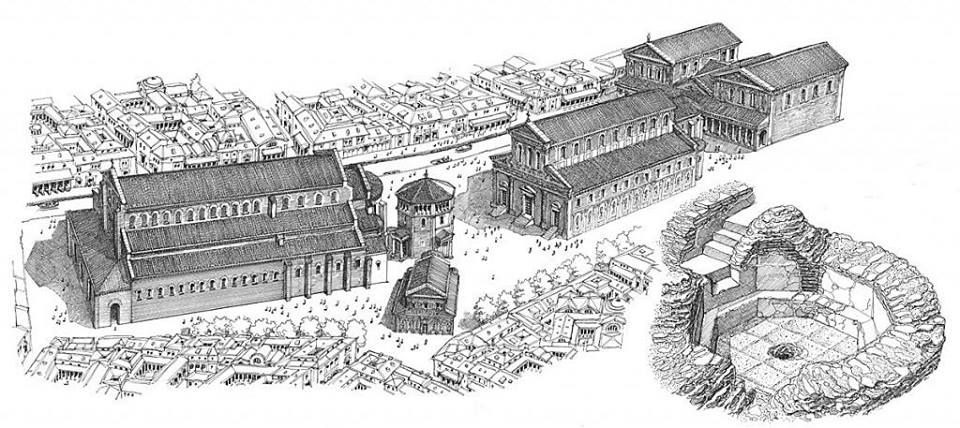
The duomo of Milan as it stands today is the result of a project which began in 1386, to replace the two cathedrals which had hitherto served the see of St Ambrose. The “winter church”, as it is still called in Ambrosian liturgical books, was the smaller of the two, dedicated to the Virgin Mary, and used from the Third Sunday of October, the feast of its Dedication, until Holy Saturday; it stood where the modern cathedral stands, but was nowhere near as large. The larger “summer church”, which was demolished in 1543, stood on the opposite end of the modern Piazza del Duomo, and was dedicated to St. Thecla, for which reason her name is included in the Canon of the Ambrosian Mass.

A reconstruction of the cathedral complex of Milan, with the summer church of St Thecla on the left, and the winter church of the Virgin Mary at the right. The octagonal structure in front of St Thecla is the baptistery of St John; the smaller structure beneath it is the baptistery of St Stephen. At the lower right is a partial reconstruction of the interior of the baptistery of St John.
The Ambrosian Rite has several customs which were designed around this arrangement, one of which is a special set of litanies said after Terce on Wednesdays and Fridays of Lent. These litanies have the same structure as those of the Greater and Lesser Rogations: an opening collect; a series of processional antiphons; a litany of the Saints; another collect; another set of antiphons; and then the same concluding formula. On these Lenten ferias, the first set of antiphons was sung as the clergy processed from the winter church over to the summer one, where the litany of the Saints was said as they knelt before the altar; the second set was sung as they returned to the winter church. The proper texts of these litanies vary from day to day, as do the number of antiphons within each set; here are the texts for today, the Friday of the Second Week of Lent. Until 1913, the Ambrosian clergy were required to say these as part of their Office, just as Roman clergy are required to say the Litany of the Saints on the Rogation days, so they are printed in the breviary. This picture is taken from the first post-Tridentine edition of the Ambrosian breviary, printed by authorization of St Charles in 1582. (Click to enlarge and read the Latin text.)

The opening collect: Be present, Lord, to our supplications, and with Thy heavenly aid, through the intercession of all Thy Saints, kindly protect those who hope in Thy mercy. Through our Lord...

Antiphon I In Thee, o Lord, do we hope, let us not be confounded forever; in Thy justice deliver us, and rescue us, that we may not perish.
Antiphon II Lord, for the multitude of our sins, we are not worthy to look upon the height of heaven: destroy us not unto the end with our sins.
Antiphon III Lord, if Thou shalt be wroth against us, what helper shall we find, or who will have mercy upon our infirmities? Thou didst call the woman of Chanaan and the Publican to repentance, and receive Peter as he wept; receive also our repentance, o Merciful One, and save us, o Savior of the world.
Antiphon IV With Thy unassailable wall surround us, o Lord; and with the arms of Thy might protect us always; deliver, o God, of Israel, those who cry out to Thee.
Antiphon V Hear, o Lord, the voices of Thy servants that cry to Thee, and say, ‘Lord, have mercy on us!’, and with the arms of Thy might protect us always; deliver, o God, of Israel, those who cry out to Thee.
Each version of the litany of the Saints is introduced by three Kyrie, eleisons, three repetitions of “Domine, miserere – Lord, have mercy”, three of “Christe, libera nos - Christ, deliver us”, and three of “Salvator, libera nos – o Savior, deliver us.” The names of the Saints are then sung by the cantors, to which all others answer, repeating the names and adding “intercede pro nobis.” (“Sancta Maria. – Sancta Maria, intercede pro nobis.”) In the Roman Rite, the list of the Saints is always the same, although local Saints may be added by immemorial custom; in the Ambrosian Rite, the Saints named in the litany change from one occasion to another.
St Ambrose, 1465-70, by the Sienese painter Giovanni di Paolo (1403 ca - 1482) 
On this day, after the Virgin Mary, the three Archangels are named, followed by St John the Baptist as the last prophet, and St Joseph as the last patriarch; the Apostles Peter, Paul, Andrew, Thomas and Barnabas, whose is traditionally said to be the founder of the see of Milan and its first bishop; the protomartyr Stephen, followed by the local martyrs Nazarius and Celsus, Protasius and Gervasius, Victor, Nabor and Felix, then two Easterners, George and Theodore (both soldiers, as were the three named before them); Faustinus and Jovita, the patrons of nearby Brescia, and Aquilinus; the virgin martyrs Thecla, Agnes and Pelegia; then Galdinus, Charles Borromeo, and Ambrose, who always conclude the litanies in the Ambrosian Rite. The litany ends with three repetitions of “Exaudi, Christe. R. Voces nostras. Exaudi, Deus. R. Et miserere nobis.”, (Hear, o Christ, our voices. Hear o God, and have mercy on us.), and three Kyrie eleisons.
The second collect: O God, who causest all things to benefit those who love Thee; grant to our hearts a disposition of inviolable charity; that desires conceived from Thine inspiration may not be able to be changed by any temptation. Through our Lord...
The processional antiphons for the return to the winter church.
Antiphon I We have sinned, o Lord, we have sinned: spare our sins and save us. Thou who governed Noah upon the waves of the flood, save us, and Thou who called Jonah back from the depth with a word, deliver us. Thou who stretched for Thy hand to Peter as he sank, come to our aid, o Christ, son of God.
Antiphon II Let Thy right hand lift us up straight, whom the weight of sins boweth down, et because we have fallen to the earth, may we be lifted up o Lord, by Thy mercy.
Antiphon III Lord, incline Thine ear and hear us; look down from heaven, and hear out groaning, and deliver us, o Lord, from the hand of death.
The litany concludes with the following formula each day:

Kyrie, eleison (six times)
V. Agnus Dei, qui tollis peccata mundi, miserere nobis.
R. Gloria Patri. Sicut erat.
V. Agnus Dei, qui tollis peccata mundi, miserere nobis.
R. Sucipe deprecationem nostram, qui sedes ad dexteram Patris.
V. Agnus Dei, qui tollis peccata mundi, miserere nobis.
R. Kyrie, eleison. Kyrie, eleison. Kyrie, eleison.
R. Benedicamus Domino. R. Fidelium animae.

Sunday, May 11, 2025

A Litany for the New Pope

With our new pope, Leo XIV, we might consider praying this beautiful litany originating from Silverstream Priory, invoking every canonized or beatified pope in the history of the Church. The Litany is divided up according to days, with repeated opening and closing sections.

(At the bottom of this post is a 4-page printed version, if anyone prefers that form instead.)

A Litany of Holy Popes

Lord, have mercy upon us. R/ Lord, have mercy upon us.
Christ, have mercy upon us. R/ Christ, have mercy upon us.
Lord, have mercy upon us. R/ Lord, have mercy upon us.
Christ, hear us. R/ O Christ, hear us.
O Christ, graciously hear us. R/ O Christ, graciously hear us.

O God the Father, of whom all Fatherhood is named,
R/ Have mercy upon us.
O God the Son, Shepherd and Bishop of the souls of men,...
O God the Holy Ghost, strong Defender of Christ's Flock....
O holy Trinity, one God, R/ Have mercy upon us.

Holy Mary, Mother of the Church,
R/ Pray for him.
Holy Mary, Health of the Roman People,
R/ Pray for him.
Holy Mary, conceived immaculate and assumed into heaven.
R/ Pray for him.

Saint Peter, son of Jonas and steadfast confessor of the God-man,
R/ Pray for him.
Saint Paul, glorious Preacher of Truth throughout the world,
R/ Pray for him.
Saint Peter, firm Rock of faith upon which the Church is built,
R/ Pray for him.
Saint Paul, chosen vessel and Apostle of the Gentiles,
R/ Pray for him.
Saint Peter, bearer of the Keys that open to us the gates of heaven,
R/ Pray for him.
Saint Paul, God's ravening Wolf of the tribe of Benjamin,
R/ Pray for him.
Saint Peter, Prince of the Apostles and pastor of Christ's flock,
R/ Pray for him.
Saint Paul, most afflicted one for whom Christ' grace was sufficient,
R/ Pray for him.
Saint Peter, lowly Fisherman chose to catch souls for Christ,
R/ Pray for him.
Saint Paul, willingly burdened with the care of all the Churches,
R/ Pray for him.
Saint Peter, who followedst thy Master even to the death of the Cross,
R/ Pray for him.
Saint Paul, who bowedst beneath the sword of Nero for Christ's sake,
R/ Pray for him.
O ye holy Apostles, strong pillars of the Church of Rome,
R/ Intercede for him.

On Sundays:

Saint Linus, first successor of Peter and Paul
R/ Pray for him.
Saint Anacletus, baptized by the Apostles,
R/ Pray for him.
Saint Clement, preacher of charity and obedience,
R/ Pray for him.
Saint Evaristus, faithful son of Bethlehem,
R/ Pray for him.
Saint Alexander, disperser of demons with hallowed water,
R/ Pray for him.
Saint Sixtus I, singer of the thrice-holy hymn,
R/ Pray for him.
Saint Telesphorus, hermit of the Word made Flesh,
R/ Pray for him.
Saint Hyginus, wise organizer of the sacred hierarchy,
R/ Pray for him.
Saint Pius I, loving shepherd and confounder of the Gnostics,
R/ Pray for him.
Saint Soter, saviour of the poor and the exiled,
R/ Pray for him.
Saint Eleutherius, liberator from the chains of Montanus,
R/ Pray for him.
Saint Victor, follower of Christ risen and victorious,
R/ Pray for him.
All ye holy Popes, who sat on the throne of blessed Peter,
R/ Intercede for him.

On Mondays:

Saint Zephyrinus, good shepherd of the flock of the west,
R/ Pray for him.
Saint Callistus, most beautiful disciple of Christ,
R/ Pray for him.
Saint Urban, destroyer of the idols of the City,
R/ Pray for him.
Saint Pontian, reconciler of schismatics to Christ's Church,
R/ Pray for him.
Saint Anterus, slave of Jesus the great Martyr,
R/ Pray for him.
Saint Fabian, chosen by the Dove, the blessed Paraclete,
R/ Pray for him.
Saint Cornelius, dispenser of God's mercy ot penitents,
R/ Pray for him.
Saint Lucius, prudent pastor and exile for Christ,
R/ Pray for him.
Saint Stephen, who pouredst out thy blood on Peter's chair,
R/ Pray for him.
Saint Sixtus II, maker of peace among the Churches,
R/ Pray for him.
Saint Dionysius, dispenser of order and right teaching,
R/ Pray for him.
Saint Felix I, defender of the Unity of Christ the God-man,
R/ Pray for him.
All ye holy Popes, who sat on the throne of blessed Peter,
R/ Intercede for him.

On Tuesdays:

Saint Eutychian, hallower of the good fruits of God's earth,
R/ Pray for him.
Saint Caius, wise builder of the House of the Church,
R/ Pray for him.
Saint Marcellinus, most penitent confessor of the Faith,
R/ Pray for him.
Saint Marcellus I, diligent restorer of the persecuted Church,
R/ Pray for him.
Saint Eusebius, healer of strife, exiled for Christ's sake,
R/ Pray for him.
Saint Miltiades, presider over the Peace of Constantine,
R/ Pray for him.
Saint Sylvester I, zealous founder of holy temples,
R/ Pray for him.
Saint Mark, diligent collector of the lives of the Saints of God,
R/ Pray for him.
Saint Julius, defender of Athanasius and confounder of Arius,
R/ Pray for him.
Saint Damasus, poet of the Martyrs and lover of the Scriptures,
R/ Pray for him.
Saint Siricius, destroyer of heresy and pacifier of schism,
R/ Pray for him.
Saint Anastasius, disciple of the Risen Christ, and rich in poverty,
R/ Pray for him.
Saint Innocent, blameless shepherd and protector of Christ's sheep,
R/ Pray for him.
All ye holy Popes, who sat on the throne of Blessed Peter
R/ Intercede for him.

On Wednesdays:

Saint Zosinus, herald of divine grace and scourge of Pelagius,
R/ Pray for him.
Sant Boniface, defender of right order and friend of Augustine,
R/ Pray for him.
Saint Celestine, support of Cyril and foe of Nestorius,
R/ Pray for him.
Saint Sixtus III, devout client of the Mother of God,
R/ Pray for him.
Saint Leo the Great, glorious Doctor of the Lord's Incarnation,
R/ Pray for him.
Saint Hilary, successor and confirmer of holy Leo,
R/ Pray for him.
Saint Simplicius, stalwart champion of Chalcedon,
R/ Pray for him.
Saint Felix III, venerable ancestor of Gregory the Great,
R/ Pray for him.
Saint Gelasius I, careful preserver of the sacred liturgy,
R/ Pray for him.
Saint Symmachus, raised to the Holy See in a time of strife,
R/ Pray for him.
Saint Hormisdas, bridge-builder between East and West,
R/ Pray for him.
Saint John I, imprisoned for Christ by a cruel tyrant,
R/ Pray for him.
All ye holy Popes, who sat on the throne of Blessed Peter,
R/ Intercede for him.

On Thurdays:

Saint Felix IV, champion of divine grace and lover of peace,
R/ Pray for him.
Saint Agapetus I, great patron of learning, sacred and secular,
R/ Pray for him.
Saint Silverius, son of blessed Hormisdas and exile for the faith,
R/ Pray for him.
Saint Gregory the Great, glorious Doctor and Apostle of Britain,
R/ Pray for him.
Saint Boniface IV, consecrator of the Pantheon to the Saints of God,
R/ Pray for him.
Saint Adeodatus I, good shepherd given by God to Rome,
R/ Pray for him.
Saint Martin I, glorious martyr for the Two Wills of Christ,
R/ Pray for him.
Saint Eugene I, gentle and loving pastor, well-born of God,
R/ Pray for him.
Saint Vitalian, maker of peace in the Church from East to West,
R/ Pray for him.
Saint Agatho, scourge of Monothelistes and healer of schism,
R/ Pray for him.
Saint Leo II, sweet singer of chant and lover of the poor,
R/ Pray for him.
Saint Benedict II, humble student of the Holy Scriptures,
R/ Pray for him.
Saint Sergius, servant of the Lamb and his blessed Mother,
R/ Pray for him.
All ye holy Popes, who sat on the throne of Blessed Peter,
R/ Intercede for him.

On Fridays:

Saint Gregory II, defender of icons and enlightener of Bavaria,
R/ Pray for him.
Saint Gregory III, beautifier of temples and fortifier of the City,
R/ Pray for him.
Saint Zachary, gentle lawgiver and father of nations,
R/ Pray for him.
Saint Paul I, builder of sanctuaries and custodian of holy relics,
R/ Pray for him.
Saint Leo III, crowner of kings and defender of the Creed,
R/ Pray for him.
Saint Paschal I, Shelter of monks and finder of holy Cecilia,
R/ Pray for him.
Saint Leo IV, repairer of ruins and bearer of the Cockerel,
R/ Pray for him.
Saint Nicholas the Great, defender of the primacy of Peter,
R/ Pray for him.
Saint Adrian III, zealous seeker of unity and distributor of bread,
R/ Pray for him.
Saint Leo IX, son of Germany and reformer of the clergy,
R/ Pray for him.
Saint Gregory VII, monk of Cluny and protector of the episcopate,
R/ Pray for him.
Blessed Victor III, humble abbot of Monte Cassino,
R/ Pray for him.
Blessed Urban II, defender of Christians from violent aggression,
R/ Pray for him.
All ye holy Popes, who sat on the throne of Blessed Peter,
R/ Intercede for him.

On Saturdays:

Blessed Eugene III, monk of Claivaux and lover of simplicity,
R/ Pray for him.
Blessed Gregory X, healer of strife in Christ's broken Body,
R/ Pray for him.
Blessed Innocent V, son of holy Dominic and lover of unity,
R/ Pray for him.
Saint Celestine V, holy hermit and seeker of solitude,
R/ Pray for him.
Blessed Benedict XI, martyr of peace between nations,
R/ Pray for him.
Blessed Urban V, great educator and lover of the Holy Rule,
R/ Pray for him.
Saint Pius V, new Moses and son of the Most Holy Rosary,
R/ Pray for him.
Blessed Innocent XI, great pontiff and father of the poor,
R/ Pray for him.
Blessed Pius IX, herald of the Immaculate Virgin Mother,
R/ Pray for him.
Saint Pius X, renewer of all things in Christ Jesus,
R/ Pray for him.
Saint John XXIII, good and humble father of Christians,
R/ Pray for him.
Blessed Paul VI, defender of human life and chaste love,
R/ Pray for him.
Saint John Paul II, ambassador of Christ, the Redeemer of man,
R/ Pray for him.
All ye holy Popes, who sat on the throne of Blessed Peter,
R/ Intercede for him.

Daily conclusion:

Saint Joseph, most chaste Spouse of the Virgin Mother,
R/ Pray for him.
Saint Michael, invincible Warrior and Protector of Holy Church,
R/ Pray for him.
Saint Thésèse, herald of merciful Love in the heart of the Church,
R/ Pray for him.
All ye holy Men and Women, Saints of God,
R/ Intercede for him.

We sinners.
R/ Beseech thee to hear us.
That it may please Thee to save and protect thy holy Catholic Church,
R/ We beseech thee to hear us.
That is may please Thee to preserve our Apostolic Lord, the Holy Father N. and all orders of thy Church in holy religion,
R/ We beseech thee to hear us.
That he may be a faithful Pontiff, who shall act according to thy heart and mind,
R/ We beseech thee to hear us.
That both by his life and teaching he may be a wholesome example to the people committed to his charge,
R/ We beseech thee to hear us.
That we, who are thy flock and the sheep of thy pasture, may give thanks to thee for ever in thy heavenly kingdom,
R/ We beseech thee to hear us.

O Lamb of God, that takes away the sins of the world,
R/ Spare us, O Lord.
O Lamb of God, that takest away the sins of the world,
R/ Graciously hear us, O Lord.
O Lamb of God, that takest away the sins of the world,
R/ Have mercy upon us.

O Christ, hear us.
R/ O Christ, hear us.
O Christ, graciously hear us.
R/ O Christ, graciously hear us.

Let Thy hand be upon the man of Thy right hand:
R/ And upon the son of man whom Thou hast confirmed for Thyself.

Let us pray. Almighty and everlasting God, have mercy upon Thy servant, N. , Our Supreme Pontiff, and direct him, according to Thy loving-kindness, in the way of eternal salvation; that, of Thy gift, he may ever desire that which is pleasing unto thee and may accomplish it with all his might. Through Christ our Lord. R/ Amen.

(Composed by a monk from the Silverstream Priory, Stamullen, Co Meath, Ireland. Imprimatur: Michael Smith, Bishop of Meath, 17 Feb. 2015)

Monday, August 05, 2024

A Litany of Importunity

Delacroix painted at least six versions of the biblical story of Christ sleeping during a storm while on the Sea of Galilee. (source)

In the eighteenth chapter of the Gospel of Luke (1-8) we find the parable of the unjust judge and the importunate widow. It is regrettable that the word “importunate” is rarely used nowadays. In Ronald Knox’s Enthusiasm he says that words rise up when they are needed and fall away when they cease to be needed. I am afraid the truth is rather different: words rise when literacy and education rise, and fall when those fall. But I digress.

The following Litany of Importunity was originally proposed to me by a friend and reader of NLM, who sent me raw materials and asked me to complete it. This I gladly did, and now share with you the result. Regardless of whether or not the rumors about future actions against the liturgical tradition of the Church prove true, there can be no question that the Church is oppressed by false churchmen, wolves in sheep’s clothing, tares masquerading as wheat, and that we should plead with the Lord for deliverance, using the bold words He Himself has given us in Holy Writ.

Litany of Importunity


Kyrie, eléison. Kyrie, eléison.
Christe, eléison. Christe, eléison.
Kyrie, eléison. Kyrie, eléison.
Christ, hear us. Christ, graciously hear us.

Why sleepest Thou? Arise, O Lord!
Cast us not off to the end. Arise, O Lord!
Help us and redeem us for Thy name’s sake. Arise (&c.)
Let not man be strengthened.
Let the Gentiles be judged in Thy sight.
Let Thy hand be exalted: forget not the poor.
Be attentive to our judgment, to our cause.
For Thy people’s sake, return Thou on high.
Why turnest Thou Thy face away,
   and forgettest our want and our trouble?
Our souls are humbled down to the dust,
   our bellies cleave to the earth.
Let Thy enemies be scattered:
Let them that hate Thee flee from before Thy face.
Preserve us and keep us from this generation forever.
Save us, Lord, we perish.
Stir up Thy might, and come to save us.

Lamb of God, Who takest away the sins of the world: Spare us, O Lord.
Lamb of God, Who takest away the sins of the world: Graciously hear us, O Lord.
Lamb of God, Who takest away the sins of the world: Have mercy on us.

V. 
Arise, O Lord, help us:
R. And deliver us for Thy Name’s sake.

Let us pray. Graciously hear the prayers of Thy Church, we beseech Thee, O Lord: that her enemies and all heresies be brought to nought, and that she may serve Thee in perfect security and freedom. Through Christ our Lord. Amen.

Litaniae Importunitatis


Kýrie, eléison. Kýrie, eléison.
Christe, eléison. Christe, eléison.
Kýrie, eléison. Kýrie, eléison.
Christe, audi nos. Christe, exaudi nos.

Quid obdormis? Exsurge, Dómine!
Ne repellas in fínem. Exsurge, Dómine!
Ádjuva nos et rédime nos propter nomen tuum. Exsurge (&c.)
Non confortétur homo.
Iudicentur Gentes in conspectu tuo.
Exaltétur mánus tua: ne obliviscáris páuperum.
Intende ad judicium nóstrum, ad causam nostram.
Propter populum tuum, in altum regrédere.
Quare faciem tuam avertis:
   et oblivísceris inopiae nostrae et tribulationis nostrae?
Anima nostra humiliata est in púlvere:
   conglutinátus est in terra venter noster.
Dispergantur inimici tui:
Qui te oderunt, fugiant a facie tua.
Serva nos et custodi nos a generatione hac in aeternum.
Salva nos, perímus.
Excita potentiam tuam, et veni, ut salvos facias nos.

Agnus Dei, qui tollis peccata mundi: Parce nobis, Domine.
Agnus Dei, qui tollis peccata mundi: Exaudi nos, Domine.
Agnus Dei, qui tollis peccata mundi: Miserere nobis, Domine.

V. 
Exsurge, Christe, adiuva nos:
R. Et líbera nos propter nomen tuum.

Oremus. Ecclésiae tuae, quǽsumus, Dómine, preces placátus admítte: ut, destrúctis adversitátibus et erróribus univérsis, secúra tibi sérviat libertáte. Per Christum Dóminium nostrum. Amen.

Sunday, May 05, 2024

Of Litanies and Rogations in Old England

The narratives, teachings, and poetry of Holy Scripture are occasionally enriched with a technique known as the envelope structure (often called inclusio in Biblical studies). The “envelope” is created by a phrase that is repeated at the beginning and end of a literary unit, as in the following example from Psalm 103, which opens and closes with the speaker exhorting himself to praise God:

O my soul, bless thou the Lord:
       thou, my God, hast shown thy glory,
clothed thyself in splendor and majesty:
       radiance is thy garment.
...
Let sinners vanish from the earth,
       and the wicked be no more.
O my soul,
       bless thou the Lord.

Envelope structures create a sense of unity and closure, with emotional effects similar to those of a decrescendo in music, and they may also accentuate an important theme or precept in the enclosed text. They are used throughout the Bible – in the New Testament and the Old, in verse and in prose. And if we think of sacred liturgy as a dramatic celebration and continuation of the events, heroes, teachings, and poetic meditations of Holy Scripture, we will expect to find envelope structures in the Church’s public worship.

Indeed, we are now in the midst of one: the Litany of Saints that signaled the beginning of the Easter Vigil Mass on Holy Saturday will soon be repeated on the three Rogation Days that precede Ascension Thursday. What a memorable way this is to emphasize the spiritual and liturgical unity of the forty joyful days when the risen Christ walked the earth and conversed with men. It also draws our minds to the essential fruit of Our Lord’s Resurrection: the Saints in heaven, who were once mortals like us, burdened by sin and doomed to die, and are now gloriously alive, shining on high with God and His angels.

“What I saw seemed to me to be a smile / the universe had smiled; my rapture had / entered by way of hearing and of sight. / / O joy! O gladness words can never speak! / O life perfected by both love and peace! / O richness so assured, that knows no longing!” (Dante, Paradiso, 27; Mandelbaum translation)

Litanic prayer originated in the East, where it formed part of both the Eucharistic liturgy and the Divine Office, and it soon migrated to the Roman church. These texts were shorter and less elaborate than the prayers that we now call litanies, and their defining characteristic was supplication (for the sick, the dead, the bishop, etc.) intensified by a communal response such as Kyrie eleison or Domine exaudi et miserere. (The word “litany” derives from Greek litaneia, which simply means “petition” or “entreaty.”) The Kyrie eleison as it currently exists in the Roman Mass is actually a vestigial form of litanic prayers recited during the Eucharistic liturgy in the early Church.

The beginning of the Litany of the Saints in the eleventh-century breviary known as St. Wulfstan’s Portiforium (Cambridge, Corpus Christi College, MS 391, p. 221). Note the legibility of the text (compared to some manuscripts produced much later) and the visual prominence given to the names of Our Lady and St. Peter.

Other occasions on which the Church employed litanies were solemn processions. This practice is of venerable antiquity, dating at least to the fifth century, and has endured to the present in the Church’s traditional Rogation Day ceremonies. A homily composed by St. Avitus, a sixth-century bishop of Vienne in southern Gaul, is a striking example of historical continuity in Catholic liturgy. He refers to Rogation fasts, which included processions and litany chants, occurring on Monday, Tuesday, and Wednesday before Ascension Thursday—precisely as they do in the Roman liturgy of our own day. [1]

Jules Breton, La Bénédiction des blés en Artois (oil on canvas). The artist is portraying the blessing of agricultural fields that occurred during the Rogation processions.

Latin-language Saint litanies are relatively abundant in manuscripts from the Anglo-Saxon period of English Catholicism. The earliest records take us all the way back to the seventh century, but most of what has survived dates to the tenth century or later. These litanies vary in form and content, but exhibit a common structure that is remarkably similar to what we pray and sing today in the Roman rite.

A story recounted by Bede in his Ecclesiastical History of the English People (see book I, chapter 25) reveals that the combination of litany and procession has an illustrious role in the history of Anglo-Saxon Christianity. When St. Augustine and his evangelizing companions reached the Isle of Thanet in Kent, King Ethelbert, who knew of Christianity but was still a pagan at the time, was “sitting in the open air” and

ordered Augustine and his companions to be brought into his presence. For he had taken precaution that they should not come to him in any house, lest, according to an ancient superstition, if they practiced any magical arts, they might impose upon him.

Thus, the missionaries came to the king—himself later venerated as a saint—in procession,

bearing a silver cross for their banner, and the image of our Lord and Savior painted on a board; and singing the litany, they offered up their prayers to the Lord for the eternal salvation both of themselves and of those to whom they were come.
Stained-glass depiction of King Ethelbert (d. 616), from All Souls College Chapel, Oxford.

Anglo-Saxon Saint litanies were prayed both publicly and privately, and many of the surviving litanies appear in manuscripts that are primarily psalters. This suggests that they served as a supplement to the psalms, which were the principal fount of prayer for laity and clergy alike during the Ages of Faith.

One thing that stands out in the litanies of Old England is the multitude of English saints. Names such as Æthelthryth, Cuthberht, Botwulf, Wihtburg, Mildthryth, and Switthun are well represented in these texts. How exactly liturgical singers integrated these names into the Latin pronunciation system is an open question, but in any case, I feel some nostalgia for a time when the Church’s litanies were inhabited by a more equal distribution of local and universal saints.

Litany of the Saints in the late-ninth-century Psalter of Count Achadeus (Cambridge, Corpus Christi College, MS 272, folio 151r). This litany invokes 160 saints.

Scholars do not know when exactly the Western churches began incorporating individual saints into their litanies. In other words, the history of litanic prayer in general is well established, but the origin of what we now call the Litany of the Saints has proved elusive. The eminent medievalist Dr. Michael Lapidge, whose research inspired me to write this article, believes that Saint litanies first achieved widespread usage in eighth-century England. What an extraordinary thought, that Anglo-Saxon England—a recently converted, far-flung outpost of Western Christianity—may have been the birthplace of the Latin Litany of the Saints, which would soon spread to continental Europe and eventually occupy a place of great honor and distinction in the liturgy of the universal Church.


NOTES

1. These three days are currently known as the Minor Rogations. A Major Rogation takes place every year on April 25th.


For thrice-weekly discussions of art, history, language, literature, Christian spirituality, and traditional Western liturgy, all seen through the lens of medieval culture, you can subscribe (for free!) to my Substack publication: Via Mediaevalis.

Monday, April 04, 2022

A Litany of Saints Who Suffered for the Sake of Holy Images

(icon courtesy of Uncut Mountain Supply)
An earlier litany at NLM invoked saints who had been driven into exile for the Faith. The largest single subcategory of exiles were the Byzantine iconophiles, bitterly persecuted by the iconoclasts. As many have pointed out (including me in an earlier article at NLM), there have been three great periods of iconoclasm in the Church: the Byzantine period; the Protestant period; and the modernist period during and after Vatican II. In terms of the sheer quantity of religious art and architecture destroyed, the last of these three periods has been by far the worst[i]—especially because the greatest of all holy “images,” namely the liturgy itself, was also violently defaced, and continues to subsist in many places in that condition. We are therefore all the more justified in calling on the intercession of those who gave their health, their limbs, their very lives, for the defense of holy icons.

A Litany of Saints Who Suffered for the Sake of Holy Images
(for private use)

Lord, have mercy on us. Lord, have mercy on us.
Christ, have mercy on us. Christ, have mercy on us.
Lord, have mercy on us. Lord, have mercy on us.
Christ, hear us. Christ, hear us.
Christ, graciously hear us. Christ, graciously hear us.
God the Father, invisible and uncircumscribed, have mercy on us.
God the Son, Image of the Father, made flesh for man, have mercy on us.
God the Holy Ghost, sent under the form of a dove and tongues of flame, have mercy on us.
Holy Trinity, one God, have mercy on us.
Holy Mary, pray for us.
Holy Mother of God, pray for us.
Holy Virgin of virgins, pray for us.

Ye forty-two holy monks of Ephesus, tortured under Constantine Copronymus, pray for us.
St Lazarus, monk, tortured under Theophilus as a painter of sacred images,
St Tharasius, bishop, recipient of a letter from Pope Adrian I in defense of holy images,
St Euthymius of Sardis, bishop, exiled by Michael and martyred under Theophilus,
St Theophanes, monk, imprisoned, then exiled by Leo the Armenian for venerating images,
St Nicephorus, bishop, exiled to the island of Prokonesis for reverencing holy images,
St Paul of Constantinople, burnt to death under Constantine Copronymus,
St Nicetas of Apollonia, bishop, driven into exile,
St John Damascene, apologist of icons, whose cut-off hand was restored by the Mother of God,
St Macarius, who under the Emperor Leo ended his life in exile,
St Nicetas of Medikion, abbot, who suffered much under Leo the Armenian,
St Plato, monk, who strove dauntlessly against the heretical breakers of holy images,
St George of Antioch, bishop, who died in exile for the veneration of holy images,
St Anthusa, virgin, beaten with scourges for the veneration of holy images and exiled,
St Emilian, bishop, who suffered at the hands of the Emperor Leo and died in exile,
SS Julian, Marcian, and eight others, slain with the sword for venerating an image of the Saviour,
St George Limniota, whose hands were cut off and whose head was set on fire,
SS Hypatius and Andrew, who suffered flaying, burning, and the cutting of your throats,
St Theophilus, cruelly scourged and driven into exile by Leo the Isaurian,
St Andrew of Crete, monk, scourged by Constantine Copronymus who cut off thy foot,
St Theodore of Studium, zealous fighter for the Catholic veneration of holy images,
St Gregory Decapolites, who suffered much for the veneration of holy images,
SS Theodore & Theophanes, brothers, beaten and sent into exile twice for the honor due to icons, pray for us.

Lamb of God, who takest away the sins of the world, spare us, O Lord.
Lamb of God, who takest away the sins of the world, graciously hear us, O Lord.
Lamb of God, who takest away the sins of the world, have mercy on us.

V. 
There is no idol in Jacob, neither is there a simulacrum in Israel.
R. The Lord his God is with him, and the sound of the King’s victory is in him. (Num 23:21)

V. He is the image of the invisible God, the firstborn of every creature:
R. For in him were all things created in heaven and on earth, visible and invisible. (Col 1:15–16)

Let us pray. Almighty everlasting God, who dost not forbid us to carve or paint likenesses of Thy saints, in order that whenever we look at them with our bodily eyes we may call to mind their holy lives and resolve to follow in their footsteps: may it please Thee to bless us by images made in memory and honor of Thine only begotten Son, our Lord Jesus Christ, and to grant that all who in their presence pay devout homage to Thine only-begotten Son may by His merits and primacy obtain Thy grace in this life and everlasting glory in the life to come, through Christ our Lord. Amen.
 
St Andrew of Crete

Sources in the Martyrology

At Ephesus, the passion of forty-two holy monks, who were cruelly tortured under Constantine Copronymus in defense of the veneration of holy images, and consummated their martyrdom. (Jan 12)

At Constantinople, St Lazarus, monk, who was tortured with dread torments by command of the Iconoclast Emperor Theophilus, because he painted sacred pictures. His hand was burnt with a hot iron, but he was healed by the power of God and repainted the holy pictures that had been destroyed. He ended his life in peace. (Feb 23)

At Constantinople, St Tharasius, Bishop, famous for learmng and piety. A letter of Pope Adrian I to him, defending holy images, is extant. (Feb 25)

At Sardis, St Euthymius, Bishop, who was sent into exile by the Iconoclast Emperor Michael because of his veneration of holy images. Later on during the reign of Theophilus he suffered martyrdom by being cruelly beaten with leather thongs. (Mar 11)

At Constantinople, St Theophanes, who from being a very rich man became a poor monk. He was kept in prison for two years by the impious Leo the Armenian, for his veneration of holy images, and then exiled into Thrace, where, weighed down with miseries, he gave up the ghost. He was renowned for many miracles. (Mar 12)

At Constantinople, the translation of St Nicephorus, Bishop of that city and Confessor. His body was brought to Constantinople from the island of Prokenesis, in the sea of Marmara, where he had died on June 5 in exile because of his reverence for holy images, and it was buried with honour by St Methodius, Bishop of Constantinople, in the church of the Holy Apostles in this the very day on which Nicephorus had been driven into exile. (Mar 13)

At Constantinople, St Paul, Martyr, who was burnt with fire under Constantine Copronymus for his defense of the veneration of holy Images. (Mar 17)

At Apollonia, St Nicetas, Bishop, who was driven into exile for the veneration of holy images, and there died. (Mar 20)

At Damascus, the festival of St John Damascene, Priest, Confessor and Doctor of the Church, famous for his learning and holiness. By his writings and preaching he powerfully defended the veneration of holy images against Leo the Isaurian. When his right hand had been cut off by the Saracen caliph because of the calumnies of the emperor, he appealed to the Blessed Virgin Mary, whose images he had defended: forthwith he recovered his right hand, whole and well. (Mar 27)

At Constantinople, St Macarius, Confessor, who under the Emperor Leo ended his life in exile for defending holy images. (Apr 1)

In the monastery of Medikion in Bithynia, St Nicetas, Abbot, who suffered much under Leo the Armenian, for the veneration of holy images, and finally, as a confessor, died in peace near Constantinople. (Apr 3)

At Constantinople, St Plato, monk, who strove with dauntless spirit for many years against the heretical breakers of holy images. (Apr 4)

At Antioch in Pisidia, St George, Bishop, who died in exile for the veneration of holy images. (Apr 19)

In the island of Prokonesis in the Sea of Marmara, St Nicephorus, Bishop of Constantinople; he was a most zealous fighter for the traditions of the fathers and fearlessly opposed Leo the Armenian, the iconoclast emperor, in regard to the veneration of sacred images. On this account he was exiled by him and, after a long martyrdom of fourteen years, departed to the Lord. (Jun 2)

At Constantinople, blessed Anthusa, Virgin, who was beaten with scourges under Constantine Copronymus for the veneration of holy images, and being sent into exile, fell asleep in the Lord. (Jul 27)

At Cyzicus, on the Hellespont, St Emilian, Bishop, who suffered much at the hands of the Emperor Leo on behalf of the veneration of holy images, and at last ended his life in exile. (Aug 8)

At Constantinople, the holy martyrs Julian, Marcian and eight others, who after many torments were slain with the sword by command of the impious Emperor Leo because of an image of the Saviour which they had set up on a brazen gate. (Aug 9)

St George Limniota, a monk, who reproved the wicked Emperor Leo for breaking the holy images and burning the relics of the saints. At the latter's command his hands were cut off and his head set on fire, and he passed as a martyr to the Lord. (Aug 24)

At Constantinople, the holy martyrs Hypatius (a bishop of Asia) and Andrew (a Priest), whose throats were cut, under Leo the Isaurian, after their beards had been smeared with pitch and burnt,  and their heads flayed because of their defence of the veneration of holy images. (Aug 29)

At Constantinople, St Theophilus, monk, who was most cruelly scourged by Leo the Isaurian for defending the veneration of holy images, and driven into exile where he passed to the Lord. (Oct 2)

At Constantinople, St Andrew of Crete, a monk, who was often scourged by Constantine Copronymus on account of his veneration for the holy images, and at length gave up the ghost  after one of his feet had been cut off. (Oct 20)

At Beyrouth in Syria, the commemoration of the Image of the Saviour, which when crucified by the Jews poured forth blood so plenteously that the churches of the East and West drew copiously from it. (Nov 9)

At Constantinople, St Theodore, Abbot of Studium, who fought zealously for the Catholic faith against the Iconoclasts and became famous in the Universal Church. (Nov 11)

At Constantinople, St Gregory Decapolites, who suffered much for the veneration of holy images. (Nov 20)

At Constantinople, the holy confessors Theodore and Theophanes, brothers, who were brought up from childhood in the monastery of St Sabbas. They strove zealously against Leo the Armenian in defense of the veneration of holy images, and by his command were beaten with sticks and sent into exile. After his death they again bravely resisted the Emperor Theophilus, who continued the same impiety, and were again scourged and driven into exile. There Theodore died in prison; but Theophanes, when peace was at length restored to the Church, became Bishop of Nicaea, and, famous for his glorious witness for the faith, rested in the Lord. (Dec 27)
 
St Theodore the Studite

NOTE [i] Fr. Jean-François Thomas, S.J., noted: “France is an immense reliquary, both because of the number of saints who rest there and are venerated there, and because of the names of places. All who fought against this over the centuries were not mistaken: the Protestants, the first iconoclasts in France, destroyed reliquaries and relics, and burned pilgrimage shrines; then the French Revolution completed the sacrilege by attacking relics and confiscating the precious metals and gems of the reliquaries for its war effort; not to mention—which is really the last straw!—that a portion of the clergy itself, in the wake of the Second Vatican Council, decided that all these superstitions no longer made sense and, having become effectively Protestant, removed reliquaries from churches or sold them to the highest bidder. A cultural heritage curator told me thirty years ago that, in the region for which he was then responsible, the post-Vatican II destructions had without doubt been more significant than those that took place during the French Revolution itself” (Are Canonizations Infallible? [Arouca Press, 2021], 7).

Monday, February 14, 2022

Litany of Saints Sent into Exile for the Faith

Certainly the most famous exiled saint is St Athanasius; but he was far from alone

In keeping with my publication of new devotional litanies of saints from time to time, today’s focuses on saints listed in the traditional Roman Martyrology who were sent into exile by their persecutors. They offer many models for bishops who have discovered that teaching the Faith and favoring tradition will earn them nothing but cold shoulders, whispers, looks of scorn and disapproval, pressure from the nuncio. Highly appropriate for priests who are sent into the boonies as well as “canceled clergy” who are left without assignment due to their love of the traditional Catholic faith.

It is remarkable to ponder just how many of the great saints were driven into exile. All who are unjustly condemned to this kind of punishment (or its psychological equivalent in modern liberal societies) should recognize the quality of the company they are being invited to join.

A Litany of Saints Sent into Exile for the Faith
(for private use)
Lord, have mercy on us. Lord, have mercy on us.
Christ, have mercy on us. Christ, have mercy on us.
Lord, have mercy on us. Lord, have mercy on us.
Christ, hear us. Christ, hear us.
Christ, graciously hear us. Christ, graciously hear us.
God the Father of heaven, have mercy on us.
God the Son, Redeemer of the world, have mercy on us.
God the Holy Ghost, have mercy on us.
Holy Trinity, one God, have mercy on us.
Holy Mary, pray for us.
Holy Mother of God, pray for us.
Holy Virgin of virgins, pray for us.

St. Cyprian of Carthage, who consummated martyrdom after a hard exile,
St. Clement I, pope and martyr, exiled by Trajan to the Crimea,
St. Athanasius, valiant defender of Christ’s divinity, driven many times into exile,
St. Hilary of Poitiers, valiant defender of the divinity of Christ,
St. John Chrysostom, driven from Constantinople and ill-treated by soldiers,
St. Eusebius of Vercelli, exiled to Cappadocia by Constantius and finally slain by Arians,
St. Flavian of Constantinople, attacked by heretics with blows and kicks,
St. Maximus Confessor, deprived of hand, tongue, and homeland by thine enemies,
St. Dafrosa, wife of St Flavian and mother of SS. Bibiana and Demetria, pray for us.
St. Mela, Bishop, exiled under Valens for the Catholic Faith,
St. Volusian, Bishop, captured and exiled by the Goths,
SS. Maximus, Claudius, Praepedigna, Alexander, and Cutias, exiled under Diocletian,
St. Quodvultdeus, Bishop of Carthage, sent off in leaking boats without oars or sails,
St. Pontius, deacon and biographer of St. Cyprian, companion in his exile,
St. Serapion, anchorite and bishop, driven into exile by the fury of the Arians,
SS. Maro, Eutyches and Victorinus, exiled to Ponza for the confession of Christ,
SS. Flavia Domitilla, Nereus, and Achilleus, exiled to Ponza with many others,
St. Paul of Constantinople, often driven from thy See by Arians,
St. Maximus of Naples, strenuous confessor of Nicaea,
St. Asterius of Petra, exiled by Constantius but restored to thy church,
St. Macarius of Palestine, exiled to Africa by the Arians,
St. Eusebius of Samosata, minister to the anti-Arians under disguise,
St. Eustace of Antioch, famed for learning and holiness,
St. Flavian II of Antioch and St. Elias of Jerusalem, exiled for your defense of Chalcedon,
St. Paulinus of Trier, exiled by the Arians from place to place far beyond Christian lands,
SS. Donatian, Praesidius, Mansuetus, Germanus, Fusculus, and Laetus, slain in exile by the Arians,
St. Cornelius, pope and martyr, exiled by Decius and beheaded with many companions,
SS. Palatias and Laurentia, sent into exile under Diocletian and overcome by labors,
St. Ignatius of Constantinople, driven into exile for rebuking the adulterous Bardas Caesar,
St. Martin I, pope and martyr, taken prisoner and exiled by the Emperor Constans,
SS. Arcadius, Paschasius, Probus, and Eutychian, Spaniards, exiled by the Arian Genseric,
SS. Eugene and Macarius, rebuked and exiled to the desert by Julian the Apostate,
Ye holy bishop and priest martyrs of Alexandria, sent into exile by the Arians,
Ye 4966 martyrs of the Vandal persecution under Hunneric, driven into a horrible desert, pray for us.

(The Defenders of Icons)
St. Theophilus, Bishop, exiled for thy defense of holy images, pray for us.
St. Paul of Pelusium and St. Euthymius of Sardis, exiled for the same defense,
St. Theophanes, monk imprisoned by the iconoclast Leo the Armenian,
St. Nicephorus of Constantinople, zealous fighter for the traditions of the fathers,
St. Nicetas of Apollonia,
St. Macarius of Constantinople,
St. George of Antioch,
St. Anthusa, Virgin, beaten with scourges and sent into exile,
St. Emilian, Bishop, who ended thy life in exile,
St. Theophilus, monk, cruelly scourged and driven into exile by Leo the Isaurian,
SS. Theodore and Theophanes, brothers, resisters of successive iconoclast emperors, pray for us.

Lamb of God, who takest away the sins of the world, spare us, O Lord.
Lamb of God, who takest away the sins of the world, graciously hear us, O Lord.
Lamb of God, who takest away the sins of the world, have mercy on us.

V. 
Therefore my people go into exile for want of knowledge:
R. Their honored men are dying of hunger, and their multitude is parched with thirst. (Is 5:13)

Let us pray. Almighty and eternal God, look kindly upon Thy people who implore Thy mercy, that, through the intercession of Thy glorious saints who suffered exile for the love of Thy truth, we may imitate their example of zeal and inherit their reward of glory. Through Our Lord Jesus Christ Thy Son, who liveth and reigneth with Thee in the unity of the Holy Ghost, God for ever and ever. Amen.
 
St. Paul of Constantinople (June 7)

Sources in the Martyrology
Also at Rome, blessed Dafrosa, wife of St Flavian, Martyr, and mother of SS. Bibiana and Demetria, Virgin-Martyrs, who after the slaying of her husband was first sent into exile, and afterwards beheaded under the same prince. (Jan 4)

At Poitiers in France, St Hilary, Bishop and Confessor, who on behalf of the Catholic faith, for which he fought valiantly, was sent into exile in Phrygia for four years, and there among his other miracles raised a man from the dead. Pius IX, Supreme Pontiff, made him a Doctor of the Church. (Jan 14)

At Rhinocolura, Egypt, St Mela, Bishop, who, after he had suffered exile and other bitter pains under Valens for the Catholic faith, rested in peace. (Jan 16)

At Tours in France, St Volusian, Bishop, who was captured by Goths, and gave up his spirit to God in exile. (Jan 18)

At Comana in Pontus, St John, Bishop of Constantinople, Confessor and Doctor of the Church, surnamed Chrysostom by reason of the golden stream of his eloquence, who was driven into exile by a faction of his enemies. He was recalled by a decree of Pope Innocent I, but, suffering many evils on the journey at the hands of the soldiers who guarded him, he rendered up his soul to God. Pope Pius X declared and appointed this most famous preacher of the divine Word patron in heaven of religious preachers. (Jan 27)

At Ostia, the holy martyrs Maximus and Claudius, brothers, and Praepedigna, the wife of Claudius, with their two sons, Alexander and Cutias; who, though they were of very noble birth, were at Diocletian's command all put to the test, and sent into exile. Later they were burned to death, offering themselves to God as a sweet sacrifice of martyrdom. Their relics were cast into the river, but discovered by the Christians, and near same city. (Feb 18)

At Constantinople, St Flavian, Bishop, who fought for the Catholic faith at Ephesus, and was attacked by the faction of the impious Dioscorus with blows and kicks, and driven into exile, where after three days he died. (Feb 18)

At Naples, in Campania, St Quodvultdeus, Bishop of Carthage, who together with his clergy was placed in leaking boats without oars or sails by the Arian King Genseric; but he unexpectedly reached Naples, and died there in exile as a confessor. (Feb 19)

At Nicomedia, St Theophilus, Bishop, who by reason of his veneration of holy images was driven into exile and there died. (Mar 7)

At Pelusium in Egypt, St Paul, Bishop, who died an exile in the same cause. (Mar 7)

At Carthage, St Pontius, a deacon of blessed Cyprian, Bishop, who up to the day of his death underwent exile with him, and left an excellent account of his life and passion. Unceasingly glorifying the Lord in his sufferings, he merited the crown of life. (Mar 8)

At Sardis, St Euthymius, Bishop, who was sent into exile by the Iconoclast Emperor Michael because of his veneration of holy images. Later on during the reign of Theophilus he suffered martyrdom by being cruelly beaten with leather thongs. (Mar 11)

At Constantinople, St Theophanes, who from being a very rich man became a poor monk. He was kept in prison for two years by the impious Leo the Armenian, for his veneration of holy images, and then exiled into Thrace, where, weighed down with miseries, he gave up the ghost. He was renowned for many miracles. (Mar 12)

At Constantinople, the translation of St Nicephorus, Bishop of that city and Confessor. His body was brought to Constantinople from the island of Prokenesis, in the sea of Marmara, where he had died on June 5 in exile because of his reverence for holy images, and it was buried with honour by St Methodius, Bishop of Constantinople, in the church of the Holy Apostles in this the very day on which Nicephorus had been driven into exile. (Mar 13)

At Apollonia, St Nicetas, Bishop, who was driven into exile for the veneration of holy images, and there died. (Mar 20)

At Alexandria, blessed Serapion, anchorite and Bishop of Thmuis, a man of great virtues, who was driven into exile by the fury of Arians, and passed to the Lord. (Mar 21)

At Constantinople, St Macarius, Confessor, who under the Emperor Leo ended his life in exile for defending holy images. (Apr 1)

On the same day, the holy martyrs Maro, Eutyches and Victorinus, who were in the first place exiled with blessed Flavia Domitilla to the island of Ponza for the confession of Christ. They were afterwards set at liberty under the Emperor Nerva, but when they had converted many to the faith, at the order of the judge Valerian they were slain by various torments in the persecution of Trajan. (Apr 15)

At Antioch in Pisidia, St George, Bishop, who died in exile for the veneration of holy images. (Apr 19)

At Alexandria, the birthday of St Athanasius, Bishop of that city, Confessor and Doctor of the Church, most renowned for holiness and learning. Almost all the world conspired to persecute him, but he zealously fought for the Catholic faith against emperors, governors and innumerable Arian bishops, from the time of Constantine until Valens. He was the victim of many plots at their hands, and was driven into all parts of the world as an exile, and no place was left to offer him safe shelter. At length he returned to his own church, and after many contests and many trials of his patience, he passed to the Lord, in the reign of the Emperors Valentinian and Valens, in the forty-sixth year of his priesthood. (May 2)

The festival of blessed Flavia Domitilla, Virgin and Martyr, who was the daughter of St Plautilla, sister of the martyr St Flavius Clemens, a consul, and was consecrated to God by St Clement. In the persecution of Domitian she was exiled to the island of Pontia with many others for bearing witness to Christ, and there endured a long martyrdom, but at last she was brought back to Terracina, and there, when she had by her teaching and miracles converted many to the faith of Christ, at the judge's command she completed the course of her glorious martyrdom on a burning bed, whereon she was placed together with her maidens Euphrosyne and Theodora. (May 12)

At Rome, on the Via Ardeatina, the holy martyrs Nereus and Achilleus, brothers. At first, together with Flavia Domitilla, whose eunuchs they were, they endured a long exile in the island ofPonza for Christ's sake; later they were afflicted with very severe scourging. Then, when they were urged, by means of the rack and of fire, by the judge Minutius Rufus, to offer sacrifice, they said that, as they had been baptized by blessed Peter the Apostle, they would in no wise sacrifice to idols, and they were beheaded. Their holy relics, and those of Flavia Domitilla, were on the day before this solemnly translated, by command of Pope Clement VIII, from the deaconry of St Adrian to the old church dedicated under their name, now restored, where of old they had been long preserved and kept. (May 12)

At Alexandria, the commemoration of the holy bishops and priests who were sent into exile by the Arians and merited to be joined to the saint-confessors. (May 21)

In the island of Prokonesis in the Sea of Marmara, St Nicephorus, Bishop of Constantinople; he was a most zealous fighter for the traditions of the fathers and fearlessly opposed Leo the Armenian, the iconoclast emperor, in regard to the veneration of sacred images. On this account he was exiled by him and, after a long martyrdom of fourteen years, departed to the Lord. (Jun 2)

At Constantinople, the birthday of St Paul, bishop of city, who was ofttimes driven from his see by the Arians for the Catholic faith, and restored by St Julius I, Roman Pontiff. Finally, he was exiled by the Arian Emperor Constantius to Cucusum, a little town Cappadocia, and there passed to the heavenly realms, being cruelly strangled by the wiles of the Arians. His body was translated to Constantinople with great honour in the reign of Theodosius. (Jun 7)

At Naples Campania, St Maximus, Bishop and Martyr, who for his strenuous confession of the Nicene faith was exiled by the Emperor Constantius, and worn out by toilsome misery he died there. (Jun 10)

At Petra in Africa, St Asterius, Bishop, who suffered much for the Catholic faith at the hands of the Arians, and was sent into exile in Africa by the Emperor Constantius; he was finally restored to his Church, and died a glorious Confessor. (Jun 10)

At Petra in Palestine, St Macarius, Bishop, who suffered much at the hands of the Arians, and being exiled to Africa, rested, a Confessor, in the Lord. (Jun 20)

St Eusebius, Bishop of Samosata, who in the reIgn of the Arian Emperor Constantius went about among the Churches of God disguised in military uniform, to strengthen them in the Catholic faith, and afterwards, under Valens, was exiled to Thrace. But when peace returned to the Church in the time of Theodosius, he was recalled from exile, and again visited the Churches. Eventually, his head was smashed by a tile thrown down on him an Arian woman and so died a martyr. (Jun 21)

At Antioch in Syria, the birthday of blessed Eustace, Bishop and Confessor, famous for learning and holiness; under the Arian Emperor Constantius, for his defence of the Catholic faith, he was exiled to Trajanopolis in Thrace, and there rested in the Lord. (Jul 16)

On the same day, the birthday of St Flavian II, Bishop of Antioch, and St Elias, Bishop of Jerusalem; they were driven into exile by the Emperor Anastasius for their defense of the Council of Chalcedon, and there passed in triumph to the Lord. (Jul 20)

At Constantinople, blessed Anthusa, Virgin, who was beaten with scourges under Constantine Copronymus for the veneration of holy images, and being sent into exile, fell asleep in the Lord. (Jul 27)

At Cyzicus, on the Hellespont, St Emilian, Bishop, who suffered much at the hands of the Emperor Leo on behalf of the veneration of holy images, and at last ended his life in exile. (Aug 8)

At Constantinople, St Maximus, Abbot, famous for his learning and zeal for Catholic truth. He fought strenuously against the Monothelites, and so his hands and tongue were cut off by the heretical Emperor Constans, and he was exiled to the Crimea, and there, famous for his glorious confession, he gave up the ghost. At that time also two of his disciples, both named Anastasius, and many others suffered various torments and bitter exile. (Aug 13)

At Trier, the birthday of St Paulinus, Bishop; in the time of the Arian heresy he was exiled by the Arian Emperor Constantius on account of the Catholic faith. Wearied out by constantly changing the place of his exile until the day of his death, in places far beyond the Christian lands, he finally received from the Lord the crown of such blessed suffering, and died in Phrygia. (Aug 31)

In Africa, the holy bishops Donatian, Praesidius, Mansuetus, Germanus and Fusculus, who in the Vandal persecution, for asserting Catholic truth, were cruelly beaten with rods at the command of the Arian king Hunneric and were slain in exile. Among them also a bishop named Laetus, a zealous and very learned man, was burnt with fire after long enduring a filthy prison. (Sep 6)

At Rome, on the Via Appia, blessed Cornelius, Pope and Martyr; in the persecution of Decius, after being exiled, he was commanded to be beaten with leaden scourges, and was beheaded with twenty-one others of both sexes. And Crerealis also, a soldier, with his wife Sallustia, whom the same Cornelius had instructed in the faith, were beheaded on the same day. (Sep 16)

In Africa, the passion of St Cyprian, Bishop of Carthage, most renowned for holiness and learning, who after a hard exile consummated martyrdom by beheading, under the Emperors  Valerian and Gallienus, six miles from Carthage, near the sea. (Sep 16)

At Constantinople, St Theophilus, monk, who was most cruelly scourged by Leo the Isaurian for defending the veneration of holy images, and driven into exile where he passed to the Lord. (Oct 2)

At Ancona, SS. Palatias and Laurentia, who were sent into exile during Diocletian's persecution under the governor Dion and were overcome by labours and hardships. (Oct 8)

In Africa, 4966 confessors and martyrs in the Vandal persecution under the Arian King Hunneric, some of whom were bishops of the Churches of God, some priests and deacons, with multitudes of the faithful people in addition. They were driven into exile in a horrible desert for defending Catholic truth; many of them were cruelly treated by the Moors and compelled to run at the spear-point and beaten with stones; others, with their feet tied together, were dragged like corpses through rough and hard places and torn limb from limb; and all at last, having been tortured in various ways, obtained martyrdom. Among them were those distinguished priests of the Lord, Bishops Felix and Cyprian. (Oct. 12)

At Constantinople, St Ignatius, Bishop, who, as he rebuked Bardas Caesar for putting away his wife, was by him afflicted with many torments and driven into exile. He was, however, restored by the Roman Pontiff Nicholas, and at last rested in peace. (Oct 23)

The feast of St Martin I, Pope and Martyr. He called together a Council at Rome and condemned the heretics Sergius, Paul and Pyrrhus. And so by order of the heretical Emperor Constans he was taken prisoner by guile, brought to Constantinople and exiled to the Crimea; there he ended his life, being worn out with his labours for the Catholic faith and illustrious for many miracles. His body was afterwards brought to Rome and buried in the church of SS. Silvester and Martin. (Nov 12)

In Africa, the holy martyrs Arcadius, Paschasius, Probus and Eutychian, Spaniards, who in the Vandal persecution, since they would by no means turn aside to the Arian heresy, were by the Arian King Genseric first of all proscribed, then sent into exile and tortured with the keenest punishments, and afterwards slain by various kinds of death. At that time also shone forth the courage of Paulillus, the little brother of SS. Paschasius and Eutychian, who, since he could in no way be turned from the Cathoiic faith, was long beaten with rods and condemned to the basest servitude. (Nov 13)

The birthday of Pope St Clement I, who held the pontificate third after blessed Peter the Apostle, and in the persecution of Trajan was exiled to the Crimea. There an anchor was tied to his neck and he was cast into the sea and crowned with martyrdom. In the pontificate of Pope Adrian II his body as brought to Rome by the brothers SS. Cyril and Methodius, and buried with honour in the church which had formerly been built and named after him. (Nov 23)

At Vercelli, the birthday of St Eusebius, Bishop and Martyr, who for his confession of the Catholic faith was sent into exile by the Emperor Constantius to Scythopolis in Palestine, and thence to Cappadocia. He afterwards returned to his Church and suffered martyrdom at the hands of the persecuting Arians. (Dec 16)

In Arabia, the holy martyrs Eugene and Macarius, Priests, who were afflicted with most cruel wounds by Julian the Apostate when they rebuked his impiety, and, being exiled to a vast desert, were slain by the sword. (Dec 20)

At Constantinople, the holy confessors Theodore and Theophanes, brothers, who were brought up from childhood in the monastery of St Sabbas. They strove zealously against Leo the Armenian in defense of the veneration of holy images, and by his command were beaten with sticks and sent into exile. After his death they again bravely resisted the Emperor Theophilus, who continued the same impiety, and were again scourged and driven into exile. There Theodore died in prison; but Theophanes, when peace was at length restored to the Church, became Bishop of Nicaea, and, famous for his glorious witness for the faith, rested in the Lord. (Dec 27)

Athanasius being driven into exile (the artwork is tilted rather heavily towards him; the other exiles deserve some more attention!)

Monday, January 03, 2022

A Litany of Child Saints

As I continue to read the Roman Martyrology in connection with the Office of Prime (which counts as an ideal morning prayer for traditional Catholics both because it simply is, and because it was “abolished” by the Second Vatican Council, which means we have a particular reason to keep it going), year after year, different groups of saints stand out to me at this or that time. As long-time readers of NLM may recall, I have published prior to this a litany of subdeacon saints, a litany of minor orders, a litany of married saints, and a litany of elderly saints, all based on the Martyrology.

One category of saints that has struck me repeatedly is that of children, who are mentioned with some frequency in the pages of this liturgical book. At this time of year, when we ponder the nativity, childhood, and youth of Our Lord, it seems appropriate to invoke these saints, who showed the pagan world a wonder it had never seen or even imagined possible: the heroic witness, despite torture and death, of little ones whose faith in Christ sustained them in laying down their lives for Him.

I did not include any entries about “youths” since this probably means young adults; the age cut-off was 18. I have also not included martyrs identified as sons and daughters whose ages are not stated in the Martyrology. Finally, there are some more famous saints whose legends declare them to be within the stated age-range, but whose status as children or adolescents is not noted in the Martyrology. My interest here is to make obscure saints known and to encourage people to invoke them.

A Litany of Child Saints
(for private use)
Lord, have mercy on us. Lord, have mercy on us.
Christ, have mercy on us. Christ, have mercy on us.
Lord, have mercy on us. Lord, have mercy on us.
Christ, hear us. Christ, hear us.
Christ, graciously hear us. Christ, graciously hear us.
God the Father of heaven, have mercy on us.
God the Son, Redeemer of the world, have mercy on us.
God the Holy Ghost, have mercy on us.
Holy Trinity, one God, have mercy on us.
Holy Mary, pray for us.
Holy Mother of God, pray for us.
Holy Virgin of virgins, pray for us.

St. Celsus, martyr with thy mother and seven brothers, pray for us.
St. Neophitus, scourged, cast into flames, thrown to beasts, and slain with a sword, pray for us.
SS. Modestus and Ammonius of Alexandria, pray for us.
Ye twins of the holy woman of Numidia, who all died for Christ, pray for us.
Martyred pupils of St. Laurence of Novara, pray for us.
Children of St. Palmatius, Consul of Rome, pray for us.
St. Pancras, beheaded under Diocletian, pray for us.
St. Venantius of Camerino, decapitated under Decius, pray for us.
Ye three children martyred with the bishop St. Valens, pray for us.
Ye children of the holy martyrs Susanna, Marciana, and Palladia, pray for us.
Son of St. Conon of Iconium, roasted on a red-hot gridiron and stretched on the rack, pray for us.
SS. Pergentius and Laurentine, brothers in miracles and punishments, pray for us.
St Aquilina, smitten with buffets and scourges and pierced with heated awls, pray for us.
St. Eutropia, who through torments attained the crown of martyrdom, pray for us.
St. Cyricus, three-year-old child of St. Julitta and fellow martyr, pray for us.
Thou little boy who encouraged SS. Mark and Mucian not to sacrifice to idols, pray for us.
Ye child readers in the Church of Carthage who suffered with thy bishop St. Eugene, pray for us.
Ye ten children of Alexandria who suffered with SS. Philip, Zeno, and Narseus, pray for us.
St. Celsus of Milan, enfeebled in prison and slain with the sword, pray for us.
St. Secunda, virgin martyr together with SS. Maxima, Donatilla, and Secunda, pray for us.
SS. Justus and Pastor, schoolchildren who strengthened each other in dying, pray for us.
St. Maximus of Carthage, nailed to wood and smitted with oars, pray for us.
St. Agapitus of Palestrina, fervent in love for Christ, pray for us.
St. Antonine of Capua, companion of Bishop St. Aristreus, pray for us.
St. Basilissa, who at nine years of age overcame great trials and converted the governor, pray for us.
Ye holy child-martyrs Rufinus, Silvanus, and Vitalicus, pray for us.
St. Crescentius of Rome, who fell smitted by the sword under Diocletian, pray for us.
St. Flocellus, torn to pieces by wild beasts, pray for us.
St Justus, beheaded in the persecution of Diocletian, pray for us.
Thou five-year-old confessor who threw thyself into the fire to join your mother, pray for us.
St. Paulillus, little brother of SS. Paschasius and Eutychian, condemned to basest servitude, pray for us.
St. Barula of Antioch, eloquent witness of the unity of God, pray for us.
St. Eulalia, virgin, racked, torn with hooks, and burned with torches, pray for us.
St. Dioscorus of Alexandria, repeatedly scourged and then released to his people, pray for us.
Ye children of St. Venustian of Spoleto, slain by the sword under Maximian, pray for us.

Lamb of God, who takest away the sins of the world, spare us, O Lord.
Lamb of God, who takest away the sins of the world, graciously hear us, O Lord.
Lamb of God, who takest away the sins of the world, have mercy on us. 

V. The mercy of the Lord is from eternity and unto eternity upon them that fear Him:
R. And His justice unto children’s children, to such as keep His covenant.

Let us pray. Almighty and everlasting Father, who dost choose the weak things of the world to confound the strong, mercifully grant that we who honor the memory and invoke the intercession of these, Thy children saints, may experience their pleasing intercession with Thee, through our Lord Jesus Christ Thy Son, who livest and reignest with Thee in the unity of the Holy Ghost, God for ever and ever. Amen.
 
Sources in the Martyrology
Jan. 9. At Antioch, under Diocletian and Maximian, the birthday of St Julian, Martyr, and of Basilissa, Virgin, his wife, who kept her virginity while with her husband, and ended her life in peace. But Julian (after a crowd of priests and ministers of Christ’s Church, who fled to them because of the cruel persecution, had been burnt with fire) was tortured with many torments at the command of the governor Marcian and condemned to death. With him suffered also Antony, a priest, and Anastasius. The latter, after he had been raised from the dead, Julian himself had made a sharer of Christ’s grace. Celsus, a boy, with his mother Marcionilla, and his seven brothers, and many others, suffered martyrdom.

Jan. 20. At Nicaea in Bithynia, St Neophitus, Martyr, who, when fifteen years old, was scourged, cast into a furnace and thrown to the beasts; but as he remained unhurt, and constantly professed the faith of Christ, he was at last slain with the sword.

Feb. 12. At Alexandria, the holy child martyrs Modestus and Ammonius.

Apr. 29. At Cirta in Numidia, the birthday of the holy martyrs Agapius and Secundinus, Bishops, who after a long exile in this city and a glorious priesthood, ended as illustrious martyrs in the persecution of Valerian, in which the fury of the Gentiles greatly raged in trial of the faith of the righteous. There suffered in the same company Emilian, a soldier, Tertulla and Antonia, holy Virgins, and a certain woman with her twin children.

Apr. 30. At Novara, St Laurence, Priest, and certain children, Martyrs, received by him to be educated.

May 10. At Rome, blessed Calepodius, Priest and Martyr, whom the Emperor Alexander had slain with the sword, and his body dragged through the city and cast into the Tiber. Pope Callistus buried it after it had been recovered. Palmatius the consul was also beheaded, with his wife and children, and forty-two others of his household, of both sexes; likewise Simplicius the Senator with his wife and sixty-eight of his household; and also Felix with Blanda his wife, whose heads were suspended at different gates of the City as a warning to the Christians.

May 12. In the same city, on the Via Aurelia, St Pancras, Martyr, who at the age of fourteen was martyred under Diodetian by beheading.
 
St. Pancras, from the Cathedral of the Holy Cross and Saint Eulalia in Barcelona
May 18. At Camerino, St Venantius, Martyr, who when fifteen years old fulfilled the course of a glorious combat by decapitation, together with ten others, under the Emperor Decius and the governor Antiochus.

May 21. St Valens, Bishop, who was slain with three children.

May 24. Likewise of the holy martyrs Susanna, Marciana and Palladia, wives of these soldiers, who were slain together with their children.

May 29. At Iconium in Lycaonia, the passion of St Conon and his twelve-year-old son. In the reign of the Emperor Aurelian they were placed on a red-hot gridiron over burning coals on which oil had been poured; they were also stretched on the rack and courageously suffered burning with fire; lastly their hands were broken with a wooden mallet and they yielded up their spirits.

June 3. At Arezzo in Tuscany, the holy martyrs Pergentius and Laurentine, brothers, who, though they were children, were slain with the sword in the persecution of Decius under the governor Tiburtius, after having endured dire punishments and performed great miracles.

June 13. At Byblos in Phrenicia, St Aquilina, Virgin and Martyr, who when twelve years old, under the Emperor Diocletian and the judge Volusian, was smitten with buffets and scourges for her confession of the Catholic faith, and pierced with heated awls. At length, slain with the sword, she consecrated her virginity by martyrdom.

June 15. At Sibapolis in Turkey, the holy martyrs Libya and Leonidis, sisters, and Eutropia, a girl of twelve years, who through various torments reached the crown of martyrdom.

June 16. At Tarsus in Cilicia, the holy martyrs Cyricus and Julitta, his mother, under the Emperor Diocletian. The former, a child of three years, grieved inconsolably for his mother, was most severely scourged with whips by the governor Alexander, and died, struck down on the steps of the tribunal. Julitta, after grievous stripes and severe torments, fulfilled the course of her martyrdom by being beheaded.
 
Russian icon of SS. Cyricus and Julitta.
July 3. On the same day, the holy martyrs Mark and Mucian, who were slain with the sword for Christ’s sake. When a little boy called upon them with a loud voice that they should not sacrifice to idols, he was ordered to be scourged; and as he then confessed Christ more vehemently, he was slain, together with one Paul who was exhorting the martyrs.

July 13. In Africa, the holy Confessor Eugene, Bishop of Carthage, glorious for faith and virtues, and all the clergy of that Church, who to the number of 500 or more (among whom were several children who fulfilled the office of readers), weakened by attacks and famine in the Vandal persecution under the Arian King Hunneric, and, rejoicing in the Lord, were sent far away into cruel exile. The most celebrated among them were an archdeacon named Salutaris, and Muritta, second officer of this Church, who thrice confessed Christ and were gloriously resplendent in Christ because of their perseverance.

July 15. At Alexandria, the holy martyrs Philip, Zeno, Narseus and ten children.

July 28. At Milan, the birthday of SS. Nazarius and Celsus, a boy, Martyrs, whom Anolinus, in the fury of the persecution aroused by Nero, for a long time enfeebled and kept in prison, and then ordered to be slain with the sword.

July 30. At Tuburbo Lucernaria in Africa, the holy virgins and martyrs Maxima, Donatilla and Secunda; the two former, in the persecution of Valerian and Gallienus, were made to drink vinegar and gall, then beaten with very sharp stripes and tortured by being stretched upon the rack, burnt on gridirons and rubbed with lime. Afterwards, together with Secunda, a maiden of twelve years, they were thrown to the beasts, but as they were untouched by them, they were slain with the sword.

Aug. 6. At Alcala de Henares in Spain, the holy martyrs Justus and Pastor, brothers, who while still children in school, casting away their class books, willingly hastened to martyrdom. Forthwith Dacian the governor ordered them to be arrested and scourged. They strengthened each other with great constancy by mutual exhortation, and being led forth from the city, their throats were cut by the executioner.
 
SS. Justus and Pastor. Las Palmas (Gran Canaria). Museo Diocesano de Arte Sacro
Aug. 17. At Carthage in Africa, the holy martyrs Liberatus (Abbot), Boniface (Deacon), Servus and Rusticus (Subdeacons), Rogatus and Septimus (monks) and Maximus, a boy; in the Vandal persecution under King Hunneric they were assailed by various unheard-of tortures for confessing the Catholic faith and defending the non-repetition of baptism. Last of all they were fastened with nails to pieces of wood wherewith they were to be burnt; but although the fire was kindled again and again, yet by the power of God it was each time extinguished, and by command of the king they were smitten with oars and their brains dashed out, so that they were slain, and thus, being crowned by the Lord, they fulfilled the splendid course of their battle.

Aug. 18. At Palestrina, the birthday of St Agapitus, Martyr, who was arrested by command of the Emperor Aurelian at the age of fifteen, being fervent in love for Christ. He was first of all scourged for a long time with thongs of raw hide, and then, under Antiochus the prefect, suffered more severe punishments; finally, when by the Emperor’s command he was thrown to the lions, and yet not hurt, he was struck with the sword by the Emperor’s hirelings, and crowned with martyrdom.

Sep. 3. At Capua, the holy martyrs Aristreus, Bishop, and Antonine, a boy.

Sep. 3. At Nicomedia, the passion of St Basilissa, Virgin and Martyr; though she was only nine years of age, yet by the power of God she overcame scourges, fire and the beasts under the governor Alexander, in the persecution of the Emperor Diocletian. So she converted the governor to the faith of Christ, and at length gave up her spirit to God while she was at prayer outside the city.

Sep. 4. At Ancyra in Galatia, the birthday of the three holy children Rufinus, Silvanus and Vitalicus, Martyrs.

Sep. 14. At Rome, St Crescentius, a boy, the son of St Euthymius, who fell, smitten by the sword, in the persecution of Diocletian, under the judge Turpilius, on the Via Salaria.

Sep. 17. At Autun, St Flocellus, a boy, who suffered much under Antoninus the emperor and Valerian the governor, and at last, being torn to pieces by wild beasts, obtained the crown of martyrdom.

Oct. 18. At Saint-Just-en-Chausee, in the neighbourhood of Beauvais, St Justus, who, while yet a boy, was beheaded in the persecution of Diocletian under the governor Rictiovarus.

Oct. 24. Among the Homerites in the city of Nagran in Arabia, the passion of SS. Aretas and his 340 companions in the time of the Emperor Justin, under the Jewish tyrant Dunaan. After these, a Christian woman was delivered to the flames, and her son, five years old, in his lisping voice confessed Christ, and could not be silenced by promises or threats, but threw himself headlong into the fire where his mother was burning.

Nov. 13. In Africa, the holy martyrs Arcadius, Paschasius, Probus and Eutychian, Spaniards, who in the Vandal persecution, since they would by no means turn aside to the Arian heresy, were by the Arian King Genseric first of all proscribed, then sent into exile and tortured with the keenest punishments, and afterwards slain by various kinds of death. At that time also shone forth the courage of Paulillus, the little brother of SS. Paschasius and Eutychian, who, since he could in no way be turned from the Cathoiic faith, was long beaten with rods and condemned to the basest servitude.

Nov. 18. At Antioch, the birthday of St Romanus, Martyr, who in the reign of the Emperor Galerius, when the prefect Asclepiades broke into the church and attempted completely to destroy it, exhorted the rest of the Christians to oppose him. And so after severe torments his tongue was cut out (but even without it he spoke praise of God) and then he was strangled in prison, and crowned by an illustrious martyrdom. Before him there suffered also a young boy named Barula, who, being asked by the same prefect whether it were better to worship one God or many, replied that we must needs believe in the one God whom the Christians worship. Wherefore he was beaten and ordered to be beheaded.
 
Zurbaran, SS. Romanus and Barulas
Dec. 10. At Merida in Spain, the passion of St Eulalia, Virgin, who when she was twelve years old suffered many torments. for her confession of Christ, under the Emperor Maximian, by command of the governor Dacian. Last of all she was placed on the rack and torn with hooks, burning torches applied to her sides, and when the fire died out, she gave up the ghost.

Dec. 14. At Alexandria, the holy martyrs Heron, Arsenius, Isidore and Dioscorus, a child; the first three the judge, in the Decian persecution, ordered to be delivered to the flames, after he had wounded them by various tortures, and saw that all were armed with equal constancy; Dioscorus however was again and again scourged, and then, by the divine will, released, to the consolation of the faithful.

Dec. 30. At Spoleto, the birthday of the holy martyrs Sabinus, Bishop of Assisi, Exuperantius and Marcellus, Deacons, and Venustian the governor, with his wife and children, under the Emperor Maximian. Of these Marcellus and Exuperantius were first of all stretched on the rack, then grievously beaten with scourges, afterwards torn with hooks and roasted by the burning of their sides and so fulfilled martyrdom; but Venustian, not long after, was slain with the sword, with his wife and children, while St Sabinus, after his hands had been cut off, and he had suffered a long imprisonment, was scourged even to death. The martyrdoms of these saints, although they took place at various times, are remembered on the same day.

Photos of stained-glass windows by Fr. Lawrence Lew, O.P.

More recent articles:

For more articles, see the NLM archives: