
Monday, August 15, 2022

50 Years Ago Today: Paul VI’s (Attempted) Abolition of the Subdiaconate and Minor Orders

Today is the fiftieth anniversary of one of the most tragic of the ruptures introduced into the Church by Paul VI: the abolition and distorted reconfiguration of the minor orders and subdiaconate by means of the apostolic letter Ministeria Quaedam released on this date in 1972, and bearing no relationship whatsoever to anything that had been said in Sacrosanctum Concilium.

Or, we should say, the attempted abolition, for the minor ordines and subdiaconate, which have belonged to the heritage of the Church for at least 1,700 years (their actual origin, like that of many other ancient things, remains hidden to our eyes), have never ceased to be used in the liturgy of the Latin rite, even after Paul VI’s document. Archbishop Lefebvre continued to confer them in the 1970s and beyond, and all communities that took their origin from him or allied with him did the same. The Priestly Fraternity of St. Peter, the Institute of Christ the King Sovereign Priest, and the Institute of the Good Shepherd have done and do likewise. There have even been occasional diocesan ordinaries who have conferred these minor orders on diocesan seminarians and clergy, especially under the beneficent influence of Summorum Pontificum.

The liturgical ministries of the minor orders and the subdiaconate are not rooted simply in baptism (as some have speciously claimed) but rather in are extensions or distributions of the servanthood of the diaconate, as Bishop Athanasius Schneider demonstrates so well (here and here). [1] In the absence of the traditional sacramental-liturgical account, the ministries of lector and acolyte cease to have any rationale other than providing jobs for the unemployed, avenues of “active participation” that instantly divide the congregation into gold stars and silver stars and bronze stars and black dots.

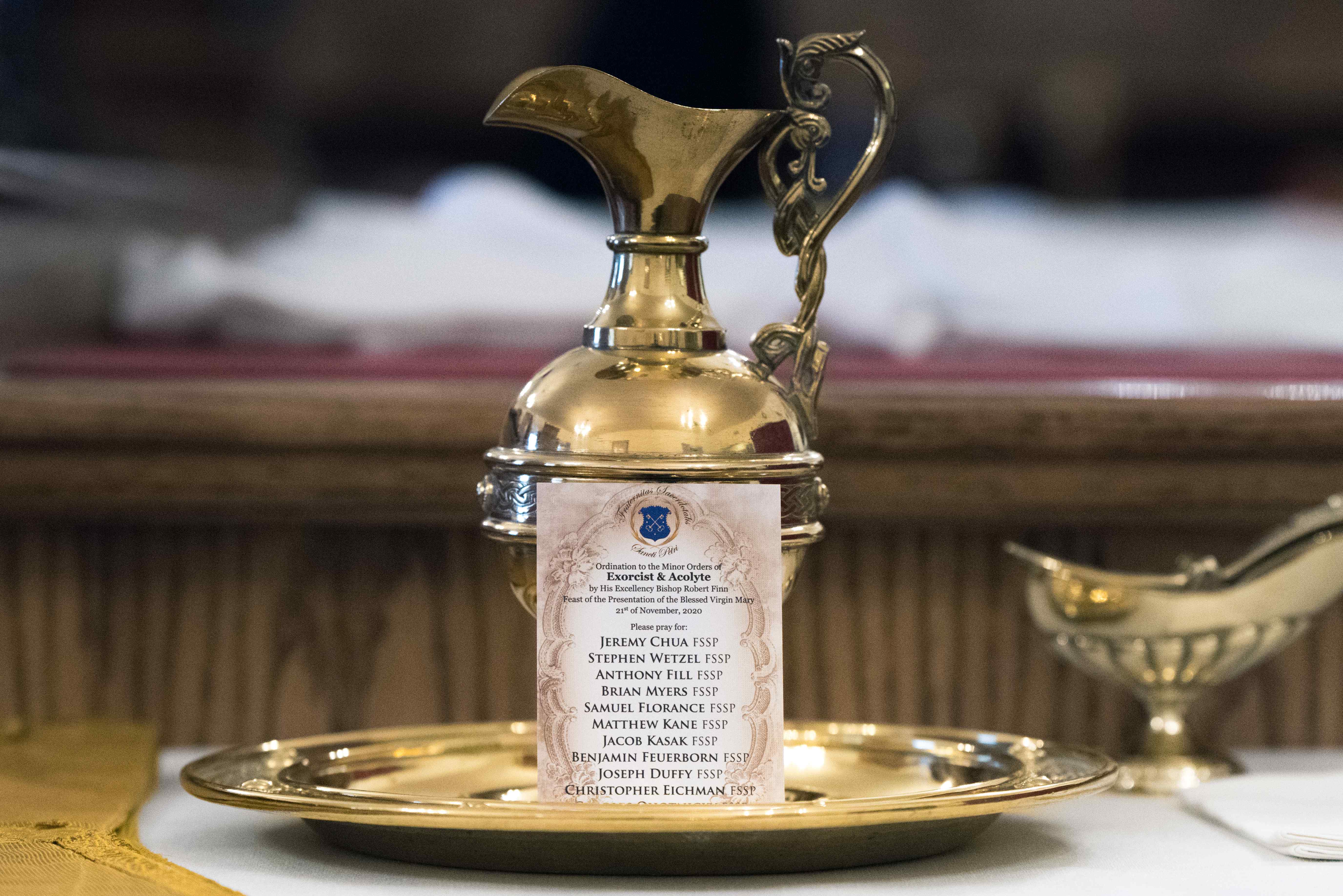
Ordination of acolytes
It may well be believed that a pope has no authority to abolish a bimillennial approved and received tradition. This had already been recognized regarding the venerable Roman Mass when Benedict XVI stated in Summorum Pontificum and Con Grande Fiducia that the old missal was never abrogated — even though nearly everyone, except a tiny number of traditionalists, acted as if it had been. In light of the perennial doctrinal principles declared in the motu proprio Summorum Pontificum and its accompanying letter, the subdiaconate and minor orders have no more been abolished than has the ancient usage of the Roman Rite itself, nor could they be. The old rites, when used today, confer the minor orders and the subdiaconate that they intend to confer.

Catholics have long been told that they should engage in ecumenism, but the one ecumenism that was oddly forbidden was respecting the traditions we hold in common with the Eastern Churches. The lectorate and the subdiaconate still abide in the East. Rather than thinking they have somehow vanished into thin air, it is far more plausible to assume that they abide — and must abide — in the Roman Church as well, albeit in a condition of widespread underappreciation and underuse.

Blessing of a reader in the Eastern rite
A beautiful culture and highly practical asceticism goes with the minor orders: they set their recipient apart for liturgical offices and activities and prepare a man step by step, through lower forms of ministry, to receive the higher forms of the major orders (subdiaconate, diaconate, and priesthood), by which he is decisively inserted into the servanthood and priesthood of Jesus Christ.

The conferral of the minor orders is more than a mere delegation but less than a sacramental ordination in the full sense, which inscribes an indelible mark or character on the soul. If (as in the most common theological opinion) the minor orders do not confer a character and are not part of the sacrament of order but are instituted by the Church, they should be classified as sacramentals. [2] This seems in keeping with the definition of sacramentals given in the 1917 Code: “things or actions which the Church uses in a certain imitation of the sacraments, in order, in virtue of her prayers, to achieve effects, above all of a spiritual nature.” [3]

Specifically, the ceremonies are constitutive blessings that permanently depute persons to divine service by imparting to them some sacred identity, by which they assume a new and distinct spiritual relationship. These blessings entitle their recipients to actual graces for the performance of their ministries, much like the sacramental graces associated with the reception of the sacraments, and similar to the blessing of an abbot. [4] This makes the men in minor orders to be sacramentalia permanentia — blessed and consecrated objects of a sort! For instance, the blessing of a rosary is a sacramental; the blessed rosary itself is a sacramental; the use of the blessed rosary is a sacramental. Likewise, we can say that the ceremonies conferring the minor orders are sacramentals, those in minor orders are sacramentals, and the exercises of their offices are sacramentals.

Wijding van mensen binnen de rooms-katholieke kerk, Bernard Picart (atelier van), 1722 [Note that "porter" is called here "sacristan"]
So the ceremonies of the minor orders and of the subdiaconate confer both the right to perform the ministries and also the promise of actual graces in carrying them out. [5] If we humbly allow ourselves to be guided by the traditional rites of the Pontifical, we can see that there is a solemn imparting of new responsibilities and the assurance of graces to fulfill them worthily. The Church has always endeavored to follow the exhortation of St. Paul: “Let all things [in public worship] be done to edification. . . . Let all things be done decently, and according to order.” [6]

Following apostolic and ancient discipline in regard to the ordines or ranked ministers of the Church ought to matter to us. To hold it as a thing of no worth would be an imperfection, even a vice, for we must never treat longstanding ecclesiastical tradition as deserving of contempt or rejection. As St. Thomas Aquinas wrote in the thirteenth century, a time when minor orders would already have seemed extremely ancient: “The various customs of the Church in the divine worship are in no way contrary to the truth: wherefore we must observe them, and to disregard them is unlawful.” [7]

In a magnificent passage from the Summa theologiae, the Angelic Doctor holds forth on the appropriateness of the Church’s manifesting an orderly diversity of offices and ways of life, as she did throughout her history and well into modern times, and as she will continue to do, wherever sound theology prevails. The vision presented here is at the furthest possible remove from the democratic egalitarianism, traffic of interchangeable functionaries, and lack of architectural and ministerial boundaries characteristic of the postconciliar era. Thomas writes that the differences of states and duties in the Church regards three things:

In the first place, it regards the perfection of the Church. For even as in the order of natural things, perfection, which in God is simple and uniform, is not to be found in the created universe except in a multiform and manifold manner, so too, the fullness of grace, which is centered in Christ as head, flows forth to His members in various ways, for the perfecting of the body of the Church. This is the meaning of the Apostle’s words (Eph. 4:11–12): “He gave some apostles, and some prophets, and other some evangelists, and other some pastors and doctors for the perfecting of the saints.”
          Secondly, it regards the need of those actions which are necessary in the Church. For a diversity of actions requires a diversity of men appointed to them, in order that all things may be accomplished without delay or confusion; and this is indicated by the Apostle (Rom. 12:4–5), “As in one body we have many members, but all the members have not the same office, so we being many are one body in Christ.”
          Thirdly, this belongs to the dignity and beauty of the Church, which consist in a certain order; wherefore it is written (1 Kings 10:4–5) that “when the queen of Saba saw all the wisdom of Solomon . . . and the apartments of his servants, and the order of his ministers . . . she had no longer any spirit in her.” Hence the Apostle says (2 Tim. 2:20) that “in a great house there are not only vessels of gold and silver, but also of wood and of earth.”[8]
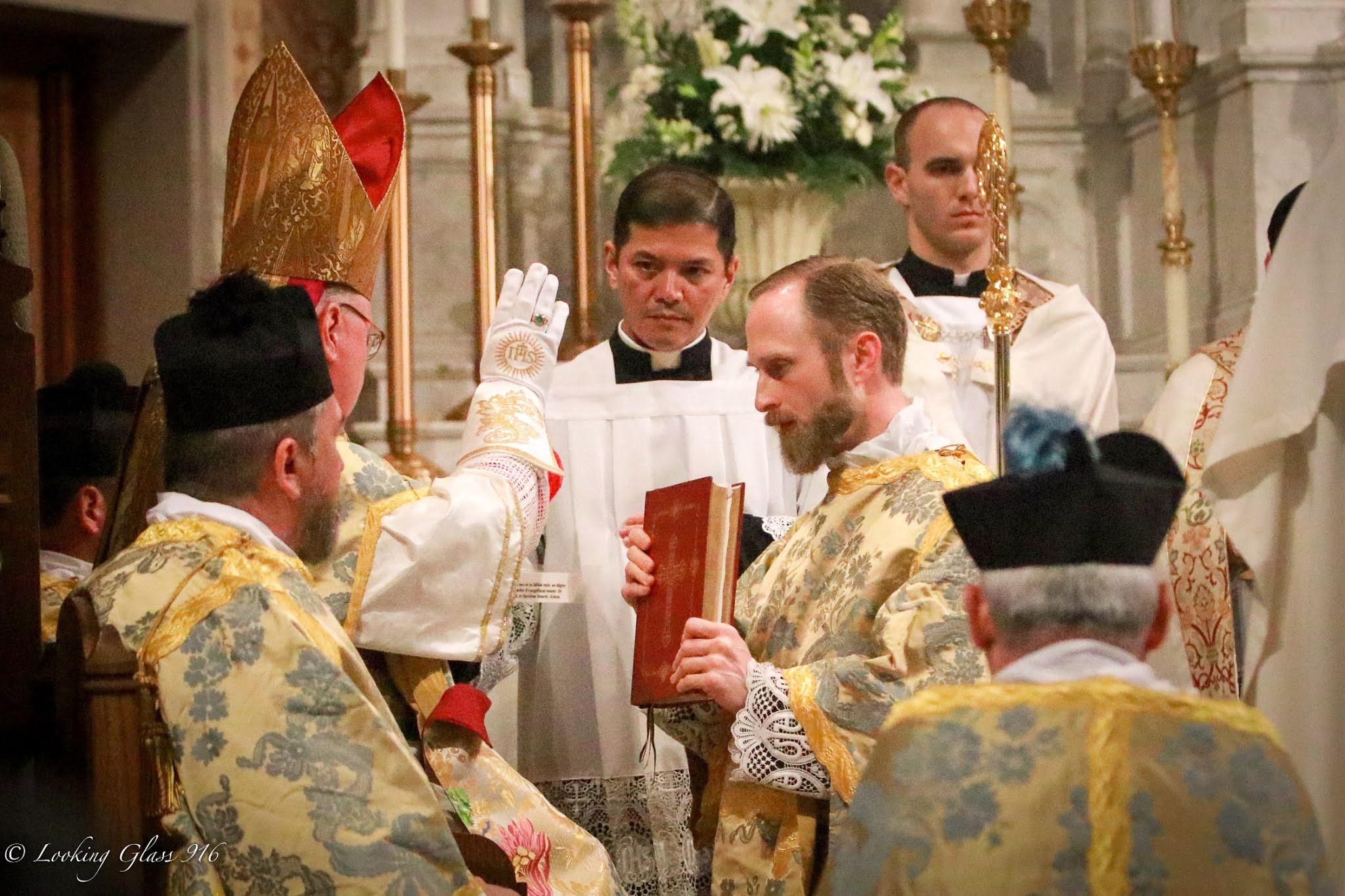
The beauty of hierarchical order

Monday, December 06, 2021

New Book Defends All-Male Liturgical Ministry, Subdiaconate/Minor Orders, and Proper Roles of Clergy and Laity

I am pleased to announce the release of my latest book, Ministers of Christ: Recovering the Roles of Clergy and Laity in an Age of Confusion (Crisis Publications).

When this project was first conceived over a year ago, my initial idea was to write a critique of Paul VI’s attempted suppression of the subdiaconate and minor orders, of John Paul II’s permission of altar girls, and of Francis’s innovation of female “acolytes” and “lectors.” During its writing, however, the scope of the book considerably broadened to include a full-scale presentation and defense of the traditional sevenfold manifestation of Orders — priest, deacon, subdeacon, lector, acolyte, exorcist, and porter — together with an explanation of the distinct but mutually supporting roles of clergy and laity. In order to accomplish this, I stepped back further to look at the distinction and complementarity of the sexes in the order of creation and the order of redemption, a perspective that provides the ultimate foundation for the Church’s entire teaching on states of life, roles, and ministries. In this way the book serves as a response to the “gender madness” that afflicts the world and increasingly infects the Church.

The summer’s anti-TLM motu proprio Traditionis Custodes and the mounting threats against the former Ecclesia Dei institutes that avail themselves of the traditional rites of ordination conspire to make the book’s overall argument more urgent still. (Fortunately, subsequent to July 16 I was given the opportunity to do some last-minute revisions to the text in order to take this new scenario into account. Nothing of substance had to be changed in the overall argument.)

Ministers of Christ analyzes the problems with recent popes’ successive innovations in the area of ministry, showing how they have created a theologically and liturgically incoherent situation—a categorical rupture from a tradition firmly rooted in the most profound anthropological, Christological, and ecclesiological principles. In this regard the Church stands in desperate need of the correct (and corrective) witness of the usus antiquior. This will remain true even if a tyrannical attempt is made to prohibit the ancient rites of ordination, an act that would have no more legal validity than Traditionis Custodes itself.
Part I, “Foundations,” looks at the most fundamental questions: how sexuality and the body have personal significance and therefore moral, theological, and liturgical significance as well; the connection between the Incarnation of Our Lord and the male priesthood and male sanctuary service; the blessing on womanhood conferred in and through Our Lady, the Virgin Mother of God; the Old Testament background and New Testament roots of the diaconate, subdiaconate, and minor orders, seen as radiating outward from the priesthood of Jesus Christ, and the solemn tradition behind this ecclesiastical hierarchy; and the proper role of the laity in the great world outside the churches, where they exercise their primary responsibilities.

Part II, “Deviations,” takes a critical look at practices that entered the Church after the Second Vatican Council—above all, the attempt to sideline the subdiaconate and minor orders and the habitual use of female lectors and altar servers, whether filling in as “substitutes” or, as Pope Francis would have it, installed as ministers. It explains how these distortions and novelties misconstrue and muddle the callings of laity and clergy as well as their diverse but complementary modes of participation in the liturgy. In the course of the chapters, the notion of “active participation” is freed from its harsh captivity as a slogan trafficked by modern liturgists.

Part III, “Restoration,” charts a path out of this mess into a healthier church life, making the case for several related proposals:

– the universal reestablishment of the subdiaconate and minor orders, which have never been and cannot be abrogated and which remain in use to this day;

– a return to the traditional lex orandi of the classical Roman rite, which embodies true doctrine about states of life, ministries, and sexes;

– the wearing of veils by women in church as a sign of their dignity and role within the Mystical Body;

– the full acceptance of the supernatural and sacrificial vision of priesthood and consecrated life that attracts vocations today as it always did in the past, together with a firm repudiation of the “heresy of activism” that extinguishes the primacy of prayer and the ultimacy of contemplation;

– a reversal of the mad race of aggiornamento, to be replaced by the serene embrace of the essential changelessness of the Christian religion, which worships the immutable God in His eternal truth, reflected in traditional liturgical rites.

This book also includes the definitive versions of two essays by Bishop Athanasius Schneider: “The Significance of Minor Ministries in the Sacred Liturgy” and “Healing the Rupture: A Call for the Restoration of Minor Orders.”

Ministers of Christ concludes with three litanies for private devotional use. The first is for the clergy in general. The second and third, based on the Roman Martyrology, remind us that the Church’s history provides many examples of saintly subdeacons, lectors, acolytes, and exorcists whom we ought to invoke. Lastly, there is a select bibliography divided into topics.
Ministers of Christ: Recovering the Roles of Clergy and Laity in an Age of Confusion.
   By Peter Kwasniewski, with two chapters by Bishop Athanasius Schneider.
   Foreword by Leila Marie Lawler.
   Manchester, NH: Crisis Publications, 2021.
   xliii + 285 pp.
   Paperback $19.95.

Available directly from the publisher or from Amazon.com.

Here is a short video (by no means professional...) that has more or less the same content as the post above, for those who prefer the video format.

Monday, March 08, 2021

Are Women Permitted to Sing the Propers of the Mass?

In the wider Catholic world, the question posed in the title is not even on the radar screen. If you can have altar girls and female lectors — indeed, apparently, acolytesses and lectresses, in a veritable salmagundi of sanctuary servants — then why not women singing music for the Mass? (Never mind the fact that the concept of “propers” has more or less disappeared outside the world of the usus antiquior.) However, traditionalists, myself included, reject both altar girls and female lectors, arguing that it is only appropriate for males to fill these roles, and, in general, that the patronizing and vocationally deviant clericalization of the laity should be avoided. It might therefore be thought that, as a matter of logical consistency, we ought to maintain that women should not form a chant schola to execute the propers of the Mass. Yet this conclusion does not follow.

While I am an adamant opponent of feminism, I am no less staunch an opponent of chauvinism wherever I see it — and I do see it reappearing in the traditional movement, along with other -isms (e.g., antisemitism, libertarianism, sedevacantism) that are incompatible with Catholic tradition. The revival of traditional liturgical practice has permitted the reappearance of some extreme points of view that deserve refutation. For example, not only have I heard traditionalists argue against women singing the propers; I’ve heard them argue that none of the laity whatsoever should sing any of the Mass Ordinary or responses. (On that last point, see here, here, and here.)

The point of departure for the question on women chanters is the rather blunt statement of Pope St. Pius X in his famous 1903 motu proprio Tra le Sollecitudini:
With the exception of the melodies proper to the celebrant at the altar and to the ministers, which must be always sung in Gregorian chant, and without accompaniment of the organ, all the rest of the liturgical chant belongs to the choir of levites, and, therefore, singers in the church, even when they are laymen, are really taking the place of the ecclesiastical choir…. On the same principle it follows that singers in church have a real liturgical office, and that therefore women, being incapable of exercising such office, cannot be admitted to form part of the choir. Whenever, then, it is desired to employ the acute voices of sopranos and contraltos, these parts must be taken by boys, according to the most ancient usage of the Church.

Stated thus, it sounds cut and dried. But is it self-evident that “all the rest of the liturgical chant” (would this include the Ordinary?) “belongs to the choir of levites” (whatever that means exactly)? It seems that Pius X has in view singers in the sanctuary or the “choir” area of a transept of a monastic-style church, where their placement and vesture suggest that they are performing a ministerial function. The operative conception here, it seems to me, is that of a cathedral, seminary, or boys’ school.

If singers are, in contrast, somewhere in the nave, whether on the floor or up in a loft, it is more difficult to see that they constitute a “choir of levites” with a “real liturgical office.” Just as laywomen were not forbidden to sing the Ordinary of the Mass (indeed Pius X and his successors encouraged this) even though the Ordinary is manifestly a liturgical text also said by ordained ministers, by the same logic women would be competent to sing the propers.

To make the situation clearer, Pius XII in his encyclical Musicae Sacrae of 1955 lifted the ban for lay women as long as they were not in the sanctuary (the internal quotations are from three earlier decisions of the Sacred Congregation of Rites):
Where it is impossible to have schools of singers [scholae cantorum] or where there are not enough choir boys, it is allowed that “a group of men and women or girls, located in a place outside the sanctuary set apart for the exclusive use of this group, can sing the liturgical texts at Solemn Mass, as long as the men are completely separated from the women and girls and everything unbecoming is avoided. The Ordinary is bound in conscience in this matter.”
Granted, Pacelli’s words are not exactly a resounding encouragement to have women, but it shows that there is no ban on women singing, as long as they are outside the sanctuary.

Let’s think this through, with attention to the symbolism of church architecture. The development of choir lofts, which can certainly be said to be the norm in most churches built in the century prior to Vatican II, perfectly accords with the role of the choir as a body that provides chant and polyphony for the liturgy, with mixed voices as needed or desired, and in a way that does not involve the singers in the ceremonies taking place below. This preserves the anonymity of the choir and bypasses the danger of distraction for the congregation, since the musicians do not so easily risk “putting on a show.” If the propers can be sung polyphonically with men and women, does that not establish that women may sing the propers by themselves?

Admittedly there is a longstanding tradition of having only men singing, inasmuch as the choir was seen as fulfilling a properly liturgical role. Yet just as it is possible for altar boys to substitute for acolytes, and even for any laity (such as girls in a girls’ school) to make the responses at Mass provided they are in the pews and not in the sanctuary, so too it is possible for non-vested laity to substitute for a properly liturgical choir. Put differently, lay people from outside the choir area can fulfill a liturgical function, but not in a properly liturgical manner, which would involve their being vested and being more closely associated with the ritual action in or near the sanctuary, as we see in solemn Vespers when the singers in cassock and surplice process into the sanctuary, genuflect, bow to each other, and split off to their seats on the sides for the chanting of the psalmody. (It also seems clear enough that whenever there is a schola of clergy or male religious singing the propers, as Pius X envisioned, women should not join them.)

We should also take into account the not inconsiderable witness of centuries of women religious singing the sacred liturgy, and doing so not because there are no men around to do it (although that will usually be true), but because it is proper to themselves: it is a requirement of their consecrated life, expected and indeed demanded of them by the Church. They do not “substitute” for anyone else but do it by a right proper to and inherent in them. Moreover, depending on the order or congregation, the nuns might perform this opus Dei in the choir area of a monastery church (still with a symbolic separation from the sanctuary), chanting all the parts of the Mass except those of the major ministers. It is true that this fact in and of itself does not establish an analogous right for unconsecrated lay women to do the same, but it does establish, once and for all, that women as such are not disqualified from singing the chants of the liturgy, provided that good order is maintained.

Once again we can see what a fine and helpful development the choir loft was, and why it should be present in every Catholic church. How many blessed hours of my life have been spent in choir lofts, leading or singing with scholas and choirs of men and women, in Santa Paula, California; in Washington, D.C., and Silver Spring, Maryland; in Gaming and Vienna, Austria; in Lander, Wyoming and in Lincoln, Nebraska!

We cannot leave history and prudence behind. There has been an evolution in the attitudes toward women in the Church, even while we still hold fast to the ancient truth, now contradicted by Pope Francis, that women should not be vested and serving in ministerial roles (cf. 1 Cor 14:34). One need look no further than the redoubtable Justine Ward to see that women were heavily involved in the resurgence of Gregorian chant in the twentieth century and taught people how to sing it, which means that they were in the lay schola.

It’s not clear to me what we could possibly gain by trying to prevent women from singing the propers, provided the singers are musically qualified (and the same holds, obviously, for men — no one’s sex makes him or her more adept for the art of singing). Unlike the minor orders of acolyte and lector, there has never been a minor order of cantor/singer. It is therefore impossible to classify women singers along with altar girls/acolytesses and female readers/lectresses as part of the same progressive “slippery slope” for the ordination of women as deacons or priests. Musicologists and musicians are free to argue about whether a higher-pitched or lower-pitched rendering of chant works better from the point of view of liturgical aesthetics, and sociologists or anthropologists of religion could argue about cultural expectations and associations, etc., but none of this pertains to the question at hand.

On a practical level, unless there is some extenuating circumstance like a CMAA Sacred Music Colloquium with its pedagogical aims, it would be strange to have a men’s schola and a women’s schola dividing up tasks at the same liturgy; this is best avoided. When only men or only women are singing the propers, the worshiper can more easily forget about it and pay attention to the chants, the texts, and the ceremonies. When the two scholas go back and forth, it draws attention to the octave difference between men and women — that is, it draws attention to the performers, which is not ideal. Similarly, chant sung by men and women simultaneously is sometimes an unavoidable necessity, but chant tends to sound best in a true unison, not in organum of parallel octaves. If a chapel or parish has two scholas, a men’s and a women’s, it would be better to have one or the other sing all the propers at Mass. This is what I did at Wyoming Catholic College. The men’s schola sang multiple times a week; at a certain point, a women’s schola was created to give the women a chance to immerse themselves more fully in the chant and to give the men a much-needed rest. Here, too, a certain complementarity developed that was beneficial for all.

Visit Dr. Kwasniewski’s websiteSoundCloud page, and YouTube channel.

Wednesday, January 20, 2021

Guest Article: Bishop Athanasius Schneider on the Significance of Minor Ministries in the Sacred Liturgy

NLM is grateful to His Excellency Bishop Athanasius Schneider for offering us the first publication of his profound analysis of the ancient origins of the minor orders and their liturgical-theological rationale, together with a critique on that basis of the novel path taken in the post-conciliar period, from Ministeria Quaedam of 1972 to Spiritus Domini of 2021.

Ordination of lectors in the traditional Roman rite

The Significance of Minor Ministries in the Sacred Liturgy


1. The principle of Divine law in the liturgy

Regarding the nature of the sacred liturgy, that is, of Divine worship, God himself has spoken to us in His Holy Word, and the Church has explained it in her solemn Magisterium. The first basic aspect of the liturgy is this: God himself tells men how they must honor Him; in other words, it is God who gives concrete norms and laws for the development, even exterior, of the worship of His Divine Majesty.

In fact, man is wounded by original sin and for this reason he is profoundly characterized by pride and ignorance, and even more profoundly by the temptation and tendency to put himself in the place of God at the center of worship, that is, to practice self-worship in its various implicit and explicit forms. Liturgical law and norms are therefore necessary for authentic Divine worship. These laws and norms must be found in Divine Revelation, in the written word of God and in the word of God transmitted by tradition.

Divine Revelation transmits to us a rich and detailed liturgical legislation. An entire book of the Old Testament is dedicated to liturgical law, the Book of Leviticus; partially also the Book of Exodus. The individual liturgical norms of Divine worship of the Old Testament had only a transitory value, since their purpose was to be a figure, looking to the Divine worship that would reach its fullness in the New Testament. However, there are some elements of perennial validity: firstly, the very fact of the need for liturgical legislation; secondly, that there is a detailed and rich legislation of Divine worship; and finally, that Divine worship takes place according to a hierarchical order. This hierarchical order presents itself as concretely tripartite: high priest–priest–levite; in the New Testament, respectively: bishop–presbyter–deacon/minister.

Jesus came not to abolish the law, but to bring it to its fullness (cf. Mt 5:17). He said: “Until heaven and earth have passed away, not one iota or a sign of the law will pass, without all being completed” (Mt 5:18). This is particularly valid for Divine worship, since the adoration of God constitutes the first commandment of the Decalogue (cf. Ex 20, 3-5). The purpose of all creation is this: angels and men and even irrational creatures must praise and worship the Divine Majesty, as the revealed prayer of the Sanctus says: “The heavens and the earth are full of Thy glory” (cf. Is 6:3).

Old Covenant hierarchy
2. Jesus Christ, the supreme worshiper of the Father and the supreme liturgical minister

The first and most perfect worshiper of the Father is Jesus Christ, the incarnate Son of God. His work of salvation had as its main purpose to give honor and glory to the Father in place of sinful humanity, unable to give a worthy and acceptable worship to God. The re-establishment of true Divine worship and the atonement of Divine Majesty, outraged due to the innumerable forms of perversion of worship, constituted the primary purpose of the Incarnation and the work of Redemption.

By constituting His apostles true priests of the New Covenant, Jesus left His priesthood to His Church and with it the public worship of the New Testament, which has for its ritual culmination the offering of the Eucharistic sacrifice. He taught his apostles through the Holy Spirit that the worship of the New Covenant was to be the fulfillment of the worship of the Old Covenant. Thus the apostles transmitted their power and their liturgical service in three degrees, that is, in three hierarchical orders, in analogy with the three degrees of the ministers of the cult of the Old Covenant.

The supreme performer of the liturgy is Christ (in Greek: hó liturgós). He contains in himself and exercises all the Divine worship, even in the smallest functions. The following words of Christ can also be referred to this fact: “I am among you as one who serves” (Lk 22:27). Christ is the minister; he is also the “deacon” par excellence. So too is the bishop, as the supreme possessor of the liturgical service of Christ. The episcopate contains all the ministries and services of public worship: the ministry of the presbyterate, the ministry of the diaconate, the ministry of the minor orders, that is, also, the service of ministers (“altar boys”). In the pontifical Mass according to the most ancient form of the Roman rite, the bishop dresses in all the robes, even of the lower orders. In the absence of all the lower ministers, the bishop himself performs all the liturgical functions of the presbyter, of the deacon, and even of the minor orders, that is, of the altar servers. In the absence of the deacon, the presbyter himself performs all the liturgical functions of the deacon and of the minor orders, that is, of the altar servers. In the absence of the deacon, the sub-deacon, the holders of the minor orders, or the altar servers can perform some of the functions of the deacon.

The vesting of a pontiff
3. The tradition of the apostles

The apostolic tradition has seen in the triple hierarchical order of the Church the fulfillment of the typology of the triple hierarchical order of Divine worship in the Old Covenant. This is what Pope Saint Clement I, the disciple of the Apostles and third successor of the Apostle Peter, testifies to us.

In his letter to the Corinthians, Saint Clement presents the liturgical order divinely established in the Old Covenant as an exemplar for the right order of the hierarchy and worship of every Christian community. Speaking of Divine worship, he states:

We must do everything in order with regard to what the Lord has ordered to do according to the appointed times. He ordered the oblations and worship services to be performed not by chance or without order. By his sovereign decision, He Himself has determined where and by whom these services are to be performed, so that all things will be done in a holy manner according to His good pleasure and pleasing to His will. For the high priest has been assigned liturgical services (liturghíai) reserved for him, priests have been given their own proper place, on the levites devolve special ministrations (diakoníai), and the layman (ho laikòs ànthropos) is bound by the laws that pertain to laymen (laikóis prostágmasin). (1 Clem 40:1-3.5)
Pope Clement understands that the principles of this order divinely established in the Old Covenant must continue to operate in the life of the Church. The most evident reflection of this order should be found in the liturgical life, in the public worship of the Church. Thus the Holy Pontiff draws this conclusion, applied to the life and worship of Christians: “May each of you, brothers, in the position that is proper to him, be pleasing to God in good conscience and with reverence, without transgressing the established rule of liturgical services (kanón tes leiturghías)” (1 Clem 41:1).

Later (cf. 1 Clem 42:1ss.) Pope Clement describes the hierarchy of the New Covenant, contained in the Lord Jesus Christ himself and concretized in the mission of the apostles. This reality corresponds to the order (táxis) willed by God. Here Saint Clement uses the same terms with which he had previously described the liturgical and hierarchical order of the Old Covenant.

From the first centuries, the Church was aware that Divine worship had to take place according to an order established by God in keeping with the example of the Divine order established in the Ancient Covenant. Therefore, in order to carry out a task in public worship, it was necessary to belong to a hierarchical order. Consequently, Christian worship, that is, the Eucharistic liturgy, was carried out in a hierarchically ordered manner by persons officially appointed for this purpose. For this reason, these agents of worship constituted an order, a sacred order, divided into three degrees: episcopate, presbyterate and diaconate, paralleling the three degrees of ministers of Old Covenant worship: high priest, priests, and levites. Pope Saint Clement in the first century designated the service of the Old Testament levites with the word “diakonia” (1 Clem 40:5). We can therefore identify here the foundation of the ancient ecclesiastical tradition, since at least the fifth century, of designating the Christian deacon with the word “levite,” for example in the Constitutiones Apostolicae (2, 26:3) and in the writings of Pope Leo the Great (cf. Ep. 6:6; Ep. 14:4; Serm. 59:7; 85:2).
 
St. Peter ordains St. Stephen a deacon (Fra Angelico)

Monday, January 18, 2021

Lay Ministries Obscure Both the Laity’s Calling and the Clergy’s

The recent motu proprio Spiritus Domini has a personal resonance for me. Under the regime of progressive Catholicism in which I grew up, I recall hearing one message loud and clear: “Show your faith by signing up for XYZ ministry.” The underlying assumption was that merely assisting at Mass was not quite good enough; that was for the uncommitted, the uninterested, the unmotivated.

So I dutifully signed up to be first an altar boy, then a lector, and finally, an extraordinary minister of Holy Communion (this would have been in the 1980s). Throughout boyhood and adolescence, I didn’t understand at all what the Mass was about; I hardly had a clue what the Eucharist was; I’m not even sure my views would have differered, in essence, from how Protestants view their services. Actually, that’s not true; a Protestant would have had a much higher view of Biblical inspiration and inerrancy than I would have had. I was serving at something, I knew not what; I was reading something, I knew not what; I was distributing something, I knew not what.

It was for me a huge breakthrough, a profound liberation, to discover through the traditional Latin Mass that one can simply be at the liturgy and soak it in like a sponge; one can come to find this receptivity utterly fulfilling. Perhaps that is the saddest lesson of Spiritus Domini: its change to canon law makes sense only in the context of a liturgy that has lost its raison d’être.

The motu proprio once again raises the question of the vocation of the laity. What are laypeople supposed to be doing? Have they a proper work of their own, or do they just collect the scraps that fall from the clergy’s table — better yet, climb up and jostle elbows?

The Church’s answer has always been consistent: the laity’s work is to influence, purify, and elevate temporal affairs, bringing them as much as possible into conformity with the law of God and the Church’s mission to glorify God and save souls. The Second Vatican Council espoused this traditional point of view: Gaudium et Spes exhorts the laity “to impress the divine law on the affairs of the earthly city” (n. 43), while Apostolicam Actuositatem sets as our goal “rectifying the distortion of the temporal order and directing it to God through Christ” (n. 7).

The latter document establishes a distinction between those who teach principles and those who implement them: on the one hand, “Pastors must clearly state the principles concerning the purpose of creation and the use of temporal things and must offer the moral and spiritual aids by which the temporal order may be renewed in Christ” (ibid.); on the other hand, the “apostolate in the social milieu,” which is proper to laity, involves “the effort to infuse a Christian spirit into the mentality, customs, laws, and structures of the community in which one lives” (n. 13). As John Paul II wrote in Ecclesia in Oceania: “It is the fundamental call of lay people to renew the temporal order in all its many elements. In this way, the Church becomes the yeast that leavens the entire loaf of the temporal order” (n. 43).

Police taking part in a Sacred Heart procession
Thus, in spite of Pope Francis’s talk about the “co-responsibility” of the ordained and the lay faithful, we may say that the true responsibility of the laity is not the taking on of tasks inside the church, but taking on the world outside the church. Confronting unbelief with Christian witness, defeating secular narrowness with the grandeur of the Gospel, leavening temporal occupations with a supernatural perspective and motivation, and doing all this consistently and courageously, is far more challenging — and far more urgent — than mounting an ambo and reading a text, or donning an alb and passing cruets. In fact, the more that laity see themselves as fulfilled in aping the clergy, the more they will be deceived into thinking that they have done what they were supposed to do as Catholics. They have, as it were, punched their religion ticket, and can get back to secular life in its total secularity.

In the sacred liturgy, the laity exercise the Marian role of receiving divine gifts, which is the creature’s highest activity. No charism can be more honorable or more important than this receptivity. The gifts bestowed upon the clergy, and the various liturgical ministries, are at the service of the charity and holiness of the Church; they do not exist as ends in themselves, but as instruments for the pilgrimage of mankind to the City of God, where there will be no sacraments and no temple, since God will be “all in all” (cf. Rev 21:22–23; 1 Cor 15:28). The Marian receptivity of laymen and laywomen furnishes the light and strength necessary for their active, transformative mission in the family and in the world. Without drinking deeply from the wellspring, there can never be watered gardens. How ironic and how tragic that the laity’s misplaced liturgical activism seems inversely proportional to their zeal for the irreplaceable mission that is theirs in the home, on the land, in the city! The laity are meant to offer themselves up in sacrificial love (cf. Rom 12:1), so as to be a leaven in the world. That is their domain, that is their honorable and salvific “service.”

The Catholic peasants and aristocrats of the Vendée lived a pure Marian faith during the Terror by fully assuming their role to defend the Faith, to protect Catholic cities and families, to do battle against hostile forces; never did they try to substitute for clergy when their priests went missing. They knew, intuitively, the teaching of St. Paul in 1 Corinthians 12 — how the Body of Christ has many diverse and unequal members that depend one upon another; that the eye has to be the eye, the hand the hand; each part has to be just what it is, to the best of its ability, and not a poor substitute for some other one. The “dignity” of the laity is in no way augmented by their taking on of quasi-clerical liturgical functions, just as neither is their dignity diminished by being spouses, parents, workers, citizens.

The Virgin Mary receiving her Son from the hand of St John
I couldn’t help noticing this past weekend in the usus antiquior, in which we celebrated the Second Sunday after Epiphany, that “the liturgical providence of God” furnished us with an Epistle and a Gospel that both referred expressly to “ministries.” We can learn some important lessons from meditating on these readings.

The Epistle is Romans 12:6–16:

Brethren: Having different gifts, according to the grace that is given us: either prophecy, to be used according to the rule of faith; or ministry, in ministering [Vulg.: ministerium in ministrando]; or he that teacheth, in doctrine; he that exhorteth, in exhorting; he that giveth, with simplicity; he that ruleth, with carefulness; he that showeth mercy, with cheerfulness. Let love be without dissimulation. Hating that which is evil, cleaving to that which is good: loving one another with the charity of brotherhood, with honour preventing one another: in carefulness not slothful: in spirit fervent: serving the Lord: rejoicing in hope: patient in tribulation: instant in prayer: communicating to the necessities of the saints: pursuing hospitality. Bless them that persecute you: bless, and curse not. Rejoice with them that rejoice, weep with them that weep: being of one mind one towards another; not minding high things, but consenting to the humble.

The Apostle gives us here a rich portrait of the true variety of gifts to be found in the Holy Church of God. There are gifts of ministry, but there are also gifts of prophecy, teaching, exhorting, ruling, and works of mercy. The passage then shifts from special charisms to the fundamental Christian vocation of loving: loving without dissimulation, with the charity of brotherhood; hating what is evil and cleaving to what is good; honoring, serving, praying, and offering hospitality.

When we read about offering hospitality, should we not be thinking of the baptized and confirmed laity? Hospitality has always been seen as one of the great duties and privileges of lay people: to open their homes, to share with the needy, to welcome friends and strangers. Indeed, what greater hospitality can husband and wife exercise than by giving food and shelter, love and education, to the children who are their common bond and the chief calling of their life? They own and manage property precisely for that reason: to share generously. Their primary calling is to bring Christian prayer, witness, and virtues into the home, and thence, into the workplace and marketplace, the political arena, the broad world of culture. The sanctuary is not their home, but their home can become an extension of the sanctuary. They do not “mind high things,” as if seeking a rank or a task that does not belong to them; rather, they consent to be found among the humble (another translation has: “do not be haughty, but associate with the lowly”).

The clergy, stewards of the mysteries of Christ, are busy with their own proper work, according to the gifts bestowed on them in the Mystical Body. Their primary calling is within the temple of God, offering Him exalted praise and ministering to the people, and in this work they will find fulfillment and sanctity, if — and this is a crucial if — they enjoy the freedom to be fully what they are and to utilize fully the armory and treasury of the Church’s liturgical inheritance. In short, they must have the best wine, drink it freely, and give it to others to drink.

The Gospel for the Second Sunday after Epiphany is John 2:1–11:

At that time there was a marriage in Cana of Galilee: and the mother of Jesus was there. And Jesus also was invited, and His disciples, to the marriage. And the wine failing, the mother of Jesus saith to Him: They have no wine. And Jesus saith to her: Woman, what is that to Me and to thee? My hour is not yet come. His mother saith to the waiters [ministris]: Whatsoever He shall say to you, do ye. Now there were set there six water-pots of stone, according to the manner of the purifying of the Jews, containing two or three measures apiece. Jesus saith to them: Fill the water-pots with water. And they filled them up to the brim. And Jesus said to them: Draw out now, and carry to the chief steward of the feast. And they carried it. And when the chief steward had tasted the water made wine, and knew not whence it was, but the waiters [ministri] knew who had drawn the water: the chief steward calleth the bridegroom, and saith to him: Every man at first setteth forth good wine: and when men have well drunk, then that which is worse: but thou hast kept the good wine until now. This beginning of miracles did Jesus in Cana of Galilee; and manifested His glory, and His disciples believed in Him.

In this Gospel, Jesus is the Eternal High Priest who will offer the perfect sacrifice when “his hour” has come to glorify the Father (note how His Holy Name is mentioned seven times, which underlines His perfection as God and man — readers of St. John will know that this is anything but accidental); wine will be the symbol of the sweetness and abundance of His redemption. The architriclinus or chief steward is like the deacon who ministers to the priest at Solemn Mass; the “waiters” (ministri in Latin) are like the subdeacon and the acolytes who minister, in turn, to their superiors.

The guests at the wedding feast are the congregation. They are not serving, they are not busy with providing the food and drink; they are simply taking it all in and feasting. Theirs, in a sense, is “the better part” of Mary of Bethany.

The Virgin Mary is neither a minister nor a simple guest. Like the ministers, she brings about results, but in the mode of an intercessor — one who joins the power of the priest to the needs of the people, even as she joined in her womb the supreme deity with the neediness of human nature. Like the guests, she gratefully and joyfully receives good things from the Lord.

The Epistle and Gospel of the Second Sunday after Epiphany remind us of the wisdom of the Catholic Church in her traditional hierarchical and Christocentric liturgical praxis. Compared with the irrefutable coherence of the usus antiquior as it returns to more and more altars, the “polyesterdays” of liturgical experimentation are shown to have no staying power, no future — even on the artificial life support of canon law. 

Monday, November 30, 2020

On the Status of Minor Orders and the Subdiaconate

Roman subdiaconate ordination (post-1973!)
Arising more and more often nowadays is the question: What exactly is the status of the minor orders (porter, lector, exorcist, acolyte) in the Roman rite? We can add to this list the major order of subdeacon. In spite of their immense antiquity, which ought to have gained them the principled support of the liturgical reform — they are, for example, more ancient than the season of Advent — the minor orders were abolished in the form in which they had existed previously (or at least, it seemed to observers that they were abolished) by Paul VI in his Apostolic Letter Ministeria Quaedam of 1973. Yet never since that time have both minor orders and the subdiaconate ceased to be conferred in this or that corner of the vast Catholic world; with increasing frequency thanks to John Paul II’s Ecclesia Dei and Benedict XVI’s Summorum Pontificum, these orders are routinely imparted to the many young candidates who flock to traditional orders. It certainly seems like an odd situation.

As far as I can tell, there’s the “conservative” view and the “rad trad” view.

The conservative view, such as one might find it on the faculty of an Opus Dei university, is to say that the minor orders and subdiaconate were in fact abrogated and their functions reassigned, but that, just as the old liturgical tradition continued and was eventually regularized, so, too, the use of the ceremonies for the suppressed orders were regularized in that context, and are efficacious in that context. It’s “praetercanonical.”

The weakness of this position is that it leans too much on canon law. Canon law is not some kind of inerrant or infallible thing; it’s just a compilation of ecclesiastical jurisprudence, and it can be badly done, have omissions, need correction or supplementation, etc. Canon law’s silence on the minor orders and the subdiaconate does not logically preclude the possibility of their continuing existence. Not all things in heaven and on earth are contained in the 1983 Code of Canon Law.

With this, we segue into the rad trad position, which maintains that no pope has the authority to abolish a millennial tradition like the minor orders and the subdiaconate, just as no pope, strain he ever so many a pontifical muscle, could abolish the immemorial Roman Mass codified but not created by St. Pius V in 1570. On this view, Paul VI’s attempt to do both of these things wasn’t worth the paper it was written on. This has already, in a sense, been recognized regarding the Mass by Benedict XVI when he said in Summorum Pontificum that the old missal was never abrogated, even though nearly everyone, except a tiny number of traditionalists, acted as if it had been. Due to craven ultramontanism, however, people went along with the pretense and still act as if the minor orders and the subdiaconate were suppressed. Traditional religious and clerical communities, on the other hand, know better, and continue to follow the settled and venerable Roman tradition.

At very least something like the conservative view has to be true; otherwise, in conferring minor orders today (and most of all, the subdiaconate!), one would be guilty of simulating a conferral that cannot happen — a sort of contraceptive liturgy. It is impossible that the Church could continue to use such rites without their being efficacious in accomplishing what they intend to accomplish. A sacramental theologian of Scotistic subtlety might rejoinder that there is a third possibility: these rites are not efficacious in se — they actually do nothing to the recipients — but their content, being piously edifying, offers an occasion of grace for the devout in their progress toward the diaconate and priesthood. It would be essentially fancy playacting in the sight of God, publicly and solemnly marking stages of formation.

All of these positions seem ecclesiologically unsatisfactory in one way or another. The least problematic, it seems to me, is to maintain that the old rites, when used today, confer the orders they intend to confer, while admitting that how the order is regulated in the Church is governed by the 1983 Code of Canon Law. With the 1983 Code, Ministeria Quaedam became a moot point — of historical interest, no doubt, and offering guidelines for acolytes, etc., but it was superseded. Hence, by the only code currently in force, reception of tonsure does not make one a cleric. A man becomes a cleric with the diaconate. He can freely take upon himself the obligations for the Divine Office that once came with the subdiaconate, but he is not strictly bound by law until he is ordained a deacon.

That is not to say, as mentioned above, that this law is a good one and should not be changed in the future. Not is it to say that the commitment is not serious prior to the diaconate. There is a whole culture that goes with the minor orders: they set a person apart for liturgical offices and activities, preparing a man step by step, through lower forms of ministry, to receive the higher forms of the major orders, by which he is decisively inserted into the exercise of the priesthood of Jesus Christ in the Church.

Catholics were told that they should engage in ecumenism, but the one ecumenism that was forbidden was respecting the traditions we hold in common with the East. The minor orders and the subdiaconate abide in the Eastern churches. It is far more plausible to assume that they abide, and must abide, in the Roman Church as well.

Further reading: 
Visit Dr. Kwasniewski’s websiteSoundCloud page, and YouTube channel.

Thursday, December 26, 2019

Minor Orders at the Monastère Saint Benoît

Last Saturday, December 21st, His Excellency Dominique Rey, bishop of Fréjus-Toulon, France, ordained a member of the Monastère Saint Benoît to the minor orders of Exorcist and Acolyte. The day was the Saturday Ember Day of Advent, one of the very ancient traditional days for the conferal of holy orders, which this year was kept in the EF as a commemoration on the feast of St Thomas the Apostle. Congratulation to the new acolyte, Dom Ildephonse (who received this name in religion in honor of the Bl. Ildephonse Schuster), and to his community - feliciter!

The ordinand comes forward at the call to receive orders.
The traditional ordination rites contain an admonition to the ordinands, the text of which is fixed and included in the Pontifical, in which the bishop explains the duties of each order to the ordinands, who kneel before him holding a lit candle.
There follows a “porrectio instrumentorum – the handing over of the instruments”, in which the bishops gives the ordinand (or has him touch) an object associated with the exercize of the order he is receiving. For the exorcists, this is a book containing the text of various rites of exorcism (e.g. that of the salt used in making holy water), but a Missal or Pontifical, both of which contain several such exorcisms, may be used instead.
The bishop then says a prayer over the ordinands.

Friday, December 06, 2019

Minor Orders and Tonsure Ceremonies at FSSP Seminary

On November 23rd, the feast of Pope St Clement I, His Excellency Fabian Bruskewitz, Bishop Emeritus of Lincoln, Nebraska, celebrated a solemn Pontifical Mass at the FSSP’s North American seminary of Our Lady of Guadalupe, during which he conferred the Minor Orders on several of the seminarians. Our thanks to the OLGS Photography Dept., for sharing these photos with us; below, we have photos of the tonsure ceremony which was celebrated on October 19th by His Excellency Robert Finn, Bishop Emeritus of Kansas City.

The ordination rites for the minor orders involve touching the instruments by which the proper duties of that order are exercized; during the Ordination of the Porters, they touch the keys of the church...
and are then accompanied by the assistant priest (Fr Joseph Bisig, founding Superior General of the FSSP, and now rector of the seminary) to the doors of the church, which they close and open...
after which, they ring the church’s bell.

Monday, October 07, 2019

A Litany for Sacristans and Those Receiving Minor Orders

Ordination of acolytes (FSSP)
Having in mind institutes and communities that continue to make use of the ancient rites for Minor Orders, seminaries and dioceses that implement the ministries of instituted acolytes and lectors, and Catholics who serve their local parish or chapel as sacristans, I have compiled the following litany of all of the holy sacristans, acolytes, exorcists, and lectors honored by Holy Mother Church in the last edition of the traditional Roman Martyrology. (Please note that anyone listed in the Martyrology as having exercised power over demons has been included.)

This litany is intended for private recitation by those who are either already in one or more of these offices, or who may be soon promoted to them. What could be better than to call upon the intercession of the glorious martyrs and confessors of the Faith who, in their own lifetimes, received the dignity of these offices in the Church and are forever remembered by her in that manner?

As far as I could tell, the Martyrology contains no porters or doorkeepers. If anyone is aware of a porter or doorkeeper who has been acknowledged by the Church as a saint, please let me know so that I may update the litany. In the following, I have adopted the general format of the Litany of the Saints. After the litany are the corresponding entries from the Martyrology.

Over the course of the coming months, I will be publishing similar litanies for Subdeacons and for Deacons. (It would not be possible to do so for priests, since there are far too many in the Martyrology for just one litany.) I also plan litanies for married couples — there are many couples listed in the preconciliar Martyrology, long before the canonization of Louis and Zélie Martin, though one would hardly know it from online commentary — as well as for saints who are mentioned expressly as fighters of heresy and schism, for martyrs killed by Muslims, and for martyrs who died in defense of holy images.


A Litany for Sacristans and Those Receiving Minor Orders


(for private use)

Lord, have mercy on us. Lord, have mercy on us. 
Christ, have mercy on us. Christ, have mercy on us.
Lord, have mercy on us. Lord, have mercy on us.
Christ, hear us. Christ, hear us.
Christ, graciously hear us. Christ, graciously hear us. 
God the Father of heaven, have mercy on us. 
God the Son, Redeemer of the world, have mercy on us.
God the Holy Ghost, have mercy on us.
Holy Trinity, one God, have mercy on us.
Holy Mary, pray for us.
Holy Mother of God, pray for us.
Holy Virgin of virgins, pray for us.

(Sacristans)
St Abundius, sacristan in Rome of the Church of St Peter, pray for us.
St Constantius, church guardian remarkable for the grace of miracles, pray for us.

(Acolyte)
St Tharsicius, martyr for the Real Presence, pray for us.

(Exorcists)
St. Agatho, burnt up for God’s glory, pray for us.
St. Theodore, notable for works of power over demons, pray for us.
St. Philip, liberator of those possessed by demons, pray for us.
St. Calogerus, freeing the devil’s captives, pray for us.
St. Fortunatus, famous for putting unclean spirits to flight, pray for us.
St. Paulinus, renowned for casting out demons, pray for us.
St. Arsacius, adorned with virtue and authority over demons, pray for us.

(Lectors)
St. Eutropius, falsely accused of arsony, pray for us.
St. Bassian, put to death by fire, pray for us.
Sts. Serapion and Ammonius, witnesses for Christ, pray for us.
St. Theodulus, drowned in the sea, pray for us.
African lector killed while singing the alleluia, pray for us.
St. Marian, strengthened in torment by revelations, pray for us.
St. Jovinian, victim for Christ, pray for us.
St. Dioscorus, favored with a shining light from heaven, pray for us.
St. Desiderius, fettered for the Word of God, pray for us.
St. Viator, faithful companion in years of desert exile, pray for us.
Sts. Fortunatus and Septimus, who refused to yield up the sacred books, pray for us.
St. Synesius, who converted many souls to Christ, pray for us.

Lamb of God, who takest away the sins of the world, spare us, O Lord. 
Lamb of God, who takest away the sins of the world, graciously hear us, O Lord. 
Lamb of God, who takest away the sins of the world, have mercy on us. 

Let us pray. Grant, we beseech Thee, O almighty God, that the intercession of holy Mary, Mother of God, and of all the holy apostles, martyrs, confessors, and virgins, and of all Thine elect, may everywhere gladden us, that, while we commemorate their merits, we may experience their protection. Through our Lord Jesus Christ Thy Son, who livest and reignest with Thee in the unity of the Holy Ghost, God for ever and ever. Amen.

Recipients of minor orders

Source of the Litany: Entries from the Martyrology

Sacristans
-At Rome, St Abundius, sacristan of the Church of St Peter. (Apr. 14)
-At Ancona, St Constantius, guardian of the church, remarkable for the grace of miracles. (Sep. 23)

Acolyte
-At Rome, on the Appian Way, St Tharsicius, an acolyte, whom the heathen found bearing the Sacrament of the Body of Christ, and asked what it was that he bore; but he deemed it unbecoming to cast pearls before swine, and was therefore attacked by them for a long time with sticks and stones, until he gave up the ghost. When his body was moved, the sacrilegious assailants could find nothing of Christ's Sacrament in his hands or among his clothing; but the Christians gathered up the body of the martyr and buried it with honour in the cemetery of Callistus. (Aug. 15)

Exorcists
-At Alexandria, the holy martyrs Cyrion, a Priest, Bassian, a Lector, Agatho, an Exorcist, and Moses, who were all burnt and winged their flight to heaven. (Feb. 14)
-At Constantinople, St Theodore, Confessor, surnamed Trichinas from the rough habit of sackcloth which he wore, who was noteworthy for many works of power, especially against demons. From his body flows an oil which gives health to the sick. (Apr. 20)
-At Agirone in Sicily, St Philip, Priest, who was sent to that island by the Roman pontiff, and converted a great part of it to Christ. His holiness was chiefly manifested in freeing those possessed with devils. (May 12)
At Sciacca in Sicily, St Calogerus, hermit, whose holiness was shown especially in liberating those possessed by devils. (Jun. 18)
-At Todi in Umbria, St Fortunatus, Bishop, who (as blessed Pope Gregory relates) was remarkable for his great power in putting unclean spirits to flight. (Oct. 14)
-At Nola, a town in Campania, birthday of blessed Paulinus, Bishop and Confessor, who, though a man of great riches and nobility, for Christ's sake became poor and humble, and what was more, even gave himself up into slavery to redeem a widow's son, whom the Vandals had taken captive into Africa after the devastation of Campania. He was renowned, not only for learning and for the great holiness of life, but also for his power over demons. SS. Ambrose, Jerome, Augustine and Pope Gregory set forth his praises in their writings. His body was afterwards translated to Benevento, and thence to Rome, but was eventually restored to Nola by command of Pope St Pius X. (June 22)
-At Nicomedia, St Arsacius, Confessor, who in the persecution of Licinius forsook the life of a soldier and lived as a solitary. He was adorned with so great virtues that he is said to have cast out demons, and by prayer to have slain a huge dragon; at last, after foretelling the future destruction of the city, he yielded up his spirit in prayer to God. (Aug. 16)

Lectors
-At Constantinople, SS. Tigrius, Priest, and Eutropius, Lector, who in time of the Emperor Arcadius were falsely accused of the fire which destroyed the chief church and the Senate House; it was alleged that they had caused the fire to avenge the exile of St John Chrysostom. They suffered under Optatus the prefect of the city, a man attached to the worship of false gods and a hater of the Christian religion. (Jan. 12)
-At Alexandria, the holy martyrs Cyrion, a Priest, Bassian, a Lector, Agatho, an Exorcist, and Moses, who were all burnt and winged their flight to heaven. (Feb. 14)
-At Pentapolis in Libya, the birthday of the holy martyrs (Bishop), Irenxus (Deacon), Serapion and Ammonius (Lectors). (Mar. 26)
- At Thessalonica, the holy martyrs Agathopodes, Deacon, and Theodulus, Lector, who, under the Emperor Maximian and the governor Faustinus, were for their confession of the Christian faith drowned in the sea, with stones tied to their necks. (Apr. 4)
-In Africa, the passion of the holy martyrs who, in the persecution of Genseric, the Arian king, were slain the church on Easter Day; and among them a lector, who, while he was singing the Alleluia in the pulpit, was pierced through throat by an arrow. (Apr. 5)
At Lambesa in Numidia, the birthday of the holy martyrs Marian, Lector, and James, Deacon; the former, when he had overcome the assaults of the Decius persecution in his confession of Christ, was again taken with his renowned companion, and both suffered dire and cruel torments, during which they were twice miraculously strengthened by divine revelations. Finally with many others they were martyred by the sword. (Apr. 30)
-At Auxerre, the passion of St Jovinian, a Lector. (May 5)
-At Heracles in Egypt, St Dioscorus, Lector, against whom the governor practiced many different torments, such as pulling out his nails, and burning his sides with torches. But those who were torturing him fell down, terrified by the shining of a light from heaven: and at last, burnt with hot plates, he completed his martyrdom. (May18)
- At Pozzuoli in Campania, holy martyrs Januarius, Bishop of the city of Benevento; Festus, his Deacon; and Desiderius, a Lector; Sosius, a Deacon of the church of Miseno; Proculus, a Deacon of Pozzuoli; Eutychius and Acutius. All these being fettered and imprisoned were beheaded, under the Emperor Diocletian. (Sep. 19)
-At Lyons in France, St Justus, Bishop and Confessor, a man of wondrous sanctity and endowed with the spirit of prophecy. He gave up his bishopric and departed with Viator, his lector, into an Egyptian
desert and, after leading an almost angelic life for many years, and the fitting end of his labours drew nigh, he passed to the Lord to receive just reward. His holy body, and the bones of blessed Viator, his minister, were afterwards translated to Lyons on September 2. (Oct. 14)
-At Venosa in Apulia, the birthday of the holy martyrs Felix (an African Bishop), Audactus and Januarius (Priests), Fortunatus and Septimus (Lectors), who in the time of Diocletian were by the procurator Magdellian put into irons and for a long time enfeebled in prison in Africa and Sicily. Since Felix would not, in accordance with the emperor's edict, deliver up the sacred books, they were at last slain with the sword. (Oct. 24)
-At Rome, St Synesius, Martyr, who was ordained lector in the time of blessed Pope Sixtus II. After he had converted many folk to Christ, he was accused before the Emperor Aurelian and, being smitten with the sword, obtained the crown of martyrdom. (Dec. 12)

Ordination of a lector in the Eastern Church
(The authentic Roman liturgy and the Byzantine are blood brothers.)

More recent articles:

For more articles, see the NLM archives:



