Monday, July 05, 2021

An Expansive Counter-Reformation Lex Orandi Retains Its Relevance

It seems to have become almost fashionable in traditional circles — a sign of sophistication, as it were — to speak slightingly of “Masses added in the nineteenth century” and “regional Italian saints who don’t really belong on the general calendar.”

I understand the reasons why they are saying this. The sanctoral cycle has a tendency to fill up over the centuries, and sometimes a gentle pruning is needed (certainly not what happened in 1969, which was more like an atom bomb). Moreover, the perspective of the Vatican has too often been confined to the Italian peninsula, from which historically most of its office-holding prelates have been drawn. Some examples of more recent Italian saints added to the general (traditional) calendar would be St. Andrew Avellino, St. Andrew Corsini, St. Francis Carraciolo, St. Gabriel of Our Lady of Sorrows, St. Jerome Emiliani, and St. Philip Benizi.

However, I have a confession to make. I rather like the proper Masses for such newer feasts. As I illustrated in an article on the Mass of St. Jerome Emiliani, these Masses enrich the Tridentine Missale Romanum with a greater variety of antiphons, readings, and orations, in ways that integrate well into the proper and common Masses already present for many centuries or millennia. Even if these recent additions are not of the same venerable spirit and language as the rest of the missal, they present to us minor facets of the same lustrous jewel whose splendor we enjoy throughout the year. I would say they amplify the lex orandi and should be counted strengths of the usus antiquior as we have inherited it.

Today’s saint — Anthony Mary Zaccaria (1502-1539)  — is a fine example of how beautiful in itself, and how pertinent to our situation, such a proper Mass may turn out to be in God’s Providence. Here we have, I submit, an exemplary Counter-Reformation (and therefore, by extension, counter-revolutionary) Mass.

The Collect reminds us that it is the Catholic Church, not the Protestants, who correctly receive, understand, and apply the doctrine of St. Paul the Apostle, and that the supereminent science of Christ is not to be found in wearisome disputations or endless Scriptural exegesis but in vital contact with His holy mysteries in the sacred liturgy of the Church and in her sacraments.
Fac nos, Dómine Deus, supereminentem Jesu Christi scientiam, spíritu Pauli Apóstoli edíscere: qua beátus Antonius María mirabíliter erudítus, novas in Ecclesia tua clericórum et vírginum familias congregávit. Per Dóminum…
       Grant us, O Lord God, to learn in the spirit of Paul the Apostle, that transcendent knowledge of Jesus Christ by which blessed Anthony Mary, wonderfully instructed, gathered in Thy Church new families of clerics and virgins. Through our Lord…
This theme is strongly accentuated by the Introit, Gradual, Alleluia, and Communion, all of which are taken very unusually from Pauline Epistles — 1 Cor. 2, 4: “My speech and my preaching was not in the persuasive power of human wisdom, but in the showing of spirit and power”; Phil. 1, 8–9: “For God is my witness, how I long after you in the bowels of Jesus Christ. And this I pray, that your charity may more and more abound in knowledge and in all understanding. V. That you may approve the better things, that you may be sincere and without offence unto the day of Jesus Christ”; Phil. 1, 11: “Alleluia, alleluia. Filled with the fruit of justice through Jesus Christ unto the glory and praise of God, alleluia”: and Phil. 3, 17: “Be ye imitators of me, brethren, and observe them who walk, so as you have our model.”

The Epistle, again, is from St. Paul, this time 1 Tim. 4, 8–16, which is a most magnificent tribute to the ministry of priests:
Godliness is profitable to all things, having promise of the life that now is, and of that which is to come. A faithful saying and worthy of all acceptation. For therefore we labor and are reviled, because we hope in the living God, Who is the Saviour of all men, especially of the faithful. These things command and teach. Let no man despise thy youth: but be thou an example of the faithful, in word, in conversation, in charity, in faith, in chastity. Till I come, attend unto reading, to exhortation, and to doctrine. Neglect not the grace that is in thee, which was given thee by prophecy, with imposition of the hands of the priesthood. Meditate upon these things, be wholly in these things: that thy profiting may be manifest to all. Take heed to thyself, and to doctrine: be earnest in them. For in doing this thou shalt both save thyself and them that hear thee.

This reading from 1 Timothy appears only in this Mass in the usus antiquior (see Matthew Hazell, Index Lectionum, p. 156), which is beneficial to all: an organic and gentle addition of Scripture to the annual cycle, rather than the drinking-from-a-fire-hose approach of the multi-year lectionary. I have often said that if enrichment with Scripture was (and is) desired, it should take the form of assigning appropriate readings to individual saints or subclasses of saints, so as not to lose one of the chief perfections of the traditional Roman rite: the textual and theological integrity that results from keeping a particular person or mystery or season in view from Introit to Postcommunion.

The Gospel (Mark 10, 15–21) recounts the rich young man whom Jesus invited to the way of perfection; he went away sad because he did not follow the Master’s advice, but the saint we are celebrating took the advice and ran with it. (This Gospel, or nearly the same one, is also read in the usus antiquior for the feast of St. Gabriel of Our Lady of Sorrows on February 27.)

A host of saints (among them St. Anthony Mary Zaccaria) venerating the Blessed Sacrament

The Offertory transmits the message that the praise of God will be best given to Him liturgically, and that it involves the whole heavenly court: “I will sing praise to Thee in the sight of the angels; I will adore at Thy holy temple, and give glory to Thy name.” Bear in mind that St Anthony Maria Zaccaria was called the Apostle of the Quarant’ore (Forty Hours’ Devotion), which he spread with marvelous zeal.

The Secret reminds us of the purity, bodily and spiritual, necessary for offering this most holy sacrifice and partaking of the sinless flesh of Christ. It reiterates the salutary discipline of celibacy.

Ad mensam caelestis convivii fac nos, Dómine, eam mentis et córporis puritátem afferre qua beátus Antonius María, hanc sacratíssimam hostiam ófferens, mirífice ornátus enítuit. Per Dominum…
       May we bring to the table of the heavenly banquet, O Lord, that purity of mind and body with which blessed Anthony Mary, in offering this most sacred Victim, was so wonderfully adorned and resplendent. Through our Lord…

Finally, the Postcommunion reminds us that we are in a spiritual battle and that the Eucharist is elevated as a standard against heretical foes. It is not all “comfort and joy”; there is grit and determination in this prayer, as well as a potent mysticism of divine charity, a charity that seeks and saves the lost. The prayer also happens to be one of those (the significance of which is discussed elsewhere at NLM) that addresses directly the Lord Jesus:

Caelesti dape qua pasti sumus, Dómine Jesu Christe, eo corda nostra caritátis igne flammescant: quo beátus Antonius María salutáris hostiae vexillum contra Ecclesiae tuae hostes éxtulit ad victoriam: Qui vivis et regnas…
       By the food of Heaven with which we have been fed, O Lord Jesus Christ, may our hearts be inflamed with that fire of charity with which blessed Anthony Mary carried the banner of the saving Victim to victory against the enemies of Thy Church. Who livest and reignest…
However the Tridentine or medieval purists might feel about feasts and Masses like this one (and they are entitled to their opinion), I for one am grateful they’re on the old calendar and I look forward to assisting at them year after year. St. Anthony Mary Zaccaria, pray for us.

Wednesday, February 17, 2021

Forty Hours at Santissima Trinità dei Pellegrini

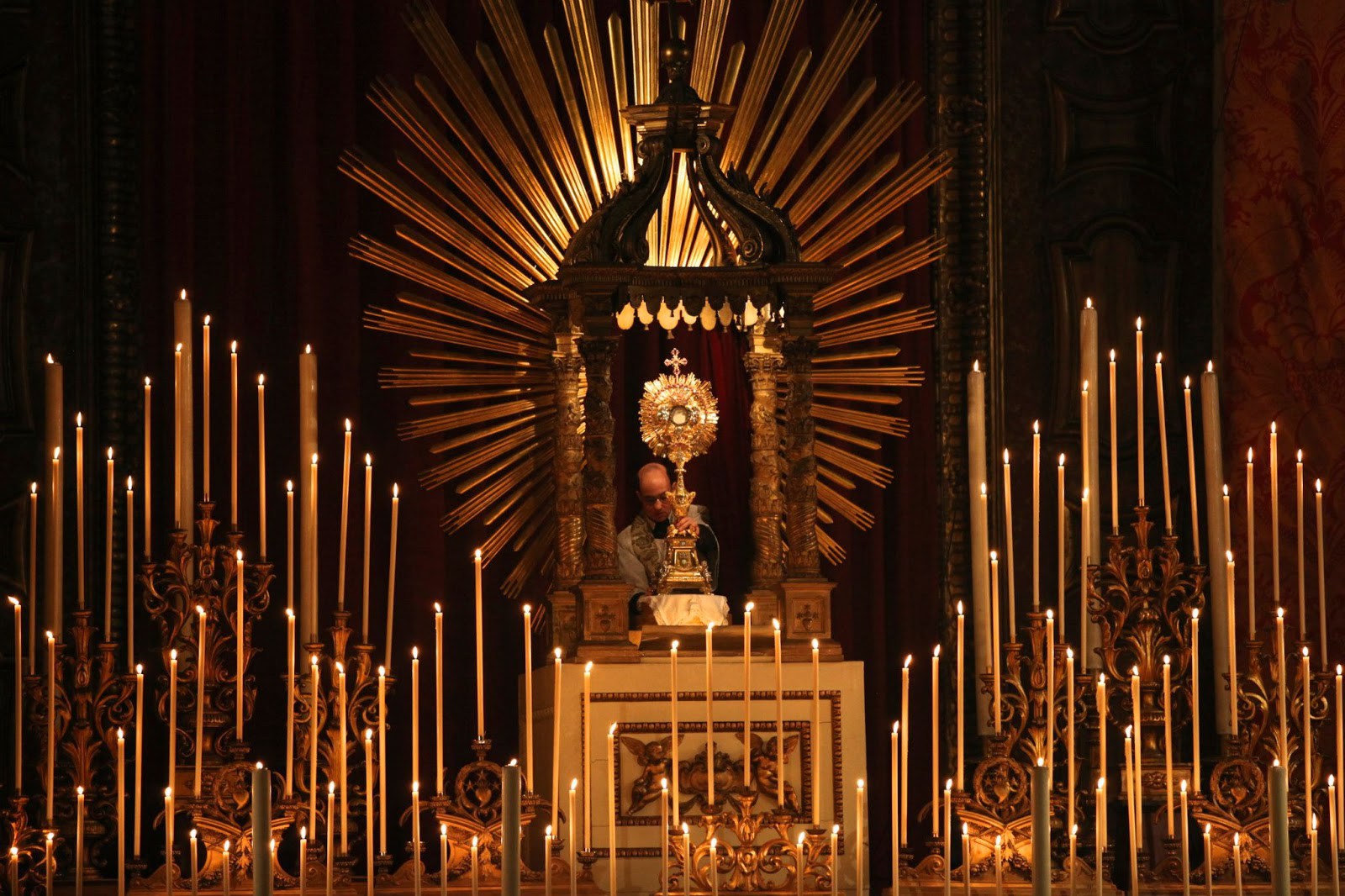
For the past few years, the FSSP parish in Rome, Santissima Trinità dei Pellegrini, has celebrated the traditional devotion of the Forty Hours of Exposition of the Blessed Sacrament on the three days before Lent begins. Three years ago, we published an article by Henri de Villiers in a translation by the authors of the blog Canticum Salomonis, on the origin and significance of this practice, which also explains a bit about the “machina”, as it is called in Italian, which is set on the main altar especially for this kind of exposition. Our thanks to the parish for sharing these beautiful photos with us.

The Archconfraternity of the Most Holy Trinity of the Pilgrims traditionally did the Forty Hours devotion once every month, and for many years, it was maintained continually in Rome, beginning in one church as it ended in another. A special medallion is therefore hung over the door of the church to let passersby know that the exposition is going on, inviting them to come in and pray before the Lord.

A solemn votive Mass of the Blessed Sacrament is celebrated before the Exposition begins.

Our Roman pilgrim friend Agnese Bazzucchi attends the Mass among the members of the archconfraternity. Their habit includes a medallion with an image of their founder, St Philip Neri, kneeling before the Holy Trinity, amid a group of the members and the pilgrims whom they took care of.

Wednesday, March 06, 2019

Forty Hours at St Mary’s Oratory in Wausau, Wisconsin

The Institute of Christ the King’s church in Wausau, Wisconsin, St Mary’s Oratory, recently held the Forty Hours devotion, from Thursday, February 28, to Saturday, March 2nd. Our thanks to them for sharing with us these photos of the various parts of the celebration.

Before the end of the opening Mass, the Blessed Sacrament is exposed on the altar, and the rest of the Mass is celebrated as Missa coram Sanctissimo.

Note how the priest gives the final blessing standing off to the side and not fully turned around, so as not to turn his back on the Sacrament.
Mass celebrated at a side altar on the morning of March 1, since the Sacrament is still exposed on the main altar.

Tuesday, March 05, 2019

Bishop Schneider Celebrates at Trinità dei Pellegrini

This past Sunday, His Excellency Bishop Athanasius Schneider, who is in Rome for the ad limina visit of the bishops of Kazakhstan, celebrated Mass at the FSSP’s Roman parish, Santissima Trinità dei Pellegrini. In keeping with the old Roman custom of celebrating the Forty Hours devotion on the three days before Ash Wednesday, a solemn votive Mass of the Blessed Sacrament was said; towards the end, the Sacrament was placed a the monstrance, and set on the large throne seen in the photos below. (The tabernacle of the high altar is actually on runners, and designed to be pushed backwards precisely for this type of exposition, since back in the day, Trinità dei Pellegrini would hold the Forty Hours every month.) After the Mass, a procession was held within the church; the Sacrament was then returned to the throne above the altar until this morning, when the Forty Hours concluded.

Thursday, February 28, 2019

Forty Hours in Grand Rapids, Michigan, March 3-5

Sacred Heart of Jesus Catholic Parish in Grand Rapids, Michigan, will celebrate the Forty Hours Devotion at the traditional time between Quinquagesima Sunday (March 3rd, starting at 12:30 p.m.) and Shrove Tuesday (March 5th, ending at 7:45 a.m.) The Masses of Exposition and Deposition will be in the Extraordinary Form of the Roman Rite, featuring Gregorian Chant and polyphony by Duruflé and Lotti. This devotion serves as one of the main events of the parish’s nine-month novena of reparation for the sins of the clergy. The church is located at 156 Valley Avenue SW.

Sunday, September 09, 2018

Forty Hours for Reparation in Englewood, Colorado, Sept. 13-15

All Souls Parish in Englewood, Colorado, will hold a 40 Hours’ Devotion for the sanctification of the Church and in reparation for sins of Her members, from the evening of Thursday, September 13 through to the morning of Saturday, September 15th. On Thursday, the votive Mass for the forgiveness of sins will be celebrated, starting at 7pm, with Adoration beginning immediately after. On Friday, the Mass of the Exalataion of the Cross will begin at 8:15 am, and Adoration will resume afterwards. On Saturday morning, after prayers of reparation and Benediction, the Mass of Our Lady of Sorrows will be celebrated, beginning at 11:45 am. All three of the Masses will be offered in the Ordinary Form of the Roman Rite ad orientem; the schola will sing the Gregorian propers, including the Graduals. The church is located at 4950 South Logan Street.

Wednesday, March 07, 2018

A History of the 40 Hours Devotion, by Henri de Villiers

A warm thanks to Henri de Villiers and the Schola Sainte Cécile for permission to publish this translation of his article Les Quarante-Heurs: Histoire et Liturgie. The translation was made by the authors of the blog Canticum Salomonis, and is being publishing there simultaneously with NLM.
Les-Quarante-Heures-à-lOratoire-de-Londres-1
Forty Hours at the London Oratory
The Forty Hours refers to a period of devout prayer sustained by adoration of the Blessed Sacrament, solemnly exposed on the altar of a church for 40 hours. Traditionally, this form of prayer takes place in the hours that precede the beginning of Lent, from Quinquagesima Sunday to the Tuesday before Ash Wednesday, but it may be arranged at other times of the year as well.

HISTORY. During Holy Week, the faithful used to keep vigil in the churches before a representation of Christ’s sepulchre from the time of his death—at None of Good Friday—until His resurrection, which is celebrated by the Paschal procession in the early morning of Easter: a period of around 40 hours in total. In many places, the clergy lay the Body of Christ to rest in a tomb along with a host after the Mass of the Presanctified on Good Friday, and it was this host that was taken from the tomb and led in solemn procession to be placed triumphantly on the altar on the morning of Easter. This symbolic number of 40 hours spent by Christ in death harkens back to an old tradition already reported by St. Augustine (De Trinitate IV, 6): From the hour, then, of His death to the dawn of the resurrection are forty hours, counting in also the ninth hour itself. And with this number agrees also His life upon earth of forty days after His resurrection. (Ab hora ergo mortis usque ad diluculum resurrectionis horae sunt quadraginta, ut etiam ipsa hora nona connumeretur. Cui numero congruit etiam vita eius super terram post resurrectionem in quadraginta diebus. We should keep in mind that the ancient form of reckoning the hours does not correspond to our current practice of having hours of a fixed 60-minute duration.)

The Forty Hours, church of Bottanuco
The veneration of Christ in the tomb—which in many parts of medieval Europe became a veritable military guard of the Eucharistic Body at the tomb awaiting the resurrection—was repeated outside of Holy Week beginning in the 16th century, in response to the Protestant denial of the Real Presence of Christ in the Sacred Host outside the Mass. The Forty Hours—at first considered an exceptional devotion—appeared in Milan in 1527 amidst wars and calamity, the sack of Rome and the French invasion of the Duchy of Milan. They were instituted by Giovanni Antonio Bellotti for the beginning of each trimester until 1529. In 1537, the Milanese Capuchin Giuseppe da Ferno took up the practice and made of it a series of solemn prayers with a Eucharistic procession: when one parish ended its Forty Hours, another took its place, such that the Holy Sacrament was adored perpetually (this practice is the origin of perpetual adoration). St. Anthony Mary Zaccaria (1502 † 1539), the founder, also at Milan, of the Clerks Regular of St. Paul (the Barnabites) promoted them with great zeal

The Forty Hours at Azzone in Italy
The Capuchins and Barnabites rapidly diffused the Forty Hours beyond Milan. Giuseppe da Ferno introduced the devotion to Pavia, Siena, and Arezzo during his missions there in 1537-1539, and his confrere Francesco di Soriano established the custom in Umbria. In 1550, St. Philip Neri introduced them in Rome and had the custom of organising them at the beginning of each month in the various churches of the Confraternities he directed, among which was the Santissima Trinità dei Pellegrini. At Messina, besieged by the Turks in 1552, it was the Jesuits who organized them to beg for and obtain the liberation of the city. Beginning in 1556, the Jesuit order was used to making the Forty Hours prayer from Quinquagesima Sunday to the Tuesday before Ash Wednesday, in order to expiate the faults committed during Carnival.
The Forty Hours Machine at the church of Bienno, Italy
In 1575 the archbishop of Milan, St. Charles Borromeo, in a pastoral letter of wondrous eloquence on the sacredness of Septuagesima, deplores the sad state of those lukewarm Christians who use these precious days so poorly, when they should be giving themselves over especially to prayer and good works. To that end, he ordered the organization of Forty Hours in the largest diocese of Europe: the Blessed Sacrament would be exposed for three days before Lent, in the cathedral of Milan, and in thirty other churches in the city; in the morning and evening there would be a solemn procession, and the parish priests would distribute the hours of the day for their parishioners, in such a way that there would always be a large number of adorers before the Most Holy Sacrament.

The Forty Hours machine of the parish of Colere in Italy
On the 25th of November 1592, Pope Clement VIII, in the Constitution Graves et diurturnae, organized the Forty Hours in the city of Rome in the form in which it had been done previously by Giuseppe da Ferno: in a continuous manner, the prayers would begin in one Roman Church just as they ended in another. The Pope asked that the prayer of Forty Hours be made for three intentions:
  1. For the salvation of the Kingdom of France, at that time rent by the succession of Henry III,
  2. for the victory of Christianity against the Turks,
  3. for the unity of the Church.
The pope began this series of prayers on the 30th of November 1592 at the Sistine Chapel.

Neapolitan machine

Thursday, October 26, 2017

40 Hours at Holy Innocents in NYC, Oct. 27-29

The Church of the Holy Innocents in New York City will start its Forty Hours Devotion tomorrow evening, at 6 p.m., with a Votive Mass of the Most Blessed Sacrament, followed by Exposition of the Blessed Sacrament a solemn Eucharistic procession inside the church, the Pange lingua, the Litany of the Saints; other special psalms and prayers will be chanted. On Saturday, October 28 at 1 p.m., the traditional Votive Mass for peace will be celebrated. The closing Mass on the third day, Sunday, October 29, will be that of the feast of Christ the King, starting at 10:30 a.m celebrated coram Sanctissimo (in the presence of the Blessed Sacrament exposed throughout the entire Mass). At the end of the closing Mass, the Litany of the Saints and other special psalms and prayers will be chanted and we will have another Procession of the Blessed Sacrament inside the church. This Procession will end with Benediction of the Most Blessed Sacrament, the Divine Praises, and the recitation of the Act of Consecration of the Human Race to the Sacred Heart of Jesus.


Thursday, August 06, 2015

40 Hours’ and Sawdust Carpets in a Eucharistic Procession

On Monday, August 3, Saint Joseph Parish in Williamsburg, Pennsylvania, celebrated the close of 40 Hours’ Devotion. A packed attendance included over 20 priests of the Diocese of Altoona-Johnstown, seminarians, Fourth Degree Knights of Columbus, and the parish community. Antiphonal and sacred music selections were conducted by Nicholas Will, Assistant Professor of Music at Franciscan University of Steubenville. A beautiful tradition which the pastor Saint Joseph’s, Fr. Aron Maghsoudi, has included with this annual 40 Hours’ is sawdust carpets. Parishioners dyed sawdust in burlap bags in a number of different colors, drew outlines of liturgical designs in chalk, then filled them in to create a beautiful “carpeted” walkway for the priest to follow during the Eucharistic Procession. The idea of sawdust carpets originated at a seminary in the Black Forest region of Germany; the tradition eventually found its way to the United States in an area near Pittsburgh called Tarentum in 1943. The priest there, Father James MacNamara, assistant pastor of the former Sacred Heart Parish, suggested it as a good way to celebrate the feast of Corpus Christi. (Thanks to Mr Jordan Hainsey for sending us these photos.)


Friday, October 03, 2014

Upcoming Events : 40 Hours in New York, A Suspicious Concert in Philadelphia, Requiem in Latrobe

The weekend of October 17-19 will be busy with interesting events. In New York City, the Dominican Church of St Catherine of Siena will hold a Forty-Hours Devotion. The preacher this year is Fr. Gabriel O’Donnell, O.P., who in addition to being a renowned preacher and spiritual director, is the postulator of the causes for canonization of Mother Mary Alphonsus (Rose Hawthorne) and the Venerable Fr. Michael J. McGivney, founder of the Knights of Columbus. The weekend’s devotions will include ample time for Eucharistic Adoration, Masses, Confessions, and the music of St. Catherine’s professional choir, Schola Dominicana. Full details are available in the flyer below.


On Friday October 17th, at 8 p.m., the Suspicious Cheese Lords will offer a special concert at the Cathedral Basilica of Ss Peter and Paul in Philadelphia. The Cheese Lords (see explanation here and here) are a sacred music ensemble specializing in the works of lesser-known composers; the concert is described as follows on their website:

The Suspicious Cheese Lords present a program of unaccompanied Renaissance works, focusing on an exquisite but little-known repertoire, such as an anonymous setting of the Salve Regina from a 17th-century Guatemalan choirbook. The bulk of their program will consist of “FrankenMass,” a complete Mass setting which they’ve crafted from five different bodies (of work), and sutured together with the threads of their parodied melodies. Come hear the Cheese Lords dig up a war song, a love song, a Gregorian chant, and a polyphonic motet from the Renaissance and reanimate them into…FrankenMass!

On Saturday, October 18, at 10:30 a.m., St Vincent Archabbey in Latrobe Pennsylvania will celebrate a Requiem High Mass for Br. Nathan Cochran, O.S.B., who passed away on July 30, 2014. Br. Nathan was a monk of the Archabbey, where he taught art and music at the college, and served as curator and director for over 20 years at The Saint Vincent Gallery. He is most known for his works as the Canadian and U.S.A. Delegate for the Kaiser-Karl-Gebetsliga für den Völkerfreiden, (Emperor Karl League of Prayers for Peace Among the Nations). He worked at Vatican City as the special secretary for the Beatification of Emperor Karl I of Austria. He received the Signum Memoriae Civilian Medal of Honor from H.I.R.H. Otto von Habsburg, Archduke and Crown Prince of Austria and King of Hungary; it was the first time the medal had been bestowed since 1898, and was presented in honor of Archduke Otto’s 95th birthday. Full details are available in the flyer below.

More recent articles:

For more articles, see the NLM archives: