Friday, March 27, 2026

Catholic Sacred Music Project Summer Institutes at Princeton, NJ, June 7th - 20th, 2026

Composing, Singing, Conducting Institutes With Sir James MacMillan, Gabriel Crouch, Tim McDonnell, and Peter Carter

The Catholic Sacred Music Project (CSMP), led by Peter Carter, is once again hosting workshops on the Princeton University campus this coming summer. As in 2024, the CSMP is hosting three institutes - composition, singing, and conducting – with unparalleled opportunities to work with an incredible faculty that includes Sir James MacMillan (whose Angels Unawares was premiered by The Sixteen in the Sistine Chapel on March 22nd – see the video below), Gabriel Crouch of Princeton University, and Timothy McDonnell of Hillsdale College. See posters for each workshop below.

The event is co-sponsored by the Scala Foundation, and there will be talks to the attendees by me and Margarita Mooney Clayton. Margarita, Executive Director of Scala, has been giving tours of the Gothic Princeton University Chapel. She will explain the content and the symbolism of the spectacular stained glass and the images depicting the unity of human reason and supernatural knowledge. (Mass takes place for the students in this beautiful chapel on the University campus on a daily basis during the academic year, and the choir director for Sunday Mass is Peter Carter.) I will talk to the young musicians on the faculties of creativity and co-creation with God in the creative process in art and music for the liturgy.
Tim McDonnell directs at the CSMP Institutes, 2024, in Princeton Theological Seminary Chapel
In addition, there will be public events on June 13 and June 19:

Scala Foundation is pleased to once again welcome the musicians to the chapel at Princeton Theological Seminary for a free public lecture and performance on Saturday, June 13th, at 11:30 am.

A second public concert with talks will take place at 7 pm, Friday, June 19th, at St. Paul’s Catholic Church in Princeton, NJ.

More details forthcoming, but save the dates for these incredible public events!

Please share this incredible opportunity with young musicians—applications are open until mid-April.

Conducting Institute with Dr. Timothy McDonnell – June 7-13, 2026

Composition Institute with Sir James MacMillan – June 14-20, 2026

Choral Institute with Gabriel Crouch – June 14-20, 2026

In-depth information about each program can be found on the CSMP website. There will be more details about each program soon, but for now, please look at the programs to see if you would be interested in applying, and forward the information to any musicians you know who may be interested.
sacredmusicproject.org
Here is a video of the world premier of Sir James MacMillan’s oratorio in the Sistine Chapel on March 22.

Wednesday, December 13, 2023

A Marian Pilgrimage in Oxford

Transmiting the Faith, contributing to the culture, and building community amongst friends.

Here are some photos and of a pilgrimage that my wife Margarita and I undertook recently, on the Saturday morning before the Solemnity of the Immaculate Conception. The idea began because Margarita is on sabbatical at Blackfriars College, the Dominican house in Oxford. The Dominicans have a great devotion to Mary of course and Margarita offered a weekly breakfast seminar group, open to all, focusing on the role of Mary as Theotokos. It was offered especially for searchers who are looking at the Faith and the Catholic approach to Mary, including pilgrimages and devotions. It attracted many Protestants who were curious, as well as Catholic and Orthodox students. The core of this group was enthusiastic to go on a pilgrimage, and so we organized one together.

Our pilgrimage was a deliberately low key, do-it-yourself affair, but all the more joyous an occasion for it. It is another expression of our cultural mission of trying to offer the faith through personal connection and hospitality to others. The content, route and day were totally our own idea - we weren’t following any precedent that we were aware of. We just decided to create our own pilgrimage and invite people to be our friends along the way. It was planned and organized with an Oxford graduate student, Lauren Spohn, and we  had great support from a core of singers who helped us sing the eight stations along the towpath. Eleven people came along and braved the cold - it was below freezing the whole time and the coldest day of the winter so far.

We met for Mass at Holy Rood Catholic Church in Oxford, after which the pastor, Fr Daniel Lloyd, sent us on our way (well wrapped up!) with the Salve Regina, a blessing, and solemn recitation of a Pilgrims’ Prayer, in which St Rafael was implored to accompany us, as I am certain he did! Our destination was the beautiful 12th-century church of St Mary the Virgin in Iffley. If you want to see some simple phone video of our humble chant on the towpath follow this link here.

Leaving Holy Rood Catholic Church
Making our way to the towpath

Those who came were a range of people - several academics and university graduate students, a lawyer, and two Dominican Sisters. One was a grad student from China who was curious, and had no prior knowledge of Christianity.

We sang opening hymns and at each station we paused and boldly sang - for all nearby to hear - a verse of the Magnificat and a hymn called the Megalynarion. I led the line of people, holding an icon of the Theotokos, and we decided to progress in silence. At the first station, a man who was coaching a rowing eight in the River Thames stopped and looked at us. He beamed broadly and said, “How wonderful to hear the Magnificat sung like that!” Others looked at us quizzically, some smiled, some seemed less happy with what they saw, but none could avoid noticing that we we doing this for Our Lady!

The words of the Megalynarion are:

More wonderful than the cherubim and more glorious beyond compare than the seraphim. Who, without stain, bore God the Word, you are truly Theotokos, we magnify you.

When we got to the church in Iffley, we put down icons to the Theotokos, Christ on the Cross, Christ in Glory and St Michael. We sang the lines of the Magnificat, the Megalynarion, the Our Father, the St Michael Prayer and finally the Salve Regina. Overall it took less than two hours!

Praying in the church

The wonderful thing about pilgrimage is that it is relatively simple to organise, but requires all those present to make a sacrifice of time and give something of themselves. This inevitably opens the hearts of those present to the mysteries being contemplated in a way that attending a lecture could never do. The shared experience brought us together and established, one personal interraction at a time, an authentic culture of faith that has the power to draw others in, because all are so obviously invited.

We invite friends to our home regularly to sing the Office and for dinner, as part of our witness of the Faith. This is something else by which we re-establish a Christian culture of faith through personal contact. We hope to do many more pilgrimages like this in the future. We also hope to encourage people to think about organising their own. This format is adaptable - we can easily change the hymns to suit the place and the occasion.

This pilgrimage was consummated six days later for those who participated in the feast of the Immaculate Conception on December 8th. Margarita and I attended a beautiful sung Mass at Holy Rood, the church from where we set out earlier that week.

Below I have posted an excerpt from the front sheet of the materials handed out on the day that explained the structure, and the poster that was circulated to attract people:

We will gather in the car park of Holy Rood Church immediately after Mass for the first station. We encourage you to walk silently together reflecting on words we have sung. We will pause six times along the way with a signal from the cantor. At each of these stations the cantor will sing a stanza of the Magnificat and then we will all sing the Megalynarion (the ancient hymn to Mary sung in the Byzantine liturgy daily). When we get to St Mary the Virgin, we will go into the church, gather before the altar with the icons set before it, and sing the final station and the closing prayers and hymns. We then adjourn for lunch at a nearby pub for any who wish to come.

Eight pilgrim stations - we have eight stations. The first seven represent the old covenant and the seven days of Creation. The eighth represents the new covenant ushered in by the life, death and resurrection of Our Lord, who is called the ‘eighth day’ of Creation. Also, seven repetitions, in the number symbolism of the Old Testament, constitute the equivalent of a single, perfected or continuous act. As the Psalmist says, ‘The words of the Lord are pure words: as silver tried by the fire, purged from the earth refined seven times.’ (Ps. 12, 6). For the Christian, eight repetitions represents superabundance, an overflowing of that old perfection into all things, made new in Christ. The governing number of the pattern of Christian liturgy is eight, rather than seven. For example, the weekly day of worship was moved from the Jewish celebration of the Sabbath (Saturday) on the seventh day, to the Lord’s Day (Sunday), which is simultaneously the eighth day of the previous week and the first of the next. This is why also we have octaves for feast days in the liturgy. There are many examples, through centuries of tradition, where we see the pattern of eight manifested in sacred time and, for example, in sacred art and architecture.

By chanting eight stations we hope to participate in the Pauline exhortation to pray without ceasing:

“Rejoice always, pray without ceasing, give thanks in all circumstances; for this is the will of God in Christ Jesus for you.” (1 Thessalonians 5, 16-17)


The icons - we will lay down the three core and essential images for worship: Our Lady showing us Her Son, Christ on the Cross, the Risen Christ. These together communicate essential truths of salvation history, the person from whom Our Lord, who is both God and man, received his humanity; the life, the death, and the Resurrection of Our Lord. And they tell us that we participate also in that story, putting on Christ. St Augustine said that when we sing our prayers we pray twice. I would extend this argument and say that when we sing our prayers and engage with sacred art and consider our posture we engage the whole person, body and soul, in what becomes a multifaceted act of worship.

Tuesday, September 26, 2023

The Art of Virtue and the Virtue of Art

This is the foreword to The Shape of the Artistic Mind, by Fr Bradley T. Elliot, OP, recently published by Pontifex University Press on September 6. It is written by Margarita Mooney Clayton.

What is art for? For many, the answer is that art is simply for self-expression or for enjoyment. Listening to music is pleasing (who chooses to listen to ambulance sirens?) Anyone who appreciates art can see that a Picasso is not a Rembrandt—the imprint of each artist is distinct.

What is moral virtue for? Moral virtue is a means of human perfection. Moral virtue is doing good; moral virtue requires effort, perhaps sacrificing something short-term for a longer-term material or spiritual benefit. 

The idea that art is related to moral virtue will strike many as quite odd. Art, understood as self-expression or enjoyment, is a spontaneous realm apart from the calculating, choosing, and sacrificing of virtue. Art as self-expression or enjoyment must therefore allow for total freedom to explore one’s desires; by contrast, the hard-won perfection of moral virtue requires restraint and discipline.

Modern Romantic notions of art have emphasized the subjectivity of human creativity, purportedly to free human instincts in order to reach their fulfillment. But by separating art from reason, Romanticism opened the way for what we see today: much of the art produced today is kitsch—excessively sentimental—or transgressive (seeking to shock or produce outrage).
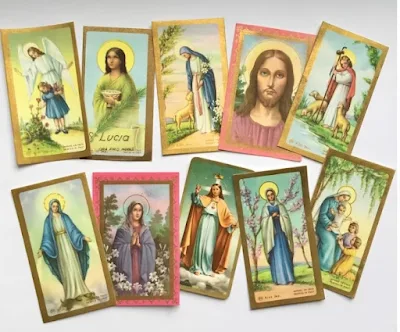
Catholic kitsch: prayer cards from the 20th century
But in his book The Shape of the Artistic Mind,,  Fr. Brad Elliott, O.P., provides a crucial philosophical grounding that will connect art back to moral virtue. Re-thinking the relationship between art and virtue leads to very different answers to the questions: What is art for? What is moral virtue for?

Through a thorough review of Thomistic principles, Elliott moves from considerations about art as an imitation of God’s creation to art as a virtuous participation in God’s governance. For Elliott, both art and moral virtue are ways that humans imitate God; by imitating God, we therefore participate in His governance, as he draws all things back to Himself. To some finite degree, all creation, from small living organisms like molecules to inanimate things like stones, participate in God’s being. But Elliott emphasizes that only the rational human person participates in God's governance through the activity of acting and making.

By bringing new things into being, humans co-create with God. Apart from virtue, the power to bring new things into being will be disordered. As he writes, “art and morality are merely two aspects of man’s participation in the reason and creativity of God.” Hence, art seen as a practical virtue extends God’s governance over creation. Humans move towards their proper ends, contribute to their own governance, through co-creation with God.

Elliott contrasts this view with Plato, for whom human creativity could only ever represent a shadow of the ultimate reality. For Plato, no human advancement in knowledge or art could ever get us out of the cave—we are forever seeing only shadows of reality.

By contrast, Elliott explains that our rationality is not purely speculative or abstract. Rather, the human person has the unique capacity to take an idea and impress it upon the external world, making what we create something that shares in the spark of God’s reason. As he explains, building on St. Thomas Aquinas, Etienne Gilson and other Catholic thinkers, “by learning to imitate nature and her laws through skill or craft, the human intellect is also learning to imitate the Divine creator… Simply put; God, nature, human intellect, and art all relate by a mysterious pattern of imitation spanning the whole range of the cosmos.”

By emphasizing the intellect as a commonality between art and moral virtue, Elliott does not dis-regard human enjoyment or self-expression. The problem is that not all things that humans create, think, or do are good. If we are fallen and wounded creatures, why would we magically expect all art to be morally good? And why do so many people seem to think that there is no objectivity in what we enjoy or how we express ourselves?

Elliott’s Christian anthropology—his understanding of who we are as humans—underlies his entire argument. Human beings are a unity of body and soul; we have the capacity to make things and to contemplate. Elliott brilliantly describes how humans imitate God in a finite manner by bringing the outside world into the mind through contemplation and then going back out, perfecting things in art. As he writes:

“This bringing the outside world into the inside world terminating in the perfection of the inside, the intellect’s perfection of knowing, is the intrinsic operation of which St. Thomas speaks. By this action, the created intellect imitates God-as-artist in an unprecedented way, by imitating, in a finite manner, the oneness and unity of its creator…Art or craft is the mode by which the perfection of the inside world (the act of knowledge) impresses its likeness on the outside world; perfective action moving from the inside out.”

If moral virtue is imitating God’s goodness, and artistic creation is imitating God’s creation, then co-creating through art is one of the ways we participate in God’s governance. Art and moral virtue, thus, participating in God’s governance: using human freedom to direct our thinking and action towards their true ends.

Art understood as a practical virtue makes visible the invisible inner world of the human person and the goodness of God. By participating in God’s governance, art understood as a practical virtue contributes to the right ordering of creation.

St Joseph with Our Lord, by Georges De La Tour, French 17th century.
In spite of our woundedness as experienced in laziness, idle curiosity, and self-centeredness, we can grow in virtue through art. Elliott provocatively states that “it is the virtue of art that emerges as the supreme master coordinator between man’s internal and external worlds.” The very act of writing this short essay is an expression of art as a practical virtue: I’ve fought many distractions as I read and pondered Elliott’s words and crafted my own thoughts into words to share with readers.

Art is not moral as in a command about how to act, but art can “indirectly influence morals by providing an ‘aptness’ to act well.” Like books and articles which encapsulate ideas into form, the music, paintings, nature, we encounter are an invitation to contemplate God’s goodness. Focusing my attention to craft this article forms my inner life to be more apt in moral virtue. By co-creating with God, we imitate His goodness, participate in His governance, and bring more of creation into the divine unity.

St Bonaventure Receiving the Blessed Sacrament, by Francisco Herrera the Elder, Spanish, 17th century.

Margarita Mooney Clayton is founder and Executive Director of the Scala Foundation, a non-profit which has the mission of promoting beauty in education and the transformation of American culture.

Fr Bradley T. Elliot is a priest of the Western Dominican Province of the USA.

Tuesday, August 22, 2023

The Enduring Mystique of the Mother of God

by Margarita Mooney Clayton

Here is a another guest post by Margarita Mooney Clayton, the founder and Executive Director of Scala Foundation, a non-profit which has the mission of promoting beauty in education and the transformation of American culture. This piece will appear in the Christian magazine Comment in September; a sign, perhaps, that as Protestants search for authentic tradition and their Christian roots in order to bolster their churches against the attacks of today, there is a greater openness to a traditional understanding of role of Mary in salvation.

I chose the images for this post, and what struck me is how simple it was to draw on the rich tradition of images of Mary to illustrate the aspects of Mary that Margarita Clayton discusses. This is undoubtedly because her thoughts are inspired by the writing of Benedict XVI, which is turn rooted in scripture and holy Tradition.

She writes:

Doctrine and devotion. Practices and experiences. Doing and being. Mystery and Identity. Seeing and knowing. How do doctrine, images, story, and identity all come together in the journey of Mary?

After reading Benedict XVI’s Chapter 4, “Hail Full of Grace: Elements of Marian Piety According to the Bible,” in Mary: The Church at the SourceI saw more clearly that we are called to know Mary in our hearts, not just our heads. Whether we are already familiar with Marian doctrine and piety, or this entire topic is new to us, many people are curious about Mary. They are drawn to her image and her life story. Much of the history of Marian piety undoubtedly has a deep mystical element—personal revelations, pilgrimage sites, a profound sense of need for a mothering, nurturing figure.

In previous chapters of Benedict XVI’s book, he characterizes an activist view of the Church as masculine and a feminine view of the Church as a home.

The verbs associated with Mary like listen and ponder convey deep, slow, intuitive movement. Nouns associated with Her like seed and soil also point to depth, humility and patience. Caryl Houselander writes that Mary is like fugue—a musical term for repetition, interweaving, and bringing together.
The Annunciation, by Fra Angelico, Italian 15th century. 
Mary is a woman of prayer, a woman who knows what it is to pray. She is a model of prayer, and a prophet, a visionary… but a prophet and visionary who can be in the dark and have faith, not a visionary who flees from this life’s troubles.
Mary of the miracles.
The image of Our Lady of Guadalupe, miraculously created, and through it, miracles of conversion occurred.
Mary of the sorrows.
Our Lady of Sorrows in the church of Vera Cruz, Salamanca, Spain, 17th century polychrome wood carving.
Mary at the cross.
Mary at the foot of the cross, with St John, to the left of the figure of Christ as we see it. Painting by David Clayton.
Mary slaying demons.
The Immaculate Conception, by Tiepolo. Italian 18th century
Mary encapsulates the paradoxical meanings of Christianity: the divine became human; matter can be made whole; suffering can free us; darkness contains light.

Studying Mary isn’t enough. We are called to know her, and through knowing her, to know her son, and therefore to know ourselves as God made us to be. How do we come to know Mary? One way is through prayer.

But studying Mary also has helped me to know her. As with any of the saints, Mary can seem distant, perfect, so close to God, so special to God. I can’t have that kind of intimacy with God, I often tell myself. Let me just use my head to learn the teachings of the church; let me just submit my body to the practices of the church and I’ll find peace and happiness.

Tuesday, January 17, 2023

Join an Online Discussion with Iconographer Jonathan Pageau, Jan 30th.

The Scala Foundation is inviting you to their next online interactive discussion, featuring the iconographer Jonathan Pageau on January 30, from 12-1 PM ET; You can RSVP by following this link; the event is free of charge. Jonathan is one of today’s leading iconographers and a widely-sought after public speaker who excels at plumbing Scripture and tradition to explore the rich symbolism of Christianity, including that of Mary, the Mother of Jesus. I certainly plan on attending!

Images of the Virgin Mary abound in nearly every Christian culture. To understand Her role in salvation, scholars often refer to Scriptural images such as the burning bush in Exodus. Why are there so many symbols that reflect on the meaning of Mary’s life? How is it that one woman has been so influential in the individual identity of so many people, the formation of the church, and the memory of nations? What does it mean to say that reality is veiled through symbols? How does Marian imagery reveal universal archetypes—that is, models of a life of faith?   

Scala’s Executive Director Margarita Mooney Clayton will serve as the host of this interactive conversation. As a sociologist and contextual theologian, Mooney Clayton has written on and taught about Marian devotion among Italian, Haitian and Mexican immigrants to the United States as well as African-Americans. This online event will be structured as a seminar—a guided discussion in which the audience may interact with the hostess and guest speaker. Mr Pageau will further explore the symbolic meanings of Scripture at his keynote address at Scala’s conference on Art, the Sacred and the Common Good on the campus of Princeton Theological Seminary, April 21-22.
If you RSVP here, Scala Foundation will send the link for participation to anyone who registers. And if you haven’t done so already, register to join Margarita and me in-person or via livestream for Scala’s annual conference from April 21-22, 2023, featuring artists such as Mr Pageau and my old teacher Aidan Hart!

More recent articles:

For more articles, see the NLM archives:



