Wednesday, November 26, 2025

From All Saints to Advent: the Dedication Feasts of November

In the Roman Breviary, the Matins lessons for the dedication feasts of the Lateran and Vatican basilicas state that Pope St Sylvester I (314-35) consecrated them on November 9th and 18th respectively. However, there is no contemporary or early historical source that attests to this. The Liber Pontificalis, which dedicates a considerable amount of space to Sylvester’s career, says nothing of it; neither do his contemporary Eusebius of Caesarea, the famous Church historian, or the acts of Sylvester mentioned in the Gelasian Decree (ca. 500 A.D.) as one of the reliable lives of the Saints to be read in the liturgy. The tradition of these dates seems to have been popularized by a much later sermon which was commonly read at Matins of a church dedication. [1]
The Consecration of the Lateran Basilica by Pope St Sylvester I; fresco in the transept of that basilica, by Giovan Battista Ricci (1597-1601). The decorations in this part of the church were commissioned by Clement VIII (1592-1605), the same Pope who issued the Roman Pontifical, the liturgical book which contains the rite of a church consecration. (Image from Wikimedia Commons by Sailko, CC BY 3.0)
The earliest liturgical books of the Roman Rite do not have these feasts, nor indeed, any annual commemoration of a church’s dedication at all. Such feasts are one of the enrichments introduced into the liturgy in the Carolingian period, and these particular two examples are indisputably post-Carolingian. As I noted in an article last week, in the Middle Ages they were kept only in Rome itself, and did not begin to be celebrated by other churches until after the Tridentine reform, when those churches adopted the Breviary and Missal of St Pius V, and their calendar with them.
This means that they also post-date the institution of the feast of All Saints, and I here make bold to offer an explanation of why this may be relevant. It is impossible to say, and I certainly do not pretend to say, whether this was a deliberate choice of the unknown persons who instituted them, or another happy example of the mysterious providence by which God refines the liturgy towards ever great beauty and intricacy.
On October 31st, the Church militant upon the earth prepares itself for the great solemnity of All Saints with a day of fasting, as it does for all the greatest feasts. On November 1st, it celebrates all the Saints in the Church triumphant in heaven, and the following day, prays for all those in the Church suffering in Purgatory. Thus, the three liturgical days are dedicated to the three parts of Christ’s mystical body, on earth, in purgatory, and in heaven.
Speaking only of those feasts which are attested on calendars of the Roman Rite from the earliest times [2], November continues with at least one feast of each of the traditional classes of Saint: the Apostle Andrew on the 30th; a martyred bishop, Pope St Clement I, on the 23rd; a martyr, St Chrysogonus, on the 24th (plus the Eastern martyrs Theodore and Menna); a group of several martyrs, the Four Crowned Martyrs, on the 8th; a confessor, St Martin, on the 11th; a virgin and martyr, Cecilia, on the 22nd, and a matron, St Felicity, also on the 23rd. Thus the month itself becomes, so to speak, an icon of all the Saints.
The calendar page for November in a Gregorian sacramentary produced in the second half of the 9th century at the abbey of St-Amand-les-Eaux, about 130 miles north north-east of Paris. (Bibliothèque nationale de France. Département des Manuscrits. Latin 2290). All of the Saints named above are included except for the Egyptian martyr Menna, whose feast coincides with that of St Martin, kept in Gaul as a solemnity of the highest degree, and therefore without commemoration.
With the exception of Martin, each of these Saints is also very Roman. St Andrew is the Apostle Peter’s brother, and has been the subject of great devotion in the Eternal City from earliest times. The rest are either Roman themselves or have important Roman connections. Clement, Chrysogonus, Cecilia and the Crowned Martyrs all have large and prominent basilicas in the city; Felicity had one near the catacomb where she was buried, and the feast of her seven sons on July 10th is in all Roman liturgical books, going back to the so-called Leonine Sacramentary.
Looking back to the earliest calendars, there is no other month which has such a variety of different kinds of Saints, and almost all of them Roman. Perhaps this was the inspiration for placing the annual commemoration of the dedication of Rome’s cathedral in November as well, once such a commemoration had been instituted as a regular feature of the liturgy. And when this was done, the logical thing would be to also add the commemoration of the dedications of the basilicas of Ss Peter and Paul, the Roman church’s two apostolic founders and principal patrons. This complex month-long celebration of the church of Rome and its Saints would then serve as the link between All Saints and the beginning of the new liturgical year in Advent, the season which draws our mind both to the first coming of Christ in the Incarnation, and His second coming in glory at the end of the world, when all the Saints shall be perfected in the fullness of His Redemption.
The placement of the two dedication feasts between All Saints and Advent thus also reminds us of the mediating role which the Church itself plays in bringing us to our own place in heaven among the angels and the saints. And perhaps it is not too extravagant to posit that there is some intentional symbolism in placing them at intervals of nine days, the number of the choirs of angels in heaven: the dedication of the Lateran is on the 9th, of Ss Peter and Paul on the 18th, and the earliest possible beginning of Advent on the 27th.
The interior of the dome of St Peter’s basilica, with Christ, the Virgin, the Baptist and the Twelve Apostles, and above them, the choirs of angels, with God the Father in the mosaic inside the lantern. (Image from Wikimedia Commons by Gary Ullah, CC BY 2.0)
[1] The first part of this sermon, which opens with the words “Consecrationes altarium”, was read as the lessons of the first nocturn of a church dedication in the pre-Tridentine Roman breviary, and the Office of many other liturgical Uses. In the breviary of St Pius V, it is rewritten according to the general literary criteria of that reform, and read in part in the second nocturn of November 9, and in part on the 18th, with various other material added to it. The lessons for these two days were considerably expanded in later additions, in order to give more of the history of the three churches as they were rebuilt and renovated in the 17th, 18th and 19th centuries.
[2] All of these are in their places by the time the first version of the Gregorian Sacramentary was created towards the end of the 8th century.

Tuesday, November 18, 2025

The Dedication of the Basilicas of Ss Peter and Paul

The basilicas which house the tombs of Saints Peter and Paul are among the six which the Emperor Constantine built in Rome in the first years of the peace of the Church. Already by the later 4th century, a hymn of St Ambrose speaks of a procession to visit them both on the Apostles’ feast day, June 29th. However, the most ancient liturgical books of the Roman Rite do not attest to a celebration of the anniversary of their dedication, nor indeed of any such anniversary; the annual commemoration of the dedication of a church is one of the many happy inventions by which the Carolingians enriched the Roman Rite. It is reasonable to assume that once this custom had taken root, the joint celebration of the dedication of the two basilicas was inspired by the joint celebration of the two Apostles to whom they are dedicated, which is one of the universal and most ancient customs of all Christian liturgy. As far as I have been able to ascertain, this is the only pre-Tridentine example of the dedication of two separate churches being kept as a single feast.
Pope Urban VIII draws the letters of the Latin alphabet in ashes spread over the floor, during the consecration of St. Peter’s Basilica on November 18, 1626, the 1300th anniversary of the original church’s consecration by Pope St Sylvester I. (Roman tapestry, ca. 1660)
Prior to the Tridentine reform, however, this feast and the dedication of the Lateran basilica on November 9th were kept almost nowhere outside of Rome itself. Even the Franciscans, who adopted the liturgy of the Roman Curia from their very beginning, did not keep either one. Most of Europe celebrated November 9th as the feast of the martyr Theodore, who is still commemorated on that day, and the 18th as the octave of St Martin.
The breviary of St Pius V, issued in 1568, and the missal which followed it in 1570, were the first liturgical books of their kind deliberately designed to be used outside their place of origin, since they came with the Pope’s permission (not requirement) to adopt them anywhere the Roman Rite was used, in place of the local liturgical use which had hitherto prevailed. However, the liturgy of November 18th contains an interesting anomaly which is found on no other occasion; although the feast commemorates the dedication of two different churches, the Collect of the Mass, which is also said six times in the Office, remains in the singular.
“Deus, qui nobis per síngulos annos hujus sancti templi tui consecratiónis réparas diem … præsta, ut quisquis hoc templum beneficia petitúrus ingréditur, cuncta se impetrasse laetétur.
O God, who each year renewest for us the day of the consecration of this Thy holy temple … grant that whoever entereth this temple to ask for (Thy) favors, may rejoice in having obtained all (that he sought).”
The prayers for the Mass of the anniversary of the dedication of a church in the Echternach Sacramentary, 895 A.D. (Bibliothèque nationale de France, Département des manuscrits, Latin 9433)
Likewise, none of the other references to “church” in the singular are changed in either the Office or the Mass. Since most places in Europe only began to keep these feasts when (and if) they adopted the Roman liturgical books, they would have encountered this anomaly for the first time in the celebration of this feast.
Some might find it tempting to dismiss this as no more than an example of the habitual, and some might say lazy, liturgical conservatism of the Roman church. I do not believe this to be the case, since the Tridentine books are in so many ways a carefully thought-out response to the novelties of the Protestant reformation.
It is well known that the Reformation, starting with Luther himself, pretended to find justification for its novelties in some of St Paul’s letters, which became for them “the canon within the canon”, the yardstick against which everything else in Scripture, tradition and history was to be measured. This includes not just everything taught by the papacy and the Church in communion with it, but the papacy itself, and thus would the so-called reformers pit Peter and Paul against each other. The Roman liturgy (more precisely, the specifically Roman iteration of it then spreading out to other parts of the world), therefore treats the two churches and the two tombs of the two Apostles as if they were one, to lay emphasis on their real and ancient unity, always faithfully maintained and fostered by the Roman church.
The chancel arch, apse and high altar of the basilica of St Paul Outside-the-Walls, seen from the nave. Each image of St Paul is accompanied by one of St Peter, on the chancel arch, in the apsidal mosaic, and with the two statues seen here at the lower corners. (Image from Wikimedia Commons by Fallaner, CC BY-SA 4.0)
As noted above, the joint feast of Ss Peter and Paul is extremely ancient, while that of the dedication of their basilicas is a product of the early Middle Ages. The Protestant reformers believed that they could restore the original ancient Christian faith by liberating it from the supposed accretions of the medieval period, although they often disagreed amongst themselves, and often quite violently, as to what exactly those accretions were. The Tridentine reform was essentially the Catholic Church’s answer to the question of what to do with all that it had inherited from the Middle Ages, in response to the Protestant repudiation of that inheritance. The Tridentine liturgy therefore reasserts the unity between Peter and Paul with two feasts, one ancient and one medieval, in which they are jointly commemorated, as an assertion of continuity between Christian antiquity and the Middle Ages. [1]
Furthermore, the Protestants often accused the Catholic Church of emphasizing the Saints so much as to eclipse Christ Himself. Many of them believed, and still believe, that devotion to the Saints was no more than a shallow Christianization of ancient polytheism. But this idea is refuted specifically by St Augustine, the same author to whom they turned for proof of their doctrine of grace. In The City of God, 8, 27, he writes, “But who ever heard a priest of the faithful, standing at an altar built for the honor and worship of God over the holy body of some martyr, say in the prayers, ‘I offer to you a sacrifice, Peter, or Paul, or Cyprian?’ For it is to God that sacrifices are offered at their tombs – the God who made them both men and martyrs, and associated them with holy angels in celestial honor; and the reason why we pay such honors to their memory is that by so doing, we may both give thanks to the true God for their victories, and, by recalling them afresh to remembrance, may stir ourselves up to imitate them by seeking to obtain like crowns and palms, calling to our help that same God on whom they called. Therefore, whatever honors the religious may pay in the places of the martyrs, they are but honors rendered to their memory, not sacred rites or sacrifices offered to dead men as to gods.” [2]
(The Communio of the Mass of a church dedication: “My house shall be called a house of prayer, sayeth the Lord; in it, everyone who asketh, receiveth; and he that seeketh, findeth; and it is open to him that knocketh.” Matthew 21, 13)
The choice of Matins readings for a dedication and its octave reinforces this. On the feast itself and the following five days, those of the second nocturn are taken from Augustine. On the seventh day, St John Chrysostom is brought in as a witness that the Eastern churches have always held the same ancient Faith as the West; on the octave itself, the reading is from an early medieval Pope, St Felix IV, as quoted in a medieval collection of canon law. (Canon law was especially hated by the early Protestants as one of the worst medieval “corruptions.”) Likewise, in the third nocturn, the readings begin with St Ambrose, then pass to St Gregory the Great, and finally to the Venerable Bede, a symbol of the faithful transmission of the Church’s teaching from one generation to another. [3]
The very first such reading (on the second day of the feast) shows how carefully this was all thought out, a passage from St Augustine’s Treatise on Psalm 121, which quotes both Peter and Paul.
“ ‘Jerusalem that is being built as a city.’ Brethren, when David was saying these things, that city had been finished; it was not still being built. He speaks therefore of some city, I know not which, that is now being built, unto which living stones run in faith, of whom Peter says, ‘And you are built up together as living stones into a spiritual house’ (1 Pet. 2, 5) that is, as the holy temple of God. What does it mean, ‘You are built up together as living stones?’ You live, if you believe, but if you believe, you will be made a temple of God; for the Apostle Paul says, ‘For the temple of God is holy, which temple are you.’ ” (1 Cor. 3, 17)
Ss Ambrose and Augustine, ca. 1495, by the Spanish painter Pedro Berruguete (1450-1504.) Public domain image from Wikimedia Commons.
NOTES: [1] The creators of St Pius V’s reformed books may not have understood when exactly the feast of a church dedication came into existence, but they would certainly have noted its absence from the ancient sacramentaries kept in the Vatican library.
[2] Likewise, in his treatise against Faustus the Manichaean (20, 21): “For which of the bishops, while officiating at the altar in the places where the saints’ bodies lie, has ever said ‘We bring thee an offering, Peter, or Paul, or Cyprian’? But what is offered is offered to God, who crowned the martyrs, in the places of memorial of those whom He crowned, so that great affection might arise from the association with those very places, and charity kindled towards those whom we can imitate, and to Him by whose help we can imitate them.”
[3] The reading attributed to Pope Felix is not authentically his, but this fact was unknown in the 16th century. The breviary of St Pius V reads the homily of St Gregory that begins with the words “Si veraciter sapientes” on the 4th day within the octave; in the reform of St Pius X, it was moved to the octave day.

Sunday, November 09, 2025

The Dedication of St John in the Lateran

In honor of the dedication feast of the cathedral of Rome, the Archbasilica of the Most Holy Savior, popularly known as St John in the Lateran, here are some interesting thoughts from the medieval liturgical commentator William Durandus on the Office and Mass of the dedication of a church. (Rationale Divinorum Officiorum 7, 48) The version of the Office which Durandus knows is slightly different from the version in the Breviary of St Pius V, as will be noted in the text itself.

The high altar of St John in the Lateran. (Photo by Fr Kevin Kimtis.)
The feast (of a church’s dedication) is solemnly celebrated by the Church, concerning which it is written in John’s Gospel (10, 22 and 23) “It was the ‘renewal’ ”, that is, the feast of the dedication in Jerusalem, “and Jesus walked in the temple, in Solomon’s porch” in order to confirm that festival. It is called Solomon’s porch, because He was wont to pray there, and did so on the day of the dedication. (In many medieval Uses, such as that of Sarum, this Gospel, John 10, 22-38, was read on the octave of a dedication.)

This feast also took place in the Old Testament, whence we read in the book of Maccabees (1 Macc. 4, 42-43), “Judah Maccabee chose priests without blemish, and they cleansed the holy places.” Now the Church Militant can be cleansed, but not the Church Triumphant… * the Church on earth is built in baptism (i.e. washing), and in teaching, and in penance; here are heard (the noise of) the axe and every sort of metal tool, which are the many kinds of penances and disciplines in the Church Militant, … but the temple of Solomon signifies the Church Triumphant, in which these things are not heard.

The Jews celebrated the dedication for eight days, whence it seems that we likewise ought to solemnly keep the feast of the dedication for eight days. But it is strange that they celebrated it for eight days, when they kept Passover and Pentecost for only seven. The reason for this is that this festivity especially signifies the eternal dedication, in which the Church, that is, the holy soul, will be dedicated to God, that is, will be so joined to him that it cannot be transferred to other uses. And this will take place on the octave of resurrection, and therefore, in the New Testament, this feast has an octave. (In Durandus’ original text, this paragraph is actually where the red star is marked above, interrupting his allegorical passage about cleansing the Church.)

In the Office of Matins are said those Psalms in which there is a mention of doors, which represent fear and love, as in the Psalm “The earth is the Lord’s”, where it says “Lift up your gates, o ye princes” (23); those in which there is mention of an altar, as in the Psalm, “Judge me, o God, etc.” (42, not in the Roman Use); those in which there is mention of a city, such as “Our God is a refuge” and “Great is the Lord” (45 and 47); those in which there is mention of atria and gates, such as “How lovely are thy tabernacles” and “Her foundations are in the holy mountains.” (83 and 86)

Bishop Fabian Bruskewitz during the consecration of the seminary chapel of Our Lady of Guadalupe, the FSSP Seminary in Denton, Nebraska. After sprinkling the outside of the church with holy water, the bishop knocks on the door three times with his crozier, saying the words of Psalm 23, “Lift up your gates, o ye princes, and be lifted up, ye everlasting doors, and the king of glory shall come in.” From within, the deacon answers from the same psalm, “Who is this king of glory?”, and the bishop replies “the Lord of hosts, he is the king of Glory!” A porter then opens the door, and the bishop blesses the threshold, saying “Behold the sign of the Cross, let all phantasms flee,” then, as he enters, “Peace to this house” to which the deacon replies “Upon thy entrance. Amen.”
But the question arises, why is the Psalm “O Lord, God of my salvation” (87) said? To this, some say that it is because burials are mentioned in it, but this reason is not correct, since the Psalm does not speak of such burials as those in which the bodies of the faithful dwell, or are buried in a church, but rather of the burials of the wicked. Wherefore, we say that that Psalm is said because it is a penitential Psalm, and treats especially of prayer, which is to take place in a church; whence it is said therein, “Let my prayer come in before thee.” And the Lord says of the Church, “My house shall be called a house of prayer.”

But the eighth Psalm (seventh in the Roman Use) is “He that dwelleth in the aid of the Most High” (90), that is, in the Church, in which it is said, “thou hast made the most High thy refuge,” because the Church is founded above all, on the height of the mountains.

The last antiphon, that of the Magnificat at Vespers, is “Eternal peace,” since the dedication is celebrated for this reason, that we may dedicated, and have that eternal peace.


(This antiphon, incorrectly labelled in the video as the Salve regina, is found in the Dedication Office in most medieval Uses, with a number of minor textual variations. Note the long melisma on the O of the last ‘domui.’ “Pax aeterna ab Aeterno huic domui; pax perennis Verbum Patris sit pax huic domui; pacem pius Consolator praestet huic domui. - Eternal peace this house from the Eternal One; may the Word of the Father be everlasting peace to this house; may the Holy Comforter grant peace to this house.”)

… To this feast certainly belongs Jacob’s vision of the ladder, and the angels ascending and descending, which is to say, he saw the whole Church in one vision, and raised up a stone, that is, Christ, who is the cap-stone, and the corner-stone, and foundation, who supports all the rest. He raised it up as a title of proclamation, of memory, of triumph, pouring oil upon it. For Jacob, who signifies the bishop, poured oil upon the stone, that is, on Christ, to show forth His anointings, and prophesied the same, saying, “How terrible is this place! this is no other but the house of God, and the gate of heaven. Indeed the Lord is in this place, and I knew it not.” (Gen. 28, 17 and 16)

For the Church is terrible to demons, because of the likeness which it has to God, and therefore this is the Introit at the Mass, “Terrible is this place.” There follows “and it will be called the court of God.” The blessed Gregory added these words of his own initiative, since God is ready to hear us therein, as the Lord said to Solomon, “I have heard thy prayer etc.” But why it is terrible is shown in the verse, “The Lord hath reigned, he is clothed with beauty,” that is, in His members, and therefore the Church is terrible to demons. …


The Gradual “This place”, that is, the material church, “is holy”, because it is sanctified for this purpose, that the Lord may hear payers in it, and therefore it gives holiness to those praying. For Solomon prayed that the Lord might hear those who pray there, and the Lord said to him, “Thy prayer is heard.”

Wednesday, October 22, 2025

The Dominican Sequence for the Dedication of a Church

In the Dominican Rite, today is the collective feast of the dedication of all of the Order’s consecrated churches. This is a fairly new custom, instituted when the Dominican calendar was revised in the wake of St Pius X’s breviary reform; prior to that, each such church kept its own dedication feast. In the post-Conciliar rite, the Dominicans have reverted to the older custom, but the feast on October 22nd is retained for those churches whose real date of dedication is unknown; a rare example within the Novus Ordo of a return to an authentic historical custom.

In May of 2022, I addressed the persistent misunderstanding that the liturgical reform of St Pius V removed the great majority of sequences from the Mass. The reality is that the Roman Missal had always had very few sequences, and as various churches and orders adopted it, they adopted its sparse repertoire of them along with it. However, some churches and orders that did not adopt the Roman Missal nevertheless reformed their own missals in one way or another in imitation of it. One of the most common such reforms was to take out of most of the sequences, and in 1687, this was done to the Dominican Missal when the master general Antonin Cloche had a new edition published. (The Premonstratensians had done something similar in the 1620s.)
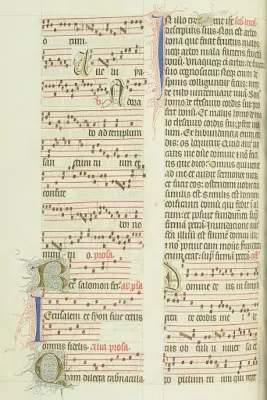
The Sequence Rex Salomon in the Codex of Humbert of Romans, the prototype manuscript of the medieval Dominican liturgy. (Rome: Santa Sabina MS XIV L1). This manuscript was compiled by the Master of the Order Humbert of Romans, in accord with the commission of the Dominican General Chapter held at Buda in 1254, and approved by the General Chapter of Paris in 1256. The sequence begins with the large blue R in the left column.
Prior to Cloche’s reform, the Dominicans sang the following sequence, Rex Salomon fecit templum, on the feast of a church’s dedication; it is attributed (with some uncertainty) to one of the most prolific authors in the genre, Adam of St Victor, who flourished in the first part of the 12th century. After serving as precentor of Notre-Dame de Paris, he entered the abbey of Augustinian Canons Regular dedicated to St Victor in Paris’ Rive Gauche, very close to the Sorbonne. This abbey was one of the major intellectual centers of the High Middle Ages, and literary works produced by its members were swiftly diffused throughout Europe. Dreves’ Analecta Hymnica (vol. 55) lists a very large number of sources for the piece, including several early manuscripts of the Dominican Use, several from the abbey, and various others from the British isles, the Low Countries, etc. The English translation is taken from The Liturgical Poetry of Adam of St Victor (vol. 1), by Digby Wrangham of St John’s College, Oxford. (Kegan Paul, Trench & Co., London, 1881.)

Rex Salomon fecit templum,
Quorum instar et exemplum
Christus et Ecclesia.

Hujus hic est imperator,
Fundamentum et fundator,
Mediante gratia.
Solomon the king a temple
Built, whose pattern and example
Christ, with Holy Church, appears:

He, its founder and foundation,
Sway, through grace’s mediation,
As the Church’s ruler bears.
Quadri templi fundamenta
Marmora sunt, instrumenta
Parietum paria.

Candens flos est castitatis,
Lapis quadrus in praelatis,
Virtus et constantia.
Squarely built, this temple’s bases
Are of marble; each wall’s space is
Formed of stones cut evenly.

Chastity’s fair flower there twineth;
Each squared stone therein combineth,
Prelates’ nerve and constancy.
Longitudo,
Latitudo,
Templique sublimitas.

Intellecta
Fide recta
Sunt fides, spes, caritas.
Its far-reaching
Length, and stretching
Width, and height that tempts the sky,

Faith explaining
The true meaning,
Are Faith, Hope, and Charity.
Sed tres partes sunt in templo
Trinitatis sub exemplo:
Ima, summa, media.

Prima signat vivos cunctos,
Et secunda jam defunctos,
Redivivos tertia.
Tripartite is this fair Temple,
After the Triune’s example,
With first, third, and middle floor:

First, the living signifying;
Second, those in death now lying,
Third, those raised to life once more.
Sexagenos quaeque per se
Sed et partes universae
Habent lati cubitos;

Horum trium tres conventus
Trinitati dant concentus
Unitati debitos.
All the parts together rated,
Or alone, are calculated
Threescore cubits wide to be:

Triply do these three, thus blending,
Harmonize with the transcending
Trinity in Unity.
Templi cultus
Exstat multus:
Cinnamomus
Odor domus,
Murra, stactis, cassia;

Quae bonorum
Decus morum
Atque bonos
Precum sonos
Sunt significantia.
Gorgeous ritual
And perpetual
Scents, sweet smelling,
Fill God’s dwelling,
Cassia, myrrh, and cinnamon;

Signifying
Never-dying
Christian graces,
Prayers, and praises,
Grateful offerings at His throne.
In hac casa
Cuncta vasa
Sunt ex auro
De thesauro
Praeelecto penitus;

Nam magistros
Et ministros
Decet doctos
Et excoctos
Igne sancti spiritus.
In this palace
Is each chalice
A gold measure
From the treasure
Pre-elected secretly:

For all teachers’
Minds, and preachers’,
Throughly furnished,
Purged, and burnished,
By the Spirit’s fire should be.
Sic ex bonis
Salomonis,
Quae rex David
Praeparavit,
Fiunt aedificia;

Nam in lignis
Rex insignis
Juvit Tyri,
Cujus viri
Tractant artificia.
Thus with treasure
David’s pleasure
Had collected
Is erected Solomon’s
great sanctuary;

But the dwelling,
All excelling,
– Timber sending,
Craftsmen lending, –
Tyre’s art fashioned cunningly.
Jam ex gente Judaeisque,
Sicut templum ab utrisque,
Conditur Ecclesia.

Christe, qui hanc et hos unis,
Lapis huic et his communis,
Tibi laus et gloria! Amen.
Formed of Jew and Gentile races,
Builds the Church her holy places,
As did both the Temple raise.

Christ, Who both in one unitest!
Corner-stone of each! the brightest
Glory be to Thee and praise. Amen.

Sunday, October 19, 2025

The Feast of the Dedication of Milan Cathedral

This article is mostly the work of our Ambrosian writer Nicola de’ Grandi; I translated it from Italian, and added the parts about the Ambrosian arrangement of the Sundays after Pentecost.

In the Ambrosian Rite, there are only fifteen Sundays formally named “after Pentecost”, and if Pentecost is very late, as few as eleven may be actually celebrated. The series is interrupted by the Sundays “after the Beheading of John the Baptist,” of which there may be four or five, followed by the first and second Sundays of October. On the third Sunday, the church of Milan commemorates the dedication of its cathedral, followed by three Sundays “after the Dedication.” This division is found in one of the very oldest surviving Ambrosian liturgical books, the 8th century lectionary of Busto Arsizio. The largest possible number of Sundays after Pentecost is therefore 26, whereas it is 28 in the Roman Rite, since the Ambrosian Advent begins two weeks earlier, on the Sunday following St Martin’s day.

A tradition which is not recorded in particularly early sources states that the dedication commemorated on the third Sunday of October took place in the year 453 under St Eusebius, archbishop of Milan from 449-462, after the cathedral had been destroyed by the Huns, and that on the same day, the lesser of the city’s two cathedrals was dedicated in 836. However, there are two things which suggest that the choice of this day as one of the hinges of this part of the liturgical year depends on more than a simple recollection of these events, especially in light of the highly conservative tradition of the Ambrosian rite.

The cathedral of Milan as it stood for many years, before the façade was completed in 1812.
The first, as noted in an article in 2016, comes from St Ambrose himself, in his “Second Apology for David”, a stenographer’s record of sermons which he preached over two or three days in the year 388. This work attests that the Gospel of the Sunday “before the Dedication”, that of the woman caught in adultery, John 8, 1-11, and that of the Dedication itself, John 10, 22-30, were already in their places next to each other in his time. Both of these Gospels take place in the temple in Jerusalem. “At that time, Jesus went unto mount Olivet. And early in the morning he came again into the temple.” (John 8, 1-2) “At that time, it was the feast of the dedication at Jerusalem: and it was winter. And Jesus walked in the temple, in Solomon’s porch.” (John 10, 22-23) This does not seem likely to be a coincidence.

The second comes from a comparison with other liturgical traditions. The rite of Milan is the only Western rite which has a liturgical season marked by a dedication, but the Syrian Rite, in both its eastern and western form, also has a season “of the dedication”, which in turn may derive from the ancient rite of the city of Jerusalem. The Armenian lectionaries of the fifth century, which faithfully reproduce the order of readings used in the Holy City, contain a feast of “the Dedication of the Holy Places” on September 13th, and assign John 10, 22-42, to be read at the “Anastasis”, the great church of the Resurrection built by Constantine. The existence of a liturgical season centered on a dedication, attested in the very oldest Ambrosian sources, may therefore derive from the tradition of Jerusalem.

The Mass texts of the Solemnity of the Dedication refer repeatedly to the Church as the bride of Christ. The Preface, for example, one of the oldest in the Ambrosian repertoire, reads as follows.

“Per Christum Dominum nostrum, qui eminentiam potestatis acceptæ Ecclesiæ tradidit, quam pro honore percepto, et Reginam constituit et Sponsam. Cuius sublimitati universa subiecit: ad cuius iudicium consentire iussit e cælo. Hæc est mater omnium viventium, filiorum numero facta sublimior: quæ per Spiritum Sanctum quotidie Deo filios procreat: cuius palmitibus mundus omnis impletus est: quæ propagines suas ligno baiulante suspensas erigit ad regna cælorum. Hæc est Civitas illa sublimis iugo montis erecta, perspicua cunctis, et omnibus clara: cuius conditor, et inhabitator est idem Dominus Noster Jesus Christus Filius tuus. Quem una tecum...”

The central portion of the apsidal mosaic of the church of St Clement in Rome, with an acanthus vine, symbolizing the Church, springing up from the Cross. (Image from Wikimedia Commons by Dnalor 01, CC BY-SA 3.0)
“…through Christ Our Lord. Who handed down to the Church the preeminence of the power which He had been given, and in accordance with the honor (She) received, made Her both Queen and Spouse, and subjected all things to Her majesty, and from heaven ordered that they obey Her judgment. She is the mother of all the living, all the more exalted for the number of Her children, who daily beareth sons unto God through the Holy Spirit. All the world is filled with Her branches; She lifts up Her shoots to the kingdom of heaven, supported by the wood of the Cross. She is that exalted city, built upon the height of the mountain, visible and bright to all; and He that founded and dwelleth in Her is the same Our Lord Jesus Christ, Thy Son; Whom together with Thee, Almighty Father, and the Holy Spirit, the Angels sing praise…”

The connection between this theme and the Sunday of the Dedication is confirmed at the very beginning of the Ambrosian Rite’s history, in the writings of St Ambrose himself, and indeed, in the same “Second Apology for David” in which he comments on the Gospel of the Adulteress. “Thus did Christ love the beauty of His Church, and prepared Her in order to take Her as His Bride.”

The Duomo of Milan as it stands today is the result of a project which began in 1386, to replace the two cathedrals which had hitherto served the see of St Ambrose. The “winter church”, as it is still called in Ambrosian liturgical books, was the smaller of the two, dedicated to the Virgin Mary, and used from the Third Sunday of October, the feast of its Dedication, until Holy Saturday; it stood where the modern cathedral stands, but was nowhere near as large. The Gospel from John 10, which is attested on this day in the oldest Ambrosian liturgical books, was read here; the “dedication” or “renewal” (“enkainia” in Greek) to which it refers at the beginning is the re-dedication of the Jerusalem Temple which took place under Judas Maccabee, as recorded in 1 Maccabees 4, 59.

On this occasion, in the portico of the Temple, the Lord rebukes those who insist that He tell them whether or not He is the Messiah. “I speak to you, and you believe not: the works that I do in the name of my Father, they give testimony of me. But you do not believe, because you are not of my sheep.” In contrast to those who do not believe, “My sheep hear my voice: and I know them, and they follow me. And I give them life everlasting; and they shall not perish for ever, and no man shall pluck them out of my hand. That which my Father hath given me, is greater than all: and no one can snatch them out of the hand of my Father. I and the Father are one.” In the treatise cited above, St Ambrose explains this same passage as a reference to the replacement of the old Temple, and the old covenant of which it is the symbol, with the New and Eternal Covenant.

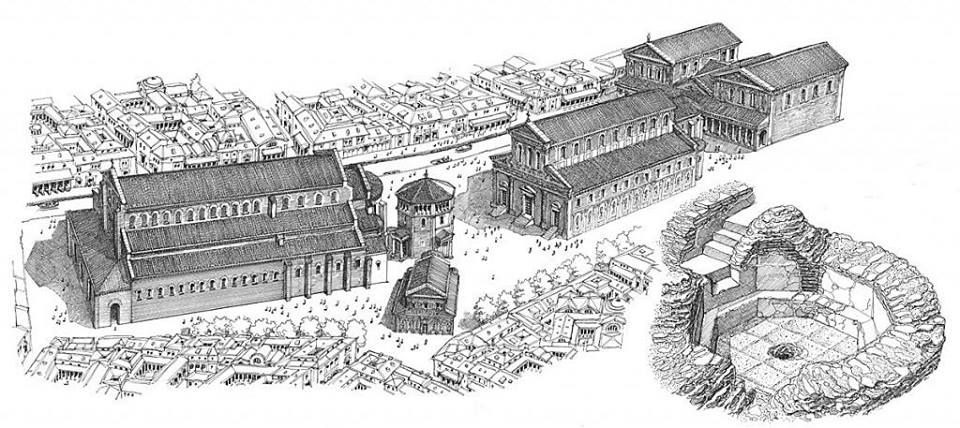
A reconstruction of the cathedral complex of Milan, with the summer church of St Thecla on the left, and the winter church of the Virgin Mary at the right. The octagonal structure in front of St Thecla is the baptistery of St John; the smaller structure beneath it is the baptistery of St Stephen. At the lower right is a partial reconstruction of the interior of the baptistery of St John.
The larger “summer church”, which was demolished in 1543, stood on the opposite end of the modern Piazza del Duomo, and was dedicated to St. Thecla, for which reason her name is included in the Canon of the Ambrosian Mass. In several important liturgical books of the Ambrosian Rite, another Gospel is assigned to the Mass on the same day in this “summer church”, Matthew 21, 10-17.

“Jesus went into the temple of God, and cast out all them that sold and bought in the temple, and overthrew the tables of the money changers, and the chairs of them that sold doves: And he saith to them: It is written, My house shall be called the house of prayer; but you have made it a den of thieves.” The purification of the Temple which follows looks forward to the establishment of the Church as the new house of God. In like manner, the basilica of the Anastasis in Jerusalem, built by the Emperor Constantine, is seen in the liturgical tradition of Jerusalem as the replacement of the temple destroyed by Titus in 70 AD.

The Expulsion of the Money-changers from the Temple, 1610-20, by the painter known as Cecco del Caravaggio, from the obvious indebtedness of his style to the works of Caravaggio.
For the many centuries during which the two cathedrals were still in use, the cathedral chapter of Milan, led by the archbishop, would celebrate a particularly interesting rite on both this day and Holy Saturday. All of the liturgical objects used in the cathedral were loaded into an “ark” (arca), and transported from the winter to the summer church on Holy Saturday, vice versa on the feast of the Dedication. The Latin word “arca” was also used for the place where the Scroll of the Law was kept in a synagogue; its use in the Milanese rite perhaps refers to the substitution of the synagogue’s worship by that of the Church, the one replacing the other, as the church building itself replaces the old temple.

A text from Vespers of the Dedication may also be read as a corroboration of this explanation. As on many of the most ancient and important feasts in the Ambrosian Rite, the first Vespers of the Dedication has only one Psalm, to which Psalms 133 and 116 are added at the end, and the three sung as a single Psalm. The Psalm in this case is 85, from which is also taken the antiphon, “All the nations thou hast made shall come and adore before thee, O Lord.” This text is therefore an assertion that Christ came as redeemer and savior not of the Jewish people alone, but for all nations who are called into His Church.
Finally, we may note the epistle of the Sunday preceding the Dedication, Romans 7, 1-6: “Know you not, brethren, (for I speak to them that know the law,) that the law hath dominion over a man, as long as he liveth? For the woman that hath an husband, whilst her husband liveth is bound to the law. But if her husband be dead, she is loosed from the law of her husband. Therefore, whilst her husband liveth, she shall be called an adulteress, if she be with another man: but if her husband be dead, she is delivered from the law of her husband; so that she is not an adulteress, if she be with another man.” In this context, this passage is taken to mean that the Law of Moses no longer has dominion over the people of God, which now lives under the grace of Christ, the “new” spouse of the Mystical Body.

Monday, September 29, 2025

The Feast of St Michael and All Angels

The traditional title of today’s feast is “The Dedication of St Michael the Archangel”, a term already found ca. 650 A.D. in the lectionary of Wurzburg, the oldest of the Roman Rite that survives, and in the ancient sacramentaries. The Martyrology erroneously refers this feast to the dedication of the famous shrine of St Michael on Mt Gargano in the Italian region of Puglia, following a medieval tradition attested by William Durandus at the end of the 13th century. In reality, the title comes from the dedication of a church built sometime before the mid-6th century on the via Salaria, about seven miles from the gates of Rome, and remained in use long after the basilica itself fell completely to ruin. The traditional Ambrosian liturgy, which borrowed the feast from Rome, has in a certain sense preserved the memory of its origin better than the Roman Rite itself; not only does it use the Roman name, but it also takes several of the Mass chants, as well as the Epistle and Gospel, from the common Mass for the dedication of a church.
The central panel of The Last Judgment, by Rogier van der Weyden, 1446-52, showing Christ above, and below, St Michael weighing the souls of the dead.
Despite the fact that the feast’s title refers specifically only to St Michael, September 29th is really the feast of all the Angels, as stated repeatedly in the texts of both the Office and Mass. The Introit is taken from Psalm 102, “Bless the Lord, all ye his angels: you that are mighty in strength, and execute his word, hearkening to the voice of his orders.”

This text is repeated in part in the Gradual.

The Communion is taken from the Old Latin version of the canticle Benedicite, “Bless the Lord, ye angels of the Lord: sing a hymn, and exalt him above all forever.” (Daniel 3, 58)

The collect of the Mass makes no reference to St Michael at all: “O God, who in wondrous order assign the duties of Angels and of men: mercifully grant that our life on earth be guarded by those who continually stand in Thy presence and minister to Thee in heaven.”

The Lauds hymn of the Office speaks in its first stanza of all the Angels, and in the following three of Ss Michael, Gabriel and Raphael, the only Archangels specifically named in the Bible. In the Greek version of the book of Tobias (12, 15), however, St Raphael refers to himself as “one of the seven holy Angels, who present the prayers of the saints, and who go in before the glory of the Holy One.” This gave rise to a Byzantine custom of depicting seven Archangels standing together around the Lord; many icons of this motif give names to the remaining four from various apocryphal sources. One is called Uriel, who is mentioned several times in the Book of Enoch which St Jude quotes in his epistle (verses 14-15). The names of the remaining three are not the same in all sources; in the 19th century icon seen below, they are given as Jegudiel, Selaphiel and Barachiel.

The Byzantine feast of all the Angels is kept on November 8th, and like the Roman feast, originated with the dedication of a church; this was a basilica in Constantinople known as the Michaelion, traditionally said to have been built by Constantine himself. The formal title of the feast is “The Synaxis of the Great Commanders (ἀρχιστρατήγων) Michael and Gabriel, and the rest of the Bodiless Powers.” Curiously, the liturgical texts of the feast make no reference to St Raphael, nor to any of the other Angels, nor to the origin of the celebration.

In the Middle Ages, many places imitated the Roman custom of celebrating a second feast of St Michael, commemorating the famous apparition which led to the building of the shrine on Mt Gargano. In northern Europe, however, we find instead the feast of “St Michael on Mount Tumba”, the Latin name of the celebrated Mont-St-Michel, as for example in the Use of Sarum, which kept it on October 16th. A votive Mass of all the Angels was already in common use in the early ninth century, as attested by Alcuin of York, and is present among the votive Masses in every medieval missal. However, only very rarely does one find a feast of St Gabriel or of the Guardian Angels in the pre-Tridentine period; a Mass of St Raphael is sometimes found among the votive Masses especially to be said for the sick, but I have seen no no more than a handful of references to an actual feast day for him in the medieval period.

In the year 1670, Pope Clement X added to the general Calendar of the Roman Rite a feast of the Guardian Angels, which had been granted to the Austrian Empire by Paul V at the beginning of the century. The feast was kept in some places on the first Sunday of September, but the common date, October 2, was chosen as the first free day after the feast of St Michael.

The Three Archangels and Tobias, by Francesco Botticini, 1470
Pope Benedict XV, who reigned from 1914 to 1922, took a particular interest in devotion to the Angels. At the end of 1917, he raised the feast of St Michael to the highest grade, double of the first class, along with the March 19 feast of St Joseph. In 1921, he added the feasts of Ss Gabriel and Raphael to the general Calendar, the former on the day before the Annunciation, the latter on October 24 for no readily apparent reason. The feast of St Michael’s Apparition was removed from the General Calendar in 1960; in the post-Conciliar liturgical reform, Ss Gabriel and Raphael have been added to September 29th, and their proper feasts suppressed, along with the traditional reference in the title to the church dedication.

Saturday, November 09, 2024

A Troped Epistle for the Dedication of a Church

In the Middle Ages, it was a very common custom to embellish the original texts of the liturgy with additions known as tropes. The most popular of these were the ones added to the Kyrie; the Mass Ordinaries in the Liber Usualis are still to this day named after them, as for example Kyrie fons bonitatis. When the tropes were used, the choir would sing the first Kyrie as follows: “Kyrie, fons bonitatis, Pater ingenite, a quo bona cuncta procedunt, eleison.” (Lord, fount of goodness, Father unbegotten, from whom all good things proceed, have mercy.) There was a troped Gloria which was written specifically for feasts and votive Masses of the Virgin Mary, which is found in a very large number of medieval Missals, and many others for the rest of the Ordinary.

A page of the Missal according to the Use of Cologne printed in 1494, with the troped Gloria for Masses of the Virgin in the left column, introduced by the rubric “Another (version of the) angelic hymn, of Our Lady on Saturdays and her feasts.”
One also occasionally finds tropes added to the Scriptural readings of the Mass; the Sarum Missal, for example, has a reading from Isaiah at the Midnight Mass of Christmas before the Epistle, which is actually more trope than scripture. In honor of today’s feast, the dedication of the Lateran Basilica in Rome, here is a particularly splendid example, the epistle for the Dedication of a Church, Apocalypse 21, 2-5. This comes from a very important late-medieval chant manuscript known as Codex Engelberg 314, which was copied out by several hands at the Abbey of Engelberg in Canton Obwalden, Switzerland. Below is the text in Latin and English, with the tropes in italics. Note that the tropes are sung by one voice, and the Biblical text by another, but they sing the conclusion together. (The German pronunciation of Latin is used, so that C sounds like TS.)

Ad decus ecclesiae recitatur hodie lectio libri Apocalypsis Johannis Apostoli, cui revelata sunt secreta caelestia. In diebus illis: talis divinitus ostensa est visio: Vidi civitatem sanctam Jerusalem novam, quae constituitur in caelis, honos ex lapidibus, descendentem de caelo nuptiali thalamo a Deo, paratam sicut sponsam ornatam viro suo super solem splendidum. Et audivi vocem magnam nuntiantem nova gaudia de throno dicentem: Veni, ostendam tibi, ecce tabernaculum Dei cum hominibus, et ad eum venient omnes gentes et dicent: Gloria tibi, Domine, et habitabit cum eis, nunc et in aevum. Et ipsi populus eius erunt, omnes Dei gratia, quos a morte redemit perpetua, et ipse Deus cum eis erit eorum Deus, qui moderatur cuncta creata: et absterget Deus omnem lacrimam ab oculis eorum, quorum non sol, luna, sed Christus vera est lucerna: et mors ultra non erit, sed caeli praemia perpetua, neque luctus, neque clamor, ubi cum beatis gloriantur, nova canunt Deo carmina, neque dolor erit ultra, gaudia permanent sempiterna, quia prima abierunt, justi florebunt. Et dixit, qui sedebat in throno in supernae majestatis arce: Ecce nova facio omnia.
Sancti Spiritus gratia,
Divina Providentia,
Per sacra mysteria
Renovatur ecclesia.

For the glory of the Church is recited today a reading from the book of the Revelation of the Apostle John, to whom heavenly secrets were revealed. [1] In those days, a vision of this sort was divinely shown: I saw the holy city, the new Jerusalem, which is built in the heavens, honor from the stones, [2] coming down out of heaven, the bridal chamber, by God prepared as a bride adorned for her husband, more splendid than the sun. And I heard a great voice, proclaiming new joys, saying from the throne: Come, I will show thee: [3] Behold the tabernacle of God with men, and all the nations will come to it, and say, “Glory to Thee, o Lord.” [4] And he will dwell with them now and forever. And they shall be his people, all by God’s grace, those whom He hath redeemed from everlasting death; and God himself with them shall be their God, who ruleth over all created things. And God shall wipe away all tears from their eyes, whose true light is not the sun or moon, but Christ [5]: and death shall be no more, but the rewards of heaven, everlasting, nor mourning, nor crying, where they glory with the blessed, and sing new songs to God, nor sorrow shall be any more, everlasting joys abide, for the former things are passed away. And he that sat on the throne in the height of supreme majesty, said: Behold, I make all things new.
By divine Providence,
And the Holy Spirit’s grace
Through the holy mysteries
The Church is renewed.

The right wing of the St John Altarpiece, by Hans Memling, 1474-79.
[1] A quote from the antiphon at the Benedictus in the Office of St John the Evangelist. “Iste est Joannes, qui supra pectus Domini in coena recubuit; beatus Apostolus, cui revelata sunt secreta caelestia. - This is John, who rested upon the breast of the Lord at the supper; blessed is the Apostle, to who heavenly secrets were revealed.”

[2] A citation of the Vesper hymn for the Dedication of a Church, Urbs Jerusalem Beata.

[3] Apocalypse 21, 19

[4] A citation of the second responsory in the Office of a Dedication. “Fundáta est domus Dómini supra vérticem móntium, et exaltáta est super omnes colles: Et venient ad eam omnes gentes, et dicent: Gloria tibi, Dómine. - The house of the Lord is founded upon the height of the mountains, and exalted above all the hills, and all the nations will come to it, and say, ‘Glory to Thee, o Lord.’ ”

[5] Apocalypse 21, 23

Thursday, November 09, 2023

A Sequence for the Dedication of a Church, by Adam of St Victor

Today is the feast of the dedication of the cathedral of Rome, formally known the Archbasilica of the Most Holy Savior, but often referred to by the nick-name St John in the Lateran. This dedication is celebrated by all dioceses and churches of the Roman Rite, in addition to their own local dedications, so here is a sequence for such feasts by one of the great masters of the genre, Adam of St Victor, who flourished in the first part of the 12th century. After serving as precentor of Notre-Dame de Paris, he entered the abbey of Augustinian Canons Regular dedicated to St Victor in Paris’ Rive Gauche, very close to the Sorbonne. This abbey was one of the major intellectual centers of the High Middle Ages, and literary works produced by its members were swiftly diffused throughout Europe.
Last year, I addressed the persistent misunderstanding that the liturgical reform of St Pius V removed the great majority of sequences from the Mass. The reality is that the Roman Missal had always had very few sequences, and as various churches and orders adopted it, they adopted its sparse repertoire of them along with it. The diocese of Paris, however, kept its own Missal, and traditionally used this sequence, but in the Neo-Gallican reform, it was shortened by the removal of several stanzas, while some others were rewritten. The reformed version is the one sung in the recording given below. The English translation is taken from The Liturgical Poetry of Adam of St Victor (vol. 1), by Digby Wrangham of St John’s College, Oxford. (Kegan Paul, Trench & Co., London, 1881.)
A page from a Missal according to the Use of Paris, written in the first quarter of the 14th century. The intonations of three different sequences (usually called “proses” in French liturgical books) are given in the lower part of the left column; the first, Rex Salomon fecit templum, is also by Adam of St Victor. At the time this Missal was produced, the Sequence might vary according to the choice of the choirmaster. Later editions of the Parisian Missal will specify that either Rex Salomon or Jerusalem et Sion be sung on the feast, and the others during the days within the octave of the dedication. 
Jerusalem et Sion filiae,
Coetus omnis fidelis curiae,
Melos pangas jugis laetitiae,
   Alleluia

Christus enim desponsat hodie
Matrem nostram, norma justitiae,
Quam de lacu traxit miseriae,
   Ecclesiam.
Jerusalem and Sion’s daughters fair!
And all the faithful crowd that
worship there! / That ceaseless strain
of tuneful joy prepare, / “Alleluia!”

For Christ, Who doth all righteousness
display, / to our Mother-Church espoused
to-day, / That Church, whom He in love
hath drawn away / From depths of woe.
In Spiritus Sancti clementia,
Sponsa sponsi laetatur gratia:
A reginis, laudum cum gloria,
   Felix dicta.


Dos ut datur, crescit laetitia:
Quæ dos! quanta! triplex potentia,
Tangens coelum, terram et stygia
   Judicia. 
Through the blest Spirit’s mercy from
above / The Bride rejoices in the Bride-
groom’s love. / Earth’s queens with
glorious praises doth she move
   To call her blest,

Mid greater joy still is her dowry given:
What! and how great! that threefold
power, which heaven, / And earth below,
and the dread judgments even
   Of hell affects.
Mira loquar, sed sanum credere:
Foederatam tarn largo munere,
De proprio produxit latere
   Deus-Homo.

Formaretur ut sic Ecclesia
Figuravit in pari gloria
Adae costis formata femina,
   Hostis Eva.
Belief is wise, though strange my tale:
that bride, / by gifts of such vast magni-
tude allied / to Him, was taken out of
His own side / By the God-Man: 

That thus the Church should form and
shape receive / equal glory, we a type
believe / was woman, formed—source of
our sorrow, Eve! /  From Adam’s rib. 
Eva fuit noverca posteris:
Haec est mater electi generis,
Vitae portus, asylum miseris
   Et tutela.

Pulchra, potens, partu mirabilis,
Ut luna, sol, fulget spectabilis,
Plus acie multo terribilis
   Ordinata.
Eve a stepmother hath been to her seed;
the Church to her elect a Mother indeed,
Life’s haven, an asylum in their need,
   And sure defense,

She, beautiful and great, in birth divine,
fair as the moon, clear as the sun doth
shine / more terrible than armies’ serried
line / With banners dight.
Multiplex est, singularis, una,
Generalis et individua
Omnis aevi, sexus, simul una
   Parit turmas.

Haec signata Jordanis fluctibus;
Haec quae venit a terrae finibus,
Scientiam audire cominus
   Salomonis. 
Multifold is she, yet but one alone
has all together, and each singly, known
of every age and sex, yet only one;
   Troops she brings forth.

Jordan! thy waves a type of her appear,
and she, that from the ends of earth drew
near, / that, face to face, she might the
wisdom hear / Of Solomon.
Haec typicis descripta sensibus,
Nuptiarum induta vestibus,
Caeli praeest hodie civibus
   Christo juncta.

O solemnis festum laetitiae
Quo unitur Christus Ecclesiae,
In quo nostrae salutis nuptiae
   Celebrantur 
She, whom these types, when understood,
portray, / Robed for her marriage-feast in
bright array, / presides o’er all the hea-
venly host to-day, / The bride of Christ.

O holy joy’s bright feast-day in the skies,
Which joins the Church with Christ in
marriage-ties! / That marriage-day,
whose rite mankind allies /
   With saving health.
Coetus felix, dulce convivium,
Lapsis ubi datur solatium,
Desperatis offertur spatium
   Respirandi!

Justis inde solvuntur praemia,
Angelorum novantur gaudia,
Laeta nimis quod facit gratia
   Charitatis. 
O happy gathering! O sweet feast of
heaven! / When consolation to the lapsed
is given, / And to the sinner, to despair
now driven, / A breathing-space!

Here their rewards are to the righteous
paid, / And angels’ joys, renewed again,
displayed / Feast, by the grace of charity
thus made / Too full of joy.
Ab aeterno fons sapientiae,
Intuitu solius gratiae,
Sic praevidit in rerum serie
Haec futura.

Christus ergo nos suis nuptiis,
Recreatos veris deliciis,
Interesse faciat gaudiis
   Electorum! Amen
The fount of wisdom from the first hath
known, / through the clear insight given
by grace alone, / As the due course of
things hath onward gone, / What is to be.

Therefore may Christ, by these His
marriage-rites, / take us, refreshed there-
by with true delights, / partake those joys
to which His love invites 
   All His elect! Amen.

Wednesday, November 23, 2022

From All Saints to Advent: the Dedication Feasts of November

In the Roman Breviary, the Matins lessons for the dedication feasts of the Lateran and Vatican basilicas state that Pope St Sylvester I (314-35) consecrated them on November 9th and 18th respectively. However, there is no contemporary or early historical source that attests to this. The Liber Pontificalis, which dedicates a considerable amount of space to Sylvester’s career, says nothing of it; neither do his contemporary Eusebius of Caesarea, the famous Church historian, or the acts of Sylvester mentioned in the Gelasian Decree (ca. 500 A.D.) as one of the reliable lives of the Saints to be read in the liturgy. The tradition of these dates seems to have been popularized by a much later sermon which was commonly read at Matins of a church dedication. [1]
The Consecration of the Lateran Basilica by Pope St Sylvester I; fresco in the transept of that basilica, by Giovan Battista Ricci (1597-1601). The decorations in this part of the church were commissioned by Clement VIII (1592-1605), the same Pope who issued the Roman Pontifical, the liturgical book which contains the rite of a church consecration. (Image from Wikimedia Commons by Sailko, CC BY 3.0)
The earliest liturgical books of the Roman Rite do not have these feasts, nor indeed, any annual commemoration of a church’s dedication at all. Such feasts are one of the enrichments introduced into the liturgy in the Carolingian period, and these particular two examples are indisputably post-Carolingian. As I noted in an article last week, in the Middle Ages they were kept only in Rome itself, and did not begin to be celebrated by other churches until after the Tridentine reform, when those churches adopted the Breviary and Missal of St Pius V, and their calendar with them.
This means that they also post-date the institution of the feast of All Saints, and I here make bold to offer an explanation of why this may be relevant. It is impossible to say, and I certainly do not pretend to say, whether this was a deliberate choice of the unknown persons who instituted them, or another happy example of the mysterious providence by which God refines the liturgy towards ever great beauty and intricacy.
On October 31st, the Church militant upon the earth prepares itself for the great solemnity of All Saints with a day of fasting, as it does for all the greatest feasts. On November 1st, it celebrates all the Saints in the Church triumphant in heaven, and the following day, prays for all those in the Church suffering in Purgatory. Thus, the three liturgical days are dedicated to the three parts of Christ’s mystical body, on earth, in purgatory, and in heaven.
Speaking only of those feasts which are attested on calendars of the Roman Rite from the earliest times [2], November continues with at least one feast of each of the traditional classes of Saint: the Apostle Andrew on the 30th; a martyred bishop, Pope St Clement I, on the 23rd; a martyr, St Chrysogonus, on the 24th (plus the Eastern martyrs Theodore and Menna); a group of several martyrs, the Four Crowned Martyrs, on the 8th; a confessor, St Martin, on the 11th; a virgin and martyr, Cecilia, on the 22nd, and a matron, St Felicity, also on the 23rd. Thus the month itself becomes, so to speak, an icon of all the Saints.
The calendar page for November in a Gregorian sacramentary produced in the second half of the 9th century at the abbey of St-Amand-les-Eaux, about 130 miles north north-east of Paris. (Bibliothèque nationale de France. Département des Manuscrits. Latin 2290). All of the Saints named above are included except for the Egyptian martyr Menna, whose feast coincides with that of St Martin, kept in Gaul as a solemnity of the highest degree, and therefore without commemoration.
With the exception of Martin, each of these Saints is also very Roman. St Andrew is the Apostle Peter’s brother, and has been the subject of great devotion in the Eternal City from earliest times. The rest are either Roman themselves or have important Roman connections. Clement, Chrysogonus, Cecilia and the Crowned Martyrs all have large and prominent basilicas in the city; Felicity had one near the catacomb where she was buried, and the feast of her seven sons on July 10th is in all Roman liturgical books, going back to the so-called Leonine Sacramentary.
Looking back to the earliest calendars, there is no other month which has such a variety of different kinds of Saints, and almost all of them Roman. Perhaps this was the inspiration for placing the annual commemoration of the dedication of Rome’s cathedral in November as well, once such a commemoration had been instituted as a regular feature of the liturgy. And when this was done, the logical thing would be to also add the commemoration of the dedications of the basilicas of Ss Peter and Paul, the Roman church’s two apostolic founders and principal patrons. This complex month-long celebration of the church of Rome and its Saints would then serve as the link between All Saints and the beginning of the new liturgical year in Advent, the season which draws our mind both to the first coming of Christ in the Incarnation, and His second coming in glory at the end of the world, when all the Saints shall be perfected in the fullness of His Redemption.
The placement of the two dedication feasts between All Saints and Advent thus also reminds us of the mediating role which the Church itself plays in bringing us to our own place in heaven among the angels and the saints. And perhaps it is not too extravagant to posit that there is some intentional symbolism in placing them at intervals of nine days, the number of the choirs of angels in heaven: the dedication of the Lateran is on the 9th, of Ss Peter and Paul on the 18th, and the earliest possible beginning of Advent on the 27th.
The interior of the dome of St Peter’s basilica, with Christ, the Virgin, the Baptist and the Twelve Apostles, and above them, the choirs of angels, with God the Father in the mosaic inside the lantern. (Image from Wikimedia Commons by Gary Ullah, CC BY 2.0)
[1] The first part of this sermon, which opens with the words “Consecrationes altarium”, was read as the lessons of the first nocturn of a church dedication in the pre-Tridentine Roman breviary, and the Office of many other liturgical Uses. In the breviary of St Pius V, it is rewritten according to the general literary criteria of that reform, and read in part in the second nocturn of November 9, and in part on the 18th, with various other material added to it. The lessons for these two days were considerably expanded in later additions, in order to give more of the history of the three churches as they were rebuilt and renovated in the 17th, 18th and 19th centuries.
[2] All of these are in their places by the time the first version of the Gregorian Sacramentary was created towards the end of the 8th century.

More recent articles:

For more articles, see the NLM archives: