Monday, November 18, 2024

“Turned Around”: Announcing a New Book of TLM Apologetics

Recent travels have thrown a wrench in my writing schedule, so it’s taken me longer to get to this announcement than I had intended. Last month, TAN Books released my latest work, Turned Around: Replying to Common Objections Against the Traditional Latin Mass, which I now commend to readers of New Liturgical Movement.

Here’s the idea behind it: I take nine objections Catholics make to the traditional Latin Mass, and turn them around in jiu-jitsu fashion: “You are right—but you don’t realize how right you are!”

To the objection that “the priest has his back to me. I can’t engage with him,” I reply: “Yes, he does, and no, you can’t—that’s exactly how it should be, and here’s why.” Or “at Mass the priest is doing everything and I’m just watching him”: “Yes, he alone does everything in his proper priestly way, and that makes it possible for you to do everything in the way proper to you.” Or: “It’s all fancy, like a royal court, which doesn’t fit with a democratic society like ours”: “That’s right, because we are in a royal court, the most royal and most courtly of all, and we have left democracy far behind.”

And so with six additional objections, having to do with:
• the use of a non-vernacular, ancient language;
• kneeling to receive Communion on the tongue;
• repetition in prayers, gestures, and readings;
• the “limits” of the one-year lectionary;
• fixed inherited rituals governed by strict rubrics;
• the inability to understand everything, even after long exposure.

By turning the tables around, my goal is to bring into clearer focus why, over the centuries, the Holy Spirit formed this venerable rite for the Holy Sacrifice of the Mass to be just the way it was and is—the way that countless saints prayed the Mass day in and day out—in order to show how we, too, stand to gain from its peculiar non-modern, even anti-modern features. As many have observed, it is the paradoxical and countercultural aspects of the Latin Mass that powerfully draw numbers of the faithful, young and old, to this mysterious and luminous rite of divine worship.

Turned Around: Replying to Common Objections Against the Traditional Latin Mass transforms challenges into gateways, perplexities into fresh insights, brick walls into garden paths. Ultimately, our Catholic tradition guides us to deeper conversion: the turning-around to God that is the most important of all conversions.
 
I’m especially pleased to convey the endorsement of Karl Keating, the founder of Catholic Answers:
The public argument in favor of the Traditional Latin Mass has been waiting for a book that handles common objections thoroughly yet winsomely. This is that book.... The writing is clear, approachable, and often elegant. Any reader, no matter his current liturgical preference, will come away instructed, intrigued, and edified.
Eminent Thomistic philosopher and bête noire of progressives on Twitter, Edward Feser, agrees: “Peter Kwasniewski’s Turned Around will contribute mightily to the restoration of liturgical and spiritual understanding.” The director of the Mass of the Ages Trilogy, Cameron O’Hearn, chimes in:
The most common objections to the TLM answered, once-and-for-all! Dr. Kwasniewski has crystallized centuries-old wisdom with his always persuasive prose and left us with a literary treasure. It might be the most convincing defense of the TLM I’ve ever read.

Lastly, Eric Sammons, editor of Crisis Magazine, has this to say:
Defending the TLM’s “foreignness” to modern minds is a high barrier that’s difficult to overcome. In these pages Dr. Kwasniewski not only ably accomplishes this task, he “turns around” the common objections against the TLM to show that it’s the Mass of Ages that is truly at home in a fully Catholic worldview.

Prompted by Turned Around, Eric conducted an extensive interview with me for Crisis Point, covering some of the major difficulties people (both ordinary faithful and academic liturgists) have with the TLM. In the end we covered a good bit of ground. Although the content would be appreciated by TLM attendees, we made a special effort to address mainstream Catholics (so this could be a good one to send to people you know who are wondering what all the fuss is about, or who have been resisting your invitation to attend a traditional Mass because of preconceived ideas):


Kennedy Hall also interviewed me about the book. You can watch and listen to our conversation here:


Order a copy today, either at TAN Books (they're having a 40% off sale at the moment) or at Amazon — and, while you're at it, consider getting another copy for a friend or relative!

Monday, May 13, 2024

New Printing of the Pre-55 Little Office of the Blessed Virgin Mary

A splendid announcement to make in Our Lady's Month of May, and on this day dedicated to the Fatima apparitions!

Roman-Seraphic Books has created a new edition of the Traditional Little Office of the Blessed Virgin Mary, in accordance with the rubrics of the St. Pius X 1910 reform. This edition seeks not only to preserve but to rejuvenate a venerable form of prayer that has been the Marian Prayer par excellence of the Mystical Body for many centuries.

Featuring Gregorian Chant notation for each hymn, this edition facilitates common and public recitation. The chant notation is rendered with the usual Solesmes markings, allowing both the seasoned choir and the novice chanter to partake in this beautiful offering of praise to the Mother of God.

Accompanying the text are exquisite illustrations for each canonical hour, inviting the faithful into a visual meditation on the mysteries of Our Lady’s participation in the Passion of Our Lord, and the Mysteries associated with each Hour.

For more information and to order, visit this website.

Thursday, February 22, 2024

“Ultramontanism and Tradition”: Seeking the Roots of the Present Anti-Liturgical Heresy in Rome

Dom Prosper Guéranger famously described the “anti-liturgical heresy” of the Protestant reformers, who betrayed authentic and continuous tradition in the name of an antiquarian reconstruction imaginatively driven by their theological views. Many traditionalist writers over the past decades have noted the disturbing accuracy with which Guéranger’s critique corresponds as well to the twentieth-century liturgical reforms in the Catholic Church. (An English translation of Guéranger’s comments may be read here.)

The question naturally arises: How in the world did we reach a point where Rome, or the papacy, has given up its historical stance of being a bulwark (remora in Newman’s term) against change—for instance, only reluctantly adding a Creed to the Mass after everyone else had already done so!—and turned into a turbo-driver of innovation? Where instead of being the final court of appeals, it has become a laboratory for doctrinal invention? This is a question that any honest researcher, reviewing the records of history, must ask. At least part of the answer, and an important part at that, is the rise of the phenomenon of ultramontanism, with its panoply of intended and unintended effects.

It gives me great joy to announce, on this feast of the Chair of St. Peter, the latest book from Os Justi Press: Ultramontanism and Tradition: The Role of Papal Authority in the Catholic Faith.

This anthology presents 50 essays by 26 prominent and respected authors: Raymond Leo Cardinal Burke • Bishop Athanasius Schneider • Phillip Campbell • Stuart Chessman • Charles A. Coulombe • Roberto de Mattei • Edward Feser • Timothy S. Flanders • Rémi Fontaine • A Friar of the Order of Preachers • Matt Gaspers • Jeremy Holmes • John P. Joy • Robert W. Keim • John Lamont • Sebastian Morello • Martin Mosebach • Clemens Victor Oldendorf • Thomas Pink • Enrico Roccagiachini • Eric Sammons • Joseph Shaw • Henry Sire • Thomas Sternberg • Darrick Taylor • José A. Ureta

Here is a short video about the book: 
Transcript:

It is not possible to understand the crisis in the modern Catholic Church, much less see how it might be overcome, without a critical understanding of the ecclesial current known as ultramontanism. Originating with nineteenth-century conservatives rallying to the anti-Liberalism of Pius IX, it developed over time into a hyperpapalism that weakened subsidiarity, stifled local custom, and dismantled tradition, until with Pope Francis it has morphed into a veritable engine of progressivism.

What are the historical, theological, and cultural causes of this complex phenomenon—at once a quasi-doctrine, an attitude, and a political regime? Is an ultramontanist papacy the source of our ills, or their only possible remedy—or perhaps both, since “the corruption of the best is the worst”? Might there be a “spirit of Vatican I” as harmful, in its own way, as the later (and rightly denigrated) “spirit of Vatican II”? Can a pope be a heretic, and what, if anything, may be done when such an evil confronts the Church? What is the relationship between moral authority and coercive power? Between papacy and episcopacy? Between legal positivism, blind obedience, and clerical abuse (sexual and otherwise)? In the face of pontifical monarchy, do churches sui iuris; organized communities; subordinate rulers; baptized faithful; immemorial traditions; time-honored liturgies, (still) enjoy their own inviolable rights?

These and related questions are deftly addressed by twenty-six scholars in an anthology of the best of contemporary conservative and traditional writing on these controversial topics.

Content

It is in the nature of an anthology that it brings together previously published essays. The book does, however, include several substantial previously unpublished pieces:
  • a brilliant (and entertaining) interview with Martin Mosebach and Thomas Sternberg;
  • a major study called “What May Be Done about a Heretical Pope?” by a Friar of the Order of Preachers;
  • the essay “The Tower, and the City, of Babel: A Warning against Ultramontanism” by Robert W. Keim;
  • the masterful synthesis “Centripetal Governance and the Loss of Coherence” by Stuart Chessman.
What is more, certain chapters were revised by their authors for this edition; all of the chapters were edited for style and consistency; extensive footnotes, a comprehensive bibliography, and a detailed index were added. All in all, the book is a veritable goldmine on this topic.

Readers will especially appreciate the internal dialectic between the old-school ultramontanists (de Mattei, Ureta), their critics (Chessman, Keim, Mosebach), the mediators (Flanders, Sammons, Pink), those who bring in lots of rich historical detail that complicates the picture (Campbell, Coulombe, Taylor), etc. A very rich anthology that will become a "must-read" for those engaging it.

The Table of Contents, Preface, and a sample of the opening chapters may be found here.

Specs

510 pages, "royal size" (6.14 x 9.21 in.), in hardcover, paperback, or ebook

Where you can find it

Available directly from the publisher here, or from Amazon.com here (and all Amazon outlets across the world), or from Barnes & Noble here.

May this work—which is published with a dedication to many saints who, as it were, "spoke truth to power"—assist readers in the urgently necessary process of evaluating the relevant historical and theological data and recalibrating the proper God-fearing relations between hierarchical authority and sacred tradition in the Church. It goes without saying that the authors address liturgical issues along with everything else.
 

Monday, January 08, 2024

A Response to the Fury of Destruction: New Book Seeks to Articulate First Principles of Traditionalism

Many authors whose works I’ve enjoyed reading seem to follow a certain path as they write their books, almost as if they are working out a grand argument, the contours of which they can as yet barely perceive, but which become more distinct as time goes on. This is also compatible with a good deal of “off-roading,” where different lines are pursued, though even then there are more or less obvious connections with preceding themes; compatible, too, with occasional reversals of direction or the adoption of alternative routes.

This has certainly been my own experience. The first book I published almost ten years ago, Resurgent in the Midst of Crisis, was an initial effort to explain why I found the traditional Roman Rite superior to its postconciliar replacement. Most of what I have written there I still agree with; it was permeated with the Ratzingerian liturgical vision that still animates me. But at the time I was still inclined to believe there could be some sort of “reform of the reform” and that the new rites could be salvaged alongside the restoration of their elders and betters. A token of that is my insistence, in the opening chapter of that book, that “solemnity is the crux of the matter.” That is not my view any more: now I believe that continuity with tradition is the crux of the matter, and that solemnity is an epiphenomenon of fidelity to tradition.

As an Aristotelian philosopher by training, conviction, and temperament, I am constantly in search of “principles, causes, and elements.” I want to know why things are the way they are; if they are better that way, as more in keeping with their telos or goal; if the form suits the matter and vice versa. In the decade that followed, it seems to me that I was pursuing the principles, causes, and elements of traditional liturgy, trying to uncover the deepest logos or account of the beauty, reverence, integrity, and worthiness of the forms of worship that lovers of tradition intuitively perceive as good and holy.

But this was no peacetime operation; that decade also coincided with the reign of a pope not exactly benevolently disposed toward tradition in all its forms. All the while, in progressive and conservative circles, the liturgical tradition continued to be misrepresented and its adherents attacked; eventually, as we all know too well, it was subjected to official persecution.

One does not have to be an Hegelian to recognize, as Belloc’s epigraph to Essays of a Catholic puts it, “Truth comes by conflict.” Nothing motivates as powerfully as the prospect of eviction and the fear of extinction. The need to articulate and defend the principles of the traditionalists’ adherence to traditional forms and their decades-long resistance to the top-down twentieth-century liturgical “reform” was, therefore, no less an impelling force on my thinking and writing.

In short: what are the ultimate foundations of the traditionalist position? [1]

  • Of the many principles to which Catholics ought to adhere, where does tradition fit in, and how does it relate to ecclesiastical authority and the common good of the Church as a society?
  • How does tradition serve as (or as a norm for) law?
  • Why is a purely positivist conception of law and a voluntarist notion of authority incompatible with Catholicism? When does law cease to be law (or even fail to acquire the ratio of law)?
  • Why do we consider the so-called reform to be, in fact, an example of what Hegel called the Furie des Verschwindens, the fury of destruction or disappearance that characterizes revolutionary upheavals?
  • What is the problem with standing in judgment over the whole of tradition, picking and choosing from it as from a cafeteria, and reworking it all from a modern standpoint, so that even what is transmitted has been transmitted only because it was deemed compatible with the philosophical and theological lenses of the one who filtered it?
  • Can there be any basis for outright, public, enduring resistance to papal prudential and disciplinary measures, and if so, what exactly is that basis?
  • What moral, dogmatic, and spiritual goods are at stake in the ongoing war against tradition? (Some of them are obvious, but others are more subtle and pervasive.)
There are so many questions like this, and we have so many resources to bring to bear on them — yet discussions of them remain surprisingly shallow and inadequate. Or perhaps not so surprisingly: most discussions are conducted nowadays online, where the medium combined with attention span and a plethora of distracting rabbit-holes militate against serious thought.

But for the health of the society of the Church, it is necessary for some members of the faithful — and, I would say, especially the clergy to whom the celebration of the liturgical rites is primarily entrusted, and who thus bear a particular responsibility vis-à-vis the transmission of tradition and the nourishment of the faithful with their birthright — to seek and find this ultimate foundation, for God only knows what further attacks against the Catholic Faith’s lex orandi, lex credendi, and lex vivendi are in store for us in the years to come, and if we do not wish to see what we value and ought to value the most burned down to cinders, we had better be prepared to resist the vandals to the fullest extent compatible with the Faith.

It was for all these reasons, and more, that I devoted the latter part of 2023 to my latest book: Bound by Truth: Authority, Obedience, Tradition, and the Common Good, published by Angelico Press. It bears the following dedication:
For all priests who have sacrificed comfort, security, ambition, or reputation to remain true to Catholic Tradition and to keep it alive for Christ’s faithful: the Lord is your inheritance and the Church will one day sing your praises.
Here is the publisher’s succinct description (based on the book’s Preface):

“At the sixtieth anniversary of Sacrosanctum Concilium, the situation on the ground for Catholics is more chaotic than ever. A liturgical reform meant to usher in a new age of full churches and ecumenical rapprochement delivered neither; instead, churches are emptying and closing at an unprecedented rate. Meanwhile, an ancient old rite, grown to maturity in the Middle Ages, encrusted with Baroque pearls, and officially pronounced dead in the 1960s, has made an astonishing return around the world. Tolerated by Paul VI, permitted worldwide by John Paul II, declared free for everyone by Benedict XVI, and most recently put under ban once more by Francis, the Tridentine Mass remains a powerful and polarizing reality in the Church of Rome — an ark of holiness and beauty to the priests and faithful who love it, a belligerent ‘backwardism’ to those who seek its abolition. In this state of spiritual civil war, questions of authority and obedience are never far from anyone’s mind.

Bound by Truth grapples with the momentous issues of authority, obedience, tradition, and the common good. Part I, ‘Papacy, Patrimony, and Piety,’ addresses the teaching of Vatican I on the pope’s universal jurisdiction; the limits of his authority, in light of other authoritative principles such as liturgical tradition and local custom; the properly Catholic way to interpret and follow the Magisterium; and the virtue of intelligent, God-fearing, and communally perfective obedience versus its vicious distortions — willful rebelliousness on the one hand, and a blind, thoughtless, self-destructive submissiveness on the other. Part II, ‘Faithful Resistance,’ looks at historical examples of prelates who legitimately pushed back against papal overreach; discusses how clergy should navigate unjust episcopal decrees on private Masses, concelebration, the use of the Rituale Romanum, etc.; shares advice and strategies for laity who seek to promote and defend tradition in their dioceses; and draws inspiration from persecuted religious sisters, whether their tormentors were Soviet Communists or apparatchiks of the postconciliar ecclesiastical bureaucracy.”

In sum, Bound by Truth is my fullest effort to date [2] to articulate and defend the principles, causes, and elements of Catholic traditionalism, and to offer practical advice, to both clergy and laity, about what to do when tradition is sidelined or outlawed.

It’s also worth noting that the status and role of the Society of St Pius X are discussed at some length (pp. 227–46), and a detailed treatment of the Sunday/Holy Day obligation is given, probing, with the aid of reputable preconciliar moral theologians, questions about when that obligation ceases to bind due to ritual illicitness and irreverence, and what the faithful should or may do in such circumstances (pp. 247–74).

The table of contents, preface, and endorsements may be previewed here.

The book is available from:
“Now to Him who is able to do all things more abundantly than we desire or understand, according to the power that worketh in us — to Him be glory in the Church, and in Christ Jesus unto all generations, world without end. Amen” (Eph. 3, 20–21).
 

NOTES

[1] Whether you want to call it “traditionalist” or not is somewhat beside the point, although I have defended the usage here for those who wish to see a case made in its favor; in any case, we all frequently use “-ist” words because they are practical, just as we refer to “Catholicism” though we do not intend any ideology or camp thereby.

[2] And no doubt will remain so for quite some time, as I have turned my attention to other more granular (albeit related) topics.

Visit Dr. Kwasniewski’s Substack “Tradition & Sanity”; personal site; composer site; publishing house Os Justi Press and YouTube, SoundCloud, and Spotify pages.

Monday, October 16, 2023

The Liturgical Rosary: A Unique New Devotional Book

A blogger once wrote: “We should liturgize devotion as far as we can, rather than devotionalize the liturgy.”

I was thinking about this sentiment when Alex Barbas of Arouca Press asked me if I would contribute a Foreword to a fascinating manuscript that he sent me. It takes the form of praying the Rosary, but within the framework of the liturgical calendar and the Divine Office, drawing heavily upon their texts as a source of enrichment. The goal is not to change anything about how the Rosary is prayed—all the same prayers are used—but, in the manner of a Scriptural Rosary, to bring it into closer connection with the Missal, the Hours, and even the music of the Roman Rite (since we are given concrete means for singing the Rosary or at least parts of it ad libitum: something I can see have great application in school settings or on pilgrimages).

Once I saw the manuscript, I eagerly agreed. And after a long and involved process of typesetting and publishing with offset printing in India, the book is finally finished:

The Liturgical Rosary: Meditations for Each Hour, Day & Season of the Liturgical Year, edited by the Slaves of the Immaculate Heart of Mary.

An overview of the Contents:

Foreword by Dr. Peter Kwasniewski: Should the Laity Pray the Breviary or the Rosary?
The Prayers of the Rosary in English and Latin
A Simple Method of Chanting the Rosary with Suggested Rubrics and Antiphons
The Fifteen Promises of Our Lady to Those Who Pray the Rosary
The Fifteen Mysteries of the Rosary Synoptically Recounted
Meditations Taken from…
 Each of the Canonical Hours for Each of the Days of the Week
• The Votive Masses for the Days of the Week
• Each of the Feasts of the Sanctoral Cycle
• Each of the Feasts of the Seasonal Cycle: Advent Through Pentecost
• The Common Masses of the Blessed Virgin Mary
• The Common Masses of the Saints
The Votive Masses for Various Occasions, Including…
• For the Defense of the Church
• For Peace
• For the Sick
• For Pilgrims and Travelers
• For Any Necessity
• Of Thanksgiving
• For a Baptism
• For the Reception of Holy Matrimony
• In Preparation for Death

Details: 4.25 x 6.73 trim size | 528 pages | Paper type: 60gsm uncoated white | Black calf-skin cover | Alpha PU (Gold foiling) | Section Sewn | Hard Bound (Round Back) | HT Band & 3 Ribbons: Blue, Red & Black

$39.95 USD per copy (retail)
Bulk discounts applicable at checkout:  5–9 copies: $29.95 USD; 10 or more copies: $22.95 USD
Below are some pages from the book. I encourage lovers of the Rosary and of the traditional liturgy to pick up a copy. You can find a preview at the publisher's website; below are some further examples of pages.
(the 15 Scripture verses line up with the 15 mysteries)


Our Lady of the Most Holy Rosary, pray for us!

Visit Dr. Kwasniewski’s Substack “Tradition & Sanity”; personal site; composer site; publishing house Os Justi Press and YouTube, SoundCloud, and Spotify pages.

Monday, June 19, 2023

Taking Music Seriously — Inside and Outside of Church

Our Western art-music is the loftiest of God’s gifts to us in the natural order, the greatest artistic treasure the world has ever known, and, in its specifically liturgical manifestations, a vital, indispensable bearer of the theology, spirituality, meaning, and identity of the Catholic religion. We cannot live well without it; we will not pray well without it either.

Music is the language of the soul, its most intimate and exalted expression. Music goes deeply into the soul, into its passions and emotions; it affects us at the intersection of spirit and flesh, it gets “under the skin,” it goes into the very sense-appetites and shapes them by motion, by repetition. Just as habits of virtue or vice are formed in the sense-appetites by repeated action, so too are certain habits formed in the same appetites by repeated sensual stimulation. What we listen to does not remain “outside” of us but enters into us and changes our way of feeling, reacting, perceiving. We cannot help being affected morally by long-term exposure to any kind of music.

The sound that is language comes from our unique mode of being in this world—as being in the world, due to our physicality, but not of it, due to our being rational creatures made in the image of God. The sound that is music, for its part, is the finest flowering of language. No wonder it is the province of worship, loss and lamentation, exultation and joy! For it is a wonder past all other wonders that proceed from the heart of man. Christians, inasmuch as we are “priests, prophets, and kings” by our baptism into Christ the High Priest, Word of God, and King of Kings, deserve and require a diet of the most artistically beautiful, most emotionally satisfying, most intellectually stimulating, and most spiritually beneficial music. In short: we need, for our human and Christian perfection, music that is both good and great. Surrounding it, sustaining it, we need prayer-saturated silence.

Such is the fundamental thesis of my new book Good Music, Sacred Music, and Silence: Three Gifts of God for Liturgy and for Life, which has just been released by TAN Books of Gastonia, North Carolina. Born of decades of experience, study, and reflection as a singer, choir director, composer, and teacher, and seasoned by countless conversations with college students in particular, this work urges readers to take the art of music as seriously as it ought to be taken.
 
The first part, “Music Fit for Kings: The Role of Good Music in the Christian’s Life,” deals with the corrosive cultural and psychological effects of a lot of modern popular music, contrasted with the numerous benefits of a lifelong apprenticeship to the great music of the Western tradition (including the many excellent composers working today). Here, I draw upon thinkers such as Plato, Aristotle, Aquinas, Pieper, and Ratzinger, and offer concrete strategies for acquiring or deepening a love of beautiful music.

The second part, “Music Fit for the King of Kings: The Role of Sacred Music in the Church’s Life,” provides a thorough philosophical and theological account of what is right about Gregorian chant, polyphony, and pipe organ, and what is wrong with, say, folksy guitar-and-piano or peppy Praise & Worship genres at Mass. I do not hesitate to name names and to pursue my argument to the nitty-gritty level.

In the last and (appropriately) shortest part, I speak of the ways in which silence is both the origin and the fulfillment of music. The book ends with a thorough defense of the more-than-thousand-year-old custom of the silent Canon in the Mass, the fittingness of which Cardinal Ratzinger praised, more recently joined by Cardinal Sarah.

Here’s the Table of Contents:
 
Good Music, Sacred Music, and Silence was written for the benefit of pastors, seminarians, church musicians, homeschooling families, classical curriculum advocates, and everyone who is already in love with music or is seeking to develop a better knowledge of it. To musicians particularly, I would add: in my meandering journey from

  • a childhood liberal parish and contemporary youth group (all the while listening to prog rock, heavy rock, rap, and other, dare I call them, genres), to
  • a charismatic prayer group (when my listening incorporated some “Christian pop” artists), to
  • a Latin Novus Ordo with a chant schola (by which time I had switched over entirely to “classical” music), to
  • immersion in the Byzantine liturgy in Austria, to
  • a mixed old-and-new-Mass chaplaincy in Wyoming, to
  • life in parishes run by the Institute of Christ the King Sovereign Priest and the Priestly Fraternity of Saint Peter,
it is highly likely that I have been, for some portion of my life, in a situation similar to that in which any Catholic musician, music director, or music lover may ever find himself; so I believe my book will carry the force of conviction born of experience, and will be able to say something relevant and beneficial to readers from a wide range of backgrounds.

Nowadays I am singing in a fine men’s schola every Sunday and most holy days, and look forward — if anything, ever more as time goes on — to the joy of singing these incomparably wonderful ancient plainchant melodies, so perfectly suited for the rites to which they give musical utterance and shape. Their beauty elevates my mind to God; their tranquility comforts my heart. This is a joy in the beautiful that we should eagerly share with everyone, until they too can know it and benefit from it.

Nothing could be better than the flourishing, everywhere, and to the fullest extent, of great secular music and of the finest sacred music in the liturgy. That is why I have written my latest book, and I hope you’ll check it out.

Good Music, Sacred Music, and Silence: Three Gifts of God for Liturgy and for Life (hardcover, 344 pp., $29.95, ISBN 978-1505122282) is available from the publisher, from Amazon, and from the author if you would like a signed copy.

*   *   *
Mary Harrell of TAN Books conducted a 26-minute interview with me about the book, for those who might be interested:
 

Monday, October 10, 2022

Exalting Tradition and Refuting Rupture: New Work Argues for Total Restoration of the Tridentine Rite

I am pleased to announce to readers of New Liturgical Movement the release of my latest book, The Once and Future Roman Rite: Returning to the Traditional Latin Liturgy after Seventy Years of Exile (TAN Books, 2022). It has been several years in the making.

Although it was initially conceived as a response to the fiftieth anniversary of the Novus Ordo (1969-2019), it developed over time into a full-on response to the numerous errors and lies of progressive liturgists as we find them regurgitated in Traditionis Custodes and its accompanying letter.

The fruit of decades of research, experience, reflection, and debate, Once and Future Roman Rite argues that the guiding principle for all authentic Christian liturgy is sacred Tradition, which originates from Christ and is unfolded theologically and liturgically by the Holy Spirit throughout the life of the Church, in each age and across the ages. The prominent identifying traits of all traditional rites, Eastern and Western—including, of course, the classical Roman Rite—are markedly and designedly absent from or optional in the Novus Ordo, estranging it from their company and making it impossible to call it “the Roman rite” at all.

Paul VI’s new liturgical books, drafted in unseemly haste by an audacious committee of arrogant men who placed themselves above and outside of the stream of tradition as its jury, judge, and executioner, visited upon the longsuffering Roman Catholic faithful a hasty and far-reaching reform permeated with nominalism, voluntarism, Protestantism, rationalism, antiquarianism, hyperpapalism, and other modern errors. But this much is always true and will always be true: man is not master over divine liturgy; rather, all of us, from the lowest-ranking layman to the pope himself, are called to be stewards of God’s best and choicest gifts. This law, in turn, imposes genuine moral and ecclesial duties upon us and bestows corresponding rights.

The only possible Catholic response to this crisis of rupture is a full return to the Roman rite in its robust perennial richness as codified after the Council of Trent (i.e., the pre-55 form of the rite: hence “seventy years of exile”). No special permission is or could ever be needed to embrace this heritage and to hand it down to future generations. Fidelity to the traditional Latin Liturgy is, at its root, fidelity to the Roman Church as such and to Christ Himself, Who has inspired the growth and perfection of our religious rites for two thousand years.

In addition to its preface, twelve chapters, and epilogue, the book contains a foreword by Martin Mosebach, nine reproduced artworks, several diagrams, an appendix of (highly revealing) texts by Paul VI on the liturgical reform, a topical bibliography, and a detailed index. At the bottom of this post will be found the Table of Contents. Chapters 1 and 12 (the latter being the lengthiest of all) appear in this book for the first time. The chapters in between, although published in earlier versions online (including, in a few instances, here at NLM), have been extensively revised and expanded for their inclusion in this volume.

In the following short video, I share a bit more on what the reader will find in this unique book, which has, as far as I know, no exact parallel in the traditionalist literature: 


Some reactions:

“This work is a splendid introduction to the key issues of the liturgical debate, in the necessary historical context of liturgical development and of the 1960s reform. I recommend it wholeheartedly.” —Dr. Joseph Shaw

“In this passionate book, Dr. Kwasniewski makes a compelling case for the traditional Roman Rite.” —Stuart Chessman

“At once logical and lyrical, this book is a profound reflection on the meaning of tradition both in general and in the Roman liturgy in particular.” —Fr. Thomas Crean, OP

“At once liturgical, historical, theological, and spiritual, The Once and Future Roman Rite assures the author a place of first rank.” —Dr. Roberto de Mattei

“Dr. Kwasniewski’s detailed and unanswerable paean to Christ in Sacred Tradition.” —Dr. John C. Rao

“This eloquent apologia, written by a man obviously in love with Christ, the Church, and the Mass, deserves a wide exposure.” —Fr. Richard Cipolla

The Once and Future Roman Rite: Returning to the Traditional Latin Liturgy after Seventy Years of Exile. Hardcover • 6 x 9 • 472 pgs • ISBN: 978-1-5051-2662-4 • $32.95

Available from TAN Books, all Amazon outlets, and other online retailers.


Monday, August 29, 2022

Announcing a New Facsimile Edition of the Deluxe Desclée Clementine Vulgate

We are pleased to announce Church Latin Publishing Co.’s facsimile edition of a 121-year-old Latin Vulgate Bible (Clementine Edition). An excerpt from the “Editor to the Reader” of this bible perfectly summarizes both the reasons it was originally published and why we have labored to bring it back into print:

“May, finally, this edition of the Sacred Bible be published, and may it bear exceedingly rich fruits of knowledge and piety; we humbly pray that St. John the Evangelist, our great patron, who drew his stream of divine eloquence from the sacred font itself of the Lord’s breast and, inebriated with the grace of the Holy Ghost, more deeply revealed to others the hidden things of Divinity, might obtain these results for us through his kind intercession with the most sacred Heart of Jesus.”

In our present day, traditional Catholic worship and devotion are under attack. This reprint of the Latin Vulgate Bible is both a testimony to Catholic Tradition and a living archive of Catholic scriptural literacy. It also pays homage to the authority of the Clementine text and is a tribute to the lost art of more elegant religious and liturgical typesetting and printing. This Vulgate bible is a true icon of Catholic history; the interior text and images were described by a reviewer as “a modern adaptation of a medieval manuscript.”

It is presented in a case wrap hardcover format with a few added features such as enhanced images of the original color maps and two ribbon markers (one can see lots more images at the publisher’s website). At 6” x 9”, the size is neither too large for easy transport nor too small for easy reading. It can be ordered from www.churchlatin.com for $59.99. A full write-up explaining all of the contents and features can be found there as well.

I recommend a visit to the website, which is full of fascinating and informative things about Desclée the publisher, the Vulgate edition, and this particular project, which was years in the making.


Plenty more pictures at the publisher's page.

Friday, August 26, 2022

Fr. Kocik notes: Announcing a New Edition of Dom Gaspar Lefebvre’s “Catholic Liturgy”

R

omanitas Press has just published a revised and expanded edition of Dom Gaspar Lefebvre’s monumental study, Catholic Liturgy: Its Fundamental Principles, originally published in French as Liturgia (1920). First published in English in 1924, Dom Gaspar’s flagship work brings to its topic a wealth of biblical, patristic, and magisterial teaching together with the author’s own warmly devout exposition. The first few chapters develop the theocentric orientation of the liturgy: as the Father acts through the Son in the Holy Spirit, so the Church offers praise, thanksgiving, supplication, and (in the case of the Mass) propitiatory sacrifice to the Father through Christ, our High Priest and Mediator, in the Holy Spirit. Only after laying this solid foundation does Dom Gaspar turn his attention to the various aspects of the liturgy: the Mass, the Divine Office, the individual sacraments, sacramentals, the place of Our Lady, the saints and the holy angels in the liturgy, etc. Each chapter is a unique window onto the liturgy as the “primary and indispensable source of the true Christian spirit” (St. Pius X).
As I point out in the Introduction, Dom Gaspar (1880-1966) represents the twentieth-century Liturgical Movement in its early, and in some ways healthiest, phase. His work evinces neither the antiquarianism proscribed by Pius XII in Mediator Dei nor the misguided ecumenism that would toss aside doctrines and practices found objectionable to the Protestant mind. When, for example, he speaks favorably about freestanding altars (particularly as found in the Roman basilicas), it is not because he advocates the celebration of Mass versus populum, whether for antiquarian or ecumenical reasons. Indeed he says nothing about this novelty, and I leave the reader to learn for himself why our author prefers the table-form altar.
The original English translation of Liturgia (Benziger Brothers, 1924) features lithographic chapter headers and footers by the Belgian artist René de Cramer (d. 1951), who also illustrated Dom Gaspar’s immensely popular Saint Andrew’s Daily Missal. A second English printing of Catholic Liturgy (B. Herder Book Co., 1937—a new “impression” rather than an “edition”) omits Cramer’s artwork. The third and last edition of Catholic Liturgy to appear during the author’s lifetime (B. Herder Book Co., 1954) features slightly revised texts (e.g., to take into account the institution, in 1925, of the feast of Christ the King) and an appendix entitled “Liturgy and Catholic Action.” Romanitas Press offers the 1954 edition with a reformatted layout to make for easier reading (e.g., block quotes). Additional features unique to this new printing (softcover, 276 pages) include a short biography of the author, an Introduction situating his work within the Liturgical Movement, select brief biographies of authors whom Dom Gaspar cites (many of them are unknown today, even to students of the Liturgical Movement), and a select bibliography that compensates for poor and inconsistent footnoting. (Oh, and the lithographs are back.)
This enlarged reprint is available at a 10% discount until September 5th. Click HERE to order.

Friday, August 05, 2022

Three New Republications of Non-fiction Works by Msgr Robert Hugh Benson

On the heels of their excellent new editions of two of Msgr. Benson’s better-known historical novels, The Cenacle Press of Silverstream Priory has just released three more non-fiction titles by the same author: Confessions of a Convert, Papers of a Pariah, and The Friendship of Christ.

In his autobiographical Confessions of a Convert, Benson describes his journey to the Church, starting as an Anglican brought up in “the moderate High Church school of thought” and ending as a Catholic priest living under “the sunlight of Eternal Truth.”

Says Joseph Shaw: “Benson’s Confessions of a Convert are edifying and entertaining in equal measure, and a fascinating snapshot of the Anglican and Catholic scenes in his day. They remind us of the great soul-searching and also personal suffering undertaken by the generations of converts, from Newman up to the 1950s, who enriched the Catholic Church in the British Isles while the Church was subject to the soft persecution of prejudice and social exclusion.”

In Papers of a Pariah, Benson imagines the experiences of a fallen-away Protestant who returns to the practice of religion and then finds himself drawn to the Catholic Church. Under this literary device, Benson comments:
Even to me, Protestant as I am, it did seem completely suitable that an event so stupendous could scarcely be approached by any other process than that of a sacred dramatic dance, with an accompaniment of rigid and minute Court etiquette. To leave the conduct of such a thing to the individual personality and the private taste of a simple clergyman in a surplice, would be nothing else than bathos of the worst description; human outlines must be obliterated by some overpowering uniform, personal tastes and methods of behaving must be rigidly supplanted by set movements and gestures. In fact, for such a drama as this we need not clericalism, but the most emphatic sacerdotalism. Originality in the sanctuary, as has been well observed, is the grossest vulgarity known to men.
The relevance of these comments, made 60 years before the introduction into the Catholic liturgy of so many elements that render it casual, personal, and de-ritualized, hardly needs to be pointed out. It serves as a timely reminder that such liturgical fallacies existed and were recognized by Catholics long before they were being perpetrated within the sanctuaries of Catholic churches!
 

Speaking of Benson, Evelyn Waugh said: “He was a magnetic preacher, an excellent story-teller, a ready writer; he had enthusiasm and unremitting energy, a rich imagination, an exuberant curiosity about people and things. But he knew that there was only one relationship of absolute value, that of the soul to God.” In his book The Friendship of Christ, Benson addresses this question of the soul’s relationship with God.

“How to love an invisible God? For anyone who has asked themselves this question,” comments Melinda Nielsen of Baylor University, “Robert Hugh Benson weaves together the many strands of the Catholic faith to reveal the one thing needful—the radiant face of Christ. Here Benson unfolds the secret of the saints: that Christ is the truest of all friends, not metaphorically, but in reality.” A classic of “modern” spirituality, this work is perhaps the most essential of these three works to acquire for your Catholic bookshelf.
 

 Visit the Cenacle Press website to see all of their books and products.

Monday, June 13, 2022

Elegant Reprints of Robert Hugh Benson Novels of the English Reformation

Back in January, we mentioned the Cenacle Press website of Silverstream Priory. Since that time, much has transpired! In addition to its hundreds of items of various sorts and provenances, Cenacle Press has now turned into a full-fledged publishing operation, specializing in reprints of old classics as well as new works.

Robert Hugh Benson needs no introduction here. Two of his best historical novels, The King’s Achievement (about Henry VIII, Thomas More, John Fisher, et al.) and By What Authority? (about Elizabeth, Edmund Campion, et al.) have just been released in new editions, which are distinguished by five features that set them apart from other versions available online: (1) they are unabridged, unlike the American editions; (2) they are newly typeset, with a very readable font; (3) they have newly-commissioned illustrations by a Polish artist ; (4) they contain interesting forewords by Joseph Pearce; (5) they support the monastic community.

When I first read those books years ago, they pierced me to the quick, and I still consider them among the most vivid windows into the English Reformation period. My wife and I used them for homeschool history & literature. In September 2021, I shared at NLM a poignant scene from By What Authority? in which a secret recusant Mass is described.

Quick summaries of the novels (from the Cenacle Press site):

The King’s Achievement: One of the most coldly calculated acts of Henry VIII during the Reformations was the dissolution of the monasteries. Monks and nuns were driven from their cloisters; the abbeys were plundered and turned over to greedy courtiers. From these ignoble proceedings came Robert Hugh Benson’s inspiration for this great historical novel, the story of a house divided against itself. The Torridon brothers are sworn to serve different masters; one is a monk, in love with the Mass and the Faith of Ages, the other an agent of Thomas Cromwell, in love with a protege of Sir Thomas More. Among the giant figures who move through the tale are those of St. John Fisher and St. Thomas More, the ruthless King Henry VIII, and the grasping Cromwell. Their actual deeds are carefully woven into this harrowingly romantic tale of the attempted destruction and resilience of the Catholic Faith in England.

By What Authority?: The fates of two young people caught in a conflict of ideals is the theme of this stirring and tragic novel, set in the England of Elizabeth I. At a time when following the Old Religion resulted in penalties stretching from heavy fines to imprisonment to death, Puritan-bred Anthony and Isabel Norris find themselves drawn to the Church of their forefathers. Underlying their heroism in their struggles and conflicts with Protestant England is the strength and vitality of Catholic Church supporting and drawing the characters into Her embrace. In a story which delves into the deepest reaches of the Catholic and Anglican dilemma, Benson weaves together the lives of his characters and their encounters with central figures in English Reformation history in order to praise and defend the England that was, the England that is truly England, the Catholic England.

To read more, see Joseph Pearce’s recent article “The Genius of Robert Hugh Benson” at The Imaginative Conservative.

Links to purchase:
The King’s Achievement
By What Authority?


Wednesday, May 18, 2022

Of Liturgical Interest: Three New Books on the Papacy, Tradition, Authority, and Obedience

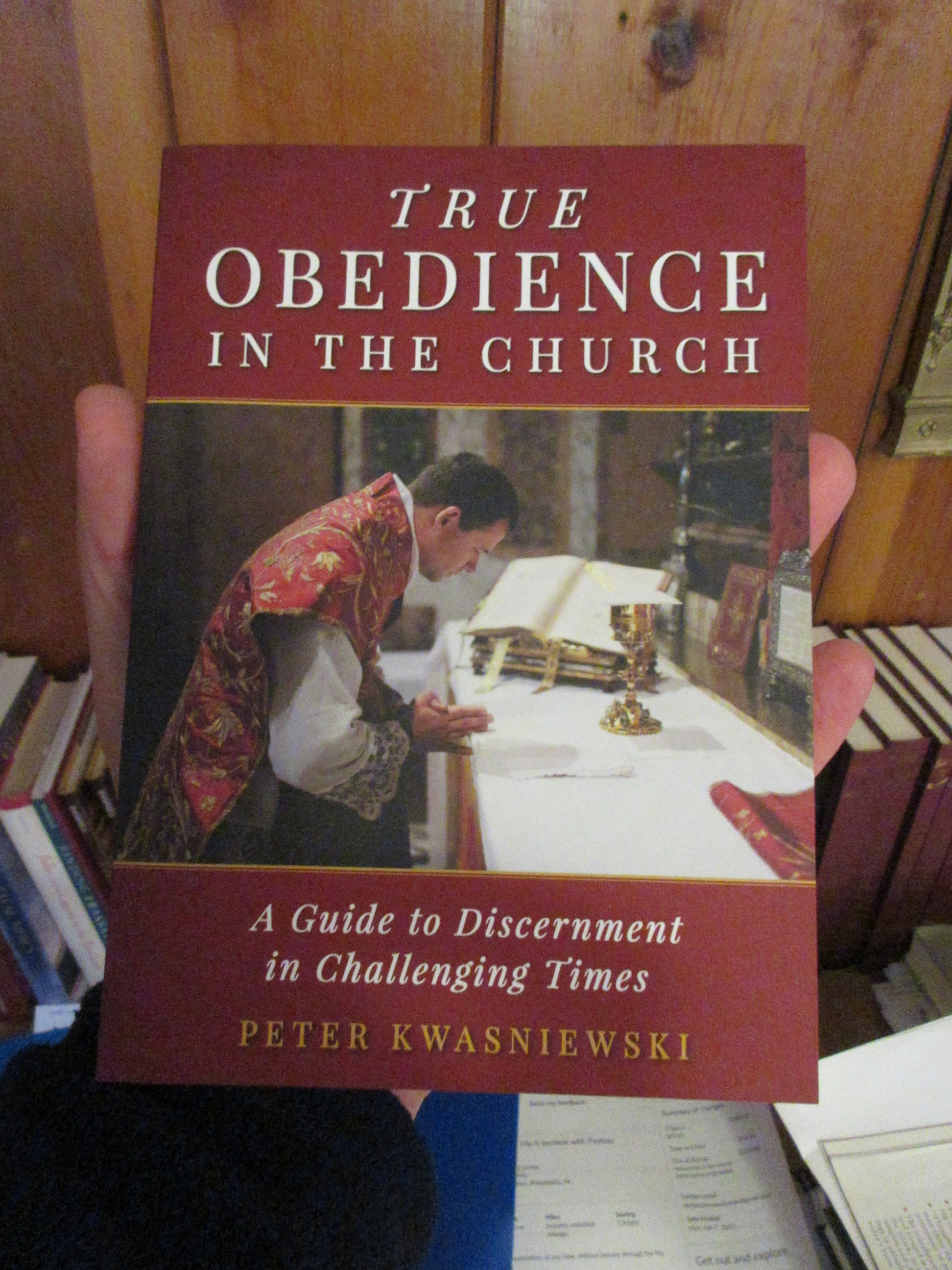
A few months ago, a “tract for the times” (so to speak) appeared from Sophia Institute Press, called True Obedience in the Church: A Guide for Discernment in Challenging Times. This small book has been the topic of many online interviews, a list of which can be found at the link above. The most recent took place with Timothy Flanders, editor of OnePeterFive, on May 16 (here). True Obedience has also been translated into Spanish and German, with Italian, French, Portuguese, and Polish on the way.

The reason it has struck a nerve is not hard to see. Traditionis Custodes presented us with a fundamentally untenable situation. As many authors have explained, it canceled out the pax Benedictina which insisted on some kind of continuity between old and new such that there was room for both in the Church (and, more importantly, such that the old should be seen as in some sense normative for the new, and as positively beneficial in the life of the Church), and replaced it with a rather blunt assertion of the cancellation of the traditional lex orandi by a modern lex orandi because the lex credendi had changed. We were faced with a more outrageous contradiction between popes than has been witnessed in a long time, or perhaps ever, because (to repeat for the hundredth time) it does not concern merely disciplinary matters.

As a result, a crisis of theology, of conscience, and of priesthood immediately follow. How are we to think about this situation, and navigate it practically? What are the principles by which we can distinguish between the obedience that must be given to legitimate authorities, and an “indiscreet obedience” (as St. Thomas Aquinas calls it) that is excessive, based on falsehood, harmful to the good of the Church or to one’s own soul? When canon law is wielded as a cudgel to dissuade or dismay tradition-loving Catholics, what recourse do we have? Do canonical penalties always take effect? What if they are based on falsehoods, both theoretical and practical? Can a falsehood generate a just law or an efficacious application of law?

These are the sorts of questions into which True Obedience delves. Thanks to a generous donor, free copies may be requested by priests, deacons, and seminarians using this link. A dedicated website has been set up, TrueObedience.com, where relevant articles, reviews, and videos may be found.

Naturally, raising such questions prompts still others that go straight back to the foundations of the Catholic religion, especially in the realm of ecclesiology:

• On what basis can we ever question the teachings, commands, or prohibitions of Church authorities?
• Does the papal office have any limits to its power? If so, what are they and how do we know what they are and when they have been overstepped?
• How is a pope’s freedom of action and teaching limited by tradition and by the actions and teachings of his predecessors?
• Did the First Vatican Council officially turn the pope into a supreme monarch whose will is law?
• Why are appeals to “living tradition” and “living magisterium” equivocal and misleading?
• What are we supposed to learn from alternating dark and bright periods of papal history?
• If a pope goes astray in teaching, have the “gates of hell” prevailed?
• Are traditional Catholics guilty of “Protestant private judgment”?
• Why are Sedevacantism and Orthodoxy dead ends rather than ways out of the crisis?
• Is there a common thread connecting the many deviations of the Bergoglio papacy?
• How can we maintain spiritual tranquility in the midst of an ecclesiastical meltdown?
 
The need to engage questions like these, plentiful in the reign of Pope Francis and its renewal of the 1970s attack against liturgical tradition, has led me to think and write frequently about the papacy and about this pontificate. I believed the time had come, in the “end of reign” mood that has taken hold, to gather the best fruit of that work and make it available in a more convenient and definitive format. Arouca Press has just released the resulting two-volume set, entitled The Road from Hyperpapalism to Catholicism: Rethinking the Papacy in a Time of Ecclesial Disintegration.

Volume 1, Theological Reflections on the Rock of the Church, takes up broader theological and spiritual themes, presenting a realistic ecclesiology in which the papacy is indeed a capital part of the Mystical Body of Christ on earth, but still only a part, with definite duties and responsibilities toward the whole; moreover, a pope’s fidelity in meeting these can be assessed by objective, knowable standards.

Volume 2, Chronological Responses to an Unfolding Pontificate, analyzes the major moments of Francis’ pontificate, illustrating and corroborating the points laid out in volume 1. Includes extensive discussions of Amoris Laetitia, the change to the Catechism ono the death penalty, the Abu Dhabi declaration, the Pachamama debacle, and various synods, especially the ones on marriage and family, on youth, and on the Amazon, concluding with analyses of the dismissal of Bishop Daniel Fernández Torres, the reconfiguration of the Roman Curia under Praedicate Evangelium, and an overview of Modernism from Pius X to Francis.

Although it’s a matching set, and obviously the topics interrelate, the volumes are designed to be self-contained and to stand alone; either one can be taken up first. In both, readers will find a searching investigation into some of the major issues facing Catholics at this time in the history of the Church and of the West.

It is only fitting for a post at NLM to draw attention to the liturgical aspects of these books.

Volume 1 argues for the inseparable triad of doctrine, morals, and liturgy: this is what the orthodox Faith necessarily involves. It is not just a matter of “true doctrine” or even “true doctrine and sound morals,” next to which liturgy is a sort of nice leisure activity to keep the faithful busy, to create opportunities for taking up collections, and to share announcements and homespun wisdom from the pulpit. Liturgy is the first and most basic work of the Church, the home of doctrine and the school of morals. More specifically, the 9th chapter of vol. 1 speaks about Pius VI’s Auctorem Fidei and similar documents, and explains why they do not furnish security to the Novus Ordo but, on the contrary, rule out the liturgical reform ahead of time.

Volume 2 contains a number of chapters directly on liturgical matters: ch. 1, an early and still optimistic piece on Pope Francis’ positive remarks about the Byzantine Divine Liturgy; ch. 2 on environmentalist ethics applied to liturgy; ch. 9 on Francis’ sociological reading of 1 Cor. 11, 27-29 in order to sidestep restrictions on Eucharistic communion; ch. 12 on the modernization of liturgy as a key psychological moment in the dismantling of the Ten Commandments; ch. 30 on the routine profanation of church buildings by secular events; ch. 35 on the traditional Martyrology’s witness to martyrs under Islam; ch. 44 on the bizarre invention of the “Sunday of the Word of God” and the refusal of the post-reform Church to acknowledge how the modern liturgy itself withholds the reverence traditionally given to Scripture; ch. 45 on the irony of replacing the feast of the Divine Maternity with the feast of John XXIII; ch. 48 on idolatry, inculturation, celibacy, and deaconesses; ch. 58 on the shattering of liturgical unity by excessive vernacularization; ch. 59 on the unbelievability of papal protestations over liturgical abuses, which “must stop” even if nothing is ever going to be done to stop them. There are, needless to say, many other references to liturgy in these pages, but the foregoing are the extended discussions.

Arouca Press is offering a 15% discount on the set at this link. Otherwise, it may be found at all Amazon outlets.

More recent articles:

For more articles, see the NLM archives: