Thursday, June 04, 2026

Britain’s Remarkable Monastic History, Told with Admiration, Humor, and Pathos

(This review was first posted at Rorate Caeli but is reprinted here for the benefit of NLM readers, who will also find much that is of liturgical interest in the book under review.)

Britain is full of monastic ghosts. Street names carry them: Monks Lane, Priory Road, Abbey Close. The landscape, too, still bears the imprint of communities that shaped it for a thousand years. The ruins of Fountains, Rievaulx, Tintern, and dozens of lesser houses stand in fields and valleys across England, Wales, and Scotland, drawing visitors who admire their picturesque qualities while knowing almost nothing of the civilization that produced them.

Joseph Kelly, in his new book Long Reign of Silence: A History of Monasticism in Britain (Cruachan Hill Press, 2026), has set out to remedy this ignorance, in what is surely one of the best popular histories of British monasticism ever written.

The scale of what has been lost and forgotten is remarkable. Kelly observes that almost nine hundred religious houses were targeted under Henry VIII between 1536 and 1541, and that their combined population in the thirteenth century numbered some twenty thousand souls in England alone (out of a total population of well under three million). By any measure, British monasticism was a civilization within a civilization, and its disappearance was not simply a matter of institutional change but of a comprehensive cultural rupture.

Kelly argues, convincingly, that the subsequent neglect of monastic history has not been accidental. The powerful new property-owning class of the Reformation whose wealth depended directly on expropriated monastic land had strong reasons to discourage nostalgia, and the cultural legacy of their prejudice is still with us. (We can also sense, against this backdrop, why the Oxford Movement, and even more the revival of monasticism among Anglicans, ignited such fury in the Establishment.)

One of the book’s most interesting segments is its account of how monasticism first took root in Britain. Kelly begins in fourth-century Egypt with Anthony and Pachomius, the desert fathers whose radical withdrawal from the world gave the monastic movement its distinctive character: poverty, common life, manual labor, and ceaseless prayer. That impulse travelled west through Gaul, was received by figures like Ninian and Patrick, and then flowered with extraordinary intensity in Ireland, a land Rome had never touched but whose tribal social structure paradoxically made communal religious life feel native rather than foreign.

The result was a monasticism of vibrant originality, whose hermits and peregrini carried the Gospel across Britain and continental Europe with zeal. Kelly vividly describes beehive huts on Skellig Michael, huddled against the Atlantic, and the monastery-city of Kildare, where the treasures of kings were stored alongside the treasures of God, and readers begin to understand that what was dissolved in the sixteenth century was not a decayed institution but the living continuation of a tradition stretching back to the first Christian centuries.

For the traditional Catholic in particular, this phenomenon matters in a way that goes beyond historical curiosity. The Celtic and Benedictine monks of Britain inhabited a sacramental cosmos wherein prayer was not private therapy but the Church’s essential public work, offered on behalf of the whole of creation—and shaping it in turn. Their monasteries were, as Kelly suggests, the heartbeat of a civilization. When Henry VIII dissolved the monasteries, what ceased was not merely a way of organizing property, but a way of interacting with reality itself. The consequences are well traced by other authors such as Sebastian Morello in his Mysticism, Magic, and Monasteries.

The central chapters of Long Reign of Silence, concerning the Benedictine reform under King Edgar and the three monk-bishops who orchestrated it (Dunstan, Æthelwold, and Oswald), deserve particular attention from readers interested in what authentic Catholic renewal actually looks like, especially when (N.B.) ecclesiastical culture is resistant.

By the early tenth century, monasticism in England had largely collapsed, its communities hollowed out by continuous Viking raids and dominated by married clergy who sang the Office and drew an income while ignoring the Rule. What followed was one of the most complete reversals in ecclesiastical history. The pious King Edgar, supported by his austere Bishop Æthelwold, instituted a thoroughgoing purge, expelling the unworthy and refounding house after house on strict Benedictine lines. The instrument of that reform was the Regularis Concordia, a document Æthelwold produced after convening the kingdom’s leading ecclesiastics at Winchester, mandating in precise detail how every monastery in the realm was to be governed.

Kelly tells this story with a novelist’s instinct for character: Dunstan, brilliant and combative, thrown bodily into the marsh by disgruntled monks and returning years later as their abbot; Æthelwold, who translated the Rule into English for the benefit of laypeople, and whose armed thanes arrived at Winchester to enforce compliance when persuasion failed; Oswald of Worcester, a descendant of Viking invaders who converted and became a champion of the civilization his ancestors had plundered. What makes this episode so interesting is that the reform succeeded not through accommodation to the surrounding culture but through an alignment of sacred and secular authority that is almost inconceivable today—together with a willingness to use “tough love” with gloves off, also quite foreign to our flaccid age.

(A few sample pages)

I’d particularly like to highlight the physical beauty of the book itself, which is a pleasure to hold and to read. The layout is clean and professional, and the more than sixty color illustrations—photographs of ruins, abbey churches, manuscript pages, beehive huts on Skellig Michael, the Book of Kells, and landscapes from Egypt to the Scottish Highlands—are reproduced with a clarity and care that genuinely enhances the text rather than merely decorating it. This is the kind of book you find yourself lingering over, turning back to an image to look again. Cruachan Hill Press and Joseph Kelly have produced a truly beautiful work that every traditional Catholic should own and read.

Long Reign of Silence
 has real virtues: narrative confidence, historical range, an accessibility that makes it suitable for any educated reader rather than Church history buffs alone. As a Brit from Oxfordshire, Kelly tells the story with a passion for the subject that only an English Catholic could bring. The endnotes are generous and point toward primary sources and scholarly literature with discernment.

Those with an interest in medieval history, in the roots of British culture, or simply in understanding what was lost when the monasteries fell will find much here to reward them. Anyone who has spent time in a functioning Benedictine monastery will recognize the life Kelly is describing, and will feel its absence in the landscape all the more acutely for having read this book. Perhaps, one might dare to hope that some of its readers will be among those whom God is calling to become monks or nuns, to help restore to the West its invisible heart, enclosed in visible walls.

Joseph Kelly’s Long Reign of Silence is available from Amazon. Alternatively, receive a 15% discount by pre-ordering at the Cruachan Hill webstore before the end of June.

Wednesday, June 03, 2026

Timely for Republication: An Interview with Dom Gérard Calvet in 1995

At the Abbey of Le Barroux
As the consecrations of the bishops for the Society of St. Pius X draw near, it seems worthwhile for the historical record to make available once again online an interview that was given by Dom Gérard Calvet, the founder of Sainte-Madeleine du Barroux Abbey (also known simply as “Le Barroux”), who lived from 1927 to 2008. He suffered much to remain faithful to the traditional monastic way of life during and after the tempests of the Second Vatican Council and eventually found himself in the ambit of Archbishop Lefebvre. However, he and his community parted company with Lefebvre over his decision to consecrate bishops without the approval of the Holy See. The interview was conducted by Stephano Paci for 30 Giorni in 1995.

How did your full reconciliation with the Holy See come about?

Dom Gérard Calvet: In 1984, while still in canonical ‘Limbo’ and without recognition by our local bishop, Cardinal Joseph Ratzinger telephoned me saying that he wanted to meet me. I immediately rushed to Rome and Cardinal Ratzinger received me. He was very respectful and listened to all I had to say. We immediately felt an affinity, both intellectual and spiritual. My esteem for him has grown with the years with every discourse of his that I read, especially his very moving intervention at the Communion and Liberation movement’s Meeting in Rimini in Italy in 1990. I was greatly impressed by the depth and clarity of its analysis of the Church today.

To go back to my meeting with him that day in 1984, I told Cardinal Ratzinger that our canonical situation at Le Barroux was not good, that we had not been welcomed by the Benedictine order. At the time, Archbishop Lefebvre was ordaining our priests. Ratzinger advised me to speak with the ‘Congregation for Religious’. But the Congregation demanded that we stop celebrating Holy Mass by the old Traditional rite - the St Pius V Rite - in order to be fully integrated within the Church, and then to receive their help. So, negotiations broke down.

Then one day, June 19, 1988, Cardinal Augustin Mayer called me telling me he wished to see me at the Vatican. He also begged me not to follow the path of Msgr Lefebvre. The Cardinal, who had also been a Benedictine abbot, came to Le Barroux here, with an aide, Msgr Perl, and told us at a deeply emotional meeting that the Pope (John Paul II) was ready to grant us whatever we asked for in our monastic life - we could celebrate all Liturgy, and the Mass, by the old rites. We were so happy at that news. It is hard to describe the joy we felt at being recognized, belonging once more fully to the Catholic Church. Our Mother had embraced us again and all we could do was chant the Magnificat ...

What Cardinal Mayer was offering you was the Protocol of Agreement which Archbishop Lefebvre also accepted on May 5th 1988, but which he then rejected the very next day. Why did you accept when he refused?

I asked him that. I was actually amazed at his refusal because Rome was agreeing to all our (traditionalist) requests after years of painful confrontations. But after all the false accusations and misunderstandings Msgr Lefebvre was really exhausted. He was wearied and exasperated. So he reacted by rejecting the offer. When I asked why he had signed the accord in the first place he said: “That’s what they all wanted. But then, when I was by myself, alone, I realized that we couldn’t trust it”. I think his age was also a factor. And he was always a suspicious man by nature. Moreover, in those years, I witnessed that in the Lefebvrist fortress at Ecône (seminary) the ‘Sensus Ecclesiae’ was becoming progressively impoverished. They themselves were starting to identify themselves with the Church: “Beware the Roman serpent!”, Msgr Lefebvre once wrote to me after I had told him that Cardinal Mayer was coming to Le Barroux to visit.

Dom Gérard Calvet with Archbishop Lefebvre

The day Archbishop Lefebvre announced that he would be going ahead with Episcopal consecrations against the Pope’s express will, he confessed to me in an interview that he was convinced a solution to all this would be found “within four or five years at the most”. But that was nearly six years ago…

Sadly, I am pessimistic. If, before his death, Archbishop Lefebvre had said: “When I’ve gone, I would like the question with Rome to be resolved”, then there would have been some hope. But he did not say this. And the ‘Lefebvrist phenomenon’ is growing. They have more and more priests and faithful and the gap with Rome is widening all the time. Of course, the Lord can do anything he pleases and a miracle could happen. But, in purely human terms, I can see no possibility of their reconciliation with Rome.

Were you ever tempted to follow Archbishop Lefebvre?

Never. I have never even considered breaking away from the Church. When we were canonically out of place, in a void, I would say to my monks: “You must suffer because of this situation. If you don’t you have lost your sense of the Church”.

Some of the younger monks here might have been tempted and I guess they were. But I wasn’t. I have never been scandalised by sin and failing in the Church. The Church is without sin, even if it is made of sinners. The Church is not out to fool anyone. Although its sociological apparatus has deteriorated, it is holy and immaculate. When there was misunderstanding and great suspicion in our regard, we were always, always writing to the Holy Father and to various Cardinals to keep up our contact with them and to remind them that there were some faithful sons here who were suffering…. No, we have always sustained that it would be unthinkable to break away from the Church.

I was surprised to hear the prayer of consecration to Our Lady that you recite in the abbey: “Let it be, Sweet Virgin Mary, that the spirit of this century, the assaults of schism and heresy, crash against our (Abbey) walls without ever penetrating them and reaching us”. When was that written?

It was written in 1986, two years before Msgr Lefebvre’s decision. Our community, gathered together at the foot of the statue of the Blessed Virgin, recited this prayer for the first time on August 22nd 1986, consecrating the abbey to the Immaculate Heart of Mary. And with her love, she has protected us. I wrote this prayer because even then I had a feeling that Msgr Lefebvre was planning something extreme. The error lies in thinking that the faith and sacraments alone are the criteria for belonging to the Catholic Church, forgetting about the bond with hierarchy. Look what happened in 1054 when the Church of Constantinople finally broke away from Rome. The Eastern Churches have remained totally faithful to the faith and Sacraments but they are no longer Catholic. By breaking the bond of dependence on St. Peter, they became schismatic. And although the Lefebvrists sincerely protest that they never caused a schism at all, they are schismatic in practice.

You call yourselves ‘traditionalist Catholics’. What does ‘tradition’ mean for you?

This is the way God chose for transmitting the message to us of the Event by which we are saved. According to the word’s Latin root, “tradere”, it means the transmission of the essential fact of divine revelation from person to person and from generation to generation. To grasp the full meaning of this solid chain, linking the whole history of the Church, there is nothing more moving than the memoirs St.Irenaeus wrote to Florinus:

“I could still show you the place where the blessed Polycarp sat when he preached the Word of God; I can see him going in and coming out, I can still see the way he walked, the way he looked, the way he lived and I can still hear his discourses to the people. All of this is engraved on my heart. I imagine I can still hear him tell us how he would talk with John and the others who had seen the Lord. He would repeat their words to us and all that he had learned about Jesus Christ, about his miracles and doctrine”.

This was the respect and fervour with which the disciples accepted the deposit of Apostolic Tradition and transmitted it to us. This deposit is both unchangeable and progressive, as St Vincent of Lerins Abbey explains to us in his fifth century Commonitorium.

“Deposit”, he wrote, “means something entrusted to you, not found by you but received, not imagined by you but a doctrine revealed, not the fruit of your spirit. It is a truth that has found its way to you, not come from you, a truth of which you are not the author but the guardian, not the initiator but the disciple, not the guide but he who follows. Guard this deposit without changing it and without corrupting it for it is the treasure of the Catholic Faith. Guard what they have entrusted to you and transmit it. You have received gold so give gold and nothing less. Do not give me lead. I do not want what appears to be gold but the real thing”. And St Vincent adds: “Always teach what you have learned but teach it in such a way as to give a doctrine that is not new the air of newness”.

Sooner or later Catholics will have to reach an agreement because some tend to stress the unchangeable nature of dogma and some are attracted by the progressive vitality of its development. But they are two sides of the same coin. Scripture contains the revelation in its entirety but down the centuries the perfectly objective and unchangeable truth revealed has allowed itself to be discovered progressively. If there are any changes, they depend on the point of view and certainly not on the object of vision. We need to be unceasing in our search for ways to revitalize our approach to unchangeable things. For tradition is not being immobile. It is living faithfulness.

The Mass at Le Barroux
Liturgy was perhaps your main bone of contention with Rome. Why are you so attached to “the Mass of St Pius V”? Does this mean that you do not believe the “modern” Mass—known as Paul VI’s—to be valid?

No, it is valid! Obviously Holy Church would not have given us an heretical Mass. But this Rite is inadequate in expressing the Real Presence manifest on the holy altar, the sacrifice of Christ, the Divine Majesty. We, as monks, are attached to the Mass that St Pius V formulated because, as the act of promulgation says, “we know that this Mass is the perfect expression of the faith of the Church”.

But remember too, that the Mass one witnesses celebrated today in most places is not the one Pope Paul VI wanted and the one Conciliar Fathers approved. The problems of the Church in these past few decades have not been caused by the Council. The problems are the result of a bad, perhaps intentionally so, interpretation of its texts which are still misunderstood today. The Mass the Second Vatican Council produced is the 1965 one, which safeguarded the crux of traditional liturgy. With the use of the [new] Vulgate and by means of a few other modifications the Mass was given a more modern tone but all its effectiveness was restored.

However, in 1969 a completely new Mass was produced. The principal person behind this sudden sweeping initiative that prevailed over the wishes of Conciliar Fathers was Msgr Bugnini who himself described this Mass explicitly as “a new creation”. He also said it was “evolutionary” to the extent that it could easily change with the times and the countries where it would be celebrated. Cardinal Ottaviani, who was prefect of the Holy Office at the time and therefore the institutional watchdog of the Faith of the Church, made a solemn declaration, saying that “this new Rite is remarkably far removed in detail and as a whole from the sacrificial theology as it had been drafted at the 22nd session of the Council of Trent” etc. But no one heeded him in those turbulent years.

Today the time has finally come to reform that negative reform, as Cardinal Ratzinger and the Primate of France, Cardinal Decourtray, have requested. In our time here, over 115 priests have come to us to learn and relearn how to say the traditional Mass so far. Now eight monasteries in France have adopted the ancient rite as we have done. The Pope should lift the restrictions on the traditional Mass and, I hope, declare that whoever wishes may celebrate it without obtaining the special permission now required. This is something I have written [asking] for.

Dom Gérard at the Mass for his 50th Jubilee of Ordination

What are those problems of the Church you mentioned?

Today there is a crisis of authority. The Church is adapting to the prevailing culture as if its doctrine were the findings of a survey: what the majority thinks, what the Church ought to teach. Pope John Paul II’s most recent encyclical Veritatis Splendour, however, highlighted the abomination of this attitude. The Church transcends all opinions, even if they are the majority. But unfortunately, the men of the Church are incredibly conditioned by the press and media.

There is another problem. It is that the Church is prey to a sentimentalist crisis. Faith is an act of the intellect guided by will, as the First Vatican Council reminded us. Faith is not just sentimentalism or even nostalgia, for the mind too has something to say about the fact revealed. But today many Christians are living the faith as if it were an emotion. Yet martyrs did not let themselves be killed for an emotion, but for a reality they had proven, and which their intellect had recognised.

Even as the third millennium approaches, you are living the lives of early monks, a strict observance. What sense is there in the monastic life today?

Monks unconsciously built Europe. Their adventure is primarily, if not exclusively, an interior thing. We are moved by thirst: thirst for the Absolute, thirst for another world, thirst of truth and beauty. Liturgy feeds this thirst by making us turn our eyes to things eternal and by it the monk becomes a man tending with all his being towards things that do not pass away. Monasteries, old and new, are primarily hands raised in silence to heaven. Then after that they might also be academies of science and cradles of civilisation. But first they are the obstinate, irreducible reminder that there is another world, of which this world is just the image, the annunciation and the herald. This is the task we monks are called to. Today, as 2,000 years ago.

Saturday, May 09, 2026

St Pachomius of Egypt

On May 9th, the Coptic Church commemorates one of the great early monastic patriarchs, a native Egyptian called Pachom, whose name is Latinized as Pachomius. He was one of the most influential figures on the organization of monastic life in the 4th century; this is true even in the West, (where his feast has only been kept very rarely), since St Benedict adopted many of his ideas into his Rule.

Pachomius was born in 292 to a pagan family in the Thebaid, the Roman province which had formerly been the kingdom of Upper Egypt, with its capital at Thebes, the modern city of Luxor. At the age of twenty, he was conscripted into the Roman army, and sent up the Nile with other conscripts under miserable conditions. When the boat stopped at Latopolis (the modern Esnah), the local Christians came out to take care of them, and Pachomius was so impressed by their kindness that he determined to embrace their faith as soon as he was able. When his unit was disbanded, he returned to his native place, a village called Khenoboskion where there was a Christian church, was accepted as a catechumen, and baptized soon thereafter.

A fresco on the wall of the Trinity Chapel in Lublin, Poland, showing several of the early monastic Saints: Pachomius furthest to the left, with his Rule in hand, then Anthony, Macarius, Spyridon of Trimythous, and Daniel the Stylite. (Image from Wikimedia Commons by Hans A Rosbach, CC BY-SA 3.0.)
He then chanced to hear of a man named Palaemon, a very holy and austere hermit living nearby in the desert, much like his contemporaries and fellow-countrymen, Ss Paul the First Hermit and Anthony the Great. Pachomius became his disciple, observing with him a life of strict fasting and abstinence, keeping long vigils, frequently reciting the entire Psalter at one go, and performing a good deal of manual labor. After several years, he visited a place called Tabennisi, about nine miles up the river, and heard a voice telling him to establish a monastery in that place. He is also said to have been visited by an angel, who confirmed this order, and gave him certain instructions as to how the monastic life was to be lived there. With his master’s encouragement, he built a cell at Tabennisi, and having settled there, soon began to attract many disciples, the first among them being his own elder brother. (Palaemon himself, however, withdrew back to his solitude.)

As with many of the early ascetics, Pachomius’ personal austerity was very astonishing, especially to our modern sensibilities. He is said to have gone fifteen years taking only brief rests, always sitting, never lying down, and never to have eaten a full meal. But he had a finely-honed sense of what others could bear, and turned no one away from joining his community, adjusting the discipline according to what was appropriate for each, as determined by his condition and temperament, both spiritual and physical. In due course, he established other monasteries, one of which, at a place called Pabau, grew to be even greater than its mother house, much as in the days of St Bernard, Clairvaux eclipsed Citeaux as the most important house of the Cistercian Order. When Pachomius died in 348, there were a total of three thousand monks in the nine houses he had founded. In the monastic tradition, both eastern and western, the Thebaid has long had a mythical role as a kind of early monastic Paradise. On the last Saturday before the beginning of Great Lent, the Byzantine Rite commemorates “All of the God-bearing Fathers and Mothers Who Shone Forth in the Ascetic Life,” singing the following hymn at Vespers.

“Rejoice, faithful Egypt; rejoice, holy Libya; rejoice, o chosen Thebaid; rejoice, every place, and city, and land that nourished the citizens of the kingdom of heaven, and raised them in self-discipline and toil, and showed them forth to God as men perfect in their desires. They were revealed as those who give light to our souls; these very same, by the glory of their miracles, and the wonders of their deeds, shone forth to our minds, unto every corner of the world. Let us cry out to them, ‘All-blessed fathers, pray that we may be saved!’ ”

Scenes from the Lives of the Desert Fathers, or “Thebaid”, by Blessed Fra Angelico, 1420; now in the Museum of Fine Arts in Budapest.
The lives of the first monks sometimes degenerated into a competition of asceticism, with men vying with each other to think up ever more bizarrely unpleasant ways of living; one Egyptian document even speaks of a “hermit” who lived like an animal in the midst of a herd of wild buffalo. St Pachomius had the wisdom to see that this made for strong temptations to pride, which were best checked by the living of a communal life under a rule and an authority. He is therefore credited as the founder of “cenobitic” monasticism, monasticism “of the common life.” (κοινὸς βίος)

St Jerome was a very small child when Pachomius died, but when he visited Egypt in the later decades of the fourth century, the communities which the latter had founded were still thriving. Jerome, who had a great deal of interest in and admiration for the monks, visited several of these communities, and, working through a Coptic-speaking translator, produced a Latin version of Pachomius’ rule. This Latin translation is considered to be the first and most faithful to the Coptic original, which is now lost, and it was through it that St Benedict came to know of Pachomius’ ideas about the monastic life. Scholars have rightly noted a great many references and even direct quotes of the Pachomian Rule in that of Benedict, who, not by coincidence, calls cenobites the best kind of monk. (cap. 1 in fine)

In his own prologue to this translation, St Jerome writes, “… while I was grieving over the death of the holy and venerable Paula… I received books sent to me by a man of God, the priest Silvanus, which he had gotten from Alexandria, so that he might send them on to be translated. For he told me that in the cenobia of the Thebaid, … there live very many Latins who do not know the Egyptian or Greek languages, in which the Rule of Pachomius, Theodore and Orosius were written. These men are the ones who first laid the foundation of the cenobia throughout the Thebaid and Egypt, according to the command of God, and of an angel who was sent to them for this very purpose. … and we have translated these letters as they are read among the Egyptians and Greeks, setting down the same elements that we found, and imitating the simplicity of the Egyptian language … lest learnèd speech should change (the readers’ impression of) those apostolic men, who were completely full of spiritual grace.”
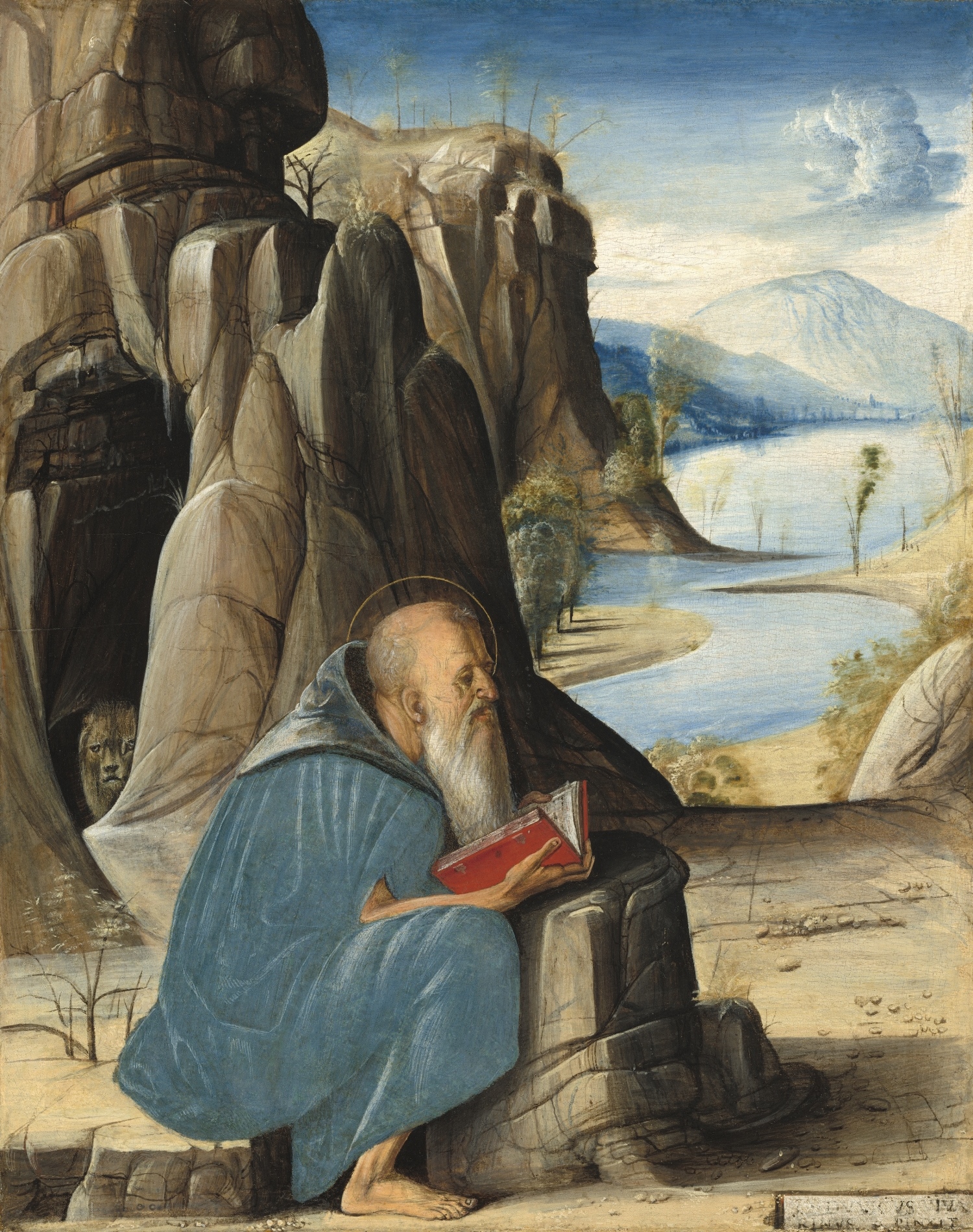
St Jerome in the Desert, ca. 1476, by the Venetian painter Alvise Vivarini (1447 ca. – 1503/5)

Saturday, February 14, 2026

“Those Who Shone Forth in the Ascetic Life”

Rejoice, faithful Egypt; rejoice, holy Libya; rejoice, o chosen Thebaid; rejoice, every place, and city, and land that nourished the citizens of the kingdom of heaven, and raised them in self-discipline and toil, and showed them forth to God as men perfect in their desires. They were revealed as those who give light to our souls; these very same, by the glory of their miracles, and the wonders of their deeds, shone forth to our minds, unto every corner of the world. Let us cry out to them, “All-blessed fathers, pray that we may be saved!”

Scenes from the Lives of the Desert Fathers, or “Thebaid”, by Blessed Fra Angelico, 1420; now in the Museum of Fine Arts in Budapest.
Χαῖρε Αἴγυπτε πιστή, χαῖρε Λιβύη ὁσία, χαῖρε Θηβαῒς ἐκλεκτή, χαῖρε πᾶς τόπος, καὶ πόλις, καὶ χώρα, ἡ τοὺς πολίτας θρέψασα τῆς Βασιλείας τῶν οὐρανῶν, καὶ τούτους ἐν ἐγκρατείᾳ καὶ πόνοις αὐξήσασα, καὶ τῶν ἐπιθυμιῶν τελείους ἄνδρας τῷ Θεῷ ἀναδείξασα. οὗτοι φωστῆρες τῶν ψυχῶν ἡμῶν ἀνεφάνησαν, οἱ αὐτοὶ τῶν θαυμάτων τῇ αἴγλῃ, καὶ τῶν ἔργων τοῖς τέρασιν, ἐξέλαμψαν νοητῶς, εἰς τὰ πέρατα ἅπαντα. Αὐτοῖς βοήσωμεν· Πατέρες παμμακάριστοι, πρεσβεύσατε τοῦ σωθῆναι ἡμᾶς.

On the Saturday before Great Lent begins, the Byzantine Rite commemorates “All of the God-bearing Fathers and Mothers Who Shone Forth in the Ascetic Life.” This text, from Vespers of the preceding day, beautifully recalls the origins of monasticism and the ascetic life in the deserts of Egypt and north Africa. The “Thebaid” to which it refers is one of the provinces into which Egypt was divided by the reforms of the Emperor Diocletian in the later 3rd century; this province had its capital at Thebes, the impressive ruins of which are now within the city of Luxor, including some of the most famous ancient temples. Likewise, the first Ode of Matins for this day begins with the words “Let us all sing together in spiritual songs, of those who shone forth in asceticism, our godly Fathers, whom Egypt, Libya and the Thebaid bore, and every place and city and land.”

One of the most influential writings on Western monasticism is John Cassian’s Institutes, which refer very frequently to the Egyptians as the models of monastic life, as, for example, at the beginning of the third book, in which he speaks of “the perfection and inimitable rigor of the discipline of the Egyptians.” Likewise, when St Benedict’s Rule commands that the entire Psalter should be said in the Office within a week, since “we read that our holy forefathers promptly fulfilled (this recitation) in one day,” he is referring to the common practice of the early ascetics. As the Fra Angelico painting above, and various others like it show, the Western Church never forgot the origin of the ascetic and monastic life; and the motif of the “Thebaid” serves to recall all religious of whatever sort to the ideal expressed by the words of Christ, “Be ye therefore perfect, even as your Father who is in heaven is perfect.”

Pope St Leo the Great writes in his fourth sermon on Lent that very few have the strength to remain continually in a spiritual condition such as the feast of Easter ought to find them in, and with the relaxation of the more strict observance of Lent, and the general cares of this life, “even religious hearts must grow dirty with the dust of this world.” Therefore, the forty days exercise of Lent was instituted by Divine Providence, so that the devotions and fasts of Lent might purify us of the sins which we have committed in the rest of the year. The Byzantine Rite therefore concludes its Fore-Lent with a commemoration of those Saints who did have such strength, and by embracing the ascetic life, lived as it were a continual Lent, invoking their intercession on behalf of the whole Church on the eve of the Great Fast.

Saturday, February 07, 2026

The Feast of St Romuald

The incorrupt body of St Romuald was transferred to the church of St Blaise in the Italian city of Fabriano on February 7, 1481. When Pope Clement VIII added his feast to the general calendar in 1595, in the second edition of the Breviary of St Pius V, it was assigned to the anniversary of this translation, since the day of his death, June 19th, had been from very ancient times the feast of the Milanese martyrs Ss Gervase and Protase. On the calendar of the post-Conciliar Rite, he is kept on the latter date.

Born in the mid-10th century, an age in which religious life had in many places fallen into terrible decadence, Romuald became one of the great monastic reformers in an age of great reformers. The pattern of Benedictine monasticism which he created was formed by bringing together two different ways of life. The first of these was the traditional communal life, as practiced at the monastery of Sant’ Apollinare in Classe near Ravenna, in accord with the Cluniac reform. To this day, there stands right in the middle of the church’s nave the altar where St Romuald was praying, when Apollinaris, an early martyr buried therein, appeared to him in a vision, and confirmed his monastic vocation.

The second was the eremitical life, a tradition more focused on personal austerity, which he learned under a spiritual master named Marinus. Romuald’s biographer, St Peter Damian, describes Marinus as “a man of simple spirit... driven to the eremitical life only by the impulse of his good will,” while referring also to his “severity lacking in judgment.” The monastery founded by Romuald at Camaldoli near Arezzo would thus become the model for a rather loosely organized order, formerly divided into five separate congregations, in which the cenobitic and eremitical life were united.

In the year 1365, the Florentine painter Nardo di Cione executed an altarpiece for the chapel of St Romuald in the Camaldolese house in Florence, St Mary of the Angels. (He is better known today as the first painter of Dante’s Divine Comedy, including what was once an exceptionally vivid, though now much-ruined vision of Hell, in the Strozzi Chapel at Santa Maria Novella.) The central panel shows the Trinity, in the form known as the Mercy Seat, with St Romuald on the left, and St John the Evangelist on the right.

The Lamb of God, as described in the fifth and sixth chapters of the Apocalypse of St John, is represented at top, on the book with the seven seals.

On the left of the predella is shown the appearance of Saint Apollinaris to Romuald.
On the left part of the middle panel, Marinus is shown disciplining Romuald by hitting him in the face with a stick. St Peter Damian tells us that after enduring many such blows, Romuald humbly asked that Marinus might beat him on the right side of his face, since he was starting to loose his hearing on the left side. (Hence the reference to “severity lacking in judgment.”) On the right, Romuald overcomes the assaults of demons, like many great monks before him, such as St Anthony the Abbot.
On the right panel, the famous vision of St Romuald is depicted, in which he beholds a ladder by which monks in the white Camaldolese habit ascend to heaven, “in the likeness of the Patriarch Jacob”, as the Roman Breviary says.

Saturday, November 08, 2025

The Octave of All Saints 2025: The Confessors

From the Breviary according to the use of the Roman Curia, 1529, the end of the sermon for the second day in the Octave of All Saints.

We believe that this day’s festivity also belongs to the priests of Christ, to the doctors, levites and other confessors and monks; in whose hearts virtue flourished, because the world had faded away. Because the will of the flesh was mortified, true charity was fervent in them, and because they were dead to the world, they lived within in it as the Saints live in Heaven. For the more a man takes delight in this world below, the more is he separated from the love of the things of Heaven. Therefore, these holy men, fleeing the world that passes and the corrupting passions of the soul, had God before them and the Angels at their sides, and so merited to be brought by the Angels into the kingdom of Heaven.

Scenes from the Lives of the Holy Hermits, or “Thebaid”, by Paolo Uccello, 1460s; now in the Academia Gallery in Florence. (Public domain image from Wikimedia Commons.)
From the Breviary of St Pius V, 1568, a passage from the fifth sermon on the feast of All Saints by St. Bernard of Clairvaux, Abbot and Doctor of the Church, read on November 6th. (In the painting above, St Bernard is represented in the lower left hand corner as the Virgin Mary appears to him.)
What does it profit the Saints that we should praise them or glorify them? What does this solemnity of ours benefit them? What are earthly honors to them whom, according to faithful promise of the Son, the heavenly Father honors? What are our commendations to them? They are full. It is indeed so, dearly beloved; the Saints have no need of our goods, and our devotion gives them nothing. It is for our sake, and not for theirs, that we honor their memory. … It is commonly said, “Out of sight, out of mind”. (literally “What the eye sees not, the heart does not long for.”) The memory is a kind of sight, and to think of the Saints, is to see them in a certain way. Such is our portion in the land of the living; no small portion, indeed, if love accompany remembrance as it ought. And so I say, our dwelling is in heaven, though in manner very different from theirs. For they are truly there, where we long to be; they are there in presence, we only in thought.
The Glory of All the Saints, by the Tuscan painter Giovanni da San Giovanni, 1630; fresco in the apse of the church of the Four Crowned Martyrs, Rome; the titular Saints of this church share their feast day with the octave of All Saints.
For many years now, the Fraternity of St Peter’s church in Rome, Santissima Trinità dei Pellegrini, has had the custom of exposing all its relics for the veneration of the faithful on All Saints’ day. In the evening, before Vespers, each reliquary is presented before the congregation, and the name of the Saint or Saints whose relics in it are read out. On the side altar of St Matthew, St Phillip Neri, who founded the confraternity that built the church, is given special prominence. (The bronze reliquary seen to the left side of the altar here is also of St Phillip, but is not held up before the faithful, since it is incredibly heavy.) Our thanks once again for the pictures to Don Elvir Tabaković, a former professional photographer from Croatia who is now in religious life, and using his skills to celebrate the beauty of the liturgy.
The sacristan returns one of the relics to its place on the altar.
Relics on the high altar.
At the end, the church’s piece of the True Cross is processed down and up the central aisle, before the faithful are blessed with it.

Tuesday, October 21, 2025

The Feast of St Hilarion the Abbot

St Hilarion was born in the last decade of the 3rd century to a pagan family, near Gaza in the Roman province of Palestine. He became a Christian when he was sent as a youth to study in Alexandria, which was of course not just a patriarchate, but one of the early Church’s major intellectual centers. Early on in his life as a Christian, he visited St Anthony in the desert, where he conceived a strong desire for solitude in the service of God. (The word “monk” derives ultimately from the Greek “monos – only, alone.”) He therefore left Anthony, who was frequently visited by people who wished him to heal or exorcise them; the continual search for solitude would form the pattern of much of the rest of Hilarion’s life.
Returning to his own country, he first gave away everything he had inherited from his parents, then withdrew into the desert at a place near the sea called Maiuma, and for many years, lived the same kind of harshly ascetic life as Anthony, conceding nothing more than the barest possible minimum to the necessities of the body. Being still a young man, he often felt the temptations of the flesh. On such occasions, he would intensify his fasting, and say to his body, “I will see to it, thou ass, that thou kick not, and feed thee with straw, rather than barley.”
The Temptation of St Hilarion, 1857 ca., by the French painter Octave Tassaert (1800-74). St Jerome describes something of the temptations to which Hilarion was subjected, in a similar vein to which St Athanasius describes those of St Anthony, and the artist here has been inspired by various depictions of those temptations.
After twenty years of this life, he performed his first miracle, the healing of a woman from barrenness. This was followed by others, and in due course, disciples began to gather around him, and form small communities, much as was happening at the same time in Egypt under Anthony’s inspiration and example. As St Jerome writes, “the Lord Jesus had the older Anthony in Egypt, and the younger Hilarion in Palestine.” For this reason, the Roman liturgical tradition honors them both with the title of “abbot”; in the Byzantine Rite, he and Anthony are both called “the Great.”
When Anthony died in 356, Hilarion knew of it by inspiration. He had long been troubled by the constant flow of visitors coming to see and speak to him, and the prosperity (such as it was) of the monastic community that had effectively grown up around him. He therefore determined to abandon Maiuma and go to Egypt. There he first visited the place where Anthony had lived for so many years, and then took up a renewed ascetic life in another part of the desert. But “the poor ye shall always have with you”, and here too, Hilarion was prevailed upon to intercede with the Lord by his prayers, to end a drought, and to heal many sick and injured persons. He therefore withdrew once again, first to Sicily, and then, when his fame also followed him there, to Dalmatia (St Jerome’s native country), and finally to Cyprus, where he ended his days. St Epiphanius, bishop of the town of Salamis on that island, came to know him in his final years, and wrote a brief account of him which St Jerome used in writing his biography.
The Monastery of St Anthony in Egypt, which is located about 210 miles southeast of Cairo, and about 18 miles west of the Red Sea coast. (Image from Wikimedia Commons by LorisRomito, CC BY-SA 3.0)
Before the Tridentine liturgical reform, most churches of the Roman Rite kept October 21st as the feast of St Ursula and her companions, said to number 11,000, and to have been martyred by the Huns near Cologne in the 5th century. St Hilarion’s feast was kept in only a minority of places, but among them was the Papal court, whose liturgical tradition was codified by Pope Innocent III (1198-1216) at the beginning of the 13th century, forming the ancestor texts of the Tridentine books. The legend of St Ursula contains a story that she and her companions traveled to Rome, and the Pope resigned to join them in their travels, after which the cardinals expunged all of his acts. The silliness of this must have been evident to the learned men of the Roman curia, who might also have preferred the life of Hilarion as the work of one of their own, since Jerome had been the secretary to Pope St Damasus I. In a Roman breviary printed at Venice in 1481, we find Ss Ursula and Companions noted in the calendar, but in the proper of the Saints, there are no lessons for them, nor even a prayer for a commemoration, while Hilarion has three fairly long historical lessons which sum up what is written in St Jerome’s life.
Saints Gregory the Great and Jerome, 1495-1500 ca., by the Spanish painter Pedro Berruguete (1450 ca. - 1504.) In accordance with a long-standing artistic convention, Jerome is anachronistically dressed as a cardinal, since the secretary of the Pope would ordinarily have been a cardinal. (Public domain image from Wikimedia Commons.)
In the Breviary of St Pius V, the virgin martyrs are kept only as a commemoration, a recognition of fact that the traditional account of their lives and martyrdom is full of impossibilities, and must be regarded as historically untrustworthy. St Hilarion, on the other hand, remains as a feast of simple rank, with two proper readings [1], though rather shorter than those of the earlier printed editions. This may seem to be a demotion, but it is not. The lessons retain the substance of what St Jerome reports about him, and are shortened to accommodate two new aspects of the Divine Office introduced by the Tridentine reform. One is that on a simple feast, at least one of the Matins readings must be taken from the Bible. The other is that the psalms of the nocturn are taken from the feria, where they were previously taken from the pertinent Common of Saints. The shortening of the lessons would therefore balance the lengthening of the psalmody. [2]
Although the post-Tridentine liturgical reform was certainly very conservative, Hilarion’s feast was not retained on the calendar merely in function of the Roman church’s habitual liturgical conservatism. The original calendar of the Breviary of St Pius V, issued in 1568, contains six abbots: three of the West, Benedict, his disciple Maurus, and the French Saint Giles, and three of the East, Anthony, Hilarion and Sabbas, the founder of the great lavra outside Jerusalem. Of these feasts, one of each part is a double feast (Anthony and Benedict), one a simple (Giles and Hilarion), and one a commemoration (Maurus, who shares his day with another Saint whose life was written by Jerome, St Paul the first hermit, and Sabbas.)
This returns to one of the most important themes of the post-Tridentine reform, its role as the Church’s liturgical answer to the emergence of Protestantism. The soi-disant reformers rejected as “corruptions” of the true Gospel any number of things that had very deep roots in the Church, roots that went far further back than what we now call the Middle Ages, to which they mostly attributed the supposed corruptions. Among them was monasticism in its manifold expressions, and it goes without saying that in lands where Protestantism prevailed, huge numbers of monastic foundations, many of them very old and important, were destroyed, and their property used to buy the compliance of the local nobility in the establishment of the new religion. The presence of three Western abbots and three Eastern ones on the calendar asserts that the monastic life is not a medieval corruption, but rather part of the common tradition shared by the churches of the East with those of the West.
The ruins of Fountains Abbey, a Cistercian house founded in 1132, 3 miles outside the English city of Ripon in North Yorkshire. Image from Wikimedia Commons by WyrdLight.com, CC BY SA 4.0. (I believe that the name “Downton Abbey” was made up by its Catholic creator, Julian Fellowes, in homage to Fountains Abbey, since the fictional estate is also located a few miles outside of Ripon. Many English houses and institutions still bear the names of the original owners dispossessed of them by the avarice and impiety of Henry VIII and his descendants.)
Likewise, the presence in the liturgy of a monastic life written by St Jerome, although the lessons of St Hilarion do not mention this fact. Jerome is the only Church Father to whom the reformers could appeal to justify their rejection of the so-called Deuterocanonical books of the Old Testament, although on this point, Jerome himself was not at all consistent. But Jerome was also very much in favor of many things to which the early Protestants were wholly opposed, including monasticism. If Jerome is to be taken as an authentic witness to the teachings of early Church on the matter of the Deuterocanonicals, why should he not also be taken as an authentic witness to the value of monasticism? This question cannot, of course, possibly be resolved without a universally recognized authority within the Church that has the right to judge on such matters.
[1] Before 1913, a simple feast could have either one or two proper readings, with the other two or one being taken from the Scripture of the day. This was changed by the reform of St Pius X, so that all simple feasts have only one proper reading.
[2] Before 1568, the psalms of Matins for the feast of St Hilarion would be taken from the common of a simple confessor, nine psalms, totaling 93 verses. In the Breviary of St Pius V, they are taken from the feria; this year, that would mean the twelve psalms of the ferial nocturn of Tuesday, which have 206 verses.

Wednesday, April 02, 2025

On the Sanctification of Time

In “Processing through the Courts of the Great King,” I spoke of how the many courtyards and chambers of the King’s palace prior to his throne room, or the many precincts and rooms of the Temple leading up to the Holy of Holies, could be a metaphor of a healthy Catholic spiritual life that culminates in the Holy Sacrifice of the Mass, but surrounds it with concentric layers of other kinds of prayer, devotion, and piety. The Eucharistic Sacrifice is the fons et culmen (font and apex) of the Christian life, but it is not the sum total of it — nor can it bear the weight of every need. I concluded the article thus:
We owe it to our King to prepare ourselves for His royal banquet, His wedding feast, and the Church has given us an abundance of ways in which we can do that: the Divine Office; Eucharistic Adoration; Lectio Divina; Confession; the Rosary; and so forth. The Mass is the crown jewel, to be sure, but it is not the entire crown; indeed, the jewel is given its appropriate place by the other materials that hold it and complement it.
The Divine Office

After the Mass, the most important public prayer offered by the Catholic Church is the Divine Office, a “sacrifice of praise” consisting of psalms, prayers, canticles, hymns, and readings divided into particular “hours” such as Lauds (morning prayer), Vespers (evening prayer), and Compline (night prayer). The shape and content of these magnificent liturgies come down to us from the monks of antiquity — in the West, above all from St. Benedict and the monastic empire inspired by his example and his Rule.

Characteristic of the Benedictine way of life is the sanctification of time through a calmly recurring cycle of prayer that permeates the day and night. In addition to the celebration of the Mass, the traditional Benedictine monk or nun prays communally seven times a day and once in the middle of the night, with the long office called Matins. In this way they fulfill what is said in the Book of Psalms: “Seven times a day I praise you” (118, 164), “I rose at midnight to give praise to thee” (118, 62), and “the just man meditates on the law day and night” (1, 2).

How beautiful is this patient, persevering dedication to set times of prayer, in order that the whole of time — the whole span of the day and stretch of the week, the month’s reach and the cycle of seasons, the passing years and decades and centuries, all of this human time — may be divinized, offered up to its unchanging Lord, penetrated with His grace, pregnant with sacred meaning and fruitful with a host of virtues!

This is the monastic life, this is the angelic life (says the Byzantine tradition), and we lay people are called to imitate it in some fashion, according to our ways and means. While the schedule of most modern lay people does not make it particularly easy to pray the Divine Office, it is often possible to find enough time in the morning for a short office like Prime, or in the evening for Vespers, or before bedtime for Compline. In fact, I am given to understand that before the Council, some used the expression “Prime and Compline Catholics” to refer to laity who made these two short hours the bookends of their day.

Being composed almost entirely from Scripture, the Divine Office is the most natural way to become intimately familiar with the Word of God, which will form our minds and hearts as Catholics. Lectio divina and the Divine Office fit together like hand in glove.


Sacred Conception of Time

It has struck me over the years how infrequently Catholics reflect on, or are even aware of, the difference between the secular conception of time and the sacred conception of time. Isaac Newton introduced the notion of absolute space and time, where space is seen as a giant grid of Cartesian coordinates, and time is seen as an equable ticking of a clock, all seconds, minutes, and hours being equal. This may be called temporal egalitarianism.

The premodern notion of time, in contrast, sees it as hierarchical, organic, and malleable. The day is understood to have a spiritually significant rhythm from dawn to noon to dusk to night, and each one of these parts has its own character, its own “weight” and role in the spiritual life, not to mention its function as a sign. The week has an internal dynamism emanating from the Sunday past and straining towards the Sunday to come, with certain days connected customarily to certain mysteries or saints, above all Friday’s connection to the Passion (hence, the rule of abstinence from flesh meat on the day when the flesh of God was crucified). Into the seasons of the year the great mysteries of the Catholic faith are woven, so that the cycle of nature mysteriously symbolizes the cycle of grace, each providing a key to the other. In short, the Catholic mind sees time as differentiated by days and seasons of feasting and fasting, by Sundays and Solemnities, by memorials, novenas, and processions.

As individuals and as communities, we should strive in big and little ways to live out a properly Catholic sense of time, understanding the calendar of days, weeks, and months as a recurrent cycle of celebrations of different persons—especially Our Lord and His Mother, but also the saints and angels. We should try to be aware of the Church calendar. “Whose feast is it today?” ought to be a question we ask every morning. Do we know when it is a major feast, e.g., the Nativity or Birthday of Our Lady, or the Exaltation of the Holy Cross? On the Exaltation of the Holy Cross, one might choose to pray the Stations of the Cross or the Sorrowful Mysteries of the Rosary. If it’s the feast day of a saint, we should invoke that saint in our prayer, think about him or her, and congratulate a fellow Catholic who shares the saint’s name.
 
The traditional Roman calendar

Levels of Time: (1) The Year

At the level of the year, numerous and profound are the differences between ecclesial time and secular time, especially in an explicitly secular country like the United States. For example, our secular year begins on January 1st, but the Western Church’s year begins with the First Sunday of Advent, while the Eastern Church’s begins in September.

The weeks before Christmas are a time of quiet expectancy (even called by the Eastern tradition “little Lent”), whereas they are an orgy of fake Christmas music and commercialism in the surrounding secular culture. Americans celebrate a Puritan Thanksgiving once a year, whereas Catholics celebrate thanks­giving every day with the Eucharistia, a Greek word that means “Thanksgiving.” Nowadays there are witches who dance around on the summer and winter solstices, but we have always celebrated these astronomical events by our own feasts: the Nativity of Our Lord Jesus Christ in December and the Nativity of St. John the Baptist in June. As St. John himself said: “He must increase, I must decrease.” John’s birthday is observed right around the time when daylight begins to lessen; Jesus is born right around the time when daylight begins to lengthen. Easter, for us, lasts two months, whereas in the secular world it lasts for one weekend of bunny rabbits and chocolate.

The United States gives days off for things like dead presidents, dead soldiers, and labor; we Catholics celebrate the living saints who are at rest in heaven. When you start to think about it, the whole mentality is different. We need to be spiritually attuned to the universal Church calendar rather than taking our bearings from the secular and American. Not that we should disdain our secular holidays, but they are not holydays, and our own true and proper holydays should take precedence.

Levels of Time: (2) The Week

The week has a kind of sacred rhythm, beginning from and culminating in Sunday, the “Little Easter.” The secular world’s week is five days of work and two days of rest and relaxation to kick back and do whatever you feel like doing (which usually means taking it easy on Saturday and mowing the grass or doing other forbidden manual labor on Sunday).

The Christian perspective is different. There are six days of work, and one day of genuine rest—a rest of worship and prayer, of feasting and rejoicing with one’s family and friends. That is more than, and better than, mere “R&R.” We resist the reduction of the Lord’s Day to mere “time off” when we make Sunday Mass the pinnacle not only of Sunday but of the entire week. We get dressed up. We take time to prepare before Mass and make a thanksgiving afterwards, circumstances permitting. Perhaps one can come back to the chapel later on in the day to pray. In any event, one should not be thinking “what’s the most convenient way to get Mass over with so that I can get back to work or get out to play.” Sunday is not merely a means to something else; it is an image or echo of the ultimate end itself. In fact, for the Church Fathers, Sunday is a symbol of heaven and eternal life, so the way we treat Sunday is a bit like telling God what we think of the end or goal of our lives.

Levels of Time: (3) The Day

The day
has its own internal rhythm. Not all hours are equal.

The morning, upon first waking, is the best time to consecrate our day to the Lord. When we retire for bed is the best time to examine our conscience, express sorrow for our sins, and commend our day’s work and our soul to God before entering the “little death” of sleep.

The source and summit of the day should be the Holy Sacrifice of the Mass. The Eucharist is the sun from which all grace radiates, so if we want to be in the sun, we have to put ourselves in its direct rays. If one goes to morning Mass, one is establishing the day on its foundation, and the rest of the day flows from it. If one goes to Mass at or around noon, one is approaching it as a kind of peak or summit towards which the morning rises and from which the afternoon descends, a centerpoint on which the day is poised. If one goes to Mass in the evening, one is gathering up the day’s work into an offering to be made to the Lord.

It’s good for us to be consciously aware of the meaning that belongs to the choices we make and the actions we perform, so that we can leverage that awareness for our spiritual benefit. Moreover, it is highly praiseworthy to form a specific intention for each Mass one attends: “Lord, I desire to offer up this Holy Sacrifice with you for [X, Y, or Z].” By doing this, you have invested yourself in the Mass—something is at stake for you.


Holiness Above All

A last word about holiness. Blessed Ildefons Schuster, Cardinal Archbishop of Milan until his death in 1954, said this to his seminarians a few days before his death:
I have no memento to give you apart from an invitation to holiness. It would seem that people are no longer convinced by our preaching; but faced with holiness, they still believe, they still fall to their knees and pray. People seem to live ignorant of supernatural realities, indifferent to the problems of salvation. But when an authentic saint, living or dead, passes by, all run to be there…. Do not forget that the devil is not afraid of our [parish] sports fields and of our movie halls: he is afraid, on the other hand, of our holiness.
In the battle for souls that is raging in the world around us (and within us), holiness will always take precedence over any other weapon we can fight with. If we want to make the kingdom of God present in time, our holiness, which is inseparably linked with our life of prayer, is truly what comes first and last. Without it, we do not make God’s kingdom present, no matter how much we build, how much we persuade, how much we campaign and conquer the field. With God’s grace in our souls, however, even the smallest things we do gain inestimable value, while the great things we attempt are blessed—not necessarily with success as the world understands it, but with a fruitfulness that touches many souls. In the words of Blaise Pascal:

Do the little things as though they were great things, remembering that the majesty of Christ within us works them and lives our life; and do the great things as though they were no more than little things easily done, remembering the power of Christ within us. 

Friday, February 07, 2025

St Luke the Younger, and the Monastery of Hosios Loukas

In the Byzantine Rite, today is the feast of a Saint called Luke, a monk who lived in the 10th century, and is traditionally known by a variety of epithets: “the Younger”, to distinguish him from the Evangelist; “of Steiris” or “Steirion”, the place where he died and was buried; “of Hellas”, the Greek word for “Greece”; and “the Wonderworker” (Thaumaturgus), in part because he is one of the first Saints who miraculously levitated. He was born in 896, and died on this day in either 946 or 953.

A mosaic portrait of St Luke in the church of the monastery dedicated to him, which houses his relics, described further below. (Public domain image from Wikimedia Commons.)
He was the third of seven children born to a couple named Stephan and Euphrosyne, who had fled from Saracen attacks on the island of Aegina, about 23 miles to the south-west of Athens, and settled in the central region of Thessaly. From an early age, Luke practiced the works of charity, giving away his clothes and food to the poor, and showed a strong inclination to the ascetic and devotional life. After his father’s death, he left home to seek a monastery to enter, but was captured by soldiers who mistook him for a runaway slave, and sent back home after being badly mistreated. Some time later, his mother allowed him to travel as far as Athens with two monks who were on pilgrimage from Rome to the Holy Land, and in that city, he entered a monastery. However, the abbot had a vision of his mother asking him to be sent back, and so he was.

As a dutiful son, Luke returned to his family, but only four months later, Euphrosyne accepted her son’s vocation, and allowed him to depart once again; he was then eighteen years old. He made his way to a mountain near Corinth, where he built himself a hermitage, and lived a life of great austerity, followed, as such lives as wont to be, by many miracles.

The 10th century was not a peaceful one in Greece’s history, and the disturbances of his times drove St Luke to move on several occasions. He eventually settled in the region of Boeotia, on the northern side of the Gulf of Corinth. On the slopes of Mt Helicon, at a place called Steiris, he founded a new hermitage, and in due course, as men came to live near him, this was formally established as a small monastery. He died seven years later after an illness of some months, during which he prophesied that Steiris would become the site of a great church and monastery, and a place of pilgrimage. The presence of his own relics there is one of the reasons why this prophecy came true, since he is one of the Saints whose tomb issues a stream of perfumed oil, along with such other Eastern luminaries and wonderworkers as Nicholas of Myra and Demetrius of Thessalonica.

The monastery has two churches right next to each other, which is not an unusual arrangement in the Byzantine world. The older and simpler one was founded in St Luke’s lifetime, and is the only church certainly known to have been built in the 10th century in mainland Greece. Next to it stands a much grander one called the Catholicon, a term which sometimes means the cathedral of a diocese, and sometimes, the largest or most important church within a monastic complex, as it does here. This was built in the early 11th century to house the Saint’s tomb, and is famous for the amount and quality of both fresco and mosaic work, contemporary to the original construction, which is preserved within it. There are a huge number of good quality photographs of it on Wikimedia Commons, from which I have made this small selection. 

The exterior of the rear of the two churches, the catholicon on the left, and the older church (originally dedicated to St Barbara, but now to the Virgin Mary) on the right.
by Andreas MessimerissCC BY-SA 4.0
The façade of the catholicon.
by Jean Housen, CC BY-SA 3.0
The tomb of St Luke in the crypt.
by Jean Housen, CC BY-SA 4.0
A fresco in the crypt of the burial of Christ, and the appearance of the angels to the woman at the empty tomb.
Public domain, anonymous.

More recent articles:

For more articles, see the NLM archives: