The small chapel itself is well appointed for the offering of the traditional Mass, a regular occurrence there:
Hanging on the wall, a portrait of Christ, with the inscription “I desire mercy.”
To submit news, send e-mail to the contact team.
To submit your own photos, photopost@newliturgicalmovement.org.
The small chapel itself is well appointed for the offering of the traditional Mass, a regular occurrence there:
Posted Wednesday, February 11, 2026
Labels: Historical Vestments, Missale Romanum, Peter Kwasniewski, Pius IX, Pius XI, Relics, St Pius X, Vancouver, Vestments
O God, who didst make blessed Albert, Thy bishop and Doctor, great by his bringing human wisdom into captivity to divine faith: grant us, we beseech Thee, so to adhere to the footsteps of his magisterium, that we may enjoy perfect light in heaven.[1]The new collect, as given in the current edition of the modern Roman Rite, reads:
O God, who made the Bishop Saint Albert great by his joining of human wisdom to divine faith, grant, we pray, that we may so adhere to the truths he taught, that through progress in learning, we may come to a deeper knowledge and love of you.[2]In the former prayer, God makes Albert great because he brought human wisdom into captivity to divine faith (in humana sapientia divinae fidei subjicienda). The prayer echoes St. Paul writing to the Corinthians about the destruction of worldly wisdom: “For the weapons of our warfare are not carnal, but mighty to God unto the pulling down of fortifications, destroying counsels, and every height that exalteth itself against the knowledge of God, and bringing into captivity every understanding unto the obedience of Christ” (2 Cor 10:4–5). It is also reminiscent of the verse from the Psalms: “Thou didst ascend the high mount, leading captives in thy train, and receiving gifts among men, even among the rebellious, that the Lord God may dwell there” (Psa 67:19 [68:18]).
O God, who hast ordained that Thine only-begotten Son when lifted up from the earth should draw all things to Himself: mercifully grant through the merits and example of Thy seraphic Confessor Joseph, that we may be lifted up above all earthly desires and be found worth to come unto Him: Who liveth and reigneth…Or, for St. Francis of Assisi on October 4:
O God, who, through the merits of blessed Francis, didst give increase to Thy Church by enriching her with new offspring: grant us that following his example we may despise earthly goods and ever be glad to partake of Thy heavenly gifts.[3](Here, for comparison’s sake, is how the new Collect for Francis reads: “O God, by whose gift Saint Francis was conformed to Christ in poverty and humility, grant that, by walking in Francis’ footsteps, we may follow your Son, and, through joyful charity, come to be united with you.”)
O God, who this day didst strengthen blessed Denis Thy martyr and Bishop with fortitude in suffering, and didst associate Rusticus and Eleutherius with him in preaching Thy glory to the heathen: grant, we beseech Thee, that following their example we may for love of Thee despise worldly success and may not fear worldly misfortune [pro amore tuo prospera mundi despicere, et nulla ejus adversa formidare].On October 10, the feast of St. Francis Borgia, also suppressed in the Novus Ordo, the traditional liturgy prays:
O Lord Jesus Christ, who art the model of true humility and its reward: we beseech Thee, that as blessed Francis took Thee as model in contemning worldly honors and Thou hast glorified him, so Thou wouldst associate us with him both in the contempt and in the glory: Who livest and reignest…On October 16, the feast of St. Hedwig — a saint who miraculously stayed on the modern calendar — we find this potent Collect in the usus antiquior:
O God, who didst teach blessed Hedwig to renounce the pomps of this world, that, with her whole heart, she might follow the humble way of Thy cross: grant that, through her merits and example, we may learn to trample under foot the perishable delights of this world, and by cleaving to Thy cross, surmount all obstacles: Who livest and reignest…(The new missal’s collect for St. Hedwig is thin gruel: “Grant, we pray, almighty God, that the revered intercession of Saint Hedwig may bring us heavenly aid, just as her wonderful life is an example of humility for all.”)
Let holy Luke, Thine Evangelist, we beseech Thee, O Lord, intercede for us, who for the glory of Thy name ever bore in his body the mortification of the Cross.The new collect, although more customized to St. Luke,[3] drops all reference to asceticism, in keeping with the prevailing bias Pristas and others have documented.
O God, who didst vouchsafe to ennoble blessed Peter, Thy Confessor, by gifts of marvellous penance and highest contemplation: grant, we beseech Thee, that by his merits pleading for us, we may so mortify the flesh as the more easily to take hold of the things of heaven.All of the above, mind you, are Collects from a one-month period, namely, September 18 to October 19. Do we detect a pattern? Yes, without a doubt. The dogmatic and disciplinary freight of the lex orandi is unmistakable. The liturgy is asking the Lord for a specific attitude of contemptus mundi, which St. Albert all the more impressively illustrates precisely because he is a scholar, author, scientist, naturalist, and man of affairs who has nevertheless held firm to the primacy of the kingdom of heaven. Century after century, collect after collect, the liturgy lucidly expressed and tirelessly inculcated this lofty vision of man’s vocation, the finality of the celestial fatherland, and the relativity of earthly affairs — until the 1960s, when Progress built a home for itself in a Church that had once anathematized the statement: “The Roman Pontiff can, and ought to, reconcile himself, and come to terms with progress, liberalism, and modern civilization.”[4]
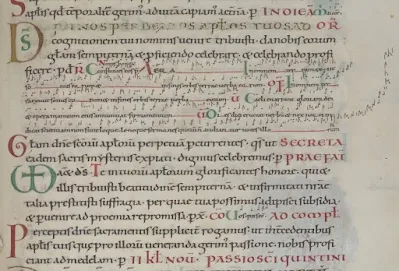
![]() |
| The 4th Sunday after Epiphany (Dom IIII post Theophaniam), in the Sacramentarium Triplex, Zürich, Zentralb. Ms. C 43, ff. 35r-35v |
Deus, qui nos, in tantis perículis constitútos, pro humána scis fragilitáte non posse subsístere: da nobis salútem mentis et córporis; ut ea, quæ pro peccátis nostris pátimur, te adiuvánte vincámus.O God, who know that our human frailty cannot stand fast against the great dangers that beset us, grant us health of mind and body, that with your help we may overcome what we suffer on account of our sins.
Concéde, quǽsumus, omnípotens Deus: ut huius sacrifícii munus oblatum fragilitátem nostrum ab omni malo purget semper et múniat.Grant, we pray, almighty God, that what we offer in sacrifice may cleanse us in our frailty from every evil and always grant us your protection.
Múnera tua nos, Deus, a delectatiónibus terrénis expédiant: et cæléstibus semper instáurent aliméntis.May your gifts, O God, detach us from earthly pleasures and ever renew us with heavenly nourishment.
![]() |
| Schema 186 (De Missali, 27), 19 September 1966, p. 18 |
[T]he motives controlling the selections [the Consilium] made, and their editorial alterations, have a consistent mens, videlicet, to enforce a levelling-down: [in the Novus Ordo] we end up with a liturgical culture squeezed everywhere into the straight-jacket of one decade. On the other hand, the Authentic Use, having evolved organically over two millennia, picking up like a glacier diverse materials from every age it passed through, contains within it so much more cultural diversity.
Posted Saturday, January 28, 2023
Labels: Consilium, Liturgical Reform, Matthew Hazell, Missale Romanum, orations, Propers, Vatican II
While this in part is true, it also wrongly gives the impression that both heritage and culture are things we create based upon what we value or dis-value at any given moment. It implies that heritage has no inherent force or stability by which we “should” value it. As a result, contemporary society is left unfettered to destroy or remake past monuments as we see fit. We are simply playing at making new transient meanings and values based upon our shifting priorities and allegiances at the moment.He then turns to the Vatican’s Pontificia Commissione per i Beni Culturali della Chiesa for guidance. The commission’s body of directives on how old ecclesiastical buildings should be treated
understands ecclesiastical heritage not firstly as high artistic achievement, but as material witness to Christian belief. The object itself (be it a sculpture or building) expresses Christian belief, but more importantly, it records and projects the faith of the community which created it – it is the witness of the witnesses. Christian heritage is theologically rooted therefore in those who have seen and confessed Christ as Lord, and is theologically oriented to continuing that witness in the present. In this way, the pertinent question for church heritage is not how may we act upon it to our own ends, but how may we become present to its inner world of meaning, what in Italian is known as valorizzazione. In this paradigm there is a very real sense of communio with and between the present church, the object, and the Christian community of the past. To tamper with the material object, is to change the record of witness. A communion suggests respect, listening, and investigation. Not hubris, hegemony, and alteration. Oddly, no one would contend that in order to understand the past and make it relevant one should enter an archive and rewrite, erase or destroy documents. But this is exactly what we continuously do in the built environment (our church buildings bearing the brunt), and in so doing we falsify and destroy the underlying witness. In this process of alteration we ultimately erase ourselves since we are constantly born out of our pasts.Hadley notes that most of the proponents of super-modern renovations to Notre Dame (thankfully all rejected) believe that moderns are inescapably stuck in modernity and cannot relate any more to past styles as if they were present languages. Citing Catholics who believe that the right approach is to “innovate for God,” to show that the community has something “new” to say, he remarks:
In a post-Christian West the necessary reflection called for by the Notre-Dame tragedy is not a question of “innovation” but of reclamation and witness. Reclaiming and fortifying our witness by understanding our past. When the fire broke out at the cathedral, the nearby monastic Fraternité de Jérusalem began signing the Litany of Saints in their church invoking the aid of French Christians of old whose faith had built Notre-Dame. They continued the litany until the flames were extinguished…. What I see at stake now is the preservation of the very possibility of religious imagination. It seems to me that what Christianity should be proposing at this time is not “innovation” but deep engagement with our past, by calling upon the people, faith, and wisdom, that created that which we postmodernists are now playing at. After all, the term innovate in its earlier Latin form meant more to “renew” than to “change.” One is hard pressed to innovate with empty hands. We need our architectural and artistic past and we need to relearn it urgently.The end of Hadley’s article is an eloquent appeal to abandon modern hubris and to sit at the feet of our ancestors in the Faith, who have something to teach us, who have indeed much to tell us that we have forgotten, to our impoverishment. Perhaps most of all, we need to be broken out of our temporal snobbery and the hidden heresy of perpetual progress. Every age is an age of progress, regress, and stasis, in different respects; and yet the most important truths, the truths by which we live and die, remain the same.
It now must be said again explicitly; Our ancestors, histories, material cultures, and built environments, have the right to be what they are. To not be re-interpreted, or reinvented. To exist today in their integrity without our pushy or hubristic updates, additions, and re-contextualization meant to sooth, temporarily mesmerize, or aggrandize ourselves… What this demands of us is humility, recognition that we are not inherently progressive in any positive way, that modernity is not innately better, that the junk we flood the earth with today, is not more enduring and meaningful than the artistry and faith of our past. We like the Russian Orthodox reformer of the 19th century, Ivan Kireevsky, cannot insist that the way forward is to change a past because we have forgotten it (Kireevsky, Fragments, 248-43). We must instead go to that place our ancestors built and learn to see it as they did, and thus bear testimony to it as eyewitnesses. And such is the case of Notre-Dame in Paris. Its restoration lies not in our changes to it, but in our submission to its form, wisdom, and witness.
Could anyone read this impassioned plea for preserving the architectural integrity of Notre Dame cathedral and not think immediately of the even greater claim made on us by the greatest work of art known to the Western world—the Roman Rite of the Mass, and its panoply of attendant rites—whose integrity was so violently assaulted after the Second Vatican Council? Just go back and re-read the quotations from Hadley, but having in mind the liturgy instead of Notre Dame. There is a nearly one-for-one equivalency of concept and praxis.
This, in turn, reminds me of one of the most splendid passages in the writings of John Senior:
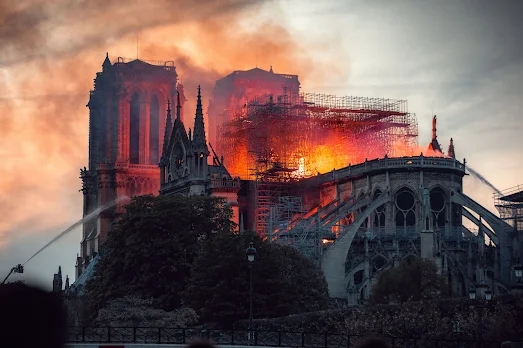
Whatever we do in the political or social order, the indispensable foundation is prayer, the heart of which is the Holy Sacrifice of the Mass, the perfect prayer of Christ Himself, Priest and Victim, recreating in an unbloody manner the bloody, selfsame Sacrifice of Calvary. What is Christian culture? It is essentially the Mass.The raging flames that burned up the spire and roof of the great medieval masterpiece of Notre-Dame in Paris, the fire that gutted its harmonious additions and renovations, provided us with a palpable image of what was done to that even greater masterpiece of medieval art (so to speak), the traditional Roman Rite, in the decade from about 1963 to 1973. The cathedral, after all, was created to house the Host and to provide a worthy space for the sacred liturgy. There would be no Notre Dame, no Chartres, not a single one of the great cathedrals, without the usus antiquior, as Marcel Proust recognized (see his important 1904 essay Death Comes for the Cathedrals, recently published by Wiseblood Books with commentary by John Pepino and me, tying it in to the traditionalist movement today).
That is not my or anyone’s opinion or theory or wish but the central fact of 2,000 years of history. Christendom, what secularists call Western Civilization, is the Mass and the paraphernalia which protect and facilitate it. All architecture, art, political and social forms, economics, the way people live and feel and think, music, literature―all these things, when they are right, are ways of fostering and protecting the Holy Sacrifice of the Mass.
To enact a sacrifice, there must be an altar, an altar has to have a roof over it in case it rains; to reserve the Blessed Sacrament, we build a little House of Gold and over it a Tower of Ivory with a bell and a garden round it with the roses and lilies of purity, emblems of the Virgin Mary ―Rosa Mystica, Turris Davidica, Turris Eburnea, Domus Aurea, who carried His Body and His Blood in her womb, Body of her body, Blood of her blood.
And around the church and garden, where we bury the faithful dead, the caretakers live, the priests and religious whose work is prayer, who keep the Mystery of Faith in its tabernacle of music and words in the Office of the Church; and around them, the faithful who gather to worship and divide the other work that must be done in order to make the perpetuation of the Sacrifice possible—to raise the food and make the clothes and build and keep the peace so that generations to come may live for Him, so that the Sacrifice goes on even until the consummation of the world.
Posted Monday, December 20, 2021
Labels: cathedrals, John Senior, Missale Romanum, modernism, Notre Dame, Peter Kwasniewski
Today’s feast of Saints Simon and Jude, inscribed in both the traditional and reformed Roman calendars on October 28th, provides more insight into the general spirit of the post-Vatican II liturgical reforms, as well as the freedom the members of the Consilium ad exsequendam felt they had when it came to changing the liturgy. In a comparative index of first lines, it would appear as though no changes were made to the prayers of this feast in the course of the reform. However, as we will see, this is far from the case.
Deus, qui nos per beatos apostolos tuos
ad cognitionem tui nominis venire tribuisti,
da nobis eorum gloriam sempiternam
et proficiendo celebrare et celebrando proficere. (CO 1906)
Deus, qui nos per beátos Apóstolos
ad agnitiónem tui nóminis veníre tribuísti,
intercedéntibus sanctis Simóne et Iuda,
concéde propítius, ut semper augeátur Ecclésia
increméntis in te credéntium populórum.
Gloriam, domine, sanctorum apostolorum
perpetuam praecurrentes,
quaesumus, ut eandem, sacris mysteriis expiati,
dignius celebremus. (CO 2711)
Perceptis, domine, sacramentis, suppliciter rogamus,
ut, intercedentibus beatis apostolis tuis,
quae pro illorum veneranda gerimus passione,
nobis proficiant ad medelam. (CO 4200 d)
Percéptis, Dómine, sacraméntis,
súpplices in Spíritu Sancto deprecámur,
ut, quæ pro apostolórum Simónis et Iudæ
veneránda gérimus passióne,
nos in tua dilectióne consérvent.
Permulti textus, decursu temporum, vitiati sunt.
Non agitur hic de aliquo archaeologismo, quo lectio antiquior, ipso facto melior aestimaretur. Sed quibusdam mutationibus textus antiqui, sub aspectu theologico vel pastorali, reapse imminuti vel corrupti sunt…
Placetne Patribus, ut, sensu quo modo de his locuti sumus, textus orationum recognoscatur, vel in casu, emendetur?
[Many texts, over the course of time, have become corrupted.
There is no question here of any archeologism, where older readings are considered better by that fact alone. However, certain alterations of ancient texts, carried out for theological or pastoral reasons, are in truth impairments or corruptions…
Does it please the Fathers that, in the way indicated about which we have spoken, the text of orations is to be revised or, in certain cases, amended?]
Over the last decade in particular, the figure of 17% has been quoted as the proportion of prayers that survived intact from the traditional Roman Missal into the novus ordo of Paul VI. [1] However, in the wake of Traditionis custodes, with renewed attention being given to the comparison of ‘forms’ of the Roman Rite as well as the canonical and theological controversy over what counts as its lex orandi, [2] it seemed opportune to build on my previous efforts and revisit this percentage through a careful and exhaustive analysis of all the orations. By doing this, not only can we arrive at a definitive number, but we can also now have all the relevant data freely and easily accessible in the public domain, so that everyone can see which prayers were preserved, edited or discarded. [3]
[I]t has similarly become clear that the formulas of the Roman Missal need both to be somewhat revised and also to be enriched with additions… In this restoration of the Missale Romanum, not only have the three parts We have already mentioned been changed, namely the Eucharistic Prayer, the Order of Mass, and the Order of Readings, but the others in which it consists have been revised and notably modified, that is: the Temporal, the Sanctoral, the Common of Saints, the Ritual Masses, and the Votive Masses, as they are called. Among these, particular care has been taken with the orations, which have not only been increased in number, so that new prayers respond to the new needs of these times, but also the most ancient prayers have been revised to accord with the ancient texts. [Paul VI, Apostolic Constitution Missale Romanum, 3 April 1969]
What has always been true throughout the varied and progressive development of the Roman liturgy, from the ancient sacramentaries to the revered post-Tridentine Missal of St Pius V, is true also of the new Roman Missal. While preserving the treasure of tradition, it has been rearranged and enhanced in consequence of the directives of Vatican Council II. [Jean-Marie Cardinal Villot, Letter to Bishop Carlo Rossi on the occasion of the 22nd National Liturgical Week of Italy, 30 August 1971]
What exactly is the Missal of Paul VI, if not that of St Pius V adapted, enriched, completed? If we were to engage in a line-by-line comparison, we would find in the Missal of Paul VI three-quarters if not nine-tenths of the content of the original Missal of St Pius V. [Dom Guy Oury, La Messe de S. Pie V à Paul VI (Solesmes, 1975), p. 30]
Lest there be any misunderstanding, let me add that as far as its content is concerned (apart from a few criticisms), I am very grateful for the new Missal, for the way it has enriched the treasury of prayers and prefaces, for the new eucharistic prayers and the increased number of texts for use on weekdays, etc., quite apart from the availability of the vernacular. But I do regard it as unfortunate that we have been presented with the idea of a new book rather than with that of continuity within a single liturgical history. In my view, a new edition will need to make it quite clear that the so-called Missal of Paul VI is nothing other than a renewed form of the same Missal to which Pius X, Urban VIII, Pius V and their predecessors have contributed, right from the Church’s earliest history. [Joseph Ratzinger, The Feast of Faith: Approaches to a Theology of the Liturgy (San Francisco, CA: Ignatius Press, 1986), p. 87]
The new Missal has eighty-one prefaces and sixteen hundred prayers, or more than twice as many as in the old Missal. Almost all the texts of the old Missal have been used, revised if need be to harmonize them with the reform and the teaching of Vatican II. [Annibale Bugnini, The Reform of the Liturgy 1948-1975 (Collegeville, MN: Liturgical Press, 1990), p. 398]
While at the Council’s behest further texts were to be added in order to reflect better the riches of the Church's tradition and in response to the needs of the people, and while some existing texts were to be corrected to reflect more accurately the gains of textual scholarship, the lines and substance of the missal of 1970 remain unmistakably those of 1962. The missal of 1970 is the missal of 1962, reinvigorated, enriched, and endowed with new lustre, like a precious stone whose perennial beauty is enhanced by being ensconced in a new setting. [Cuthbert Johnson & Anthony Ward (eds.), Missale Romanum anno 1962 promulgatum (Rome: Centro Liturgico Vincenziano, 1994), p. vi]
[I]t can be noted how the two Roman Missals, although four centuries have intervened, embrace one and the same tradition. Furthermore, if the inner elements of this tradition are reflected upon, it is also understood how outstandingly and felicitously the older Roman Missal is brought to fulfilment in the later one. [General Instruction of the Roman Missal, 3rd edition, 2002, n. 6]
The desire of both the Council Fathers and Saint Paul VI was that the liturgy should be simplified in order to make it more accessible. While the Missal retains the basic structure of that of Saint Pius V, together with ninety percent of the texts of that Missal, it removes a number of repetitions and accretions and simplifies the language and the gestures of the liturgy. At the same time, it uses more sacrificial vocabulary than was the case in the 1570 Missal. Opinions to the contrary are false. [Archbishop Arthur Roche, “The Roman Missal of Saint Paul VI: A witness to unchanging faith and uninterrupted tradition”, Notitiae 597 (2020), pp. 248-258, at p. 251]
[T]he instrumental use of Missale Romanum of 1962 is often characterized by a rejection not only of the liturgical reform, but of the Vatican Council II itself, claiming, with unfounded and unsustainable assertions, that it betrayed the Tradition and the “true Church”… To doubt the Council is to doubt the intentions of those very Fathers who exercised their collegial power in a solemn manner cum Petro et sub Petro in an ecumenical council, and, in the final analysis, to doubt the Holy Spirit himself who guides the Church… Whoever wishes to celebrate with devotion according to earlier forms of the liturgy can find in the reformed Roman Missal according to Vatican Council II all the elements of the Roman Rite…
[H]ow truly do the current liturgical books conform to Vatican II’s decrees? Rather than blindly accepting, in post hoc ergo propter hoc fashion, that simply because this is what the Consilium ended up producing they must necessarily express the lex orandi articulated by the Council, let this be demonstrated clearly and plainly. If Rome wants people to accept with willing heart the liturgical reform as delivered, let it demonstrate how it expresses the will of the Council. It is not self-evident.
![]() |
| The welcome pack given to each peritus of the Consilium (artist’s impression) |
No predisposition to change everything without reason must govern this investigation [into the liturgy], nor a hastiness, typical of the iconoclast, to emend and revise everything. The guides must be a devout prudence and a reverence combined with wisdom.
It is often impossible to preserve either orations that are found in the [current] Roman Missal or to borrow suitable orations from the treasury of ancient euchology. Indeed, prayer ought to express the mind of our current age... [Coetus XIII, Schema 306 (De Missali, 52), 9 September 1968, p. 7]
Revising the pre-existing text becomes more delicate when faced with a need to update content of language, and when all this affects not only the form, but also doctrinal reality. This is called for in light of the new view of human values, considered in relation to and as a way to supernatural goods. The Council clearly proposes this, and it was kept in mind when the temporal cycle was revised. It could not have been ignored in the revision of the sanctoral cycle... An entirely new foundation of eucharistic theology has superseded devotional points of view or of a particular way of venerating and invoking the saints. Retouching the text, moreover, was deemed necessary to bring to light new values and new perspectives. [Carlo Braga, “Il ‘Proprium de Sanctis’ ”, Ephemerides Liturgicae 84 (1970), pp. 401-431, at p. 419]
Questioning the continuity of the modern liturgical books with liturgical tradition, and with the sound principles laid down by the Council is not denying the Council or its authority. It is, rather, to seek to defend the Council from those who distorted its stated intentions.
![]() |
| Missale Romanum 1474 (1899 critical edition) |
![]() |
| 1501 Missale Romanum (Venice) |
Posted Monday, August 23, 2021
Labels: Last Gospel, Missale Romanum, organic development, Peter Kwasniewski, Pius V