Saturday, July 18, 2026

The Anniversary of St Thomas Aquinas’ Canonization

St Thomas Aquinas was canonized on this day in the year 1323. Although popular devotion to him began as soon as he died, the Dominicans did not begin officially collecting testimonies to his sanctity until 1317, over 40 years after his death. Representatives of the Order presented their evidence to Pope John XXII (1316-34, the second Avignon Pope) in an audience the following year, at which the process received formal approval to continue. One of the most famous stories about Thomas is that a cardinal objected to his cause because he had performed no miracles, to which the postulator answered, “Quot articuli, tot miracula - there are as many miracles as there are articles (in the Summa.)” The cause was concluded in five years, and the same Pope issued the bull of canonization on July 18, 1323; as was then the custom, it includes an appendix of some of the Saint’s more notable posthumous miracles. His feast day is traditionally kept on March 7th, the date of his death, but the Neo-Gallican uses of Paris and various other French sees moved it to this date to keep it out of Lent.

This altarpiece by the Sienese painter Lippo Memmi (1291 ca. – 1356) is one of the earliest to be made after the canonization. It is housed in a church in Pisa, Italy, dedicated to St Catherine of Alexandria, patron Saint of philosophers, which formerly belonged to the Dominican Order. (All images from Wikimedia Commons by Sailko, CC BY 3.0)

Above St Thomas, the Lord sits on a throne of angels, and around his head are Moses, St Paul and the Four Evangelists, figures representing his mastery of all the sources of Divine Revelation.

On the book in Thomas’ hands are written the words of Proverbs 8, 7, “Veritatem meditabitur guttur meum, et labia mea detestabuntur impium. – My mouth shall meditate truth, and my lips shall hate wickedness”, the first words of the Summa Contra Gentiles. Of the four books lying flat under it, the one on the left is the Bible, with the first words of Genesis 1, 1, while the other shows the beginning of Thomas’ commentary on the Sentences of Peter Lombard. (In medieval universities, the final step to obtain a doctorate in theology was the writing and defending of such a commentary; St Robert Bellarmine was the first person to be granted a doctorate in theology by writing one on Thomas’ Summa Theologica.) The two books under them are written with a purely ornamental form of letter called pseudo-kufic script, used by medieval artists to represent languages that they did not know such as Greek and Arabic; this would signify the superiority of Christian philosophy and theology over those of the pagans and Muslims.

Thursday, June 11, 2026

A Legend about St Thomas’ Office of Corpus Christi

O sacrum convivium, in quo Christus súmitur: recólitur memoria passiónis ejus, mens implétur gratia, et futúrae gloriae nobis pignus datur, allelúja. (The Magnificat antiphon for Second Vespers of Corpus Christi.)

O sacred banquet, in which Christ is received; the memory of His passion is recalled, the mind is filled with grace, and the pledge of future glory is given to us, alleluia.
The Office and Mass which St Thomas Aquinas wrote for the feast of Corpus Christ at the behest of Pope Urban IV (1261-4) are universally recognized to be among the finest liturgical compositions of the Middle Ages. There is a famous legend of how this came to be, which tells that the pope proposed a contest between Thomas and his friend St Bonaventure, who was at that time serving as the 7th Minister General of the Franciscan Order. Each would write an Office and Mass for the feast, which would then be read to the papal court, and the better of the two chosen. On the day of the contest, Thomas was allowed to read his first; as soon as he had finished, Bonaventure tore his own manuscript to pieces (or threw it in the fire), recognizing that Thomas’ work was far superior to his own.
Painful as it is to impugn such a charming story, it has to be acknowledged that it has no basis in fact. Among other things, we know enough about St Bonaventure’s doings and whereabouts in that period to say that he was not in Orvieto, the town where the papal court resided for most of Pope Urban’s reign, long enough for such a contest to have happened. There are no written attestations of the story before the later decades of the 15th century, over 200 years after it supposedly took place; even in the mid-15th century, Dominican writers known for their enthusiasm for these kinds of tales about the glories of their early confreres (e.g. St Antoninus of Florence) make no mention of it.
However, there is an artistic depiction of the story, or something like it, earlier than this, a painting by the Sienese artist Taddeo di Bartolo (ca. 1363 - 1422), likely made for the Dominican church of his native city around 1403-5. 
St Thomas is shown kneeling before the pope, presenting his liturgical texts, while a cardinal holds a host and chalice above him. (This is, of course, purely symbolic.) At the far right is a Franciscan cardinal who seems rather taken aback by what’s happening, while the Dominican next to him points toward the host, and the cardinal sitting with his back to the viewer gestures towards the Franciscan, as if to say, “You can stop now.” However, this painting cannot be treated as any kind of proof of the legend’s historical accuracy, since St Bonaventure was not made a cardinal until 1273, while Pope Urban died in 1264.
My thanks to Dr Donald Prudlo, an old friend and occasional guest contributor to NLM, for information which he provided me for this article.

Wednesday, March 25, 2026

The Contemplative Wellspring of St. Thomas Aquinas’ Theology

A review by David Torkington of Peter Kwasniewski’s The Anatomy of Transcendence: Mental Excess and Rapture in the Thought and Life of Thomas Aquinas (Emmaus Academic, 2025)

Anatomy of Transcendence is a brilliant work of scholarship that studies the themes of rapture, spiritual transport, and excessus mentis in the theology of St Thomas Aquinas. I found it a totally absorbing read. The author must be congratulated for his meticulous scholarly study of the writings of St Thomas in order to show and detail not only the beauty of the Angelic Doctor’s teaching on ‘ecstasy’ but also that that this teaching was based on Thomas’ own personal experience.

This work is primarily for scholars and fellow academics and must not be seen, as the author himself has made clear, as a spiritual guide for those seeking to pursue contemplative prayer. Yet it is by no means foreign to this aim.

In the mystic way, there is a clear difference between the ‘ecstasy’ that is experienced by a believer who is in what St John of the Cross would call the purification in ‘The Dark Night of the Soul’ and the ‘ecstasy’ experienced in what St Teresa of Avila would call the Mystical or the Spiritual Marriage when the purification in the ‘Dark Night of the Soul’ has ended. In the ‘Dark Night’, ecstasy is predominantly experienced in the ‘apex mentis’; however, in the mystical Marriage, when the purification of the mind and the body has been completed, the experience of ‘ecstasy’ is also experienced in the body, therefore in the emotions and in the feelings too, when what are called ‘the gift of tears’ becomes commonplace.

This is a far more complete, all-embracing and enthralling experience, the experience that finally impelled St Thomas to put down his pen and refer to all he had previously written as if it were straw. Perhaps we can see here the difference between the two ‘ecstasies’ of St Paul, the one that takes him up and into the third Heaven and the one which takes him up into Paradise. Kwasniewski does an excellent job carefully exploring this experience of St Paul with the aid of the Angelic Doctor.

I was delighted to find that in addition to St Thomas’ devotion to the liturgy, and above all else to the Mass, the author showed how St Thomas gave daily time for the personal contemplative prayer without which all his works could not have been written. True ecstasies are not arbitrary capricious events; they only regularly arise from a long-since experienced contemplative prayer life, such as Aquinas certainly enjoyed, contrary to the vain babblings of Adrienne von Speyr who wrote him off as an unrepentant rationalist.

When in addition to studying and expounding the teaching of St Thomas, his modern disciples follow him into the deep personal prayer that leads to contemplation, then they would receive the infused virtues of wisdom and prudence that would enable them to represent his teaching for the benefit of the modern Church, and the world that it is committed to serve.

Then they will be able to claim to be true Thomists, because like St Thomas they practice what they preach, and so become the long-lost apostles needed to help resurrect a decaying and dying Church, so that God’s Kingdom may once again become on earth, as it is in Heaven.

Dr. Kwasniewski is to be thanked for helping all of us to become much more aware of this vital dimension to the life and work of a theologian who has too often been reduced to a mountain of syllogism. For him, that was only the external skin of the living body, with a heart of love beating within, animated by a soul consumed with love and longing for God.

Anatomy of Transcendence is available from its publisher Emmaus Academic, from Amazon sites, or from Os Justi Press’ online shop.

David Torkington specialises in the promotion of mental prayer in the great Carmelite tradition. See his work at https://metanoia.org.uk/.

Saturday, March 07, 2026

Saints Perpetua and Felicity

For over a millennium before the birth of St Thomas Aquinas, March 7th was the feast day of Ss Perpetua and Felicity, two young women who were martyred in the stadium at Carthage on this day in the year 203. Their feast is already noted on the Philocalian Calendar in the mid-4th century, and they are first among the women named in the Communicantes of the Roman Canon, since they predate the other five. They have a Mass in the Gelasian Sacramentary (750 AD) and the Gellone (780 AD), although they are missing from many other liturgical books of the same era, perhaps because March 7 almost always falls in Lent, when the Roman tradition discourages the keeping of too many feasts. They are included in the ordinal of Innocent III (1198-1216), the ancestor of the Tridentine liturgical books.

Ss Perpetua and Felicity (in the middle, directly above the medallion portrait of a bishop), depicted in the company of many other holy women in a 6th century mosaic in the basilica of Sant’ Apollinare Nuovo in Ravenna. (Image from Wikimedia Commons by Sailko, CC BY-SA 3.0)
St Thomas died on their feast day in 1274, and was canonized in 1323. Between then and the Tridentine reform, some places moved the martyrs to either the day before or after for his sake, while others moved Thomas for theirs. However, on the calendar of St Pius V’s liturgical books, they are reduced to only a commemoration on Thomas’ day, and so they remained until 1908, when St Pius X restored their full feast, and assigned it to March 6.
The primary source for our knowledge of them is their original passion, which the revised Butler’s Lives of the Saints rightly describes as “one of the greatest hagiological treasures that have come down to us.” This is not only because it gives us an eye-witness account of their martyrdom, one which is universally acknowledged to be authentic, but also because it incorporates a diary which Perpetua kept while she was in prison awaiting execution.
Both women were still catechumens at the time of their arrest alongside three others, Saturninus, Secundulus, and Revocatus, the last a slave like Felicity. (The Roman liturgical tradition, however, celebrates only Perpetua and Felicity by name.) Their catechist, a man named Saturus, soon joined the group voluntarily. Perpetua was only twenty-two, a woman of a noble family, recently married to a prominent man, and a new mother. In her diary, she describes how her father came to visit her, and grew very angry with her when she refused to abandon the Faith; later on, he would return to her and plead with her to take pity on him for the sake of his old age, and likewise on her infant son, whom she was still nursing.
Felicity was in her eighth month of pregnancy, and anxious that she might be deprived of the chance to die as a martyr, since Roman law forbade that a pregnant woman be put to death. The soon-to-be martyrs prayed for her, and after much travail, she was safely delivered of a baby girl, who would then be raised by her sister. While she was in her birth-pangs, one of the prison-guards asked her how she could hope to face the pain of being attacked by wild beasts. To this she replied, “I myself now suffer that which I suffer, but there (i.e. in the stadium) Another shall be in me who shall suffer for me, because I am to suffer for Him.”
The diary also includes extensive accounts of the visions which were vouchsafed to Perpetua during her imprisonment. In one of these, she beheld a ladder of bronze reaching to heaven, fitted out along its rungs with various dangerous weapons, and a serpent at its base, representing the combat she was about to undertake.
A Dutch engraving of St Perpetua’s vision, 1740.
In another, she beheld her brother Dinocrates, who had died very painfully of some kind of ulcer or cancer on his face when he was only seven. In the first vision, he appeared still disfigured, in a dark place, hot and thirsty, but unable to drink from a fountain which was too tall for him to reach, and separated from her “by a great gulf”, (certainly a reference to the story of Lazarus and Dives). From this vision, she knew that she was supposed to pray for him, which she did assiduously, and after several days, she beheld him again, now healed, and able to drink from the fountain, “And being satisfied he departed away from the water and began to play as children will, joyfully.” This is, of course, an incredibly important testimony to the early Christians’ belief in the efficacy of their prayers for the dead.
This was followed by another vision of herself, as if she were a male gladiator in combat, triumphing as the leader of a troop over a large Egyptian and his supporters. Saturus also had a vision of their company in the presence of God and some other martyrs who had recently been burnt alive or died in prison.
The account of the martyrdom itself that follows these visions was written by an anonymous eyewitness. (Some scholars have posited that the author may have been the apologist Tertullian, but this is far from widely accepted.) On their last night, they were given a final meal, which they kept as a Christian agape feast. This was held in a place where people were able to come and gawk at them, but many were deeply moved by their words and behavior, and wound up converting to the Faith.
The Martyrdom of Ss Perpetua, Felicity and Companions, depicted in the Menologion of Basil II (ca 1000 A.D.)
When they were brought to the stadium, the soldiers in charge wished to dress them in the clothing of pagan priests, but backed off from this at Perpetua’s forceful remonstration. Because of their general attitude of rejoicing and bold acceptance of their face, the crowd grew enraged against them, and when they spoke of God’s judgment against the man in charge of the games, the governor Hilarian, he had them scourged, but this only brought them to give thanks at the opportunity to share in one of the sufferings that the Lord Himself had endured.
The men were set upon by wild beasts, a leopard, a bear and a wild boar, but the latter turned upon its keeper and fatally wounded him, while the bear refused to come out of the pen where it was kept, even when Saturus was tied up to a pole in front of it. He was then killed by the leopard. The women were trampled on and tossed about by a savage cow, and after being badly injured, given the coup-de-grace by gladiators. But the soldier assigned to kill Perpetua was inexperienced, and she had to guide his sword to her own throat. The account of their death ends with these poignant words: “Perhaps so great a woman, one who was feared by the unclean spirit, could not otherwise have been slain, had she not herself so willed it.”
Four sermons which St Augustine preached on their feast day have been preserved. In the first of these, he begins by making a play on the martyr’s names, speaking of their joy in heaven, and also refers to the custom which prevailed in many places by which the acts of the martyrs were read during the Mass.
“This day, as an annual recurrence, reminds us, and in a certain way, sets before us the day on which the holy servants of God, Perpetua and Felicity, adorned with the crowns of martyrdom, flourished unto perpetual felicity, holding onto the name of Christ in their combat, and at the same, time, finding also their own names (i.e. “perpetual felicity”.) as a reward. As the account was being read, we heard how they were encouraged by divine revelations, and the triumphs of their passion; we have listened, we have beheld in our minds, we have honored with devotion, we have praised with charity all of their words, as explained and clarified for us.”

Friday, March 07, 2025

Happy Feast of Saint Thomas Aquinas

Today is the traditional feastday of St. Thomas Aquinas, Common Doctor of the Catholic Church, Patron of All Catholic Schools. March 7 is the birthday of the Angelic Doctor into eternal life, at the age of 49, en route to the General Council at Lyons. In his honor, it seems fitting to share the story of his death, as told by Bernard Gui in the Vitae Sancti Thomae Aquinatis:
Some days later the holy man had recovered his strength enough to continue the journey to Rome; but, passing near the Cistercian monastery of Fossanova and receiving a warm invitation from the abbot and community to stay there a while until his health should be perfectly restored, Thomas accepted the invitation and turned aside to the abbey. And after saying a prayer before the high altar of the abbey church, as he entered the cloister the hand of the Lord came upon him, and he knew in his spirit that he had now reached the end of his life . . .
          The abbot kindly gave him a room in his own apartments, with all the comforts that could be provided, as was fitting for such a guest; and being now utterly exhausted, he was put to bed and waited on by the monks with all reverence and humility. It was winter and they kept a fire burning in his room, carrying the logs in from the wood on their shoulders. And seeing this, Thomas said, 'Who am I that the servants of God should wait on me like this?' And now with every day that passed his body grew weaker; yet still from his spirit flowed the stream of doctrine. For, being asked by some of the monks to leave them some memorial of his stay with them, he gave a brief exposition of the Canticle of Solomon [the Song of Songs]. And it was indeed appropriate that the great worker in the school of the Church should terminate his teaching on that song of eternal glory; that such a master in that school, when about to pass from the prison of the body to the heavenly wedding-feast, should discourse on the bridal union of the Church with Christ her Spouse.
          Feeling his strength ebbing away, he devoutly asked for the most holy Body of Christ: and when the abbot, accompanied by the monks, brought it to him, he did reverence to it, prostrate on the ground; weak in body, but with his mind, as it were, running strongly to meet the Lord. And being asked, as the Church's discipline requires, whether he believed that this was indeed the body of the Son of God which was born of the Virgin and hung on the cross for our sake and on the third day rose again, Thomas answered with a strong voice and alert devotion and shedding tears:
          "Even were it possible for us wayfarers through life to have some greater knowledge of this truth than sincere faith gives us—faith inexpressibly true—yet now in that faith alone I declare that I truly believe and most certainly know that this is indeed true God and Man, Son of the eternal Father, born of the Virgin Mother, the Lord Jesus Christ. This I sincerely believe and profess."
          Then with tears and devotion he received the life-giving Sacrament. But first, according to report, he said also these words:
          "O price of my redemption and food for my pilgrimage, I receive You! For Your sake I have studied and toiled and kept vigil. I have preached You and taught You. Never consciously have I said a word against You. But if I should have said or written anything amiss on this sacrament or any of the others, I leave it all to the judgment of the holy Roman Church, in obedience to whom I desire to end my life."
          On the following day he asked for and received the Last Anointing. His mind remained clear through the ceremony and he answered the prayers himself. Then, joining his hands, he peacefully gave back his spirit to its Maker.
St. Thomas Aquinas, pray for us: obtain for us the grace to imitate your humility, devotion, and obedience, and some share of your wisdom, that we may live and die as you lived and died, in faithful communion with Christ and His Holy Church. Amen.

Thursday, March 06, 2025

Concilium’s Attack on Confession (Part 4.2): Mortal Sins Before Communion? No Problem!

This is the second part of an article which we published on Tuesday, Mr Phillip Campbell’s investigation into what the writers of the “progressive” theological journal Concilium were saying about reform of the sacrament of Confession in the years which immediately followed the most recent ecumenical council. This installment is a detailed consideration of the particularly perverse work of a theologian named Jean-Marie Tillard. Once again, our thanks to Mr Campbell for sharing his highly interesting and useful work with us.

The End Game: Abolition of the Sacrament of Penance

The end game should be fairly obvious at this point: if any sinner can obtain forgiveness by receiving the Eucharist, there is no need for an individual sacrament of penance. Tillard concludes his argument by questioning the teaching of Trent that Catholics guilty of mortal sin must go to confession before receiving communion:

Why, if what I have said is correct, must one hold that “those whose conscience is weighed down by mortal sin must first go to sacramental confession if they can find a confessor”, before they approach the Eucharistic table? Does this not improperly diminish the value of full participation in the Paschal meal? [20]
In typical sophist fashion, Tillard phrases his proposition rhetorically, but the implication is clear—if the Eucharist is the sacrament of reconciliation, we do not need a separate sacrament to deal with grave sins committed after baptism.
The Prodigal Son Not Doing Anything Particularly Wrong Because He Wasn’t Acting from Deliberate Malice, by the Austrian painter Franz Christoph Janneck (1703-61). Public domain image from Wikimedia Commons.
But what about the Church’s teaching that only venial sins can be wiped out by the Eucharist, but not mortal? Tillard side steps this by denigrating the very distinction between mortal and venial sin, complaining that “these categories are awkward” [21], and preferring that
in the present-day context, one would distinguish between sins of real malice in which bad will is evident, and sins which are possibly serious in terms of matter but which imply a capitulation of the will (if, indeed, it has occurred at all) apart from the “pressure of meditated and relished malice”. These distinctions, especially the latter, are illuminating: reception of the Eucharist is enough to efface all sins where no real malice is apparent. [22]
If the sinner can be forgiven merely by approaching the Eucharist with good faith, there is no longer any need for a distinct sacrament of penance. Tillard’s conclusion makes this point crystal clear:
In strict theological terms, the presence of this contrition (and the votum guaranteeing it) suffices for the sinner—whatever the gravity of his sin—to be able in truth to eat the body and drink the blood of Jesus, and not unto his own damnation (1 Cor. 11, 27-30)… Provided that the votum exists, even though he has sinned gravely, the Christian can receive the body and blood of the Lord without previous sacramental confession, and can obtain his reconciliation from that body: one might say that God “anticipates” the confession which will make explicit a reality already essentially present in its eucharistic source. [23]
Tillard’s Canards
Where does one begin to dismantle this nonsense? Tillard is quite right that the source of the Church’s reconciliatory power flows from the Eucharist, as the Eucharist is the sacramental representation of Cavalry, the sacrifice of Christ to God the Father which is the source of all grace. Nor is he wrong to say that baptism and confession both derive their efficacy from Christ’s sacrifice, and hence these sacraments have what we might call a “eucharistic orientation” to them. From this, however, he makes several extraordinary leaps that are completely unjustified.
Tillard’s biggest problem is his conflation between sacramental grace ex opere operato and ex opere operantis, that is, the power inherent in the sacrament objectively versus what is able to be appropriated by the particular recipient due to his disposition. While Tillard is quite right to note that the Eucharist contains the grace to forgive all sins, he errs grievously about the conditions under which this can be appropriated by the recipient. The Church acknowledges that this can happen in cases of perfect contrition, but we have seen that Tillard drastically reinterprets perfect contrition to be an almost meaningless gesture. Since every sinner is able to receive full forgiveness of even the gravest sins by simply showing up, Tillard’s theology reduces the concept of ex opere operantis to an almost meaningless placeholder.
His equation of the “well-intentioned” act of the grave sinner coming to Communion with the votum by which a child is brought to the font of baptism is ridiculous. An infant is incapable of expressing mature faith at the font. An adult sinner is fully capable of repenting and going to confession before Communion. Tillard’s comparison completely ignores this fundamental distinction.
His misapplication of Aquinas is damning. Tillard frequently cites from the Summa, Tertia Pars, Q. 79, Art. 3 to argue that persons culpable of mortal sin can normatively have their sins expunged by receiving the Eucharist. But Article 3 asks “Whether forgiveness of mortal sin is an effect of this sacrament?”, to which St. Thomas responds in the negative, rightly citing 1 Corinthians 11. We have already seen how Tillard twists Thomas’ meaning of “not sufficiently contrite,” which is bad enough, but even more astonishing is how he uses Question 79 to argue in favor of the very thing Aquinas is denying in Question 79. His conclusion that coming to the Eucharist in a state of grave sin is the very act by which one is forgiven seems downright satanic—an appellation I do not use lightly!
Tillard’s proposal to do away with classifying sins as mortal and venial in preference for those of “malice” versus those where “no bad will is evident” is far too subjective to be useful. All men desire to be happy, which is plain to “all who use their brains” as St. Augustine says. [23] All men act from a desire to be happy, either rightly or wrongly. Most sins are not due to willing the bad but willing some good in a disordered way. Those who sin do so because, in a perverse way, they think it will make them happy. Even the man who hates his circumstances so much as to kill himself does so because, in a certain sense, he believes he will be “happier” dead than alive. The vast majority of us do not sin through “bad will.” Even sins like adultery often proceed from lofty—albeit drastically misplaced—motives that are in themselves positive. In other words, asking sinners to reflect on whether they have sinned through pure malice would functionally eliminate the concept of grave sin from Catholicism altogether.
Finally, Tillard completely misses a fundamental sacramental principle many Catholic children used to learn in catechism—the distinction between the sacraments of the dead and sacraments of the living. If the Eucharist is the source of all grace, why does God so ordain that we have other sacraments, such as baptism and confession? The Eucharist is a sacrament of the living; that is, it is ordered towards nourishing grace in the lives of Christians who are already alive to God. Baptism and confession are sacraments of the dead; that is, they are ordered towards bringing spiritual life to those who are dead. In III, Q. 79, so frequently cited by Tillard, Aquinas makes the common-sense observation that the signification of the Eucharist (bread and wine) pertains to those who are alive, as only the living can eat and drink. Tillard either does not understand or does not admit that sacramental grace must be dispensed differently depending on whether one is in a state of grace or not.
St Thomas Aquinas Triumphing Over Heretics, 1471, by the Florentine painter Benozzo Gozzoli (1421-97.) Public domain image from Wikimedia Commons.
Having spent the better part of a year reading these Concilium essays, I am consistently shocked at the disdain which the authors have for basic Catholic truths, as well as the complexity they introduce into theological questions which are fairly cut and dry. In conclusion, let us cleanse our palette of Tillard’s convoluted nonsense with a citation from Aquinas, who in two sentences speaks with greater truth and clarity than anything in Tillard’s tedious essay:
It is written, “He that eateth and drinketh unworthily, eateth and drinketh judgment to himself”: and a gloss of the same passage makes the following commentary: “He eats and drinks unworthily who is in the state of sin, or who handles (the sacrament) irreverently; and such a one eats and drinks judgment, i.e. damnation, unto himself.” Therefore, he that is in mortal sin, by taking the sacrament heaps sin upon sin, rather than obtains forgiveness of his sin. [25]
NOTES (numbered continuing from previous article):
[20] Tillard, 51
[21] Ibid., 52
[22] Ibid.
[23] Ibid., 54
[24] St. Augustine, City of God, Book X, Chap. 1
[25] STh, III, Q. 79, Art. 3

Tuesday, February 18, 2025

“Through My Lens”: A New Series on British EWTN with Fr Lawrence Lew

Our long-time contributor Fr Lawrence Lew, O.P., has another interesting project going on, in addition to his new book, which Peter wrote about last week. This is a series on British EWTN called “Through My Lens”, in which Father Lew shares his traveling experiences, and shows many of the wonderful photographs he takes of the places he visits. The first episode is about the Italian town of Orvieto, a place which is especially important for Dominicans. From 1261-4, St Thomas Aquinas lived and lectured in the Dominican house there, while Pope Urban IV and his court were sojourning in the city. This was the period when Thomas completed the Summa contra gentiles, and wrote the Catena Aurea, the Office and Mass of Corpus Christi, and the Contra errores graecorum

In 1447, another famous Dominican, the painter Fra Angelico (1395 ca. - 1455), was commissioned to decorate a large chapel attached to the cathedral of Orvieto, along with his assistant Benozzo Gozzoli. This commission was interrupted when the artists were called away to Rome by Pope Nicholas V, and the project was not finished until about 50 years later, but Angelico and Gozzoli did leave behind two completed sections of the ceiling vault. Here is one of them, of Christ in Majesty at the Last Judgment, photographed by Fr Lew. Fra Angelico was beatified by Pope St John Paul II in 1982; today is the anniversary of his death in 1455, and his feast day.

Tuesday, February 11, 2025

The Surprising Philosophical Sophistication of the Art of Paleolithic Man

...And Lessons that Could Be Learned From Them by the Neandertals in Our Universities

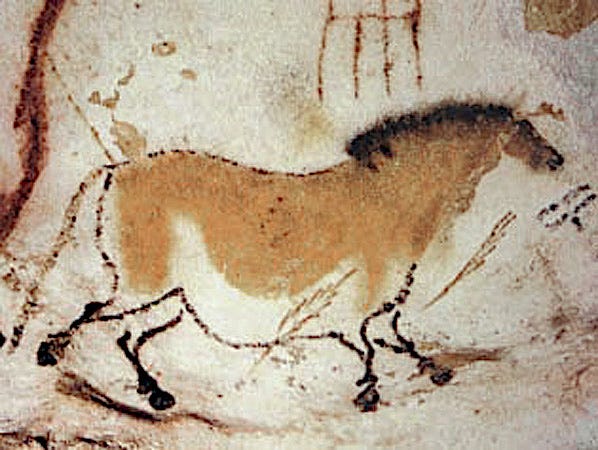
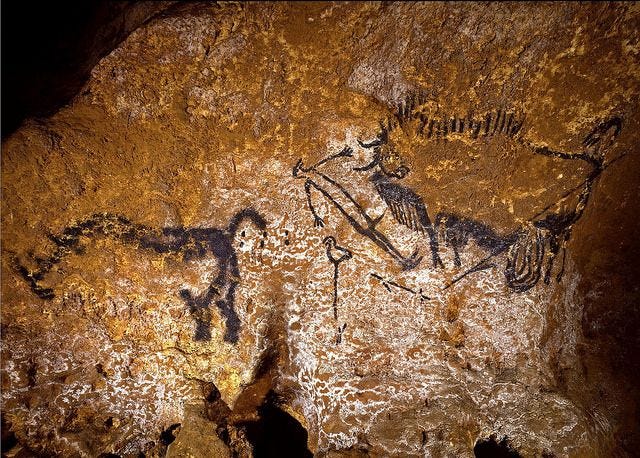
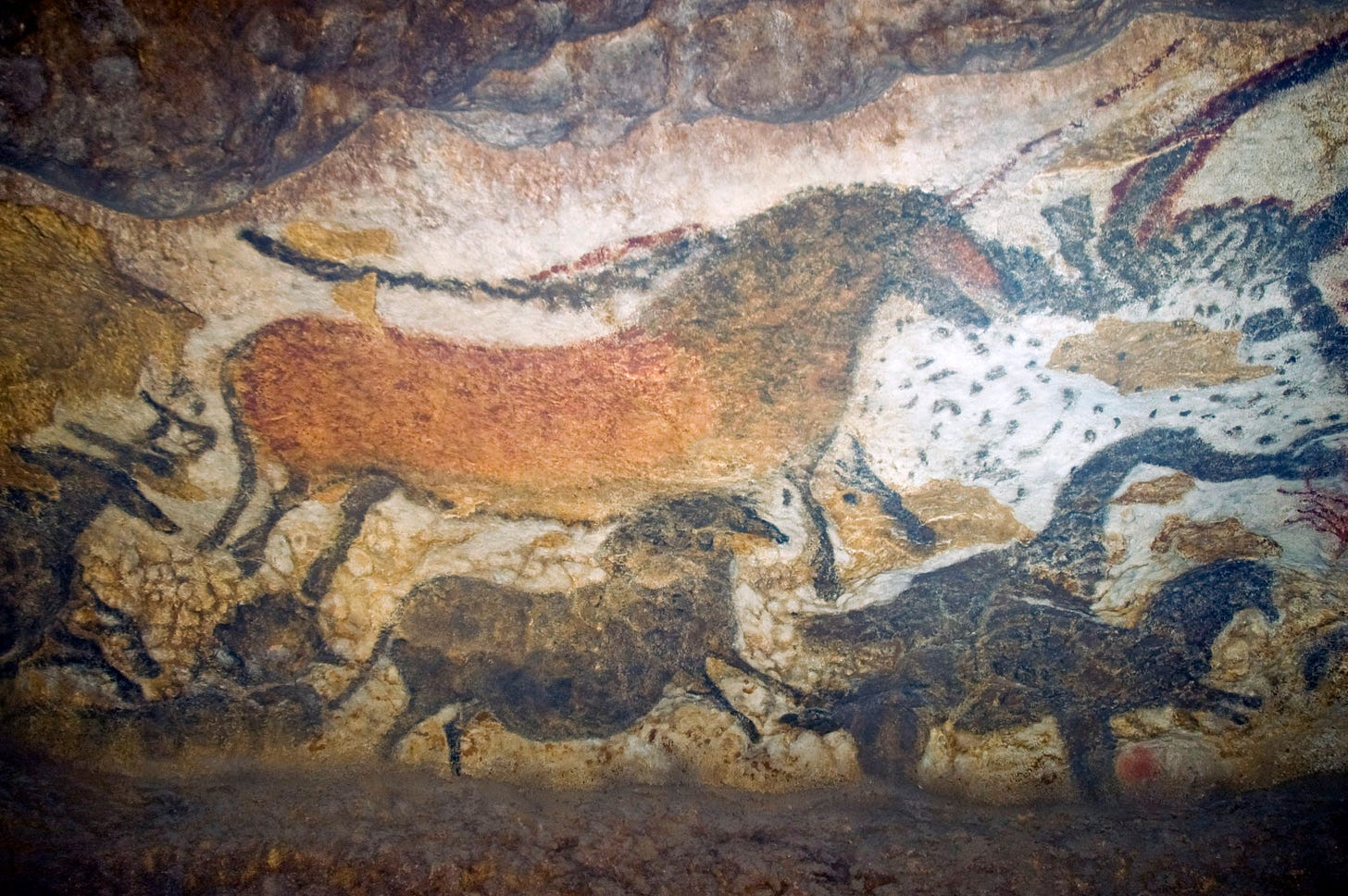
Here are wall paintings from underground caverns in Lascaux in the Dordogne region of southwest France, east of Bordeaux. Around 600 paintings exist in a network of underground caverns; archeologists estimate that they were painted during the Upper Paleolithic period, about 15,000 years ago. They were discovered in 1940 by an 18-year-old boy taking his dog for a walk, when the dog wandered into a hole in the ground leading to the cavern system. The paintings depict animals, plants, and one humanoid form—a man with a bird’s head. Although the exact reason for their creation is unknown, it is speculated that they hold some spiritual significance and are connected to ritualized worship.

Man with bird head (somewhat reminiscent of Ancient Egyptian god, Horus!
The idea that these paintings are linked to religious rituals is likely speculative but strikes me as reasonable. Traditional Catholic teaching tells us that man’s desire for God is natural. Although Paleolithic man would likely have had a dim and somewhat distorted sense of what God is like, it would have been as natural for Paleolithic society as for any other human society to develop and express through worship this desire for what they did know of Him. This being the case, it is also natural for them to desire to create images that help connect them with a higher being or beings in the context of their worship.

The Natural Desire for God

The generally accepted view amongst theologians today is, as I understand it, that man’s desire for God is natural but not innate. (1) There is an important distinction here. It is considered natural because it arises from the power of natural reason. However, it is not innate, meaning that the inclination to worship God is not an instinct we are born with. This inclination arises instead from our observation and reflection upon the nature of the world around us.

When they observe the world and see its vastness, beauty, order, and grandeur, many different people have, over millennia, concluded that a divine being (or beings) created and orchestrates it, and that any being capable of doing such a wonderful thing is greater than us and worthy of worship.

The powers of unaided human reason are limited, however. Thus, those without the benefit of Revelation will likely develop an incomplete, fractured or distorted picture of the deity. Through the power of natural reason alone, God will not be perceived, for example, as the one Triune God whom Christians know through Christ and the Gospel. Nevertheless, most societies, going back to the cavemen, it seems, have been at least philosophically sophisticated enough to conceive of a higher form of existence than human life, and have worshipped higher beings, often a series of pagan gods. Typically, this inspires artistic creation, and they create images of those gods to represent them gods, which are a focus of their worship.

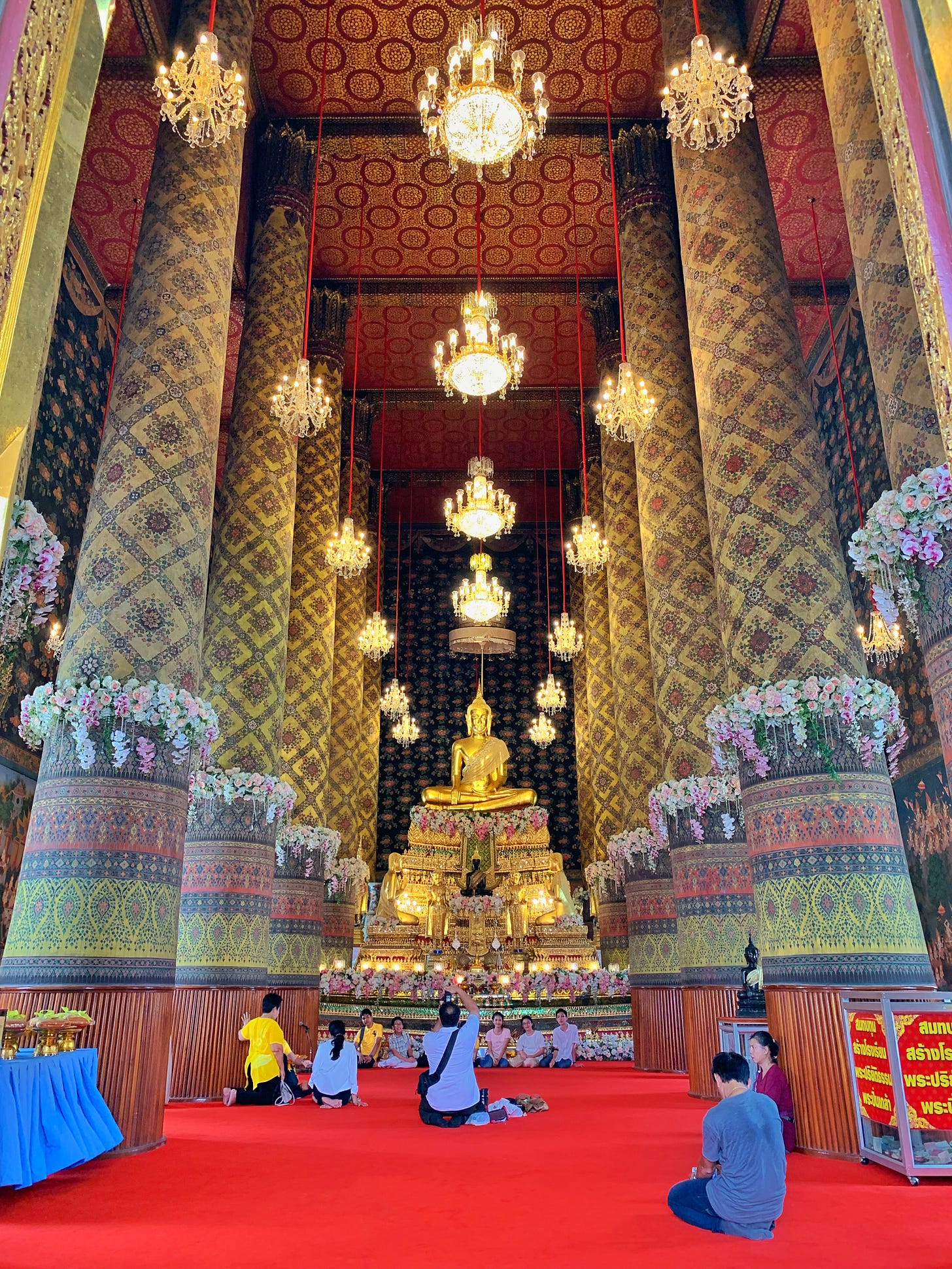
Some, even without Revelation, would get close to the truth. Ancient Greeks, like Socrates, Plato, Aristotle, and their successors, even deduced the existence of a single god or supreme Good—what one might call the “god of the philosophers”. But these are exceptions. While, as St. Thomas tells us, it is theoretically possible to use natural reason alone to deduce the existence of a single, all-powerful, all-good, and all-loving God, most societies throughout history did not reach this conclusion. Typically, they fashioned false deities, and their forms of worship were flawed. Yet, at its core, for all that, such paganism is an expression, albeit imperfect, of man’s natural desire for God. As we have stated, human reason is weak, and it is not a given that people can reflect upon the natural world and get as far, even, as concluding that there is a God or gods. Some fall at the first hurdle and reach the opposite conclusion. Accordingly, atheistic systems of thought have also arisen, often, although not always, as parallel streams of thought in predominantly religious societies and as a reaction to the religious mainstream. Even where there is no supernatural being posited in the core teachings of a system of thought, such as in Buddhism, supernatural and metaphysical elements do creep into their practices and beliefs informed by local cultures. In traditional Buddhist societies, there is mention of devas and spirits in their literature, and there are temples, which are places of quasi-religious activity such as chanting, meditation and the study of Buddhist texts. And this also inspires the creation of art - we see statues of the Buddha in Buddhist temples.
The interior of a Buddhist temple in Bangkok (Image from Wikimedia Commons by Chainwit, CC BY-SA 4.0)
From the Christian point of view, the act of worshipping any false god is a misdirected participation in its ideal, which is the act of worshipping God as part of His Church. St. Thomas Aquinas considered this act of worshipping God to arise from a virtue, which he called the virtue of religion and which he believed was the highest virtue. The virtue of religion, as defined by St. Thomas, has the purpose of rendering God the worship due to Him as the source of all being and the principle of all government of things. (2)

As we have said, neither the desire for God nor the virtue of religion are instinctive. Therefore, it is not instinctive for us to worship anything. Both arise from the use of natural reason. However, even pre-historic man was capable, it appears, of sophisticated rational thought, as evidenced by this art linked to his worship. It is one of the oddities of the modern age that so many people do not worship any god or gods and are, in this respect, one might argue, more primitive in their worldview than Upper Paleolithic man. We might describe the contemporary atheist materialist, somewhat mischievously perhaps, as philosophically sub-Paleolithic!

As followers of Christ, we are privileged to have the gift of Revelation. God has revealed Himself to us in the person of Christ, who established the Church and the patterns of authentic worship in the liturgy. To be a practising Christian is not a sign of philosophical sophistication - though philosophically sophisticated some may be - but of an openness to the gift of faith.
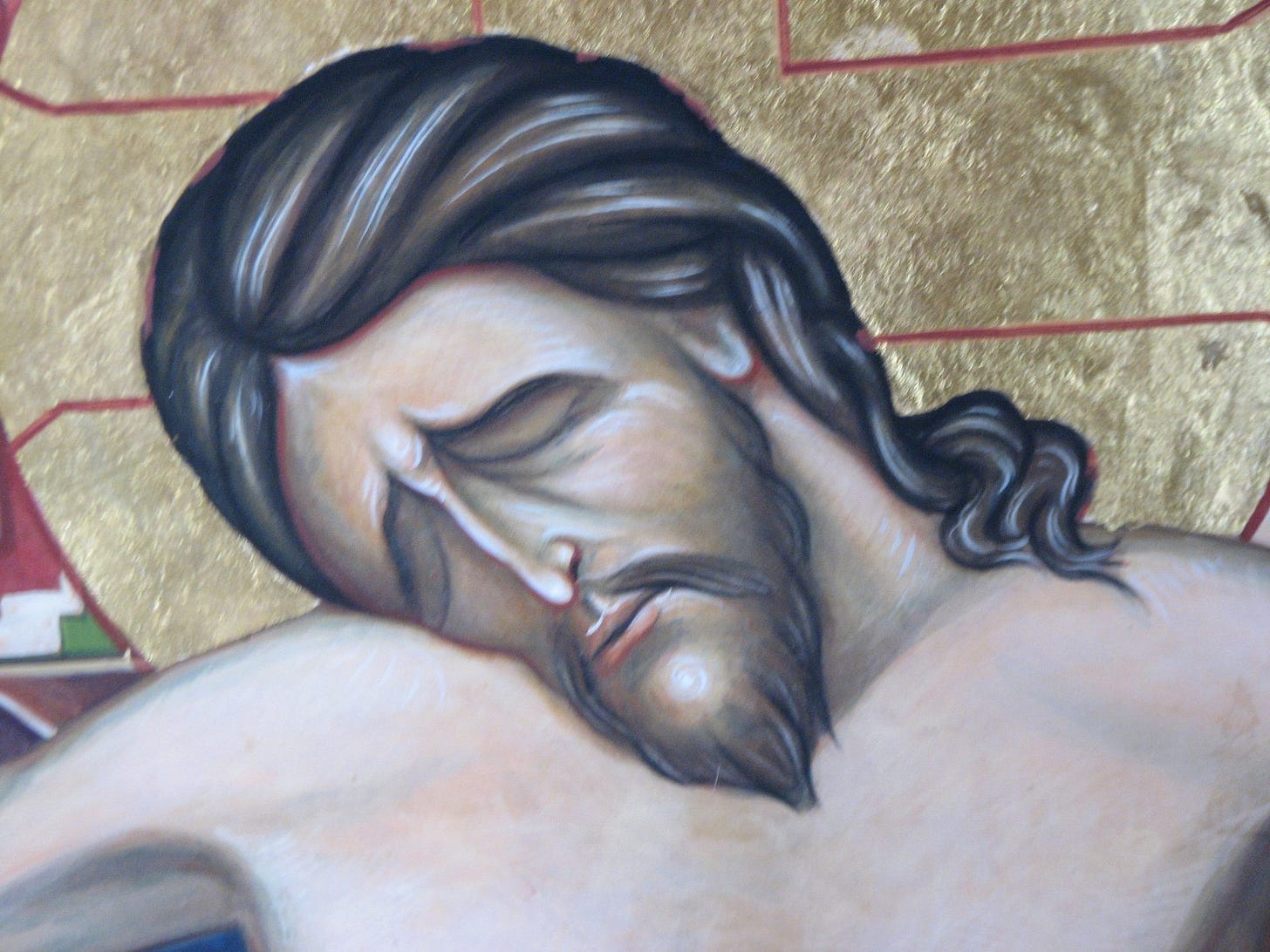
The face of the suffering Christ in the Franciscan Gothic style, painted by me.

The same may be said about the use of art in worship. Through his Church, Christ has informed us that the veneration of sacred art, which portrays the person of Christ, the Mother of God, and the Saints, is not merely allowed, but is an essential part of our worship and the practice of our faith. (3) This understanding helps us discern that even the simplest artistic depictions of divinity, as shown here, are a natural and wise anticipation of what God would later reveal to us personally and through His Church.

Education and Propaganda

Education and formation can cultivate this natural desire for God and help direct it to its proper end: Christian worship. This supernatural end is the prime goal of all sound education. Pope Benedict spoke of this and the need for good catechesis for initiates in the Faith, young and old. He also spoke of the need for a continuing formation in right worship after the rites of initiation, which he termed mystagogical catechesis directed to a deepening of the mysteries of the Faith. This would include teaching people to understand and value sacred art and venerate holy images appropriately.

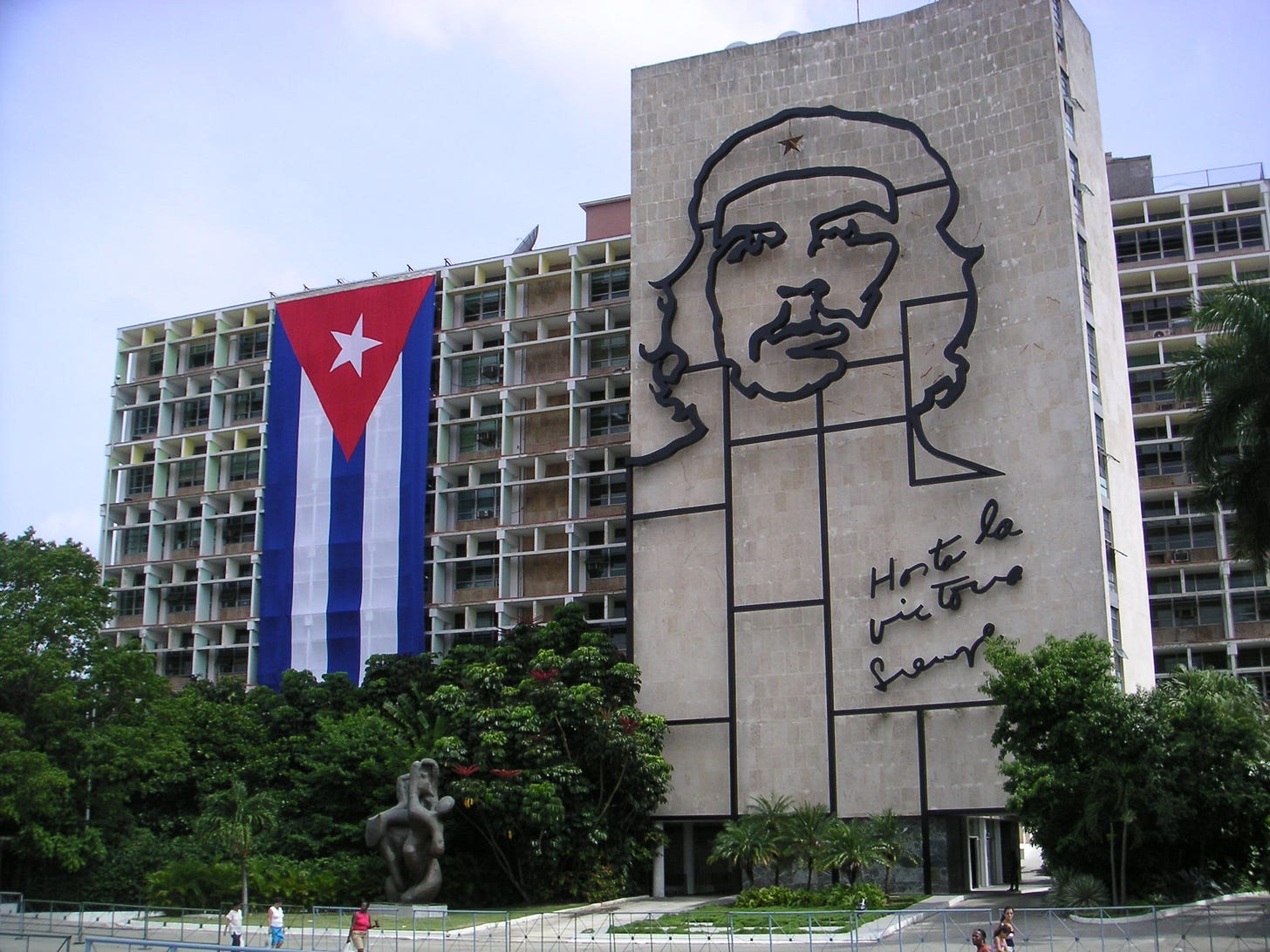
Conversely, external influences can erase or misdirect that natural desire for God. One of the sad facts of contemporary society is that much of contemporary education is anti-Christian propaganda and is at the heart of the ‘sub-Paleolithic’ contemporary mainstream in this regard, and is an ideology that dominates our elite universities. We see the propagation of atheist Marxist ideologies through the schools and universities and the cultural institutions of Western culture such as Hollywood. Marxists typically seek to eradicate any inclination toward ritual or veneration of the divine as part of their mission to destroy the West as we know it. The very act of worship implies, at the very least, the existence of the metaphysical—a notion antithetical to their atheistic, materialist philosophies. However, these ideologies do require complete subservience to, if not actual worship of, the false god of the state, so undermining human freedom and stifling our chance of happiness by exercising that freedom in the pursuit of God.

Even the Marxists realised the importance of art in this mission. To this end, Marxists have always engaged with the popular and intellectual culture; as part of their propaganda, they create images that further their goals.

Image from Wikimedia Commons by Mark Scott Johnson, CC BY 2.0
and right worship….
1. Cf, The Natural Desire for God According to St Thomas and His Interpreters, by Lawrence Feingold, Sapientia Press, Ave Maria Univ, 2004

2. Summa Theologica, II-II, Q. l xxxi.

3. Cf, The Seventh Ecumenical Council, 787 AD.

Wednesday, January 29, 2025

On Music and the Beautiful - Guest Article for the Feast of St. Francis de Sales

In honor of today’s feast, that of St. Francis de Sales, NLM is grateful to Alan Hicks for offering us this de Sales-infused reflection on the objectivity of the beautiful and the manner in which habituation in what is beautiful shapes the human character. This is a key lesson to bear in mind when considering the beauty of the liturgy in its ceremonies, music, vestments, furnishings, and architectural setting: not only is giving glory to God by the best we can offer at stake, but also the formation of Christians in right instincts, appetites, and responses. The moral and the aesthetic touch at every border. It is also clear that true beauty takes time to get used to, and that we do no service to anyone by making “instant relevance” or “easy accessibility” the sole or primary criterion. - PAK

On Music and the Beautiful

Alan Hicks 

It is often said that beauty is in the eye of the beholder, and on the surface, at least, this seems to be the case. A beautiful object is always a source of delight—what we call aesthetic pleasure—and for different people different things will please. Clearly pleasure has an obvious subjective element, in so far as it resides in a human subject with unique dispositions and inclinations.

Yet there are serious difficulties in denying any objectivity to beauty or to the pleasure it engenders; not least is the recognition that while people may sometimes differ in their judgments of what is beautiful, there is also remarkable agreement, which would not be so if beauty was purely subjective. That is why there are lines of tourists at the Grand Canyon, Niagara Falls, or St. Peter’s Basilica; for such objects, both natural and man-made, have always possessed a universal aptitude to please. It is only because of this objective element, even allowing room for subjective taste, that it is possible to educate and form in the young a sense of beauty and an aesthetic sensitivity.   

According to the ancient tradition, subsumed and elaborated upon throughout the Christian centuries, the objectivity of beauty rested upon its essential connection to what is true and good. Thus, the sense in saying that a moral person has a beautiful soul or even that a human act is beautiful. Accordingly, when the woman in the Gospel anointed Christ’s head with precious oil and was scolded for wasting wealth that could have been used for the poor, Christ replied that her act was kalos, literally translated as “beautiful.” [1] It would seem to follow, then, that one of the pathways to the good is through the beautiful, which in addition to its affective power to please, can contribute to the shaping of a virtuous and moral soul. Only with this understanding can we make any sense of the oft-cited line from Dostoevsky that “beauty will save the world.” [2] 

The connection between goodness, truth and beauty is grounded in their nature as “transcendentals,” a term signifying attributes or properties transcending any division or category of being—all of which is to say that they are coextensive with being itself, accompanying existence in all its forms. As coextensive with being, they are convertible with one another, such that we may say that a thing is both true and good to the extent that it exists, and to the extent that it exists, it is both true and good. Hence their identity.

Their differences, on the other hand, are understood in their relation to us. Goodness, for example, is a transcendental aspect of being understood as desirable. As for truth, while we might say that it exists primarily in the intellect, in the intellect’s conformity to what is, it can also be said to exist as a property of being itself insofar as what exists is capable of being known[3] Though beauty is not identified by Aristotle as a transcendental property, Plato sees the good as always beautiful, and therefore always pleasing to the perceptive powers of intellect and sense. This is essentially the position of St. Thomas as well. [4] 

St. Francis de Sales, in the opening of his incomparable Treatise on the Love of God, describes this relationship of goodness and beauty:

As the Angelic Doctor, St. Thomas Aquinas, following the great St. Dionysius, well puts it, although beauty and goodness agree to a certain extent, they are not one and the same thing. The good is that which pleases appetite and will; the beautiful is that which pleases sense and understanding. To put it otherwise, the good is that whose possession delights us, while the beautiful is that whose apprehension pleases us. For this reason, we attribute corporal beauty in the strict sense only to the object of the two senses that have the greatest capacity for knowledge and best serve the intellect, namely, sight and hearing. We do not say, ‘These are beautiful odors or beautiful tastes,’ but we rightly say, ‘These are beautiful voices or beautiful colors.’ [5]
Of course we desire to possess beautiful objects, for those objects are also good, and there is a corresponding pleasure in the possession. But the beauty of the object itself cannot be possessed and enjoyed except through apprehension, and this apprehension and its resulting aesthetic pleasure can be, and often is, of those things we do not possess in any material sense. I can get as much pleasure looking at a beautiful picture that is owned by my friend as my friend, I just don’t get it as often. 

Now one of the most widespread of human pleasures is the delight found in music, and in regards to this beauty which pleases the understanding through the medium of sound, we may ask: what it is in music that gives it its beauty and appeal? St. Francis de Sales is again a rich source of insight:
Unity established within a variety of different things produces order. Order produces harmony and proportion, and in things that are whole and complete harmony produces beauty. We speak of a fine army if all the parts making it up are so arranged that their differences are reduced to the relative proportions needed to constitute a single army. For music to be beautiful it is necessary not only that the voices be pure, clear, and quite distinct from one another, but also that they be blended in such fashion that a right consonance and harmony result by means of both union in the midst of variety and variety within that union of voices. Not incorrectly, then, is music called a discordant harmony, or a harmonious discord.[6]
St. Francis continues in elaboration on the added elements of the beautiful object—splendor and clarity.
 
Painting of St. Francis de Sales by Valentin Metzinger

But as significant and profound as his brief discourse on beauty is, it does not help us to understand why one person might enjoy a specific piece or form of music but not another, or why two people may have contrary responses to the same piece, which variance contributes to the perception that beauty is subjective and merely “in the eye of the beholder.” To account for this variety of taste would require an exploration of individual habits and acquired dispositions, in a similar manner by which we might explain why what appears good and hence desirable to one person might not to another, even assuming the objective nature of the good.

Years ago, while living in Northeastern Pennsylvania, my wife and I began attending the opera in New York City. We would dress and then drive in early, sometimes to shop and then to dine. After coffee and dessert, we would walk the streets in the fading daylight, enjoying the variety of people and sights, arriving at the opera house shortly before the performance. These are treasured memories, which even yet provide some pleasure in the memory, mixed with a note of sadness for days that are no more. They were times of togetherness, away from the many cares which beset our lives, sharing a beautiful and uplifting form of human expression. The theater was grand, the staging and sets elaborate, and the performances were of the highest order. But it was the music itself that touched the soul with a poignant beauty expressive of the most elevated emotions and longings of the human heart.

Now it is true that most people enjoy music, and children of all nations respond cheerfully to simple songs and melodies; for music is consonant with human nature. Yet complex musical expressions are not universally appreciated and only come to be so after experience over time. Earlier in my life I didn’t enjoy opera and in fact was quite put off by my wife’s attempts to introduce me to its pleasures. In time, however, it became one of my greatest delights.  I won’t elaborate here the progression of experiences that led me to change in my perceptions of the operatic art, but only to say that while the art remained the same, there was, over time, a clear change in me, in my perception and appreciation. 

All of which goes to show that there is a difference between the objective good or the beauty of an object and the value that we may attach to it or our appreciation; for “good” and “beautiful” denote something objective, while “value” and “appreciation” allude to our subjective response. The pleasure that we receive is no doubt connected to the good and the beautiful, but only through the value; that is to say, a good or beautiful object will please only if we see it as such. And there are many personal factors which influence how we see a thing. While I didn’t like opera in my initial exposure, we have all had the experience of having something “grow on us” as we come to know it better and thereby come to see the good that is there. My wife liked opera and I enjoyed spending time with my wife, and it was for this reason that I first submitted myself to the experience. Over time I grew to appreciate the art in itself.
 
People enjoying an opera in Romania (source)
And so it is with many of the things that we eventually come to value. In our limited understanding and perception, we often don’t see the full reality of an object or its goodness at first sight. When a young man meets a young woman fair of form and appearance, he is naturally attracted and drawn to her. Such an attraction may be superficial, but there is nothing wrong with that—that is simply the way of nature. Another woman may not be so attractive on initial meeting; yet if given the opportunity to spend time with her the man begins to see her for what she truly is. He comes to appreciate the charm of her personality, her feminine ways of thinking and looking at the world, her tender feelings and responses to things around her. Her very look begins to alter as she becomes more familiar and he sees her in a different light. Given time, the man is able to recognize a deeper and more lasting beauty, a beauty from which a greater satisfaction and pleasure is drawn.

This human progress in appreciation is multiplied repeatedly in the course of a human life. Some likes are fairly universal and immediate, while others are only what we call “an acquired taste.” No one, for example, has to be taught to enjoy food or drink. That is instinctual and innate. We exit the womb hungry for our mother’s milk. Yet eating soon becomes a more complex activity as its object becomes more diverse and differentiated. The ability to appreciate certain kinds of food or drink is not innate, but is a cultivated taste that develops over time, with culinary tastes formed according to environmental factors of culture and family joined to one’s own personal habits and experience. That being said, there are unquestionably better and worse ways to eat from an objective point of view regarding human health.

Now if pleasure immediately followed the objective good, then the best foods would always engender the most pleasure. Yet for a child, what is perceived as “best” may differ markedly from the judgment of an adult. If a child is allowed to develop bad eating habits, he will have an inclination to what is unhealthy and will generally be repulsed by what is not. The trick is thus to form the habit, thereby matching the value to the objective good. If a child is raised in an environment where the kitchen is ruled by reason as opposed to mere desire, he will have no choice but to eat what is healthy. Accordingly, he will develop in time a taste for healthy foods, after which he will eat better because that is what he likes.

For whatever agrees with a thing according to its nature is pleasurable, and as habit exists as a sort of nature—what we call “second nature”—those acts consonant with a developed habit are naturally agreeable. [7] This is true not only in regards to culinary tastes or ones taste in music and art, but in the moral realm as well, for virtue is an acquired disposition no less than one’s aesthetic sense. Thus it is that Aristotle sees the pleasure or sorrow experienced by a man in his moral activity as an indication of his true character. In his words: “every virtuous person rejoices in virtuous acts, for no one will call a man just who does not enjoy doing just deeds; no one will call a man generous who does not enjoy giving generously.” [8] For this reason, moral education was understood by Aristotle to be necessarily concerned with pleasure and pain and consists in training one to feel joy and sorrow in the proper object and at the proper time. [9]

Alan Hicks was a student of the Integrated Humanities Program at the University of Kansas under John Senior and received his degrees in Philosophy at Kansas following his conversion to the Catholic Church. He was the founding Headmaster of St. Gregory’s Academy in Pennsylvania and was subsequently the principal of Catholic schools in both St. Louis and Southern California. He has since returned to his first love—teaching—and is currently a professor of Humanities at St. Gregory the Great Seminary in Lincoln, Nebraska.

NOTES

[1] Mark 14, 6.

[2] The Idiot.

[3] See St. Thomas Aquinas, The Disputed Questions on Truth (Henry Regnery, 1952), Q. 1, art. 2.

[4] St. Thomas, On Truth, I, 5, 4.

[5] St. Francis de Sales, Treatise on the Love of God (TAN Books and Publishers, 1975), 53.

[6] Ibid., 53.

[7] See St. Thomas Aquinas, Commentary on the Ethics (Henry Regnery, 1964), 124.

[8] Aristotle, Nicomachean Ethics, bk. 1, ch. 8, 1099a 15-20.

[9] Ibid., bk. 2, ch. 3, 1104b10.

Monday, September 23, 2024

“Ten Years That Shook the Church”: Archbishop Dwyer’s 1973 Critique of the Reform and the Post-Council

Dwyer as a boy and as a bishop
Archbishop Robert Joseph Dwyer (1908-76), amidst his copious writings, penned not a few scathing critiques of the liturgical reform, at least two of which had not yet been made available online—a problem I sought and seek to remedy between last week and this. Last week, we published a newspaper column of his from July 1971 that pronounced a failing grade on the Bugnini Rite and, in particular, on the horrendously bad translations, music, and parochial balkanization that accompanied the roll-out of the Novus Ordo. Today, I publish the transcription of an article from the Twin Circle, which appears to have been launched in 1967, was sold to the Legionaries of Christ in 1995 (they bought the National Catholic Register at the same time), and was renamed Faith & Family in 2000, before folding in 2011.

Once again, it is nearly impossible to imagine a bishop writing this openly and bluntly in a Catholic newspaper today. To my mind, this suggests that the much-vaunted parrhesia is quite lacking, probably because knowledge of the traditional liturgy, of the Council, and of the details of the reform is quite lacking among those who did not personally experience all of it as Dwyer had done.


Ten Years That Shook the Church
Archbishop Robert Dwyer
Twin Circle
October 26, 1973

What happens when an institution, be it a religious body or a nation state or what you will, deliberately cuts itself off from its historical and cultural roots? Rarely according to the record have such institutions been able to survive, the shock being too great, the trauma too devastating.

They may seek in desperation to renew those roots, by some legerdemain to recover them, or to substitute some seeming equivalent, but unless any such an institution has some sort of divine guarantee, the chances of its success are, as the airline stewardesses never fail to assure us in soothing tones, exceedingly remote.

Toward the end of the Second Session of the Vatican Council, late in November 1963, the Constitution on the Sacred Liturgy was triumphantly voted in by an overwhelming majority of the assembled Fathers. As we trooped out of St. Peter’s basilica that day, spreading our amaranthine stain over the great parvis, a palpable euphoria thrilled through the entire body. Something at last had been accomplished, one item of the business which had called us to Rome had been nailed down.

The members of the Commission which had hammered out the Constitution and guided it through the grueling tests of debate and modification, were obviously elated, and the most prominent American member, the late Archbishop Paul Hallinan of Atlanta, was the glowing recipient of hearty and even gleeful congratulations.

Good Fun

It was all in good fun and no one, least of all perhaps the drafters and proponents of the Constitution in question had the slightest notion, not to say intent, of tampering with the cultural life-lines of the Roman Catholic Church.

Nor was there, on candid reading, anything in the text or in the spirit of the document which would suggest the least deviation from the historic past of the liturgy, its sacred traditions, its venerable usages.

There was, of course, a loosening of certain restrictions. The vernacular was to share with the Latin the role of liturgical communication, not by any means to replace it. Greater simplicity in ritual was to be introduced.

Though the term had not yet swung so prominently into orbit as it was to do a year or so later, the liturgy was to be made more “relevant” to contemporary man, with his increasingly secular preoccupations.

Who dreamed on that day that within a few years, far less than a decade, the Latin past of the Church would be all but expunged, that it would be reduced to a memory fading in the middle distance? The thought would have horrified us, but it seemed so far beyond the realm of the possible as to be ridiculous.

So we laughed it off.

As a personal footnote, we had been visited by some misgivings in regard to the vernacular, by way of certain apprehensions that it could lead to invidious comparisons between those prelates and priests who read well and have all the arts of elocution, who have the gift of acting their part with dignity and conviction, the Suenenses and the Sheens, and those not so happily endowed, all the way down to the poor fellows who can only mumble as unintelligible in English or Swahili as in the ancient language of the Church.

With the difference that nobody expected to understand them in Latin, whereas the whole point of the vernacular was to make the liturgy, once again, relevant. But having voiced this unworthy fear, and told to go to the corner and hide our head for very shame for entertaining such an anti­democratic notion, we lapsed into chastened silence.

And when the vote came round, like wise Sir Joseph Porter, KCB, “We always voted at our party’s call; W never thought of thinking for ourself at all.” That way you can save yourself a world of trouble.

Cultural Cut-off

Well, here we are 10 years later, and what results do we see? The result, plainly and bluntly, is that the Western Church has just about completely cut herself off from her cultural roots, the Latin tradition of the West.

Latin is practically banned from the liturgy and banned as well from the courses of study required of candidates for the priesthood.

Fewer and fewer Masses in Latin are sanctioned or approved by local ordinaries, and fewer and fewer seminarians and young priests have now more than a nodding acquaintance with the language which nourished the devotion of countless generations of Christians and gave to theology and the other sacred sciences a common tongue, so that, even though imperfectly, communication was possible.

The Church which so long had preserved Latin consciously as a bond of unity, had quite suddenly decided to discard it as a useless encumbrance.

New Tune

With this rejection, and as an almost inevitable consequence, went out the window also the whole magnificent musical heritage of the Church. For when you change your language you also change your song.

The Jewish exiles hanging their harps beside the waters of Babylon, so long ago, made that discovery.

Pope Paul VI, the other day, made an earnest plea for the revival of some parts of the Mass in Latin, the Kyrie, the Gloria, etc., with the obvious hope of salvaging something of our immense musical treasure, one of the glories of the Christian accomplishment; but whether his words will carry weight, whether his “cri de coeur” will be heard, is anyone’s guess.

Not, surely, until realization dawns on many minds how drastically we have robbed ourselves of our cultural wealth.

Less immediately cognate to the Latin past, yet in strict relationship, is the whole violent artistic rejection of the past. It is not a question of contemporary art being good or bad; it is a matter of its repudiating, often with contempt, those principles and traditions which gave art, visual or tactual, substance and meaning.

The creation of an anti-art, the sole pitiable boast of the contemporary schools, is mighty thin provender for souls hungering and thirsting for something greater than themselves, something of beauty and nobility. But we go along with the crowd, because we too have lost our way.

And the same rejection, not merely of our cultural and esthetic roots, but of our philosophical and theological foundations, is the reaction and reality of the moment. Who would be caught dead today citing a theologian older than Karl Rahner or a philosopher more antique than Bernard Lonergan?

The substitution of Teilhardism for Thomism, if not complete in our schools, our seminaries and universities, is within an ace of carrying the day. But only too insistently is it borne in on us that we are a cracked record, flawed by a fixation.

Is anything of this important? Does it matter that the Church has been led down the path of rejection, slowly at first and by imperceptible stages, then ever more rapidly and finally at breakneck speed?

Does it matter that we as Catholics have succeeded in cutting ourselves off from those cultural sources which nourished our fathers and gave support and assurance to their faith? Is it inevitable that in this last third of the 20th century the Catholic mind should seek a new milieu, new associations, new roots?

Doubtless Dr. Leslie Dewart [1] and his disciples would return a resounding yes to this.

But before we commit ourselves farther, and if there is still time for reflection, might we not do well to catch the echo of a great and now almost forgotten Father of the Council, the late Cardinal Michael Browne, who, at a decisive moment in the debate on the Constitution on the Church, raised his voice in warning with all the richness of the Irish brogue in Latin: Caveamus, Patres, caveamus! Let us take heed, Fathers, let us beware!

We thought it amusing then; we might take it a little more seriously now.

Illustration in the original newspaper article

NOTE

[1] “Leslie Dewart (1922–2009) was a Canadian philosopher and Professor Emeritus at the Graduate Department of Philosophy and the Centre for the Study of Religion at the University of Toronto…. Late in 1969 an investigation by the Vatican’s Congregation for the Doctrine of the Faith was convened to examine the theological opinions in Dewart’s writings, particularly The Future of Belief. However, no condemnatory action was taken by the authorities…. While Dewart was not a theologian, his philosophy lays a new foundation for contemporary Catholic theology that does not rely on the traditional epistemological foundation of Hellenic philosophy. His philosophical insights are a conscious, reflective ‘transposition to another key’ of the experience of the Christian faith…. Although not widely recognized at the time, the revolutionary experience was, in fact, a process of ‘dehellenization,’ as Dewart understands the process throughout in his writings. Thinkers will conceive of God, in a dehellenized future of thought, as an existential reality…. Western philosophy, “come of age,” does not experience the world as hostile, as did the Hellenists, but rather, as stimulating and challenging and Western philosophy must dehellenize its interpretation of experience accordingly. This dehellenization requires the abandonment of scholasticism, with the subsequent development of a conscious re-conceptualization of experience.” (source)

Visit Dr. Kwasniewski’s Substack “Tradition & Sanity”; personal site; composer site; publishing house Os Justi Press and YouTube, SoundCloud, and Spotify pages.

More recent articles:

For more articles, see the NLM archives: