Tuesday, May 05, 2020

May 8th: Free Virtual Conference on the Theology of the Body and the Writings of John Paul II

If you’re looking for something to do while stuck at home, the Theology of the Body Institute has organized a virtual conference which opens this Friday, May 8th. It is a mixture of recorded talks and live Q&A transmissions, which can be viewed for free for the first couple of days; after that, there will be a small fee for access to the recorded materials. Those who wish to know more should follow the link here. You can register in advance, and registrations are being taken now.

Wednesday, November 20, 2019

Pontifex University and the Theology of the Body Institute Launch a New Masters Degree

The Theology of the Body Institute and Pontifex University have formally partnered to offer a unique Master’s degree that guides students along the via pulchritudinis (“the way of beauty”), and equips them with the necessary catechetical tools and theological and cultural understanding to engage a world desperately in need of revitalization. The program includes the study of theology and philosophy, and the history of Catholic culture, with a focus on the sacred arts, and the writings of Pope St John Paul II, with a particular emphasis on the Theology of the Body.

The degree is granted by Pontifex University and is awarded after the successful completion of 36 credit hours, graded from an exam and essay for each course; and a final thesis. Twenty-two (22) of these credits will be acquired by completing 11 five-day on-site courses offered by the Theology of the Body Institute. The remaining 14 credits will be acquired via Pontifex University’s online platform. For more information go to our website www.Pontifex.University or the Theology of the Body Institute website: tobinstitute.org/master-of-arts.

Every single one of us, ordinary Catholics leading ordinary lives, can be extraordinary people following our supernatural and joyful calling leading others onto the Way of Beauty.

Tuesday, November 12, 2019

Painting the Nude: The Theology of the Body and Representation of Man in Christian Art

I am delighted to announce that Pontifex University Press is publishing my new book on the place of the nude in Christian art. With a foreword written by Dr Christopher Blum (of the Augustine Institute), Painting the Nude: The Theology of the Body and Representation of Man in Christian Art will be of interest to artists and non-artists alike. It contains a discussion on the place of the nude in the Christian tradition historically and what its place ought to be today.


In his writing on the human person and art, St John Paul II created a renewed interest among Catholics in the nude in art generally, and particularly in sacred art. His call for artists to represent the human form ‘naked without shame’ has given many artists the inspiration to paint nude figures in service of the Church, with varied results and, frankly, not all of them good.

The 10,000-word essay contained in this booklet compares his writings on the representation of the human form with the traditions of the Church in order to assess how artists and patrons ought to respond. I conclude that far from representing a new Catholic permissiveness (as some have interpreted), John Paul II is reaffirming a very traditional line.

The book is broken down into three sections:

REMOVING THE FIG LEAVES uses the case of the recent renovations of the Sistine Chapel, completed in 1994, as a starting point to examine how Christian art should portray nudity so as to avoid licentiousness on the one hand and to reveal the full beauty of a creature made by God on the other.

THE THREE TRADITIONS OF FIGURATIVE LITURGICAL ART looks at the ways in which the authentic liturgical traditions in Christian art, the iconographic style, the Gothic and the Baroque, have dealt with the dilemma in the past. These traditions each deviate from perfect realism and stylistically depict essential truths that are not always visible to the naked eye. It is the invisible truths that the artist chooses to reveal that distinguish one style from another. Given this, as I demonstrate, they are not all equally appropriate for portraying the nude.

THE PROBLEM OF THE NUDE MODEL guides Christian artists towards an understanding of their responsibility to avoid the occasion of sin while producing the art and learning to draw and paint in the studio.

Some people that Pope St John Paul II’s work shifted the balance from an outdated “prudishness” toward a genuine openness to the beauty of the human body. This is certainly true to some degree, but I argue this aspect has been exaggerated. His writings can not be understood apart from a deep awareness of the Christian artistic traditions of sacred art. In truth, his ideas are a fresh presentation of deeply a conservative approach — far from being radical and new, they reconnect us to centuries of authentic Christian anthropology and tradition, and breathe new life into the contemporary conversation around body, soul, and spirit.

In his foreword, Dr. Christopher Blum (Academic Dean and Professor of History and Philosophy at the Augustine Institute) writes:
In addressing the topic of the nude in sacred art, David Clayton has performed an act requiring considerable courage. The temper of our spirituality today is highly emotional, to say the least. We are quick to accuse earlier ages of Jansenism and slow to admit that the mortification of the senses has a permanent place in the Christian way of life. Moreover, our tastes have been permanently affected by more than one artistic revolution. Clayton’s reminder that Christian art has always had a much higher purpose, then, is a call that asks us to swim against a very strong tide. 
Clayton takes us on a journey of rediscovery, anchored in a careful reading of St. John Paul II. With his help, we can newly appreciate the essentially iconic nature of Christian sacred art. 
Deacon Keith Fournier, General Counsel Director of Diaconal Formation for the Diocese of Tyler, Texas, wrote the following review of this book: 
Between September 5, 1979 and November 28, 1984, Pope St. John Paul II delivered a series of 129 catechetical instructions called “Human Love in the Divine Plan”. It is popularly referred to as a “Theology of the Body”, a phrase the late Pope called a “working term.” The term has led to a minimization of the depth of the theological anthropology of the integrated human person as gift which the late Pope presented. The thought of the late Pope was not new; it is rooted in the Patristic Tradition and must be seen in a hermeneutic of continuity.

One of the problems arises from an oversimplification of this body of teaching in some popular presentations, and which presents the work as a break with the teaching of the Church on modesty, purity, chastity and the virtuous life – particularly as it relates to the depiction of the human body in art. This is incorrect and in this respect a disservice to the four years of teaching of this great Saint.

David Clayton has demonstrated a deep knowledge and understanding of Christian sacred art, and of the writings of John Paul II on both anthropology and art. In this book, Clayton provides us with a synthesis that places all within the context of the greater tradition of Catholic thinking on these topics and shows how, far from being a radical departure from it, the Theology of the Body is reinforcing a traditionally Christian and conservative approach to the nude in art.

Tuesday, May 01, 2018

Is it Right to Take Your Clothes Off for the Sake of Art?

Painting and Viewing the Nude in Christian Art

I recently read a short but excellent discussion of the place of nudity in Christian art written by Deacon Lawrence Klimecki. For Deacon Lawrence, the question turns on the judgment as to whether or not the nudity distracts from the Christian purpose of the art. This will depend on the response of the people who are meant to see it and the skill of the artist in representing nudity in an ordered way. I encourage you to read it.
Here is a different, but complementary argument that I make that supports his assertion that it is appropriate, but only in certain circumstances. What follows is a summary of a longer article published some time ago in a Festschrift for my friend Stratford Caldecott.

maxresdefault.jpg
When Pope John Paul II presented his Theology of the Body and addressed artists directly, he challenged them to portray the human figure “naked without shame”, and in such a way that the beauty of the human form would be revealed in an ordered way. He reiterated this when he spoke in 1994 at the re-opening of the Sistine Chapel after the cleaning and restoration of Michelangelo’s paintings.
This caused quite a stir at the time. Here was a respected Pope (now a Saint) who was putting his intellectual weight behind the artistic tradition of painting the nude... and not only excusing it, but promoting it! Many cultured and arty Catholics in the chattering classes heaved a sigh of relief. Now they could point to the words of the Pope and claim that they were right at the cutting edge of culture and simultaneously in the mainstream of the Church! Now they were as free to air their views over coffee after Mass as they were with their secular friends at dinner parties, for the Pope, no less, had become an apologist for the Sixties! After all, he was telling the Philistines who were uncomfortable with nudity that they didn’t really understand Catholic culture. Many artists didn’t miss the point either. The Pope’s challenge to them inaugurated the creation of a wave of contorted Theology-of-the-Body nudes that, the artists told us, communicated human sexuality “as a gift” through the exaggerated gestures of intertwining limbs and torsos.
Initially, I accepted this view too, to a degree. Then I actually read the Theology of the Body and John Paul II’s address on the re-opening of the Sistine Chapel.

Several years ago, when I moved to the US from the UK and started teaching at a Catholic college, I knew that I would have to deal with devout Catholic parents who might be hesitant about allowing their sons and daughters to draw nudes in figure-drawing classes. I imagined that they would have been even more nervous about the idea of some of them posing for the classes.

In order to have some good Catholic arguments to persuade them of the appropriateness of this, I set about looking at the tradition of the nude in Catholic art, while also reading the Holy Father’s words on the subjects.

I was surprised by what I came up with. Rather than finding evidence to bolster my view, I found the reverse. I had to abandon certain assumptions that I had held until that point and adopt some new ones:
  • It is not necessary to study the nude to draw or paint the human person well, even in naturalistic styles.
  • The Christian tradition is very cautious about nudity in art, and for the most part, avoids it. The nude appears consistently in the tradition only a very limited way, and in connection with certain subjects (e.g. Genesis and the account of the Fall), where it is crucial to understanding the passages. It has to be in accord with compositional and stylistic considerations that maintain the dignity of the person portrayed. 
  • The artist has to take into account the sensibilities of the time, which can vary. The artist must always avoid lasciviousness, but what that means precisely will be different at different times.
  • John Paul II himself was, consistent with tradition, extremely cautious about the portrayal of the nude. He most certainly was not promoting in any way of the liberal attitudes of the 20th century. He advocated that naturalistic styles of art, as distinct from highly idealized styles, should not be used to portray the nude.
When I read John Paul II’s writing referred to above, and his Letter to Artists of 1999, what I see is someone who understands and respects the differing traditions in art very deeply, and who is conservative by nature. Far from giving models carte blanche to take their clothes off, and voyeuristic artists his blessing to paint them, he was in fact, in accordance with Catholic tradition, strongly against the portrayal of the nude in both the grotesquely distorted and erotic modern styles and the style of the 19th-century realists.

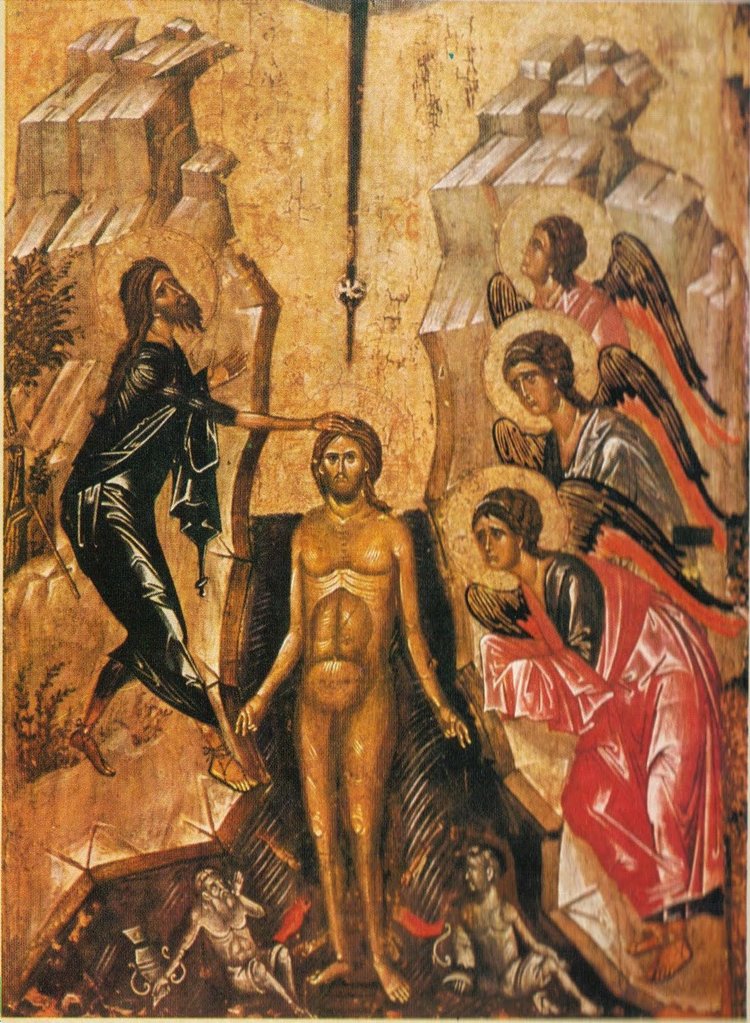
In fact, he said that the human person should only be portrayed nude when we see the body shining with the “light that comes from God.” This narrows the scope considerably. It is a reference to what is called in the context of traditional iconography the “uncreated light” of sanctity. He is proposing that only highly idealized representations of the human form are appropriate for the nude. While this doesn’t rule out new interpretations consistent with the principle, historically, it points strongly either to the highly stylized iconographic tradition, as seen here,
 An icon of the Baptism in the Jordan
An icon of the Baptism in the Jordan.
or to the Gothic tradition.
 The Temptation from the Très Riches Heures du Duc de Berry
The Temptation, from the Très Riches Heures du Duc de Berry
In common with many other Christian commentators, John Paul II also admired the nude as portrayed in ancient Greek sculpture.
  The goddess Venus.
It is the correspondence to this idealized form, and not its naturalism, that causes him to appreciate the work of Michelangelo so highly, especially his frescoes in the Sistine Chapel.
michelangelo_last_judgement_1050x700.jpg
William Blake is an artist who individualistic style also strongly reflected the Greek ideal. (Thank you to Bill Donaghy of the Theology of the Body Institute for pointing this out to me.

Monday, February 12, 2018

Holy Matrimony, Sanctified Bodies, and Sacramental Grace

In our times we have seen the important work of Pope John Paul II on the “theology of the body” misunderstood and applied in a superficial and, at times, morally problematic way. One example is a claim I once heard, namely, that the very bodies of spouses are causes of grace, such that when they come together in the marital act, and assuming no moral impediment such as contraception, an increase of sanctifying grace is bestowed on each or both spouses. This claim, as it stands, is false—although something like it is true.

The only signs that effect or bring about the sanctifying grace they signify are the seven Sacraments of the New Law. In this sense, it is impossible that the spouse’s bodies, as such, should be causes of grace in a proper sense, such that when the cause (bodily action) is posited, the effect (increase of grace) follows. Rather, the bodily mutual self-giving, open to new life, is the outward sign of the Sacrament of Matrimony itself, which, present and operative in a mysterious way in the souls of the spouses, is the cause of an increase in sanctifying grace. Put more simply, the efficacious sign is not the bodily action but the sacramental union and state, which is represented and furthered by the bodily action.

On the other hand, any bodily act done out of charity is a cause of grace in the sense of being a moral cause of meriting an increase of such grace. In this way, the nuptial act is like an act of almsgiving, or clothing the poor, or instructing the ignorant—all of these are acts of a will animated by charity, performed with the help of the body and meriting an increase of grace.

We find many profound and inspiring passages in the writings of Pope John Paul II on these matters, such as the following, from the encyclical letter Evangelium Vitae:
Within this same [contemporary] cultural climate, the body is no longer perceived as a properly personal reality, a sign and place of relations with others, with God and with the world. It is reduced to pure materiality: it is simply a complex of organs, functions and energies to be used according to the sole criteria of pleasure and efficiency. Consequently, sexuality too is depersonalized and exploited: from being the sign, place and language of love, that is, of the gift of self and acceptance of another, in all the other’s richness as a person, it increasingly becomes the occasion and instrument for self-assertion and the selfish satisfaction of personal desires and instincts. Thus the original import of human sexuality is distorted and falsified, and the two meanings, unitive and procreative, inherent in the very nature of the conjugal act, are artificially separated: in this way the marriage union is betrayed and its fruitfulness is subjected to the caprice of the couple. Procreation then becomes the “enemy” to be avoided in sexual activity: if it is welcomed, this is only because it expresses a desire, or indeed the intention, to have a child “at all costs,” and not because it signifies the complete acceptance of the other and therefore an openness to the richness of life which the child represents. (n. 23)
The Pope chooses his words with care: the body is a “sign,” a sign of self-giving, a “place” and a “language,” but in and of itself it does not expressly signify sanctifying grace, nor directly confer it. This is what the Sacrament of Marriage or Matrimony is and does. If the spouse’s body were a cause of grace just by being what it is, namely, a sign of self-giving, it would follow that the body or the nuptial act is an eighth sacrament, a claim certainly contrary to the dogma of the Faith. I know a priest (he was married as an Anglican curate and was later ordained a Catholic priest) who refers to this kind of loose talk as “gamolatry,” that is, a sort of worship of things pertaining to marriage.

In our times, so given to vapid pseudo-mysticism, we do well to remember that Our Lord instituted the seven sacraments as the ordinary means of conferring His supernatural life and charity upon us. It is through the sacraments that we become “sons in the Son” and receive all that we need to grow in our sonship until the day of glory. (I do not engage here in the centuries-old debate over what precisely it means to say that Jesus Himself instituted all and each of the seven sacraments; various more or less convincing hypotheses have been proffered. In any case, Catholics are obliged to believe that which the Council of Trent defined as de fide dogma, namely, that Christ Himself instituted the seven sacraments of the New Law.)

Thus, even that which theologians have taken to calling the “primordial sacrament,” the very humanity of Christ, is effective among us in this world precisely through the seven Sacraments of the Church, and not somehow over and above and apart from them, as if it were an eighth sacrament that could be numbered alongside the other seven. The Church, too, may be called a “sacrament,” but in an analogous sense—for she, too, is built up from the seven sacraments, from which she derives her very existence and activity, as the Second Vatican Council teaches. The Eucharist, especially, is the root and the constant origin of the Church in this world. Without the Eucharistic Body, there would be no Mystical Body. This is why St. Thomas Aquinas teaches that the “reality” of the sacrament of the Eucharist is nothing other than the unity, or charity, of the Mystical Body itself (cf. Summa theologiae III, q. 61, a. 2).

How beautiful it is that spouses receive in marriage a new participation in the love of God and the Passion of Christ, as well as a new power to participate in creation and redemption by begetting children and offering them to God in baptism! The quasi-character imprinted in their souls by the marriage vows remains throughout their life as a constant claim before God of all the graces each needs to fulfil the duties of his or her state in life; it is a permanent mark of their mutual surrender to and “ownership” of one another; it is a likeness of the relationship that unites Christ to His Bride, and the Church in turn to her Bridegroom, in an unbreakable union of eternal fecundity.

Monday, February 20, 2017

A Model Letter on the Restoration of All-Male Altar Service

This article was originally published in 2015, removed for editing, and is now ready for reposting.

A topic of conversation that often arises among young (and not-so-young) traditionally-minded Catholics is: “Can we do anything about the problem of female altar servers?” It is a problem worth solving and one that is capable of being solved, rather than a fateful mistake about which nothing can be done.

Imagine you are a bishop, thinking about what a wreckage feminism has made of the Church in the Western world, as men continue to feel alienated, women no longer offer themselves to religious life, and a pathetic number of priestly vocations dribble in. You are planning to write a letter to your presbyterate, explaining why you are abrogating, in your diocese, the use of female altar servers. What might such a letter look like? How would you make the case?

* * *
Dear Priests and Deacons,

Praised be Jesus Christ! With this letter I announce, after careful consideration and prayerful reflection, an important change in the liturgical praxis of the Diocese of Bromptonville.

As you know, some time ago the Vatican allowed local Ordinaries to permit female altar servers because, due to Pope Paul VI’s suppression of the minor order of acolyte and reassignment of its duties to the office of instituted acolyte, this type of service appeared to be no longer directly connected with the path to priestly ordination. Indeed, in the old days, laymen, particularly boys, substituted for acolytes in most situations (hence the familiar term “altar boys”). At the same time, the Vatican made it clear that female altar servers are not required, may not be imposed against the will of a celebrant of any Mass, and do not cancel out the good of retaining the traditional practice of male-only service at the altar.

With the wisdom of hindsight, we can now see that this experiment of admitting females to the service of the altar has proved problematic, for several reasons. First, altar servers are visibly dedicated, both by their responsibilities and by their vestments, to ministering in the sanctuary at the altar of sacrifice. Theirs is a role that appears to be intimately associated with the offering of the Holy Sacrifice of the Mass. It was for this very reason that the discipline of training and working with altar servers was traditionally regarded as — and, in truth, still remains — a means of fostering vocations to the priesthood. To serve at the altar is to be involved in priestlike activities. Operative here is a language of symbols that is more powerful than mere words.

Experience has shown that the now widespread presence of female altar servers in the sanctuary continues to create confusion among the faithful about the roles that women may legitimately play in the liturgical life of the Church. Again, the symbolism of a vested altar server ministering at the altar speaks more decisively than any catechesis. It is therefore no surprise that many Catholics, despite the definitive judgment of the Church expressed in John Paul II’s Ordinatio Sacerdotalis, feel that “altar girls” are a first step towards the eventual allowance of “women priests.” Such confusion on matters bound up with the very deposit of faith is not healthy for our faithful people.

More profoundly, Pope John Paul II’s “theology of the body” helps us to understand that a whole realm of cosmic and metaphysical symbolism is literally embodied in man and woman. Even if we are not always consciously aware of this symbolism, it has a steady formative effect on our thoughts and attitudes at worship. It should not be simply ignored in the assignment and execution of liturgical roles. Modern society has shown a remarkable ability to ignore the obvious natural and God-given differences between the sexes, differences that support their complementarity. As grace builds on nature, so does Christian liturgy build on natural anthropology. Introducing confusion at so basic a level prevents the liturgy from exhibiting clearly the spousal relationship of Christ and the Church, where Christ is represented primarily by the celebrant offering sacrifice at the altar in the sanctuary, and the Church is represented primarily by the assembly of believers gathered in the nave to do Him homage and to receive His gifts.

Finally, on a practical note, the placing together of boys and girls has had the effect, consistent with human nature, of driving away boys who might otherwise have been interested in serving or who might otherwise have been persuaded to serve. Boys and girls of certain ages either do not wish to be together, or find one another’s company distracting. A similar distraction is caused for laymen by older girls or fully-grown women in the sanctuary. If the “theology of the body” is true, and surely it is, we should have been able to foresee these problems and avoided them altogether by not having departed from the constant and universal custom of the Church in regard to altar servers. Moreover, boys enjoy the challenge of a demanding and regimented approach to serving, characterized by a manly esprit de corps. Mixed service cancels out this psychological advantage.

Even beyond these concerns, the expansion of ministries to more and more lay people is characteristic of the “clericalization of the laity” and the “laicization of the clergy” against which John Paul II warned many times. The role of the laity is to sanctify the vast world outside the Church, not to take care of the sanctuary and its tasks. The holiness proper to the laity is best expressed when they participate in the liturgical rites by the responses and gestures appointed for them. This is the “spiritual worship” (Rom 12:1) that corresponds harmoniously to the sacerdotal and diaconal ministries exercised at the altar.

Recognizing that the novelty of female altar servers was never to be required but only to be allowed at the discretion of the diocesan bishop, and recognizing also that male altar servers remain normative for the Roman Rite, the Vatican left the decision in this matter in the hands of the diocesan bishop. Accordingly, exercising my right to legislate, I decree that, as of the Solemnity of the Assumption, August 15, 2017, the use of female altar servers is altogether abrogated in this Diocese, and is to be discontinued without exception, all customs to the contrary notwithstanding.

I shall send you a brief pastoral letter on this subject to be read from the pulpit early in June; it will also be published in the Bromptonville Catholic Register. When and as necessary, please prepare your parishioners for the change, emphasizing that it has nothing to do with a lack of appreciation of the countless gifts that women bring to each parish and to the Church. As John Paul II frequently emphasized, the Church is feminine, indeed motherly, in her deepest identity as Bride of Christ and Mother of the faithful, and this is why the Virgin Mary is the supreme model of the Christian disciple. Those who minister at the altar, on the other hand, do so not merely as disciples, but as representatives of Our Lord Jesus Christ, who is Eternal High Priest and Servant (Deacon). This role of representation is symbolically shared by other liturgical ministries, especially that of altar server. That is the fundamental basis of my decision, and I am sure that further reflection on it will show the wisdom of the hitherto unbroken Catholic tradition.

I count on your understanding and support in this important step for the renewal of our diocesan liturgical worship, and ask that you speak with me personally if you have any concerns.

Cordially yours in Christ,
       etc. etc.

* * *
So that is how it might be done, although undoubtedly a better letter could be drafted. One can only hope that, as the years go on, bishops will become more and more aware of the harm that has resulted from unheard-of innovations in the Roman Rite and will take the necessary steps to restore liturgical tradition, such as all-male service in the sanctuary.

Although in the letter it is mentioned only in passing, I am convinced that part of the crisis of vocations to the priesthood stems from the lack of real “vocational training” in the form of a more demanding ministry for boys and young men in the sanctuary, connected with a richness of public worship that feeds the imagination and the intellect. When the liturgy is celebrated in a more traditional way, that is, with a certain solemnity, ritual beauty, and complexity, it exercises a mysterious and powerful fascination over the minds of youths. This experience of the sacred and its inherent worthiness has drawn more than a few men into the seminary, as I have witnessed in many different communities. In that sense, it is not rocket science to believe that nudging the liturgy towards greater solemnity and continuity with Catholic tradition, while curtailing female altar servers, cannot but be a most effective path to the promotion of priestly and religious vocations.

Altar boys, New York City, ca. 1957

Altar boys, St. John Cantius, today

More recent articles:

For more articles, see the NLM archives: