
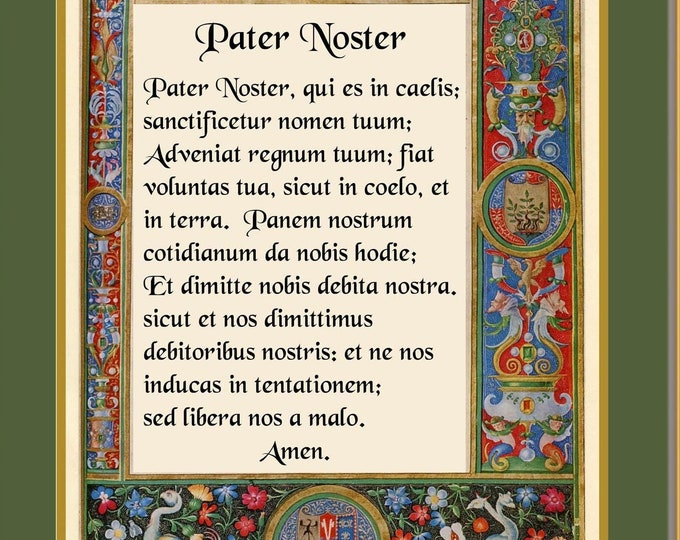
After saying the Praeceptis salutaribus, the priest recites or intones the Lord’s Prayer:
Pater noster, qui es in cælis, sanctificetur nomen tuum. Adveniat regnum tuum. Fiat voluntas tua, sicut in cælo et in terra. Panem nostrum quotidianum da nobis hodie, et dimitte nobis debita nostra sicut et nos dimittimus debitoribus nostris. Et ne nos inducas in tentationem.℟. Sed libera nos a malo.
Which is traditionally translated as:
Our Father, Who art in Heaven, hallowed be Thy name; Thy kingdom come; Thy will be done on earth as it it is in Heaven. Give us this day our daily bread, and forgive us our trespasses, as we forgive those who trespass against us. And lead us not into temptation.℟. But deliver us from evil.
It is beyond the pale of this little study to examine the long and robust tradition of commentaries on the Lord’s Prayer by the Church Fathers and medieval Doctors. Here, we limit our concerns to two: The placement of the prayer after the Canon, and how that placement shapes our reception of it.
Post Canon
In defending his decision to follow the Eastern custom of reciting the Our Father after the Canon, Pope St. Gregory the Great argues that it would be inappropriate to have any other prayer besides the one composed by Our Lord Himself follow the [manmade] Canon. The pairing is also appropriate when one considers an alternative name for the Canon used in the Middle Ages: “The Dangerous Lord’s Prayer.”
The Lord’s Prayer is related to the Canon in other ways as well: just as the Preface is the prologue to the Canon, the Lord’s Prayer is its epilogue. One can see this in the similarities between the Preface and the Lord’s Prayer. Both are introduced after a period of silence with the priest saying or intoning aloud, per omnia saecula saeculorum. Both have beautiful chant settings that are sung by the priest alone, both have responses from the congregation (the Sanctus and Sed libera nos a malo), and both use the word salutare. One could say that the Preface is the pro-logos, the Lord’s Prayer is the epi-logos, and in between is the Logos, made flesh and now dwelling sacramentally among us on the altar. In the words of Fr. Pius Parsch:
According to the great Pope [Gregory the Great], the Our Father is not so much a preparation for the Holy Banquet, as a consecration prayer, in the ancient sense of a prayer for the offering of the sacrifice. For this reason, in the Roman liturgy, it is recited by the celebrant alone, whereas in the Greek liturgy it is considered the table prayer of the congregation, who therefore recite it in common as a family about to approach the sacred banquet. According to Gregory I, therefore, the Our Father should be considered the completion of the Canon, corresponding to the Preface, in such wise that the Preface and the Our Father mark the beginning and the end of the Canon, which is recited in mystical silence. [1]
Needless to say, this ancient arrangement in the Roman Rite is undermined when the entire congregation sings the Our Father, a practice that reduces the similarity between the prologue and the epilogue. The practice is also a violation of a tradition as old as the Our Father itself in the Roman Rite, for Gregory the Great states that in contradistinction to the Greeks, at Rome the Lord’s Prayer is said a solo sacerdote.
 |
| St Gregory the Great, 1626/7, by the Spanish painter Francisco de Zurbarán. |
Another indication, incidentally, that the Canon and the Lord’s Prayer are meant to function together is the placement of the Solemn Nuptial Blessing over the bride and groom at a nuptial Mass. The intention seems to have been to place the prayer close to the Consecration at the nearest possible liturgical juncture. That the blessing was placed after the Lord’s Prayer rather than after the Great Amen suggests that the Canon and the Lord’s Prayers were seen as a practically indivisible unit.
Contextual Meaning
The Lord’s Prayer is also, of course, the beginning of the Communion Rite, thus forming a bridge between the Consecration and the reception of the Eucharist. It is when we view the Lord’s Prayer as a preparation for Holy Communion that its petitions take on added meaning.
“Our Father, who art in Heaven.” When the priest says these words, he is supposed to be staring at the Host. There is something almost ironic addressing the Father while looking at the Son and saying that God is in Heaven when He is also right before your eyes. But in a way the Eucharist, albeit in a veiled manner, is the fulfillment of John 14, 9: “He that seeth Me seeth the Father also.”
“Hallowed by Thy name.” The prayer does not say “Holy is your name” (although it certainly is), but “May your name be made holy or sanctified” (sanctificetur nomen tuum), as if we could increase the holiness of God’s name. God is maximally holy, and nothing on earth can change that. But His name can be rendered less holy by being “profaned” insofar as His chosen people, who are in a sense His representatives on earth, give Him a “bad name” by their behavior. In Ezekiel 43, 8 we read: “And they profaned My holy name by the abominations which they committed: for which reason I consumed them in My wrath.” The key, then, is to “hallow” God’s name by good behavior, but how can we be good without God? We cannot, and so we pray for help. As St. Cyprian of Carthage notes, when we say, “Hallowed be Thy name,” we mean, “May Thy name be hallowed in us”—that is, may we be transformed by sanctifying grace or holiness in order not to besmirch God’s name. [2] And to become further transfomred by sanctifying grace, we partake of the Eucharist.
“Thy kingdom come. Thy will be done, on earth as it is in Heaven.” Both of these petitions can be seen in light of what has gone before and in light of what is about to happen. When the priest turned bread and wine into Body and Blood, there is a way in which he already brought the Kingdom of God to earth, and there is a way in which He already did God’s will—namely, he obeyed the command, “Do this in memory of Me.” But when he and we receive Holy Communion, we also do God’s will and we also strengthen the bond between Him and us and each other, the Mystical Body of Christ, perhaps contributing to the coming of the Kingdom.
“Give us this day our daily bread.” Not surprisingly, this petition was interpreted by the Church Fathers to refer to the Eucharist, even when the Lord’s Prayer was said outside of Mass. The Eucharistic connection is even stronger in the version of the Our Father mentioned in St. Matthew’s Gospel: “Give us this day our supersubstantial bread.” (6, 11). With Holy Communion God is about to grant this petition of ours.
“Forgive us our trespasses.” Before the days of the second Confiteor, reciting this line before receiving Holy Communion was thought to absolve venial sins. In a sermon St. Augustine says:
If perchance, in consequence of human frailty, our thought seized on something indecent, if our tongue spoke something unjust, if our eye was turned to something unseemly, if our ear listened complacently to something unnecessary, it is blotted out by the Lord’s Prayer in the passage: “Forgive us our trespasses,” so that we may approach in peace and so we may not eat or drink what we receive unto judgment. [3]
“Lead us not into temptation.” This is one of the most fascinating verses of the New Testament to ponder because it ties into so many other verses. Here, we ask the Father not to do the very thing He did to His Son, “who was led by the Spirit into the desert, to be tempted by the devil” (Mt. 4, 1) (Yes, it was the Spirit who led Jesus, but who sent the Spirit if not the Father?) And yet we also read that God “will not suffer you to be tempted above that which you are able” and will help you “be able to bear it.” (I Cor. 10, 13) “Lead us not into temptation” is surely one of the “hard sayings” of Scripture (see Jn. 6, 61), and rather than grimace at it, we should embrace the challenge of wrestling with it.

Alas, not everyone agrees. In 1969, the Consilium for Constitution on Liturgy published Comme le Prévoit On The Translation of Liturgical Texts for Celebrations with a Congregation, which contains the following statement:
The correct biblical or Christian meaning of certain words and ideas will always need explanation and instruction. Nevertheless, no special literary training should be required of the people; liturgical texts should normally be intelligible to all, even to the less educated. For example, temptation as a translation of tentatio in the Lord’s Prayer is inaccurate and can only be misleading to people who are not biblical scholars. [4]
The assumptions of the authors are debatable, namely, that “temptation” is inaccurate and that only biblical scholars can understand the Lord’s Prayer (we wonder if the Lord would agree: would He command all of His disciples to use this prayer forever, knowing that only an elite would ever understand it?). Perhaps it is for these reasons that none of the official “vernacular” translations followed the advice of this document—not, that is, until 2019, when Pope Francis approved a request from the Italian bishops to change e non ci indurre in tentazione to non abbandonarci alla tentazione or “do not abandon us to temptation.” The allegedly problematic word “temptation” remains, but the ne nos inducas (Mē eisenkēs hēmas in the Greek) has been altered, despite the fact that the Greek verb in question eispherói (eis+phero, to lead into) is unambiguous. The decision prompted a not surprising backlash (see here and here and here and here).
“But deliver us from evil.” One petition that does admit of valid different interpretations is this one. Since Latin lacks a definitive article, libera nos a malo can mean “deliver us from evil” or “deliver us from the Evil One.” The original Greek has the definitive article in this verse, which is why Eastern churches use the latter translation. The Eastern versions, therefore, have the advantage of being more faithful to the biblical text, more vivid, and more evocative of Christ’s temptation in the desert, when He overcame the Evil One. The Latin, on the other hand, is more expansive, asking for protection not only from the Evil One, but all evils: sin, misfortune, illness, etc.
The fact that “But deliver us from evil” is a response from the people (respondentibus omnibus, as John the Arch-chanter says in the eighth century) gives this moment a special meaning. The lay faithful, listening to the Our Father as they did to the Preface, now affirm all that they have heard. “Basically, therefore,” Josef Jungmann concludes, “the people say the Our Father along with the celebrant. It is the people’s Communion prayer.” [5]
Notes
[1] Parsch, The Liturgy of the Mass, trans. Frederic C. Eckhoff (St. Louis, Missouri: Herder, 1940), 284. See Michael Fiedrowicz, The Traditional Mass: History, Form, & Theology of the Classical Roman Rite, trans. Rose Pfeifer (Brooklyn: Angelico Press, 2020), 107.
[2] Cyprian of Carthage, Treatise IV.12.
[3] Augustine, Sermo Denis 6 (229): Quia, sicut est humana fragilitas, si forte aliquid quod non decebat cogitatio nostra concepit, si aliquid lingua quod non oportebat effudit, si aliquid oculus sicut non decebat aspexit, si aliquid auris blandius quod non oportebat audiuit, si forte aliqua talia contracta sunt de huius mundi temptatione et uitae humanae fragilitate, tergitur dominica oratione, ubi dicitur dimitte nobis debita nostra; ut securi accedamus, ne quod accipimus in iudicium nobis manducemus et bibamus.
[4] [Comme le prevoit 15. a.
[5] Josef Jungmann, S.J., The Mass of the Roman Rite: Its Origins and Development, vol. 2 (New York: Benzinger Brothers, 1951), 288.




