Thursday, June 04, 2026

Britain’s Remarkable Monastic History, Told with Admiration, Humor, and Pathos

(This review was first posted at Rorate Caeli but is reprinted here for the benefit of NLM readers, who will also find much that is of liturgical interest in the book under review.)

Britain is full of monastic ghosts. Street names carry them: Monks Lane, Priory Road, Abbey Close. The landscape, too, still bears the imprint of communities that shaped it for a thousand years. The ruins of Fountains, Rievaulx, Tintern, and dozens of lesser houses stand in fields and valleys across England, Wales, and Scotland, drawing visitors who admire their picturesque qualities while knowing almost nothing of the civilization that produced them.

Joseph Kelly, in his new book Long Reign of Silence: A History of Monasticism in Britain (Cruachan Hill Press, 2026), has set out to remedy this ignorance, in what is surely one of the best popular histories of British monasticism ever written.

The scale of what has been lost and forgotten is remarkable. Kelly observes that almost nine hundred religious houses were targeted under Henry VIII between 1536 and 1541, and that their combined population in the thirteenth century numbered some twenty thousand souls in England alone (out of a total population of well under three million). By any measure, British monasticism was a civilization within a civilization, and its disappearance was not simply a matter of institutional change but of a comprehensive cultural rupture.

Kelly argues, convincingly, that the subsequent neglect of monastic history has not been accidental. The powerful new property-owning class of the Reformation whose wealth depended directly on expropriated monastic land had strong reasons to discourage nostalgia, and the cultural legacy of their prejudice is still with us. (We can also sense, against this backdrop, why the Oxford Movement, and even more the revival of monasticism among Anglicans, ignited such fury in the Establishment.)

One of the book’s most interesting segments is its account of how monasticism first took root in Britain. Kelly begins in fourth-century Egypt with Anthony and Pachomius, the desert fathers whose radical withdrawal from the world gave the monastic movement its distinctive character: poverty, common life, manual labor, and ceaseless prayer. That impulse travelled west through Gaul, was received by figures like Ninian and Patrick, and then flowered with extraordinary intensity in Ireland, a land Rome had never touched but whose tribal social structure paradoxically made communal religious life feel native rather than foreign.

The result was a monasticism of vibrant originality, whose hermits and peregrini carried the Gospel across Britain and continental Europe with zeal. Kelly vividly describes beehive huts on Skellig Michael, huddled against the Atlantic, and the monastery-city of Kildare, where the treasures of kings were stored alongside the treasures of God, and readers begin to understand that what was dissolved in the sixteenth century was not a decayed institution but the living continuation of a tradition stretching back to the first Christian centuries.

For the traditional Catholic in particular, this phenomenon matters in a way that goes beyond historical curiosity. The Celtic and Benedictine monks of Britain inhabited a sacramental cosmos wherein prayer was not private therapy but the Church’s essential public work, offered on behalf of the whole of creation—and shaping it in turn. Their monasteries were, as Kelly suggests, the heartbeat of a civilization. When Henry VIII dissolved the monasteries, what ceased was not merely a way of organizing property, but a way of interacting with reality itself. The consequences are well traced by other authors such as Sebastian Morello in his Mysticism, Magic, and Monasteries.

The central chapters of Long Reign of Silence, concerning the Benedictine reform under King Edgar and the three monk-bishops who orchestrated it (Dunstan, Æthelwold, and Oswald), deserve particular attention from readers interested in what authentic Catholic renewal actually looks like, especially when (N.B.) ecclesiastical culture is resistant.

By the early tenth century, monasticism in England had largely collapsed, its communities hollowed out by continuous Viking raids and dominated by married clergy who sang the Office and drew an income while ignoring the Rule. What followed was one of the most complete reversals in ecclesiastical history. The pious King Edgar, supported by his austere Bishop Æthelwold, instituted a thoroughgoing purge, expelling the unworthy and refounding house after house on strict Benedictine lines. The instrument of that reform was the Regularis Concordia, a document Æthelwold produced after convening the kingdom’s leading ecclesiastics at Winchester, mandating in precise detail how every monastery in the realm was to be governed.

Kelly tells this story with a novelist’s instinct for character: Dunstan, brilliant and combative, thrown bodily into the marsh by disgruntled monks and returning years later as their abbot; Æthelwold, who translated the Rule into English for the benefit of laypeople, and whose armed thanes arrived at Winchester to enforce compliance when persuasion failed; Oswald of Worcester, a descendant of Viking invaders who converted and became a champion of the civilization his ancestors had plundered. What makes this episode so interesting is that the reform succeeded not through accommodation to the surrounding culture but through an alignment of sacred and secular authority that is almost inconceivable today—together with a willingness to use “tough love” with gloves off, also quite foreign to our flaccid age.

(A few sample pages)

I’d particularly like to highlight the physical beauty of the book itself, which is a pleasure to hold and to read. The layout is clean and professional, and the more than sixty color illustrations—photographs of ruins, abbey churches, manuscript pages, beehive huts on Skellig Michael, the Book of Kells, and landscapes from Egypt to the Scottish Highlands—are reproduced with a clarity and care that genuinely enhances the text rather than merely decorating it. This is the kind of book you find yourself lingering over, turning back to an image to look again. Cruachan Hill Press and Joseph Kelly have produced a truly beautiful work that every traditional Catholic should own and read.

Long Reign of Silence
 has real virtues: narrative confidence, historical range, an accessibility that makes it suitable for any educated reader rather than Church history buffs alone. As a Brit from Oxfordshire, Kelly tells the story with a passion for the subject that only an English Catholic could bring. The endnotes are generous and point toward primary sources and scholarly literature with discernment.

Those with an interest in medieval history, in the roots of British culture, or simply in understanding what was lost when the monasteries fell will find much here to reward them. Anyone who has spent time in a functioning Benedictine monastery will recognize the life Kelly is describing, and will feel its absence in the landscape all the more acutely for having read this book. Perhaps, one might dare to hope that some of its readers will be among those whom God is calling to become monks or nuns, to help restore to the West its invisible heart, enclosed in visible walls.

Joseph Kelly’s Long Reign of Silence is available from Amazon. Alternatively, receive a 15% discount by pre-ordering at the Cruachan Hill webstore before the end of June.

Wednesday, March 25, 2026

The Contemplative Wellspring of St. Thomas Aquinas’ Theology

A review by David Torkington of Peter Kwasniewski’s The Anatomy of Transcendence: Mental Excess and Rapture in the Thought and Life of Thomas Aquinas (Emmaus Academic, 2025)

Anatomy of Transcendence is a brilliant work of scholarship that studies the themes of rapture, spiritual transport, and excessus mentis in the theology of St Thomas Aquinas. I found it a totally absorbing read. The author must be congratulated for his meticulous scholarly study of the writings of St Thomas in order to show and detail not only the beauty of the Angelic Doctor’s teaching on ‘ecstasy’ but also that that this teaching was based on Thomas’ own personal experience.

This work is primarily for scholars and fellow academics and must not be seen, as the author himself has made clear, as a spiritual guide for those seeking to pursue contemplative prayer. Yet it is by no means foreign to this aim.

In the mystic way, there is a clear difference between the ‘ecstasy’ that is experienced by a believer who is in what St John of the Cross would call the purification in ‘The Dark Night of the Soul’ and the ‘ecstasy’ experienced in what St Teresa of Avila would call the Mystical or the Spiritual Marriage when the purification in the ‘Dark Night of the Soul’ has ended. In the ‘Dark Night’, ecstasy is predominantly experienced in the ‘apex mentis’; however, in the mystical Marriage, when the purification of the mind and the body has been completed, the experience of ‘ecstasy’ is also experienced in the body, therefore in the emotions and in the feelings too, when what are called ‘the gift of tears’ becomes commonplace.

This is a far more complete, all-embracing and enthralling experience, the experience that finally impelled St Thomas to put down his pen and refer to all he had previously written as if it were straw. Perhaps we can see here the difference between the two ‘ecstasies’ of St Paul, the one that takes him up and into the third Heaven and the one which takes him up into Paradise. Kwasniewski does an excellent job carefully exploring this experience of St Paul with the aid of the Angelic Doctor.

I was delighted to find that in addition to St Thomas’ devotion to the liturgy, and above all else to the Mass, the author showed how St Thomas gave daily time for the personal contemplative prayer without which all his works could not have been written. True ecstasies are not arbitrary capricious events; they only regularly arise from a long-since experienced contemplative prayer life, such as Aquinas certainly enjoyed, contrary to the vain babblings of Adrienne von Speyr who wrote him off as an unrepentant rationalist.

When in addition to studying and expounding the teaching of St Thomas, his modern disciples follow him into the deep personal prayer that leads to contemplation, then they would receive the infused virtues of wisdom and prudence that would enable them to represent his teaching for the benefit of the modern Church, and the world that it is committed to serve.

Then they will be able to claim to be true Thomists, because like St Thomas they practice what they preach, and so become the long-lost apostles needed to help resurrect a decaying and dying Church, so that God’s Kingdom may once again become on earth, as it is in Heaven.

Dr. Kwasniewski is to be thanked for helping all of us to become much more aware of this vital dimension to the life and work of a theologian who has too often been reduced to a mountain of syllogism. For him, that was only the external skin of the living body, with a heart of love beating within, animated by a soul consumed with love and longing for God.

Anatomy of Transcendence is available from its publisher Emmaus Academic, from Amazon sites, or from Os Justi Press’ online shop.

David Torkington specialises in the promotion of mental prayer in the great Carmelite tradition. See his work at https://metanoia.org.uk/.

Friday, August 29, 2025

First English Translation of Guéranger’s Liturgical Institutions Now Available

The publication of the first English translation of Dom Prosper Guéranger’s Liturgical Institutions – in the abridged form prepared by Jean Vaquié in 1977, and now translated by Dr. David Foley and Gerhard Eger for Os Justi Press – is a moment of major importance for the Church’s liturgical and spiritual life.

For too long, Guéranger’s magnum opus, running to nearly two thousand pages and available only in French, has been a treasure beyond the reach of many English-speaking scholars and faithful. This edition brings to light a work of singular importance, serving both as a detailed history and a vehement defense of the Roman Rite in the face of corrosive innovation.

Dom Guéranger was no antiquarian. He was the founder of the modern liturgical movement, a man driven by the conviction that the liturgy is the living expression of the Church’s faith and the bulwark against the inroads of error. His prose – elevated, precise, yet burning with zeal – enfolds medieval liturgical devotion within the incisive reasoning of a modern historian. The translation by Foley and Eger preserves this spirit, restoring omitted passages and providing useful annotations and translations of Latin sources, making Guéranger’s thought accessible without diluting its force.

The Liturgical Institutions unfolds as a comprehensive narrative of the Church’s liturgical heritage, from apostolic beginnings through centuries of growth, local diversity, and, critically, the disastrous neo-Gallican reforms of the seventeenth and eighteenth centuries. These reforms were not benign liturgical experiments, but an assault on the Roman Rite’s unity, doctrinal integrity, and sacred symbolism – an assault tainted with rationalism, Jansenism, and Gallicanism, the spirit of French ecclesiastical autonomy, (living apart, if not formally divorced from, the universal Church) that Guéranger rightly identified as a poison within the Church’s bosom.

This historical analysis resonates powerfully with contemporary concerns. The liturgical upheaval of the twentieth century, particularly the post-Conciliar reforms, continue the pattern of distortion and disintegration that Guéranger identified as the “anti-liturgical heresy”, warning that it “seeks to silence this voice [of the Church] and tear up the pages that contain the faith of ages past.” This has become all the more relevant to an age which has witnessed the desacralization of the altar, the abandonment of sacred language, and the reduction of the Mass to a commonplace vernacular service – all characteristic moves of heretics, according to the plain-spoken French abbot.

To engage with Guéranger is to join a tradition of guardianship over the sacred rites that embody the Catholic faith. For those who seek a deeper understanding of the liturgical crisis and the means to restore authentic worship, this edition is an invaluable resource.

The Liturgical Institutions is available in hardback, paperback, and e-book directly from Os Justi Press, or from any Amazon site.

Those who would like to view the table of contents, foreword, and preface will find it here or here.

(In a future post I will discuss another new book just out, Lumen Christi: Defending the Use of the Pre-1955 Roman Rite, but for now I will only mention that the code RITESTUFF will unlock at 10% discount on both.)

Wednesday, September 11, 2024

Review of a New Reprint of an Old Edition of the Vulgate: Guest Article by Mr Sean Pilcher

Our thanks to Mr Sean Pilcher for sharing with us review of a new reprint of a very beautiful edition of the Clementine Vulgate. He is the director of Sacra: Relics of the Saints (sacrarelics.org), an apostolate that promotes education about relics, and works to repair, research, and document relics for religious houses and dioceses; last year we published a three-part article by him on that subject.

St Jerome’s Latin Vulgate Bible stands with St Benedict’s Rule and the Roman Missal as one of the most copied and circulated texts in the Christian tradition. It is surely a sign of the times, then, when the number of affordable editions of our canonical Scriptures wanes and the text accordingly loses its place in our daily lives. If we can wince at the scarcity of editions of these books, then we can also be encouraged when they return to print in useful, affordable, sometimes rather fine editions.

The Vulgate is the basis for most of our liturgical books, and is a locus of prayer, meditation, and commentary for so many saints and Fathers of the Church. It is the constant source of reference, and a primary text for lectio divina. In more recent decades, one of the most widely-purchased editions of the Latin Bible is the German Bible Society’s big green Bible.
This version is useful for scholars of manuscript variants and text history, but is not the common, ‘catholic’ Vulgate text. It contains many critical notes of variant readings, and can seem more like a car or computer manual than the inspired Word of God. It is perhaps not the kind of thing one would normally take up for devotional reading, and its physical presentation and strain on the eye do not encourage it. The text also lacks punctuation, as the oldest manuscripts of the Bible itself do. A new copy costs around $100, not an impossible price for a Bible, but considering its limited usability, I suggest another edition.
A more accessible edition for Catholics is the so-called Colunga-Turrado, named for the two principal editors, published by Biblioteca de Autores Cristianos (BAC): a workhorse that can be had relatively cheaply ($40-$90). The text is the Clementine Vulgate, the version used in the liturgical books. Earlier editions (bound nicely in cloth) can be found ‘used’ for an even more reasonable price, and some include helpful illustrations.
This Bible contains prefaces, some relevant decrees of the magisterium, and has a helpful index–all in Latin. I recommend this edition to students and people interested in having a reliable Bible for daily reference and reading. The notes are simple and not distracting, noting where one book references another, or where Our Lord or one of the apostles quote the Old Testament. They are helpful for study but easily ignored during quick reading or meditation. There are some spelling errors, but we shall notice this in most Bibles if we actually read them.
Most recently, Church Latin Publishing Company has reprinted a very nice edition of the same official Clementine Text, originally typeset and designed by Desclée and The Society St John the Evangelist in 1901. This book, even more than the BAC version, looks like a Catholic book. It contains clear, devotional line art very much in the tradition of older liturgical books; in other words, it looks like a prayer book, not a critical monograph. Each book or group of books of the Bible begins with an illustration of its author or principal figure, and each chapter has a very nice drop-cap letter to focus the eye.
St Jerome’s original prefaces are included at the beginning of the volume, which ends with some additional texts and indices. I emphasize that the book looks Catholic because so much of modern biblical study, and even publishing, follow protestant conventions. Biblical scholarship can certainly be undertaken by parties outside the Church, but if the way we treat the Sacred Scriptures, the names we have for the books, the critical methods we use, and even the physical books we print all resemble those used by protestants, we may be perhaps inclined to perceive the Bible as a ‘stand-alone’ or ‘independent’ text equally used by any ecclesial body.
The reason that the Bible should look and feel like a Catholic book is because it is a Catholic book–loved, preserved, copied, read, studied, and proclaimed by Holy Mother Church throughout the centuries.
Church Latin Publishing Company’s ‘resurrected’ edition of the Vulgate is a serious contribution to the shockingly small pool of editions currently in print, and as such, a good sign of renewal. Its appearance and construction inspire reverence for the written Word of God, and echo the text’s shared place in the Missal or the Breviary. Its competitive price ($100) and devotional character make it ideal as a gift or as a Bible for daily reading and meditation. The text, while ornamental, and if perhaps on the small side, is still suitable for study, and wide margins leave room for annotations or marking if desired.
Of course, having nice (or many) editions of the Bible does not do us any good if we do not make them familiar objects of study and prayer. We would do well to take up such a beautiful book and put it to use.
“Crebrius lege et disce quam plurima. Tenenti codicem somnus obrepat et cadentem faciem pagina sancta suscipiat. – Read often and learn all you can. Let sleep find you holding your book, and when your head nods let it be resting on the sacred page.” St Jerome, letter to Eustochium.
St Jerome in His Study, 1442, by the workshop of the Netherlandish painter Jan van Eyck (1390 ca. - 1441; public domain image from Wikimedia Commons.)

Friday, April 19, 2024

Review of Harry Crocker, Triumph: The Power and the Glory of the Catholic Church - A 2,000 Year History (Regnery, 2023)

Siege of Constantinople, Chronique de Charles VII by Jean Chartier

Harry W. Crocker III is no stranger to traditionalist debates and The Latin Mass magazine. In the 2002 Summer issue, Thomas Woods robustly endorsed his monograph Triumph: The Power and the Glory of the Catholic Church - A 2,000 Year History. In the next issue, he wrote a review of Vladimir Soloviev’s The Russian Church and the Papacy, which argues that Eastern Orthodox churches desperately need the papacy. His positive review drew the vehement ire of TLM’s few Eastern Orthodox readers and led to a lively exchange in the Winter 2003 issue between him and his critics. One can see why Orthodox feathers were ruffled. Crocker begins his review with: “As Newman might have said, but didn’t, ‘To be deep in history is to realize that the Eastern Orthodox are crazy.’ They are now, they were then, and they always have been.” [1]

Twenty years later, Crocker has published an updated and expanded edition of Triumph, with additions that cover the Francis pontificate. And the controversy continues.
In order to appreciate Triumph, one must understand what kind of book it is and is not. Harry Crocker is not a professional historian but an amateur (in the best sense of the word) who has deeply imbibed 2,000 years of Church history, ruminated on it, and summarized it for the general reader in light of his own judgment. For a history book that is replete with empirical facts and strives for impartiality, look elsewhere; for a history book that is unabashedly opinionated and never boring, look no further.
Every author must assume a certain persona, and Crocker’s is that of a stalwart Catholic and a somewhat aristocratic snob. He is willing to forgive popes with mistresses so long as they defend Church doctrine and attack the Church’s enemies. “On matters of sex,” he opines, “one can say that some of the Renaissance popes simply surrendered to their Mediterranean temperament or were premature Protestants” (258). And if selling indulgences is what it takes to cover Michelangelo’s salary, Crocker avers, it is money well extorted (258).
He also betrays an old-school belief that every ethnicity has its own distinctive character. Rather than shy from stereotypes, he indulges in them. After describing medieval tumult in the lands surrounding the Black Sea, Crocker quotes with approval Ambrose Bierce’s aphorism: “All languages are spoken in Hell, but chiefly those of Southeastern Europe” (224). And when commenting on the Franks’ attempt to control parts of Byzantium, he writes: “The French, however, continued to be hampered by there being too few of them—a crying need that the world has not often recognized” (180). Pope Paul II is described as “handsome and concomitantly vain” because “he was Italian, after all” (266).
And as one might expect from the 2002 Latin Mass magazine debate, Crocker saves his best zingers for our separated Eastern brethren. Before its conversion to Christianity, the Eastern Roman Empire was prone “to extremism and emperor worship” (40); afterwards, it was filled bishops who “bowed to imperial demands like reeds beaten by the winds” (106) and monks “prone to almost absurd acts of mortification” (112). Already in the early centuries of the Christian era, the Eastern churches had “febrile, hate-filled fissiparous tendencies” (119) that were only held in check when they were tethered to Rome. From the fourth to the ninth century, the East was in schism one third of the time; since it was but “a footstool for the Byzantine emperor,” it often followed the emperor’s heretical bent. The Crusaders were not impressed with the Byzantines when they first met them, regarding them “as gay Greeks—effeminate, scheming, and bitchy” (175). The sacking of Constantinople was not a travesty but condign punishment for the Byzantine court’s intrigue and backstabbing.
Crocker’s criticism of the schismatic East, incidentally, has new relevance today. Recent years have witnessed the rise of the so-called “Orthobro,” a single, usually bearded male from the Millennial or Generation Z generation who is a convert to Eastern Orthodoxy and who spends most of his time trolling the internet and excoriating the Filioque rather than asking a girl out on a date. If you have an Orthobro in your life, I highly recommend that you give him a copy of Triumph and then sit back and enjoy the fireworks. Schadenfreude is not a sin when the suffering that you delight in observing is for their own spiritual good.
Crocker’s tendentiousness (much of which is deliberately provocatory and, he admits, satirical) [2] all but guarantees that the reader will sooner or later be offended (for me it was his line that Henry II’s conquest of Ireland was a “necessary project of civilization that remains uncompleted even a thousand years later” [192]). The overall effect of Triumph, however, is—at least for orthodox Catholics—quite satisfying. Although Crocker is imprecise at times and impolitic at all times, he almost always lands in the right place. The Renaissance, he charges, was not the rejection but the fulfillment of the Middle Ages, which also revered the classical world (259). His explanations of controversial topics such as the Crusades, the Babylonian Captivity, the Inquisition, the Protestant Reformation, the American Founding, and the Napoleonic era are excellent, and he is a fine raconteur, often weaving together different threads of a story out of their chronological sequence in order to tell a more vivid tale.
Crocker’s treatment of the twentieth century is also good. After summarizing the great works of the early- and mid-twentieth-century Popes (including Pius XII’s heroic actions to save Jews from the Holocaust), he moves on to the organizers of Vatican II, whom he characterizes as misguidedly optimistic. Oddly, he spends more time on Humanae Vitae than the Second Vatican Council, and he does not address at length the liturgical revolution that ensued except to lament illicit and unwelcomes innovations such as
hand-holding during the Our Father and cupping one’s hands in imitation of the priest—offenses that should have been dealt with under sharia law, adopting the Islamic punishment for thievery, as part of the Church’s new openness to other religions (516).
As for the Francis pontificate, he is surprisingly restrained. The author who lets loose the haymaker that the Sack of Byzantium should be made a feast day puts on kid gloves to describe Pope Francis “as a sometimes charismatic, generally well-meaning, but occasionally spiteful and authoritarian man of muddle, vulnerable to liberal flattery” (535-36). Not bad, but H. J. A. Sire’s 2018 The Dictator Pope, which Crocker did not consult, paints a darker but well-documented picture. Similarly, regarding the doctrinal controversies surrounding this Pontiff, he dances like a butterfly but forgets to sting like a bee, perhaps because he published this new edition before the promulgation of Fiducia Supplicans, which in the eyes of many is when the gloves of the current pontificate have finally come off.
That said, Crocker draws a wise conclusion from the bizarre chapter of Church history in which we find ourselves:
But if Francis’s pontificate made anything clear, it was that the Church needed to move on from the liberal platitudes about the spirit of Vatican II, platitudes that would (even if this was not his intention) have the Church conform to the liberalism of the world, the dictatorship of relativism, as the only acceptable dogma (536-37).
Not all of Crocker’s facts are straight. On page 330, he states Pope Paul IV excommunicated Queen Elizabeth I, but ten pages later he states that it was Pope St. Pius V (the correct answer is Pius V). He also claims that the Church celebrates the Battle of Lepanto every year as the feast of the Holy Rosary on the first Sunday after October. In fact, the feast has been celebrated on October 7 since Pope St. Pius X changed the date in 1913. And his claim that Calvinism today is either moribund or dead is proof that he has never visited the campus of Baylor University or Wheaton College.
But overall, Triumph is an impressive achievement: a well-written, judicious, and entertaining presentation of 2,000 years of tumultuous Church history. I strongly recommend it to all faithful Catholics and sincere truth-seekers, especially those who feel embarrassed by the Church’s historical record or are disheartened by the Church’s current state of affairs. Triumph does not whitewash, but it puts the black marks in their proper perspective. Moreover, it cogently defends its main thesis, which is expressed in the final paragraph:
The triumph of the Catholic Church, from its beginnings with the Apostles filing out from the Holy Land, to its rising to be monarch over kings, to its continued survival and worldwide development against every conceivable persecution, is the most extraordinary story in the world (541).
“La Jérusalem céleste“, extraite de la Tapisserie de l'Apocalypse du Château d'Angers, France

This review first appeared in The Latin Mass magazine 33:1 (Spring 2024), pp. 60-22. Many thanks to its editors for allowing its publication here.

Notes
[1] “To Russia with Love,” TLM 11:4 (Fall 2002), 63.
[2] TLM [Winter 2003], 5.

Monday, June 27, 2022

A Beautiful Testimony to the Power of the Original Liturgical Movement

Newly released from Arouca Press in collaboration with Silverstream Priory, NLM followers will no doubt want to make a point of reading a book which combines fine art, hagiography, and sound spiritual advice: For Their Sake I Consecrate Myself. I greatly enjoyed and benefited from reading it and consider it to be one of those precious hidden gems, lost in a world of more superficial entertainment and NYT bestsellers, that readers will still be thinking about years after they read it.

The biography of a young Polish nun of the last century, it is a fascinating snapshot of the fruits of the 1950s Liturgical Movement at its finest. “There is a question of equilibrium, of balance, in the supernatural order, as in the physical universe,” writes Abbot Philip Anderson about this book. “It was the God-Man, Jesus Christ, who re-established this balance on the highest level, after sin had unleashed ruin upon mankind. But some souls are called to fill up those things that are wanting of the sufferings of Christ in their flesh for His Body, as Saint Paul tells us. How can this be? Let the story of Sister Maria Bernadette, who was surely one of those souls, lift a corner of the veil and draw you into the mystery. Maybe you too have a part to play.”

Known in the world as Róża Wolska, she was born in 1927. Reminiscent of Pier Giorgio Frassati in many ways, Róża was an avid athlete. In the early ’40s she was introduced to the monks of the Benedictine Abbey of Tyniec. At that time Tyniec was in the vanguard of the Liturgical Movement, in its healthy phase; under the monks’ guidance, Róża’s spiritual life flourished, as friendship, lectio divina, and the sacred liturgy revealed the beauty of God to her.
 
Somewhat of a surprise even to herself, Róża felt moved to enter the Benedictine Nuns of Perpetual Adoration in Warsaw after graduating from the Academy of Fine Arts in 1951. Those years were very difficult for the monastery, which was being rebuilt after the being bombed in World War II; the Communist yoke weighed heavily on the whole country. During these years, outwardly quiet but inwardly eventful, Sr. Maria Bernadette, as she was known in religion, struggled with how to overocome the old Adam and put on the new; in particular, her secular training in art had to be sublimated to monastic purposes, and in this regard she eventually produced many striking images of various sizes and for varied occasions.
 
After about ten years of living the monastic life, Sister Bernadette’s health began to fail, and in 1963 she was admitted into hospital for surgery. While there, she offered her life in reparation for the sins of apostate priests about whom she had read, particularly the so-called “Patriot Priests” who were supportive of the Communist government. Complications arose but doctors declared them normal symptoms of recovery; they were mistaken. “Both the sick and the doctors cannot get over the fact that a nun can be so cheerful,” she wrote to her parents shortly before her death. “I think that the glory of the Bridegroom grows through this, so I don’t even care anymore that my stitches hurt from laughing.”
 
A prayer card by Sr. Bernadette: "I to my beloved, and my beloved to me, [who feedeth among the lilies]" (Song 6:2)
As her strength failed, the wistful Gregorian melody for the Magnificat antiphon for the Ascension ran through her soul: “O King of glory, Lord of hosts, Who hast this day mounted in triumph above all the heavens, leave us not orphans: but send unto us the promise of the Father, the Spirit of truth, alleluia.” Sister Bernadette died on April 30th, 1963, surrendering her life into the hands of God.
 
Page from a Gospel book illuminated and calligraphed by Sr. Bernadette
Sally Read, poet and author of Night’s Bright Darkness, writes of this book: “The life of Sister Bernadette of the Cross is vividly detailed here. Her role as a child of God, in a world ravaged and abused by war and corruption, comes across as both heroic and ordinary.”

For Their Sake I Consecrate Myself is a new translation and revised edition of a Polish biography of Sister Bernadette. It contains numerous photographs and reproductions of her artwork, and extensive passages from her charming, humorous, and spiritually uplifting letters. “As we go through the pages,” Sally Read continues, “[Sister’s] very soul seems to be honed and polished before our eyes; she is both reduced and glorified by her pains. Her story is an illustration of what it means to suffer in Christ, and for the sins of others, and is given great immediacy and vitality by the examples of her beautiful art. Her words are meat for those who wonder about the role of suffering in life.” An epilogue in the book ponders the lessons of victim souls and how we are to make sense of this “scandal” in a world that has so much lost the understanding of the value of reparation and the practice of abandonment to the Father’s Providence.
 
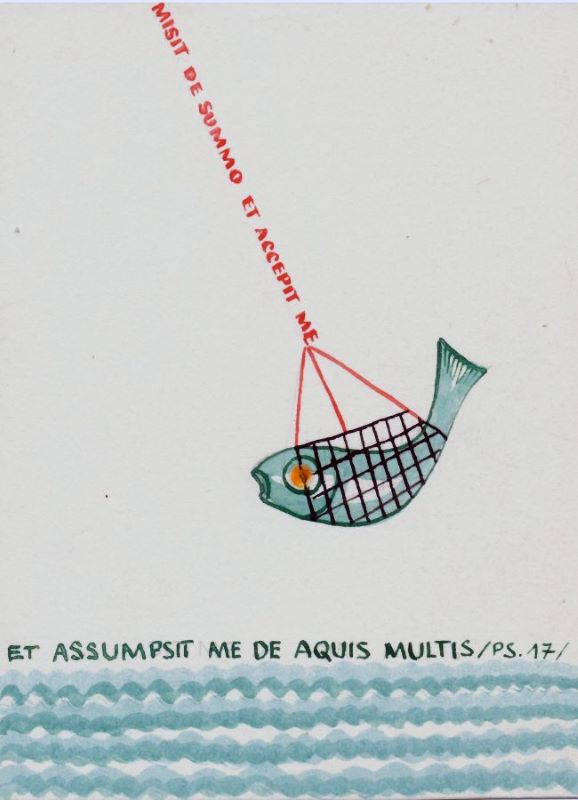
A humorous drawing showing Sister's response to the psalm verse
"And he took me up from the deep waters"
Perhaps the strongest praise comes from Scott Hahn, who writes: “This book is a roadmap to true happiness, not only in the afterlife, but beginning here and now.” Drawing attention to the remarkable cheerfulness that suffused Sister Bernadette’s often difficult life, Dr. Hahn says: “Sister Bernadette was one of those souls who, while living with the Church, the liturgy, and the Scriptures, allow themselves to be led by the Spirit to pray and to suffer—generously and cheerfully. She made an offering of her life, and in these pages we can learn to do the same.”

For Their Sake I Consecrate Myself is available for purchase on Arouca Press’s website, on Silverstream Priory’s shop, as well as Amazon.com, Amazon UK, and other retailers. I hope that many will “take a chance” on this little-known story and find a special blessing in it.

A brief preview of the photos and artwork found in the book is available in a video released by Silverstream Priory: 


Saturday, March 12, 2022

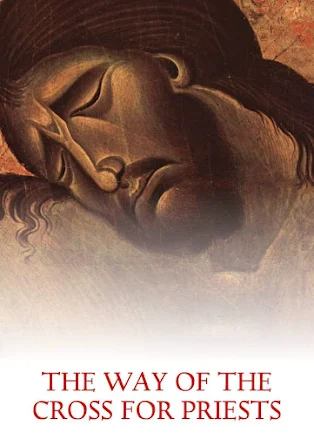
Book Review: The Way of the Cross for Priests

The following review was written by a parish priest.

The days of a widespread iconoclastic approach toward popular piety seem to be behind us. (The very phrase popular piety is no longer the slur it once was.) Happily, and despite the controversies of the day, a re-seizing of traditional Catholic liturgical life is taking place. Nevertheless, the right tools are needed in order for this rebirth to continue apace. I have one such tool before me at the moment in The Way of the Cross for Priests, by the monks of Silverstream Priory.

The preface to the volume is powerful in its own right; two themes are notable. First, the author cites the experience of the great Benedictine abbot, Columba Marmion (1858-1923.) “After the Sacraments and liturgical worship,” writes Marmion, “I am convinced there is no practice more fruitful for our souls than the Way of the Cross made with devotion.” For those who know this master of the spiritual life, that is endorsement enough. Second, we are shown how The Way of the Cross resembles the practice of lectio divina. Like this discipline of monastic prayer, The Way of the Cross is a rhythmed, ordered approach to the graces of Christ's Person.

The Way of the Cross for Priests has a number of other virtues. It is faithful to St Benedict’s injunction that prayer should be “short and pure.” Admittedly, some versions of the Stations tend toward the verbose. Yet the Passion is a heavy enough mystery as it is: manageable, but profound texts are what we need most. Silverstream’s Way provides this. Mimicking the genius of the classical Roman Rite, the texts are drawn from beautifully disparate places in the Old and New Testaments: Job, Isaiah, the Psalms, the epistles of St Paul, and the Gospels.

The Cenacle Press at Silverstream produces volumes of physical beauty, which is by no means unimportant. So the little book is a delight to behold and use. Also, the English translation of the Stabat Materis dignified and sung easily.

It is by no means the case that The Way of the Cross for Priests is suitable for the priest’s private prayer only. On the contrary, it will do much to mature and strengthen the Catholic faithful, who in our time have recovered the instinct to pray assiduously for their priests. Thanks be to God for that. Writes Marmion, “The Passion is the ‘holy of holies’ among the mysteries of Jesus, the pre-eminent work of our Supreme High Priest.” Any means which can drive us into this holy of holies is worthy of our serious attention: thus The Way of the Cross for Priests.

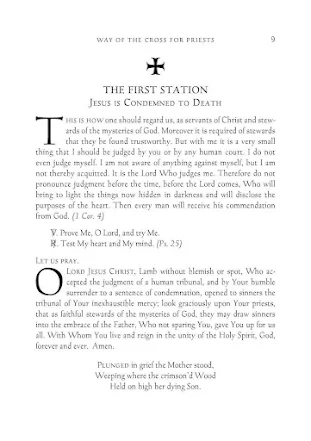
(sample page)

Thursday, March 10, 2022

“Each Has Received A Gift”: Guest Review of Dr Kwasniewski’s Ministers of Christ

NLM is pleased to offer this review by Fr. John Henry Hanson, O.Praem., of St Michael’s Abbey in Silverado, California.

Among his several recent books, Dr Peter Kwasniewski’s Ministers of Christ: Recovering the Roles of Clergy and Laity in an Age of Confusion (Manchester, NH: Crisis Publications, 2021) is remarkable for the lengths to which it goes in establishing correct Biblical and anthropological principles for why all-male sanctuary service has been the perennial norm for the sacred liturgy. It has always made intuitive sense to the clergy and faithful, so that the occasional admission of women to the sanctuary throughout Church history has been considered an abuse, and corrected as such by the hierarchy. Dr Kwasniewski includes a fine essay from Bishop Athanasius Schneider which surveys that history, showing the consistent disapproval of popes where the abuse has periodically (and infrequently) crept in. [1]
But Dr Kwasniewski’s book is more than an apologia for the restoration of all-male sanctuary service in the usus recentior of the Roman liturgy, not to mention the restoration of the minor orders. It is valuable on this score, to be sure, and leaves no doubt about the apostolicity of the practice, nor about the mind of the Church throughout the ages on the matter. In his typically sober and carefully argued way, he demonstrates not only how the current practice is clearly an aberration, but how it also ironically devalues women’s proper role in the Church.
Where the book really performs an invaluable service is its deeper look into the greatness and complementarity of maleness and femaleness with respect to Biblical revelation and the life of the Church. In fact, Dr Kwasniewski goes where few have the depth to go: into the nature of the human soul, which cannot be other than “bridal” in relation to God, and thus feminine in nature. This is a doctrine of great antiquity, the most famous Biblical example of which is the Song of Songs. Also of great note are the mystical teachings of Saints such as Bernard of Clairvaux (whose commentary on the Song is second to none), and John of the Cross, who takes this teaching for granted throughout his great works.
Why is this important?
In my experience as a priest and spiritual director, the idea of everyone, including men, having a bridal soul, although second nature to any devout woman, is often a real obstacle (even for devout men)—not surprising, since bridehood is written into a woman’s nature. Men espouse, women are espoused. So it is a significant and spiritually crucial leap for men to get there and feel natural both as men and yet receptive in spirit as women are receptive in nature. That Our Lady is the model disciple for both men and women comes directly from her complete and total receptivity to the word of God, her complete self-surrender to God’s plan for her and for the world. And this total openness is found in both male and female saints alike. You need look no farther than St Joseph for proof.
Photo courtesy of Allison Girone
But translating into practice what we know to be true in both natural and spiritual matters is where we have veered off the path taken by our ancestors. Under pressure from cultural factors, it would seem, the Church has seen fit not only to allow female altar service (under St John Paul II) but even (under Pope Francis) to normalize the practice. Dr Kwasniewski entertains the mild objection that, in fact, Pope Francis’ 2021 motu proprio Spiritus Domini merely makes official what has become standard practice in most mainstream parishes. And there is some truth in that. But there is an enormous difference between a concession—an ad hoc role undertaken in the absence of an ordinary minister—and a statement that effectively eliminates the distinction between the sexes with respect to altar service. To equalize, in this case, does not mean ennobling one to the level of another. It means sending a message to women that confuses rather than elucidates.
It would seem that equalizing men and women in the sanctuary conveys to women, along with anyone paying attention in the pews, that the Church has caught up with modern times and decided that women are “just as good as” men. Girls no less than boys can be entrusted with handling cruets, ciboria, and missals, whereas before… they weren’t trustworthy enough or somehow good enough to do what boys have always done? Is this the (at least) visible message here?
Everyone knows that women are entrusted with the care of the most precious and delicate thing on earth: human life, from its most vulnerable stages. And women do this better and more naturally than men, which every man acknowledges. God has given women this capacity and men normally must learn from them how to be gentle, tender, sensitive toward what is most fragile. Clearly, the reasons behind exclusively male altar service stem from a source other than carefulness and responsibility, other than personal worthiness—and nothing even approaching superiority or inferiority.
As worthy or unworthy as men may be, they are sacramental images of Christ in a way women cannot be, just as women are sacramental representatives of Our Lady and the Church in ways that men can never be. Most generations of Christians have had no problem with that and have seen it for what it is: something beautiful, something divinely willed. I remember hearing a Carmelite nun recount how once when she was in an airport, a child pointed at her and said very audibly to its mother: “Look! It’s the Church!” From the mouths of babes.
Compare the sacramental worldview of the Church throughout the ages to the attitudes that surrounded John Paul II’s acquiescence to female altar servers. In an April 1994 front-page article, the New York Times quoted a Monsignor Harry Burns of the New York Archdiocese lauding the decision in terms far from the sacramental, and even far from the legal:
“Msgr. Harry Byrne, pastor of the Church of the Epiphany at 22d Street and 2d Avenue in Manhattan, has allowed altar girls for 12 years, and said he had allowed them in his previous Manhattan parish since the mid-1970’s. In some cases, girls assisted during Masses celebrated by diocesan officials, he said. ‘I feel very strongly about the question of equality of women in society and church,’ Monsignor Byrne said. ‘It’s in the interest of creating a climate where women would feel the church is being responsive to them.’ Monsignor Byrne, who has a doctorate in canon law and once served as Chancellor of the Archdiocese of New York, said the Vatican’s decision [i.e., to admit women to altar service] was similar to other instances in which the church reconciled itself with common practice—as when women were allowed to be lectors and read from the Scriptures. ‘Canon law changes by some people being out on the cutting edge,’ he said. ‘The practice may not be congruent with the regulations, but regulations catch up with custom.’ ” [2]
Not surprisingly, the same Times article goes on to quote others who see the move as an advancement for women. And this is where the catechesis so exhaustively presented by Dr Kwasniewski is so crucial. For women to take an equally physical role in the liturgy as men denigrates the gifts of nature and grace God has lavished upon them—almost as if just being a woman in a pew, praying, is not “good enough.” Women are the models, after Our Lady, of how to receive the mysteries celebrated in the sanctuary. Men should be able to see the veiled woman in church and know something about his own soul, his need to be under God, humble in prayer, and docile to the promptings of the Holy Spirit.
Photo courtesy of Allison Girone
Dr Kwasniewski’s pages on the veiling of women in church are a particularly powerful expression of this modeling. “This beautiful symbol,” he writes, “gives the wife [and all women, mutatis mutandis] an opportunity to live her vocation more fully by reminding herself, including her daughters, of its Marian character of humility and obedience.” [3]  Dr Kwasniewski further elaborates on a woman’s spousal nature—highlighting, again, how nature points to the spiritual character of the soul:
[T]he traditional custom of all females wearing a veil in church finds justification in the natural and supernatural ordering of each woman to be a spouse—be it as a bride of Christ in religious life or as a wife in a Christian marriage. Even before this ordering is actualized, and even when it is never actualized, it remains an ontological and spiritual reality that deserves to be recognized, honored, and placed within the great mysterium fidei celebrated in the Holy Mass. [4]
This is exactly the kind of catechesis needed in the discussion of women in the sanctuary, instead of leaving a vacuum of ignorance, abandoning the faithful to the implication that the Church is just as confused as everyone else about the proper roles of men and women (or if they have roles proper to them at all). The truest and most beautiful teachings about men and women and their divine vocation are found nowhere more complete and convincing than in the Catholic Church. When people are exposed to and educated in these truths, then the question of distributing liturgical roles ceases to be a question at all.
The difficulty we encounter is trying to help people think in other than crude, materialistic terms, not only about the liturgy and sexual differentiation, but about life in general. Truly did St Paul say, “The unspiritual man does not receive the gifts of the Spirit of God, for they are folly to him, and he is not able to understand them because they are spiritually discerned” (1 Cor. 2, 14).
To have a sacramental worldview is crucial to living our Catholic faith with any measure of coherence in this material world. Otherwise, we fall into the mere functionality that afflicts Western society in general. The idea that men and women are interchangeable in so many departments of public life, be it the workplace or the military, easily enters a Church left undefended by decent catechesis on God’s revealed plan for men and women. Thinking in spiritual terms requires that we form our minds according to the Biblical worldview as handed on from age to age by the Church—and not only that we know the teachings, but pray and worship as though they are true.
A final point needs to be made regarding the clericalization of the laity, and it is one which Dr Kwasniewski spends much time making. He rightly acclaims Vatican II’s doctrine on the role of the laity in the modern world and their call, rooted in baptism, to holiness. It had always been true, but needed to be proclaimed anew in the context of the rapidly changing world of the 1960s. The Council’s teachings were crystalized after decades of increasingly organized lay Catholic involvement in the political and social life of many countries. The influence of St Josemaría Escrivá and Opus Dei is often rightly touted as the decisive, proximate influence on the Council’s pronouncements on the laity. Yet, what does the founder of Opus Dei say about the issue at hand? In a book of interviews entitled Conversations, St Josemaría addresses “Women in Social Life and in the Life of the Church.” [5]  While not approaching the topic of female sanctuary service—a notion he would have found unthinkable—he lays down principles relevant to it. I quote him at length. The saint is asked:
“Could you give us your opinion as to how the role of women in the life of the Church can best be promoted?”
He replies:
“I must admit this question tempts me to go against my usual practice and to give instead a polemical answer, because the term ‘Church’ is frequently used in a clerical sense as meaning ‘proper to the clergy or the Church hierarchy.’ And therefore many people understand participation in the life of the Church simply, or at least principally, as helping in the parish, cooperating in associations which have a mandate from the hierarchy, taking an active part in the liturgy, and so on.
“Such people forget in practice, though they may claim it in theory, that the Church comprises all the People of God. All Christians go to make up the Church….
“In saying this, I am not seeking to minimize the importance of the role of women in the life of the Church. On the contrary, I consider it indispensable. I have spent my life defending the fullness of the Christian vocation of the laity, of ordinary men and women who live in the world, and I have tried to obtain full theological and legal recognition of their mission in the Church and in the world. I only want to point out that some people advocate an unjustifiable limitation of this collaboration. I must insist that ordinary Christians can carry out their specific mission—including their mission in the Church—only if they resist clericalization and carry on being secular and ordinary, that is, people who live in the world and take part in the affairs and interests of the world.
“It is the task of the millions of Christian men and women who fill the earth to bring Christ into all human activities and to announce through their lives the fact that God loves and wants to save everyone. The best and most important way in which they can participate in the life of the Church, and indeed the way which all other ways presuppose, is by being truly Christian precisely where they are, in the place to which their human vocation has called them.…
“Women will participate in this task in the ways that are proper to them, both in the home and in other occupations which they carry out, developing their special characteristics to the full.
“The main thing is that like Mary, who was a woman, a virgin, and a mother, they live with their eyes on God, repeating her words ‘fiat mihi secundum verbum tuum—be it done unto me according to Thy word.’ (Luke 1, 38) On these words depends the faithfulness to one’s personal vocation—which is always unique and non-transferable in each case—which will make us all cooperators in the work of salvation which God carries out in us and in the entire world.”
Yes, in the end, the “main thing” is very simple. In fact, we are really talking about the Lord’s “one thing necessary,” the “better part” chosen by another Mary, yet surely in imitation of the Holy Virgin of Nazareth (cf. Luke 10, 42). When we keep our eyes fixed on God, all of the other things in life come into sharper focus. Gazing upon the sanctuary and the solemn rites of the liturgy, we lose interest in promoting one human thing over another, in competition, in making a point about equality or anything else.
Photo courtesy of Allison Girone
God gives His gifts unequally but wisely. It is for us to receive and cherish them, using them to increase His glory. Whether we call them talents or fruits, they are the Lord’s to give, ours to handle with reverence and a sense of mission, and so “as each has received a gift,” we may “employ it for one another, as good stewards of God’s varied grace” (1 Pet. 4, 10).

Ministers of Christ: Recovering the Roles of Clergy and Laity in an Age of Confusion may be purchased for $19.95 at Amazon.com (link; ebook also available) or from Sophia Institute Press (link).

NOTES
1. See Bishop Athanasius Schneider’s “The Significance of Minor Ministries in the Sacred Liturgy” included in Ministers of Christ in chapter 4.
3. Kwasniewski, Ministers of Christ: Recovering the Roles of Clergy and Laity in an Age of Confusion, p. 189.
4. Kwasniewski, p. 191.
5. Conversations, nos. 87-112. See especially no. 112. Online version may be accessed via Escrivaworks.org: https://www.escrivaworks.org/book/conversations-chapter-7.htm

Monday, March 01, 2021

The Ultimate Communion Antiphon Book for the Usus Antiquior

Most singers of chant will be familiar with the old workhorse Communio by Richard Rice (CMAA, 2008), my own copy of which is so well-thumbed and beaten up it’s a wonder it still holds together. Others may be familiar with the Solesmes publication Versus Psalmorum et Canticorum (repr. CMAA, 2008), which contains pointed psalm texts for the Introits and Communions of the entire liturgical year. Although I used both of these books for many years as a choir director, I have discovered a new volume that definitively surpasses them for Sundays and Holy Days.

In November of 2019, I visited Houston to give four lectures, and while there, I decided to “crash” the Schola practice on Sunday at the FSSP parish, Regina Caeli. The singers were gracious and let me join them for the High Mass. At one point, the director, Kyle Lartigue, handed me a book: Ad Communionem: Antiphons and Psalms (Justitias Books, 2016), which, I discovered, was Mr. Lartigue’s own production.

Unlike the other communion books available, which either lack the antiphons and full musical notation (Versus Psalmorum) or utilize the awkward and untraditional Nova Vulgata for the psalm texts, Ad Communionem includes the antiphons for all Sundays and first-class Holy Days, followed by the pertinent psalm from the preconciliar Vulgate, notated in square notes. (The old Vulgate verses are a breeze to sing for those who are familiar with the Missale Romanum and the Breviarium Romanum or the Breviarium Monasticum.) Ad Communionem also includes Psalm 33 and the Gloria Patri in all modes, and an appendix with the Adoro Te and Ubi Caritas. The antiphons are organized not alphabetically (as in Rice’s book, where one must rely on the index) but by Sunday and feastday in chronological order, which makes it much easier to use. While the Solesmes book is more comprehensive, it merely “points” the texts rather than musically notating them, and both the poor quality of the reproduction (many times removed from its original) and the typographical conventions contribute to confusion and stumbling performances.

It’s exactly what I’d want my own schola to have, and in fact when I returned from Houston I asked the pastor in my town if he would buy a bunch of copies for our choir loft. This book deserves to be standard issue for every TLM schola in the English-speaking world. (I should mention that the antiphons and verses are accompanied by an inline English translation from the Douay-Rheims, which closely matches the Latin sense.)
 
Having a Communion antiphon book with psalm verses (regardless of which of the above three options is used) allows the cantors and/or schola to sing however many verses may be needed to prolong or shorten the music for a particular occasion. Sometimes more than one priest is distributing communion and it goes quickly; at others times perhaps there is an overflow crowd and only one priest distributing, which can take quite some time. The chanting of psalm verses has many benefits: the texts are liturgically appropriate and the music is very much in the background, as it should be; the overall effect is calming and prayerful, but the recurrence of the antiphon adds a welcome contrast to the simplicity of the psalm tones, and impresses the repeated text and melody in the minds of all who listen to it. The format also allows for maximum flexibility in musical forces. One can arrange it this way: antiphon (sung by all); verse (begun by cantor and completed by schola); antiphon; etc. Or: antiphon (sung by all); odd verse (sung by cantor); even verse (sung by all); antiphon; etc. Or instead of cantor and tutti, the schola may be divided into two halves. The simple format allows for a ready use of isons and organum.

Now that the TLM is coming back all over the place, Ad Communionem: Antiphons and Psalms is, I would maintain, a required tool for everyone who sings the proper chants. It is one of two books I always carry with me to the choir loft (the other being my Liber Usualis). The book is available in paperback and hardcover. A large sample of the pages may be found here. An index may be found here.

Mr. Lartigue has also produced a number of other books: a newly-typeset Latin edition of the traditional Martyrologium Romanum (updated through 1961, with an appendix of saints canonized after that year); a two-volume edition of traditional Sunday Vespers; Holy Week chants and a complete Kyriale. All of these books are newly typeset and more affordable than their competitors.

Pay a visit to his website: https://justitiasbooks.com/.

More recent articles:

For more articles, see the NLM archives: