The concept of the numinous was first articulated by the German Lutheran Rudolf Otto in his seminal work The Idea of the Holy: An Inquiry into the Non-Rational Factor in the Idea of the Divine and its Relation to the Rational. Since its publication in 1917, the monograph has influenced an impressive array of thinkers with vastly different points of view: Paul Tillich, Karl Barth, Carl Jung, Joseph Campbell, Martin Heidegger, Karl Rahner, Leo Strauss, and C.S. Lewis, to name a few. Otto’s thought is not perfect (it has been rightly criticized for working within a post-Kantian framework), but it is sufficient for our purposes, namely, as a means of exploring something in worship that cannot be explained away by rationalist reduction. In fact, I would go so far as to count among the most reliable ways to measure the health of a liturgy its ability to generate a sense of the numinous.
And so, to substantiate my claim, I will in this post summarize Otto’s concept and argue that every Eucharistic liturgy is and should be an encounter with the numinous. Then, next week I will describe three ways in which the 1962 Roman Missal successfully encourages a sense of the numinous.
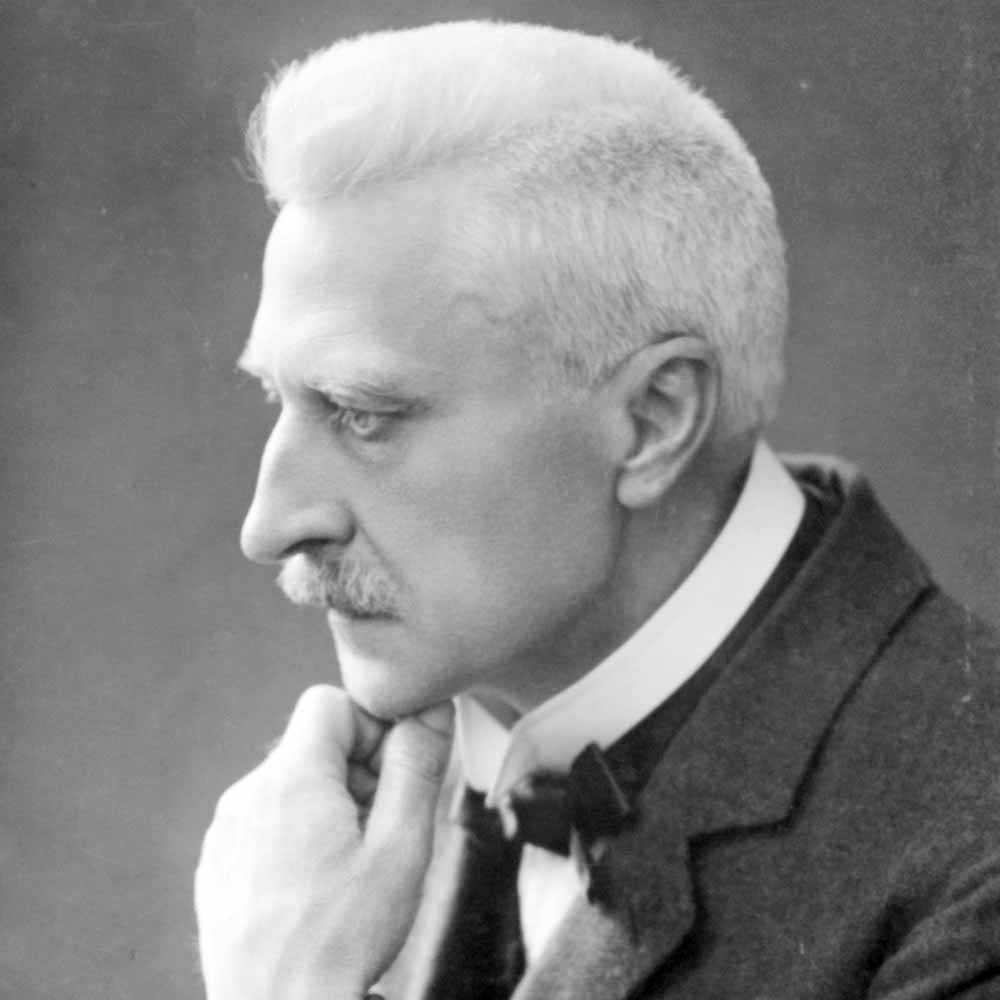
Rudolf Otto
I. Otto and the Numinous
Otto’s idea of the holy is predicated on the observation that the holy and the just are not synonymous. While every holy person is just, not every just person is holy. You might, for example, call Socrates just, and you might even call him pious, but would you ever call him holy? For Otto, the difference is that the holy person has an encounter with the “numinous,” a word he coins from a Latin word for divinity in general and divine will or sway in particular (numen). And the numinous object, Otto writes, is the “wholly other” that is experienced as a mysterium tremendum et fascinans, a formidable and fascinating mystery. [1]
Regarding the “formidable,” Otto has in mind the full range of meanings for tremendus, which, like its cognate tremor, means both fear and trembling (literally).
First, the mystery is tremendus because it contains an element of awefulness, a shuddering before God that is, paradoxically, a gift from God, for “the natural man is quite unable to shudder or feel horror in the real sense of the word.” [2]
Second, the mystery is tremendus because it contains an element of overpowering, or what the Romans called majestas. It is in the face of this Majesty that one feels a sense of one’s own miniscule creatureliness and utter dependence like never before.
Third, the mystery is tremendus because it contains an element of energy, which Otto compares to a sense of urgency and of divine wrath. In and of Himself, God is beyond emotion, but as we experience Him, the living God is a jealous God, filled with passion and power. Otto quotes with approval a line from an unnamed mystic: “Love is nothing else than quenched Wrath.” [3]
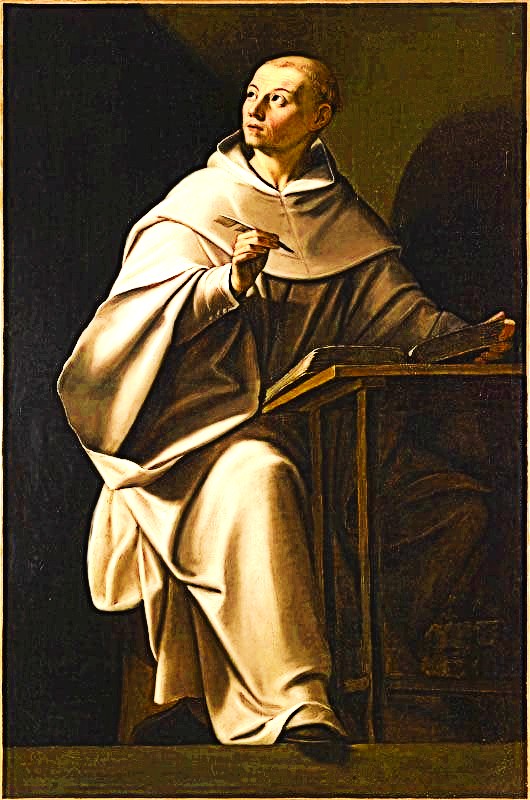
St. Bernard of Clairvaux
This tremendous mystery is also fascinans—in fact, it is “uniquely attractive and fascinating.” [4] This aspect of the mystery explains the “moment of rapture that breathes in our tenderest and most heart-felt hymns of salvation,” such as the poetic compositions of St. Bernard of Clairvaux. “Mere love” and “mere trust,” Otto contends, do not account for the ecstasies that a Saint experiences in his intimate encounters with the numinous. [5]
And the numinous can generate a variety of feelings:
The feeling of it may at times come sweeping like a gentle tide pervading the mind with a tranquil mood of deepest worship. It may pass over into a more set and lasting attitude of the soul, continuing, as it were, thrillingly vibrant and resonant, until at last it dies away and the soul resumes its “profane,” non-religious mood of everyday experience. [...] It has its crude, barbaric antecedents and early manifestations, and again it may be developed into something beautiful and pure and glorious. It may become the hushed, trembling, and speechless humility of the creature in the presence of—whom or what? In the presence of that which is a Mystery inexpressible and above all creatures. [6]
Perhaps the clearest commentator on Otto’s work is C.S. Lewis, who builds up to a sense of the numinous with the help of a mental exercise. Lewis asks us to imagine someone coming in and saying that there is a tiger in the next room. Aware of the danger, we would probably experience fear. Now imagine someone saying that there is a ghost in the next room and that we believe it. Lewis conjectures that we would experience a special kind of fear called Dread, which puts us at the “fringes of the Numinous.” Finally, imagine someone saying, “There is a mighty spirit in the room,” and that we believe it. Lewis opines:
Your feelings would then be even less like the mere fear of danger: but the disturbance would be profound. You would feel wonder and a certain shrinking—a sense of inadequacy to cope with such a visitant and of prostration before it—an emotion which might be expressed in Shakespeare’s words “Under it my genius is rebuked.” This feeling may be described as awe, and the object which excites it as the Numinous. [7]
II. The Numinous in Eucharistic Liturgy
Otto’s Idea of the Holy contains an appendix entitled “The Numinous in Poetry, Hymn, and Liturgy,” but it is a treacly collection of passages from the Bhagavad-Gita and Protestant hymnists. Still, we can at least credit him for thinking about liturgy when thinking about the numinous; for a truly sacred liturgy facilitates the greatest of encounters with the numinous, as is witnessed by the Saints who experienced ecstasies while celebrating or assisting at Mass.
Our own argument is simple:
The Mass, as consistently affirmed by the Magisterium from time immemorial to the present day, is the unbloody re-presencing of the death of the Son of God on the cross as well as His Resurrection and Ascension. [8]
This Paschal mystery that is being represenced is truly a mysterium tremendum et fascinans. For how can the Passion, Death, Resurrection, and Ascension of Jesus Christ be deemed otherwise?
Therefore, the Mass should do everything it can to foster an encounter with the numinous through its rites.
Certainly, the Mass was experienced as numinous from an early age. Consider the following passages from the Patristic era:
In a sermon, St. Augustine admonishes:
Approach the partaking of this altar with fear and trembling (see Phil. 2, 12-13). Recognize in the bread that which hung on the cross, in the chalice that which flowed from his side. [9]
In his poem On Faith, Isaac of Antioch (ca. 450) writes:
I saw the mixed vessel of faith, which was filled with blood instead of wine; and instead of bread the slain body was placed upon the table. I saw the blood and shuddered; the sacrificed body and terror seized me. [10]
St. Cyril of Jerusalem calls the Mass “a holy and tremendous Sacrifice” and “a holy mystery”; similarly, he calls the time of Sacrifice “a sublimely dread hour.” [11]
Finally, the Liturgy of St. James includes the admonition:
Let all mortal flesh be silent, standing there in fear and trembling, let all things of earth vanish from our thoughts; for the King of kings, the Lord of lords, Christ our God, is about to be sacrificed and to be given as food to the faithful. Before Him choirs of angels go, clothed with power and dominion, with faces veiled, chanting the hymn, Alleluia. [12]
Such is the numinous in the Eucharistic liturgy, according to the Fathers. Next week, we shall how this principle is instantiated in the classical Roman Rite.
This essay appeared in The Latin Mass magazine 35:2 (Summer 2026), pp. 34-38. Many thanks to its editors for allowing its publication here.
Notes
[1] The Idea of the Holy (Martino Fine Books, 2010), 25-30.
[2] Otto, 15.
[3] Otto, 24.
[4] Otto, 31.
[5] Otto, 34.
[6] Otto, 12-13.
[7] C.S. Lewis, The Problem of Pain (Zondervan, 2001), 5-6.
[8] See Catechism of the Catholic Church 1354.
[9] Sermon Denis 3.
[10] Cited in Nicholas Gihr, The Holy Sacrifice of the Mass Dogmatically, Liturgically and Ascetically Explained (Herder, 1902), 104.
[11] Cited in Gihr, 105.
[12] Cited in Gihr, 111.