
Because the Church has such a glorious history of early martyrs (think of St. Stephen being stoned or St. Lawrence being roasted alive on a gridiron), it is easy to forget that the twentieth century produced the most martyrs – in fact, more than all other centuries combined. During that bloody period, approximately one million Catholics were killed for their faith on every continent except Antarctica and Australia.
That includes Europe, once the cradle of Western Christianity, and Spain, once a stronghold of Catholicism. From 1936 to 1939 the Spanish Civil War split the country apart, pitting “Republicans” (communists and anarchists backed by the Soviet Union) against “Nationalists” (fascists backed by Nazi Germany and Italy). Every region controlled by the Republicans became home to the Red Terror, a communist persecution of the Church. In addition to acts of arson and desecration against Catholic property, the Red Terror took tens of thousands of lives, including 6,832 Catholic priests.
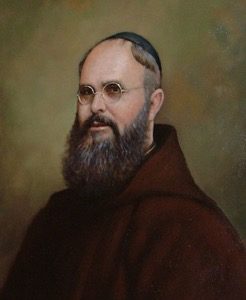
Caught up in this nightmare was Blessed Joaquín de Albocácer (1879-1936), whose feast day we celebrate tomorrow on September 26, along with other Capuchin martyrs of his community. Born José Ferrer Adell at Albocácer in the province of Castellón de la Plana, the young man received the Capuchin habit in 1896 and was ordained a priest in 1903. The Capuchins, or Order of Friars Minor Capuchin, are a branch of Franciscans that were founded in 1525 in order to return to a stricter observance of St. Francis’ Rule. (Their most famous member is Padre Pio.)
José took as his religious name Joaquín or Joachim, the grandfather of Our Lord Jesus Christ. Ten years after his ordination, Father Joaquín was sent to Columbia as a missionary, and in 1925 he was appointed Superior Regular of the Custody of Bogotá. After completing his service and returning to Spain, he was appointed director of the Seraphic Seminary at Massamagrell in Valencia.
Father Joaquín made an excellent rector. “He was tireless in his work and in his teaching the students, and he treated them as a good father,” recalls Brother Antonio Sales. “He was a mystical person. He was kind in his dealings with everyone.” One biographer describes Father Joaquín having a Eucharistic soul, so deep was his devotion to the Holy Eucharist. The magazine that he founded, Vita eucaristica, certainly reflected that fact, as the title would suggest.
When persecution broke out, Joaquín made sure that his seminarians found a safe place to hide. He himself took refuge in the family home of a fellow Capuchin in Valencia. The holy rector kept in touch his seminarians and devoted himself to prayer.
On August 30, 1936, the Republican militia captured Father Joaquín. Witnesses report that he showed great humility and docility. He was taken back to Albocácer where he was reunited with other members of his family. “If we do not see one another on earth,” he told them, “I will see you in glory.” Joaquín was brought before the president of the Committee of Rafelbuñol at ten in the morning. During his few hours in prison, he encouraged and helped his cellmates. At four o’clock in the afternoon the holy man was taken by car to the nearby town of Villafamés where he was killed. He was buried in the local cemetery, but his remains have never been recovered.
In 2001, Pope St. John Paul II beatified the “233 Spanish Martyrs,” the largest number of persons beatified at once up to that time. (That number would be surpassed when Pope Benedict XVI beatified the “498 Spanish Martyrs” in 2007 and again when Pope Francis beatified the “522 Spanish martyrs” in 2013.) Most of the 233 Spanish martyrs served and died in the diocese of Valencia, and among them was Father Joaquín de Albocácer.




