In the Ambrosian liturgy, Advent begins on the Sunday after the feast of St Martin on November 11th, making today the Second Sunday. Last week, for the First Sunday, Vespers were sung at the church of Santa Maria della Consolazione, the home of the traditional form of the rite in Milan, and as usual, our long-time contributor Nicola de’ Grandi served as the master of ceremonies. We are happy to share this video, with an explanation of the various parts, and the proper texts given below. (The video is a little wonky for a couple of minutes at the beginning, but then straightens out.)
It should be noted first that in the Ambrosian Office, almost every new feature, not just the prayers, is introduced by “Dominus vobiscum”, said by the celebrant standing before the altar; I will leave this out of the description. “Oremus” is not said before the prayers of either the Office or the Mass. (There are two exceptions at Lauds.) At Sunday Vespers of Advent in the Roman Rite, all the antiphons, the chapter and the prayer are proper to the individual Sunday, while the hymn and versicle are proper to the season. The Ambrosian counterpart, on the other hand, has a good number of things which are the same as on the Sundays per annum, and not proper to the season.
9b. Completorium I (36:04 – 37:04) Regnum tuum, Dómine, * Hallelujah, et dominatio tua in omni generatióne et progenie. Hallelujah, hallelujah. (Ps. 144 Thy kingdom, o Lord, alleluia, and Thy rule are unto every generation and descent, alleluia, alleluia.)
1. the Lucernarium, a responsorial chant, so called because originally, the lights of the church were lit while it was sung. (1:15 – 2:45) Quoniam tu illúminas lucernam meam, Dómine, * Deus meus, illúmina ténebras meas. V. Quoniam in te eripiar a tentatióne. Deus meus, illúmina ténebras meas. Quoniam tu illúminas... (Ps. 17 Because thou dost enlighten my lantern, o Lord, * o my God, enlighten my darkness. Because in Thee I shall be delivered from temptation, * o my God... Because thou dost enlighten...)
2. the antiphon ‘in choro’, so called because it was originally sung by the clergy standing around the seat of the celebrant. (2:50 – 3:25) Laudáte Dóminum, quoniam bonus est psalmus, hallelujah, hallelujah. (Ps. 146 Praise ye the Lord, for the psalm is good, alleluia.)
 |
| A photo taken in the Duomo on the feast of the Epiphany during the chanting of this antiphon, back in the day; colorized by Nicola. |
3. the hymn for Advent Conditor alme siderum, which has the same text as the pre-Urban VIII Roman version, but somewhat different music. (3:28 – 5:45)
4. the responsory ‘in choro’ (5:49 – 7:45) In quacumque die invocávero te, * velóciter exaudi me, Dómine. V. Ne avertas faciem tuam a púero tuo, quoniam tríbulor, velóciter exaudi me, Dómine. (Ps. 101 and 68 On whatever day I call upon Thee, swiftly hear me, o Lord. V. Turn not Thy face away from Thy servant, for I am troubled; swiftly hear me, o Lord.)
5. the psalmody (8:08 – 23:35) The psalms are the same as in the Roman Rite, 109-113, but the text is an Old Latin version, rather than St Jerome’s revision found in the Vulgate and the Roman Office; the differences between them are fairly minor. Some of the antiphons and all of the music are different. The antiphons are the same as those sung per annum; when psalms are sung in sequence, the last antiphon has three Kyrie eleisons added at the end. In the Ambrosian Office, the psalms are sung with no mediant, and the antiphons are always semi-doubled, apart from a handful of special exceptions.
6. the first prayer, said by the celebrant standing before the altar; Sunday Vespers typically has five prayers. (23:45 – 24:28) Deus, qui in Unigénito tuo novam creatúram nos tibi esse fecisti, réspice propitius in ópera misericordiae tuae: et in ejus adventu ab ómnibus nos máculis vetustátis emunda. Per eundem Dóminum nostrum... (O God, who in Thy only-begotten Son hast caused us to be a new creature unto Thee; look graciously upon the works of Thy mercy, and in His coming, cleanse us from all the stains of oldness. Through the same our Lord...)
7. the Magnificat with its antiphon, which is not intoned by the celebrant. (24:29 – 30:05) Anima mea, magnífica Deum, quia respexit humilitátem meam. Kyrie, eleison. 3x. (My soul, magnify God, for He hath regarded my low estate.)
While it is sung, two of the acolytes fold the vesperal on the altar back, and lay their candles on the front corners of the mensa. The celebrant imposes and blesses incense, kneels and incenses the tabernacle, then rises and incenses first the cross and then the altar. An Ambrosian thurible has no cover, and is swung in circles; as the celebrant passes it over the mensa, the acolytes take the candles out of its way. When he has finished, an acolyte takes the thurible and incenses behind the altar, walking with the boat-bearer. (In the more solemn form of Vespers, the celebrant is assisted by a deacon and subdeacon, and this part of the incensation is done by former, as also at a solemn Mass.)
The thurible is then taken by the master of ceremonies, who incenses the celebrant, the attendant clergy, and the faithful. As in the Roman Rite, Gloria Patri and the repetition of the antiphon are only sung after the incensation is complete; the words Magnificat anima mea Dominum are repeated before the antiphon. (The same is done with the first verse of the Nunc dimittis at Compline, but not with the Benedictus at Lauds.)
8. the second prayer (30:10 – 30:44) Excita potentiam tuam, Deus, et veni: ut hi qui in tua pietáte confídunt, ab omni inimíci adversitáte liberentur. Qui vivis... (Stir up Thy power, o God, and come; that they who trust in Thy mercy may be delivered from every adversity of the enemy. Who livest...)
9a. the first psallenda, a processional chant, sung with just the doxology and then repeated. (30:45 – 32:12) Qui emittit eloquium suum terrae, velóciter currit sermo ejus. (Ps. 147 Who sends forth his speech to the earth, swiftly runs his word.)
⸻
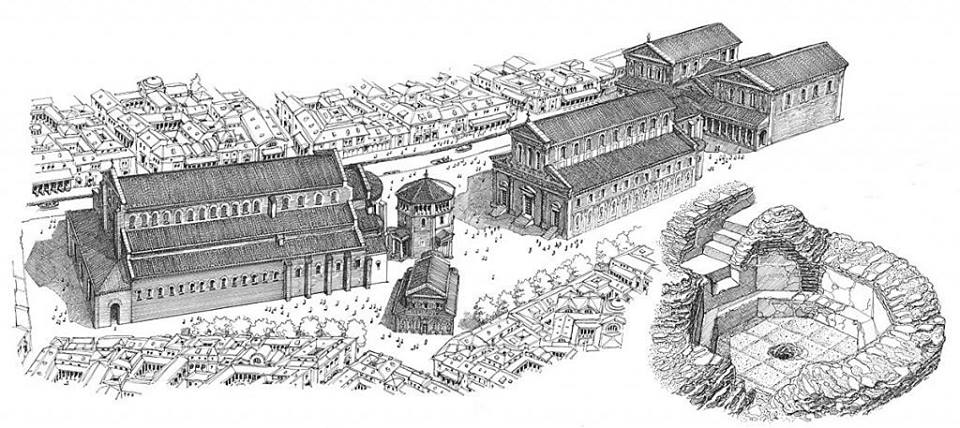 |
| A reconstruction of the ancient cathedral complex of Milan, with the summer church of St Thecla on the left, and the winter church of the Virgin Mary at the right. The octagonal structure in front of St Thecla is the baptistery of St John; the smaller structure beneath it is the baptistery of St Stephen. At the lower right is a partial reconstruction of the interior of the baptistery of St John. |
On the Sundays from First Advent to the First after Epiphany, and from Septuagesima to Easter, this chant was originally sung during a procession from the cathedral to the baptistery of St John, where another responsory and another prayer were sung.
I. the responsory in the baptistery (32:13 – 34:05) Pacem tuam da nobis, et pósside nos, Dómine, * quia praeter te alium nescímus. V. Dómine Deus noster, pacem tuam da nobis; omnia enim reddidisti nobis. Quia... (Grant us Thy peace, and have hold of us, o Lord, * for we know no other beside Thee. V. O Lord, our God, grant us Thy peace, for Thou has rendered all things to us. For we know...)
II. the third prayer (34:06 – 34:29) Festína, quáesumus, Dómine, ne tardáveris: ut et peccáta nostra déleas, et quae nobis sunt adversa depellas: Qui vivis. (Make haste, o Lord, we ask, and do not tarry; that Thou may cancel our sins, and drive away all things that oppose us: Who livest...)
The procession then went back to the cathedral, accompanied by the chant of an antiphon with only the first four verses of a psalm, in this case, Psalm 104.
III. the antiphon (34:30 – 36:00) Laetétur cor quaerentium Dóminum. (Let the heart of them that seek the Lord rejoice.)
⸻
When there is no such procession, the first psallenda is followed immediate by two chants called Completoria. These are the same on all Sundays, and intoned by the celebrant. When there is no procession to the baptistery, these forms a unit with the first psallenda, and I have numbered these elements accordingly. (Confusingly, ‘Completorium’ is also the Latin name for the hour of Compline.)9c. Completorium II (37:10 – 38:07) Benedictus es, Dómine, * Deus patrum nostrórum, et laudábilis, et gloriósus in sáecula. Kyrie, eleison, Kyrie, eleison, Kyrie, eleison. (Dan. 3 Blessed art Thou, o Lord, God of our fathers, and praiseworthy and glorious unto the ages.)
9d. the fourth prayer (38:08 – 38:32) Adjuva, quáesumus, Dómine, plebem tuam: et ad Nativitátem Unigéniti Filii tui tribue nos páriter perveníre gaudentes. Qui tecum. (Help Thy people, we ask, o Lord, and grant us likewise to come rejoicing to the birth of Thy only-begotten Son; Who lives...)
10a. the second psallenda (38:33 – 42:05) Sicut fulgur venit ab Oriente, et paret in occidentem, sic erit adventus Filii hóminis. Vigiláte omnes, et oráte; nescítis diem, neque horam, quando Dóminus noster sáeculi finem ponat. (Matt. 24, 27 & 25, 13 As the lightning bolt cometh from the East, and appeareth unto the West, so shall be the comingof the Son of man. All ye, keep watch and pray; ye know not the day nor the hour, when our Lord shall put an end to the age. - This is taken partially from the Gospel of the day’s Mass, Matt. 24, 1-42, and partly from the Gospel of the wise and foolish virgins, 25, 1-13)
10b. Completorium I (42:10 – 42:33) Quoniam tu illúminas * lucernam meam, Dómine, Deus meus, illúmina ténebras meas. (Ps. 17, the same text as the lucernarium Because thou dost enlighten my lantern, o Lord, * o my God, enlighten my darkness.)
10c. Completorium II (42:37 – 43:07) Benedictus es, Domine... (the same as above, but with simpler music)
10d. the fourth prayer (43:08 – 43:33) Redemptor noster, áspice, Deus, et veni ad liberandum nos de profundo iniquitátis: et dona Ecclesiae tuae perpetuam tranquillitátem et pacem. Qui vivis. (Look down, o our Redeemer and God, and grant to Thy Church everlasting tranquility and peace. Who livest...)




