
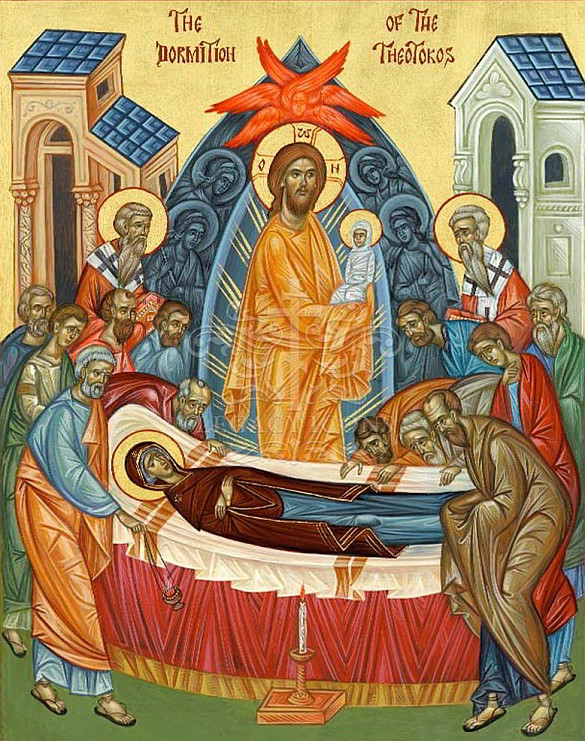
In a previous post, we described the 1951 changes to the Propers for the feast of the Assumption of the Blessed Virgin Mary. Here, we return to the 1570 Roman Missal and its implicit endorsement of the Eastern tradition that Our Lady “fell asleep in the Lord” before being assumed body and soul into Heaven. We also coordinate this belief with the devotions to Our Lady in the city of Jerusalem.
The 1570 Secret, variations of which can be traced back to the fifteenth and possibly twelfth century, states:
Subveniat, Dómine, plebi tuae Dei Genitrícis oratio: quam etsi pro conditióne carnis migrasse cognóscimus, in caelésti gloria apud te pro nobis intercédere sentiámus. Per Dóminum.
Which I translate as:
May the prayer of the Mother of God assist Thy people, O Lord: although we know that she passed according to the condition of the flesh, may we nevertheless feel her interceding for us in heavenly glory. Through Our Lord.
And for those who think that “passing according to the condition of the flesh” is not explicit enough, we turn to another ancient prayer that appears in the late eighth-century Gregorian Sacramentary, and is still used as the Collect for the feast in the Dominican Rite:
Veneranda nobis, Dómine, hujus diei festívitas opem cónferat salutárem; in qua sancta Dei Génitrix mortem subiit temporálem, nec tamen mortis néxibus deprími pótuit, quae Filium tuum Dóminum nostrum de se genuit incarnátum. Qui tecum vivit et regnat.
Which I translate as:
May the venerable feast on this day, on which the holy Mother of God underwent temporal death (although she, who brought forth Thy incarnate Son Our Lord, could not be shackled by death’s bonds), bring us salvific assistance. Who liveth and reigneth with Thee.
In Jerusalem, Dormition Abbey marks the spot where our Lady fell asleep in the Lord. The abbey is located on Mount Zion, where according to tradition Our Lady and St. John took up lodgings after the first Pentecost. It was built in the early twentieth century and is now staffed by German Benedictines.


The crypt of the Abbey, where Our Lady fell asleep in the Lord
In Jerusalem, it was not permissible for the remains of a deceased person to remain in the city over night, and so it is believed that Our Lady’s body was transferred outside the city to a cemetery near the Mount of Olives, on the other side of town. The church built over her grave, called the Tomb of the Virgin or Church of the Sepulchre of Saint Mary, is one of the nine churches in the Holy City that is part of the Status Quo, a 250-year-old understanding between religious communities brokered by Ottoman sultan Osman III in 1757. Although the Catholic Church is part of that agreement, the church is unmistakably Greek Orthodox in design and decoration. The church is inconspicuous from the outside and involves a series of descents, both exteriorly and interiorly. It is the only church I have been in that goes down rather than up.


To access Our Lady’s final – or almost final – resting place, one must bow down low through the entrance to the right of the altar. There one will find a rough stone less than six feet long.

Both East and West have versions of a story in which all of the Apostles except Saint Thomas were miraculously transported from all over the world to be present at Mary’s death, and that they remained at her tomb for three days. On the third day, Saint Thomas arrived and asked “to worship the Tabernacle of God,” that is, the body of the Blessed Virgin. When they opened the coffin, they were greeted by only her burial wrappings and an incredible fragrance (some versions of the story describe lilies in the tomb). The Byzantine icon of the Dormition (see the first image of this post) captures most of these details, including a beautiful image of Christ holding in His arms the soul of His mother prior to the reunion of her body and soul and heavenly assumption, the way that she held Him when He was a baby.




