
 |
| Van Gogh, Woman on Her Deathbed |
Lost in Translation #157
For those who think of Saint Francis of Assisi as nothing more than a Christian Dr. Doolittle, a friar who talks to the animals and hugs tree, the following stanzas of the Canticle of the Sun come as something of a shock:
Laudato si, mi Signore, per quelli ke perdonano per lo Tuo amore et sostengono infirmitate et tribulatione.
Beati quelli ke ’l sosterranno in pace,ka da Te, Altissimo, sirano incoronati.
Laudato si mi Signore, per sora nostra Morte corporale,da la quale nullu homo uiuente pò skappare:guai a quelli ke morrano ne le peccata mortali;beati quelli ke trouarà ne le Tue sanctissime uoluntati,ka la morte secunda no ’l farrà male.
Which I translate as:
Praised be You, my Lord, through those who give pardon for Your love,and bear infirmity and tribulation.
Blessed are those who endure in peacefor by You, Most High, they shall be crowned.
Praised be You, my Lord, through our Sister Bodily Death,from whom no living man can escape.Woe to those who die in mortal sin.Blessed are those who will find Your most holy will,for the second death shall do them no harm.
The first stanza praises God for giving people the grace to forgive and to bear infirmity and tribulation. The second stanza contains the only “Beatitude” in the canticle, that is, a statement beginning with “Blessed are…” In this case, Francis proclaims that those who endure in peace are blessed and will be crowned by the Most High.
These two stanzas are distinctive in that they do not praise suffering directly but praise those who respond to suffering in the right way. It is an obvious fact that every human being suffers during his or her life, for the Lord “maketh His sun to rise upon the good and bad, and raineth upon the just and the unjust” (Matt. 5, 45). Even those who do not deserve to suffer, such as Our Lord and Our Lady, suffered greatly. The key is how one responds to suffering: in a spirit of acceptance and forgiveness or in a spirit of denial, anger, or despair. And the model for the right kind of response is Saint Francis. When he wrote these stanzas, Francis was in great pain, was going blind, and was living in a hut infested with mice that kept him awake at night. But thanks to a consolation from God, he learned to rejoice in all his troubles.
Even more astonishingly, Francis learned to embrace bodily death like a sister, which is why he wrote the stanza on death as he lay dying. The Saint understood that thanks to Jesus Christ, bodily “death is swallowed up in victory” and has no victory anymore, no sting (see I Cor. 15, 54-55). For as St. Paul explains:
The dead shall rise again incorruptible, and we shall be changed. For this corruptible must put on incorruption, and this mortal must put on immortality (I Cor. 15, 52-53).
In other words, bodily death—probably the greatest natural fear in the human heart and certainly the one thing that modern man goes out of his way to avoid through medication, diet, and exercise—becomes nothing against the backdrop of eternal life. “And fear ye not them that kill the body and are not able to kill the soul,” Our Lord commands, “but rather fear him that can destroy both soul and body in Hell” (Matt. 10, 2). Moreover, bodily death is nothing in comparison to the greatest evil of all: eternal death or eternal damnation. Saint Francis was poignantly aware of this fact, which is why he adds the only warning in the canticle: “Woe to those who die in mortal sin.” Let us remember that it is called mortal sin because it is a sin that mortally wounds our chances of salvation, that kills our friendship with God. Woe indeed to those who die in such a state. Saint Francis said that he wrote Canticle of the Sun to edify his neighbor, and this section is a key part of that edification.
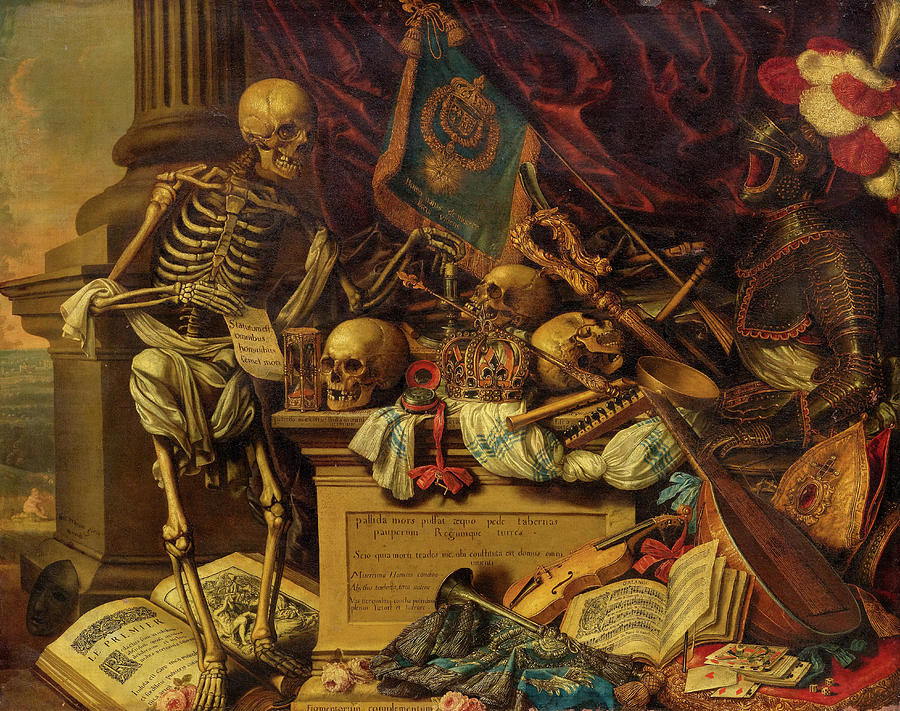
Memento Mori
This article originally appeared as “Eternal Crown” in the Messenger of Saint Anthony 127:11, international edition (November 2025), p. 33. Many thanks to its editors for allowing its publication here.




