
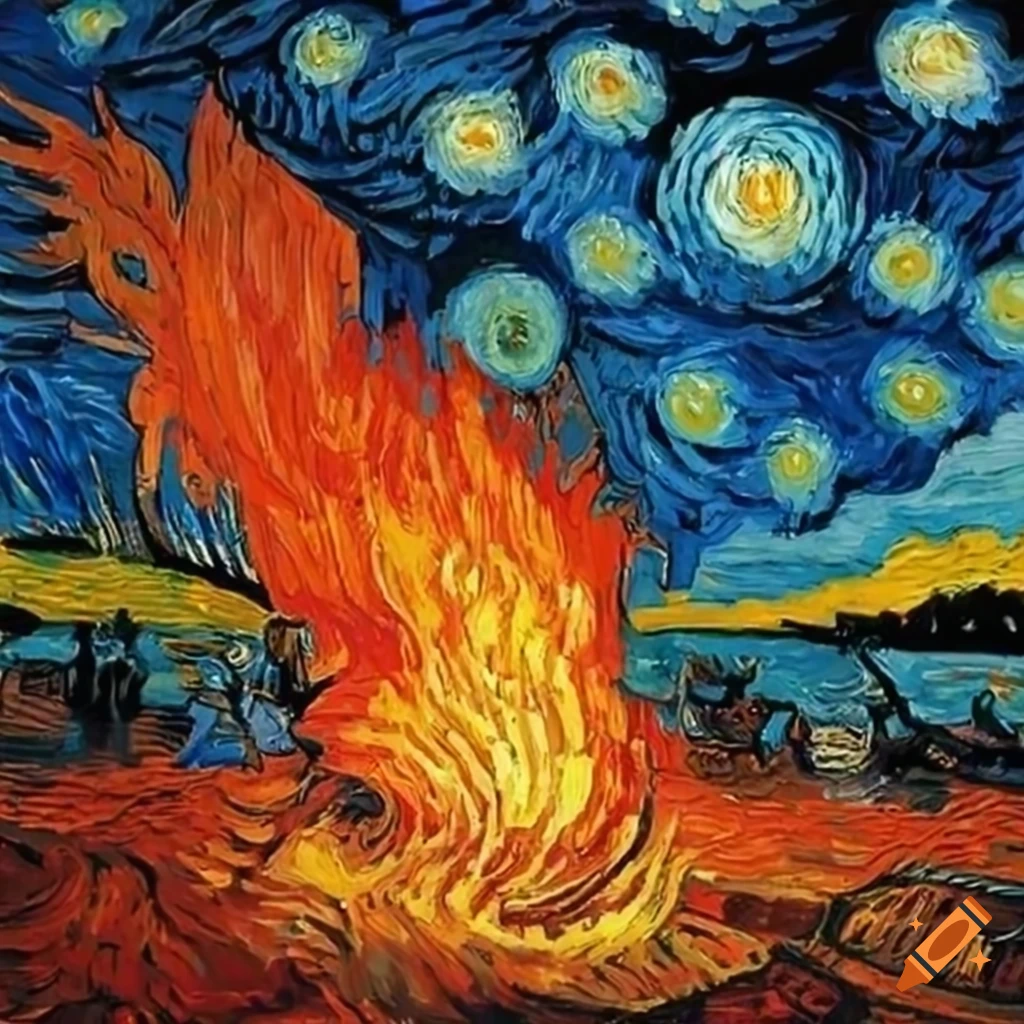
Van Gogh-inspired rendition of fire
Lost in Translation #155
In his Canticle of the Sun, Saint Francis of Assisi has this to say about fire:
Laudato si, mi Signore, per frate Focu,per lo quale ennallumini la nocte:ed ello è bello et iucundo et robustoso et forte.
Which I translate as:
Praised be You, my Lord, through Brother Fire,through whom you light the night and he is beautifuland playful and robust and strong.
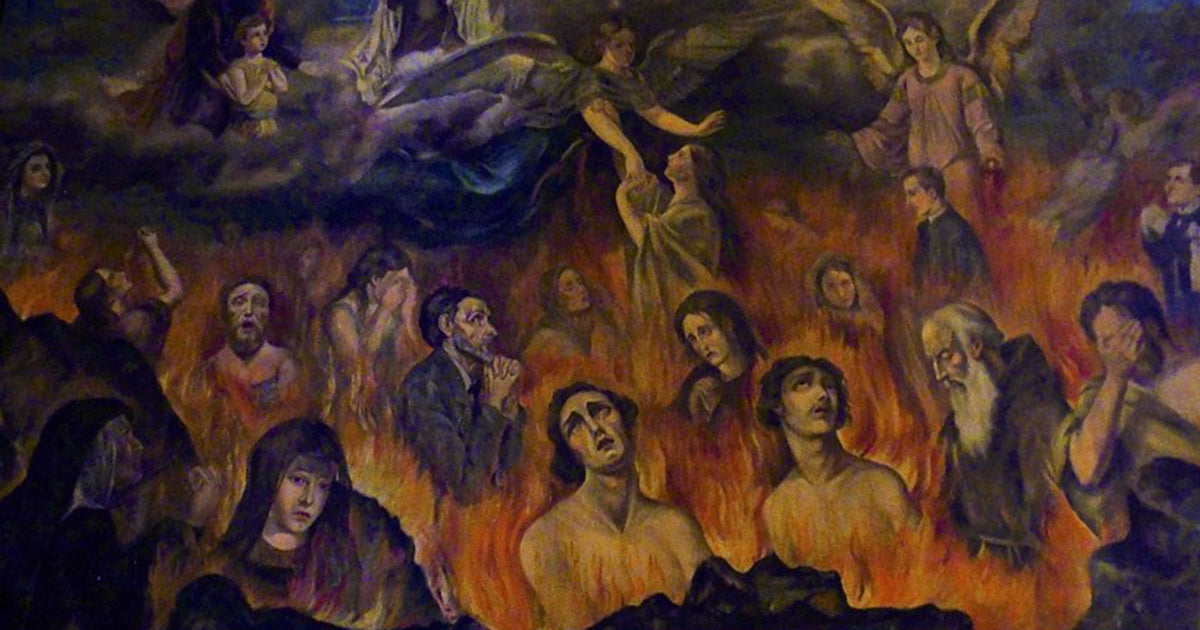
In the natural world, fire can be a destructive force, obliterating neighborhoods and forests. In the Catholic imagination, fire often represents bad things, such as the vices that burn within our souls. And of course, both eternal punishment and temporal punishment in the afterlife are described in terms of fire: the everlasting inferno of Hell and the refiner’s fire that is Purgatory.
On the other hand, the same Catholic imagination sees fire in a positive light. The Holy Spirit appeared as tongues of flame at the first Pentecost, setting the hearts of the disciples on fire with a love of God. There is an old blessing of fire that praises it for piercing the gloom of darkness. And the blessing of fire on Holy Saturday is an important prelude to the blessing of the Paschal Candle. It is also interesting that the Church insists that fire be present at every sacrifice of the Mass (in the form of lit candles) no matter how brightly lit the altar is.

Elijah calls down fire from Heaven
On a natural level, the management of fire is said to be one of the key elements in the development of our species, separating us decisively from the rest of the animal kingdom. That is certainly the point of the legend about Prometheus, who stole fire from the gods and gave it to man. Fire exponentially increases our (delicious) food options, keeps us warm, and brings us light.
Saint Francis chooses to look at the bright side of fire when he talks about his brother, describing him as beautiful and playful and robust and strong.
Fire can certainly be beautiful. Henry David Thoreau (1817-62) thought we were fools to move one of the most beautiful sights in the world—a living fire—from the fireplace to a furnace in the basement. And fire is also playful: after all, it dances. Finally, fire is robust and strong, especially with the right fuel like a nice, dry, crackling log.
There is a charming story regarding Saint Francis of Assisi and fire. Saint Clare had asked to dine with Saint Francis, and after saying no several times, he finally agreed at the urging of his disciples. Francis had the table set on the bare ground, which was his custom. The two saints sat down along with several of their companions. As the first course was being served, Francis began speaking of God so sweetly and profoundly that the entire group went into a rapture. Meanwhile, it appeared to the residents of Assisi that Francis’ church (St. Mary of the Angels) and the entire forest around it were on fire. Grabbing their extinguishers and what not, they raced to where the group was dining, only to find them safe and sound, rapt in contemplation. According to the collection of stories known as the Little Flowers: “Then they knew for sure that it had been a heavenly and not a material fire that God had miraculously shown them to symbolize the fire of divine love which was burning in the souls of those holy friars and nuns.” Happy and relieved, they withdrew.
The ecstasy of Francis and his companions lasted a long time, and when it was over, all were so refreshed by spiritual food that none of them had a bite of their actual meal.
This article originally appeared in the Messenger of St. Anthony 127:9, international edition (September 2025), p. 15. Many thanks to its editors for allowing its publication here.




