
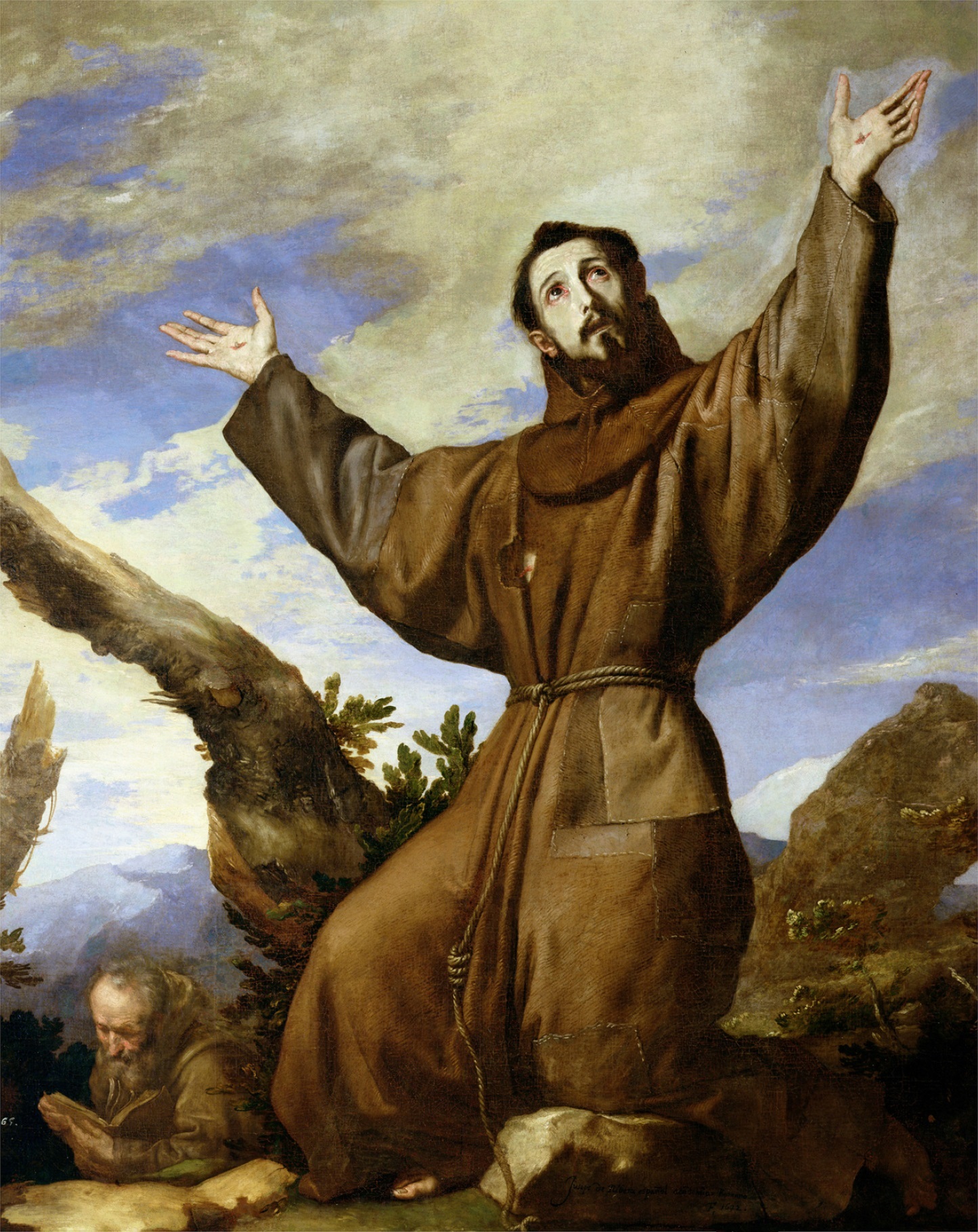
Jusepe de Ribera, Saint Francis of Assisi
Lost in Translation #158
Saint Francis ends his Canticle of the Sun with this one-verse stanza:
Laudate et benedicete mi Signore et rengratiatee seruiteli cum grande humilitate.
Which I translate as:
Praise and bless my Lord, and give Him thanksAnd serve Him with great humility.
The verse is an apt summary of the canticle, which is not, as is often thought, a praise of nature. In fact, as the Dutch Franciscan Jan van den Eijnden points out, it is not about nature at all, but about creation, the difference being that you can think about nature without thinking about God, but you cannot think about creation without thinking about the Creator. Francis is not a lover of nature but of creation, and he loves it not for its own sake but because it is the product of his loving Father.
And so, the point of the Canticle of the Sun is to praise and bless God the Creator, and to encourage its reader to serve God with humility. In this respect, the Canticle is identical to several Psalms (148 comes to mind) and the Canticle of the Three Youths in Daniel 3, 56-88. What is distinctive about Francis’ canticle is that it never addresses creation directly but repeatedly tells God that He should be praised through this or that creature. The Old Testament canticles, by contrast, command a list of creatures to praise and bless the Lord, to join together in a cosmic act of worship.
Nor is the content of the canticle so much a radical departure from the Christian worldview as a particularly vivid expression of it. Catholic thought initially sounds like a contradiction, for it combines a contempt for the world with a care for creation. What is meant by “the world,” however, are the man-made values that give us false promises of happiness, promises that often lead to an exploitation of nature. Contempt for the world, then, actually fosters care for creation, which is seen as a duty of stewardship. And creation is valued because it is a divine sign that eloquently points to God.

Bacon, Hobbes, Locke, and Hume
Modernity, on the other hand, is the photographic negative of this Christian formula, encouraging a contempt for creation and a care for worldly success. Beginning in the sixteenth century, philosophers like Machiavelli and Hobbes portrayed nature as something that needed to be beaten into submission through technological domination. It was only a matter of time before the technology caught up with this ideology, leaving us the world in which we live today.
It was in response to this situation that Pope Francis wrote his encyclical on the environment, Laudato Si’. The title is taken from a recurring phrase in Francis’ Canticle of the Sun (laudato si’ means “praised be”), and since Saint Francis wrote in the Umbrian dialect of Italian, the encyclical holds the distinction of being the only one that does not have a Latin title. But comparing the two compositions is a game of apples and oranges, for the goals of each are different. Pope Francis’ encyclical is diatribic in tone and consists largely of socio-political criticisms, such as a condemnation of “disposable culture” and the use of air conditioning. The Canticle of the Sun, on the other hand, is laudatory in tone and was intended by Saint Francis to praise God, console himself, and edify his neighbor about his eternal destiny. And the Saint succeeded. For centuries, the Canticle of the Sun has inspired the Franciscan community of friars and sisters and Third-Order members to be good stewards of creation as an act of divine praise, and it has helped them serve the Lord with great humility and die in a state of grace.
This article originally appeared as “Call to Humility” in the Messenger of St. Anthony 127:12, international edition (December 2025), p. 15. Many thanks to its editors for allowing its publication here.




