The joint commemoration of the Apostles Peter and Paul is one of the most ancient customs of the Roman Church, attested already in the oldest surviving Roman liturgical calendar, the Depositio martyrum, written in 336 A.D. A verse of the hymn Apostolorum passio, agreed by most authorities to be an authentic work of St Ambrose († 397), and still used in the Ambrosian liturgy, says that “the thick crowds make their way through the circuit of so great a city; the feast of the sacred martyrs is celebrated on three streets.” These “three streets” are the via Cornelia, the main street running up to and over the Vatican hill; the via Ostiensis, where the burial and church of St Paul are; and the via Appia, on which sits the cemetery “in Catacumbas”.
This last is the ancient Christian cemetery now called the Catacomb of St Sebastian; the word “catacomb” was in fact originally the name of the site of this cemetery specifically, and only later came to be used as a generic term for ancient subterranean Christian burial grounds. The basilica over the cemetery, now also entitled to St Sebastian, was originally known as the “Basilica Apostolorum”, in memory of a tradition that the bones of Peter and Paul were kept there for a time, probably to save them from destruction in the era of persecutions. This is referred to in various ancient sources, including the Depositio martyrum, and confirmed by modern archeological research. The celebration of the feast “on three streets” would refer then to a procession to visit the site of St Peter’s burial at the Vatican, that of St Paul on the via Ostiensis, and the cemetery where their remains were once kept.
The building of which this wall is a part was constructed over the Catacomb of St Sebastian about 250 A.D., and is covered with dozens of devotional graffiti like the one seen here. “Paule ed (et) Petre, petite pro Victore - Paul and Peter, pray (lit. ‘ask’) for Victor.”
The poet Prudentius, writing in the very early fifth century, calls the day “bifestum – a double feast”, and attests that on that day the Pope would say a Mass at the Basilica of St Peter, and then hasten to say another at St Paul’s. He does not refer to a visit to the Catacombs on the via Appia, but assuming this visit was made on the way back to the Papal residence at the Lateran, the total circuit is nearly nine-and-half miles, to be made at the height of the Italian summer. However, only seven years after Prudentius visited Rome in 403, the city was sacked by the Goths, then sacked again by the Vandals in 455; over the sixth and seventh centuries, it was largely reduced to ruins and depopulated by the long wars between the Goths and Byzantines, and the invasion of the Lombards.
It should not be surprising, then, that at a certain point the double feast was divided, and kept in a more manageable way as two separate feasts. In the Gelasian Sacramentary, we find three Masses of Ss Peter and Paul assigned to June 29th; the oldest copy of the Gelasianum dates to roughly 750, but much of the material is considerably older, some of it reaching back even to the days of St Leo the Great 300 years earlier. In some manuscripts, however, one of the three, “the proper Mass of St Paul”, has already been assigned to June 30th. In the Gregorian Sacramentary, written roughly a century later, we find the feast of St Peter on June 29th, and that of St Paul on the 30th; each Mass contains references to the other Apostle, but they are nevertheless clearly distinct. Thus, by the time of Charlemagne, the “bifestum” of Prudentius had already been separated into a two day feast.
At the traditional Mass of June 29th, the majority of the texts refer either to St Peter alone (Introit, Epistle, Alleluia, Gospel, Communion) or to Apostles generically, as in the Gradual “Thou shalt make them princes over all the earth.” The sole reference to St Paul is in the Collect, “O God, who hast consecrated this day by the martyrdom of Thy Apostles Peter and Paul, grant Thy Church to follow in all things the teaching of those through whom she first received the faith.” The Office is likewise dedicated almost entirely to St Peter, the notable exceptions being the hymns of Vespers and Lauds, and the antiphon of the Magnificat at Second Vespers. This latter is in both the structure of its text and in its Gregorian melody very similar to the Magnificat antiphon at Second Vespers of Pentecost, to indicate that the mission of the Holy Spirit is fulfilled in the lives and deaths of the Apostles, and thereafter in their successors.
Ant. Hodie * Simon Petrus ascendit crucis patibulum, alleluia: hodie clavicularius regni gaudens migravit ad Christum: hodie Paulus Apostolus, lumen orbis terrae inclinato capite pro Christi nomine martyrio coronatus est, alleluia.
On this day, Simon Peter ascended the gibbet of the cross, alleluia: on this day, he that beareth the keys of the kingdom of heaven passed rejoicing to Christ: on this day, Paul the Apostle, the light of the world, inclining his head, for the name of Christ was crowned with martyrdom, alleluia.
The following day, therefore, the whole of the liturgy is dedicated to St Paul, and is not called a day within the octave of the Apostles, but rather “the Commemoration of St Paul.” The variable texts of the Mass all refer to him, but a commemoration of St Peter is added to the feast, in accordance with the tradition that the two are never entirely separated in the veneration paid them by the Church. (The same is done on the feast of St Paul’s Conversion, and commemorations of him are added to the feasts of St Peter’s Chairs and Chains.) The Office is likewise dedicated entirely to him; both the Mass and Office, however, make use of St Paul’s own testimony in Galatians 2 to the mission of the two Apostles: “For he who worked in Peter for the apostleship of the circumcision, worked in me also among the gentiles; and they knew the grace of God that was given to me.” In the 1130s, a canon of St Peter’s Basilica named Benedict writes that it was still the custom in his time for the Pope to keep the feast of St Peter at the Vatican, but then celebrate Vespers at the tomb of St Paul in the great Basilica on the Ostian Way, “with all the choirs” of the city.
The apsidal mosaic of the St Paul’s Outside-the-Walls, executed in the 1220s, and heavily repaired after most of the ancient church was destroyed by fire in 1823. To the left of Christ are St Luke and St Paul, on the right St Peter and his brother St Andrew.
Originally, the Gospel for the feast was St Matthew 19, 27-29, and from this passage are taken the antiphon of the Benedictus and the Communion of the Mass. This same Gospel is used on several other feasts of Apostles, including the days within the octave of Ss Peter and Paul, and the feast of St Paul’s Conversion. It was changed in the Tridentine liturgical reform to St Matthew 10, 16-22, evidently because of the words “you shall be brought before governors, and before kings for my sake, for a testimony to them and to the gentiles,” an eminently appropriate choice for this feast. It is also used on the feast of St Barnabas, who, after Paul’s conversion, when the members of the Church feared that it was perhaps a ruse to further the persecution, “took him, and brought him to the Apostles, and told them how he had seen the Lord, and that he had spoken to him.” (Acts 9, 27) The Epistle of the Mass, Galatians 1, 11-20, has been added to the traditional readings for the vigil of Ss Peter and Paul as the Epistle of the vigil Mass in the new rite.
The Apostles Paul and Barnabas at Lystra (Acts 14, 5-18), by Jacob Jordaens, 1645; Akademie der bildenden Künste, Vienna
The liturgical tradition of Milan was not formed in reference to the Roman Basilicas and the tombs of the Apostles, and never adopted the Commemoration of St Paul. Both the Mass and Office of June 29th in the Ambrosian Rite give more space to St Peter, often referring to him without mentioning Paul, and elsewhere referring to them both, but never to Paul alone, with the sole exception of the Epistle of the Mass. The first reading is the same as that of the Roman Rite, Acts 12, 1-11, telling of the liberation of Peter from prison in Jerusalem; the Gospel is that of the Roman vigil, John 21, 15-19, in which Christ prophesies the manner of his death. The Epistle between them is the Roman Epistle of Sexagesima Sunday, on which the Roman Station is kept at the Basilica of St Paul. This is Saint Paul’s apologia for his status as an Apostle in Second Corinthians; the church of Milan adds two verses to the beginning of the longest Sunday Epistle of the year from the Roman lectionary. (2 Cor. 11, 16 – 12, 9) The Ambrosian Preface, however, beautifully redresses this imbalance.
Truly it is fitting and just, right and profitable to salvation to give Thee thanks always, here and everywhere, in honor of the Apostles Peter and Paul. Whom Thy election did so deign to consecrate, that it might change blessed Peter’s worldly trade as a fisherman into divine teaching; so that he might deliver the human race from the depths of hell with the nets of Thy precepts. And then Thou didst change the mind of his fellow Apostle Paul, along with his name; and whom the Church at first feared as a persecutor, She now rejoices to hold as the teacher of divine commandments. Paul was blinded that he might see; Peter denied, that he might believe. To the one Thou gave the keys of the kingdom of heaven, to the other, knowledge of the divine law, that he might call the nations; for the latter brought them in, as the other opened (the door of heaven). Therefore both received the rewards of eternal virtue.
In the Novus Ordo, the Commemoration of St Paul has been abolished, and the texts of both Mass and Office for June 29th rewritten to give equal space to both Apostles. So for example, of the two responsories in the Office of Readings, the first refers to Peter, and the second to Paul. (Inexplicably and unjustifiably, the Magnificat antiphon “Hodie” cited above was not retained.) June 30th is now the feast of the “Protomartyrs of the Roman Church”, the Christians whose martyrdom at the hands of the Emperor Nero is described in a famous passage of the Annals of Tacitus.
But all human efforts … did not banish the sinister belief that the conflagration (which destroyed much of Rome in July of 64 A.D.) was the result of an order. Consequently, to get rid of the report, Nero fastened the guilt and inflicted the most exquisite tortures on a class hated for their abominations, called Christians by the populace. Christus, from whom the name had its origin, suffered the extreme penalty during the reign of Tiberius at the hands of one of our procurators, Pontius Pilatus, and a most mischievous superstition, thus checked for the moment, again broke out not only in Judaea, the first source of the evil, but even in Rome, where all things hideous and shameful from every part of the world find their center and become popular. Accordingly, an arrest was first made of all who pleaded guilty; then, upon their information, an immense multitude was convicted, not so much of the crime of firing the city, as of hatred against mankind. Mockery of every sort was added to their deaths. Covered with the skins of beasts, they were torn by dogs and perished, or were nailed to crosses, or were doomed to the flames and burnt, to serve as a nightly illumination, when daylight had expired.
Nero offered his gardens for the spectacle, and was exhibiting a show in the circus, while he mingled with the people in the dress of a charioteer or stood aloft on a car. Hence, even for criminals who deserved extreme and exemplary punishment, there arose a feeling of compassion; for it was not, as it seemed, for the public good, but to glut one man’s cruelty, that they were being destroyed. (Book XV, chapter 44)
The Torches of Nero, by Henryk Siemiradzki, 1876
Despite the early and explicit attestation of this martyrdom by an historian with no bias in favor of the Christians, there is no historical tradition of devotion to this group of martyrs “whose number and names are known only to God”, as we read in Donald Attwater’s revision of Butler’s Lives of the Saints. A notice of them was added to the Roman Martyrology in the post-Tridentine revision of Cardinal Baronius, but their feast was not added to the calendar of the diocese of Rome until the early 20th century, by Pope Benedict XV.
The “circus” to which Tacitus refers as the site of the martyrdom was a chariot-racing facility that sat immediately to the south of the via Cornelia, next to where St Peter’s Basilica is today. It was allowed to fall to ruins after the death of Nero, and apparently razed to the ground by Constantine to make space for the original basilica. Left in place, however, was the Egyptian obelisk brought to Rome by Caligula, and set up on the “spine” of the circus, as the Romans called it, the wall down the middle around which the chariots raced. The turning posts on the end are called “metae” in Latin, and the apocryphal Acts of Peter, a work of the mid-2nd century, say that Peter was crucified “inter metas”; the obelisk, then, would have been among the last things St Peter saw in this world. After sitting next to the old Basilica for over 12 centuries, it was moved in 1586 to the area in front of the new church, then still under construction, later to be surrounded by Bernini’s Piazza. Its former location is marked by a plaque in the ground to the side of the modern basilica; the surrounding area was renamed by Benedict XV “Piazza of the First Martyrs of Rome.”
The Basilica of St Peter in 1450, according to the reconstruction of H.W. Brewer, 1891. The obelisk is seen immediately in front of the first rotunda on the left side of the basilica.
Gratias quam maximas refero Bono Homini, quo sagacior et diligentior consulendus non invenitur!
It has often seemed to me bizarre in the extreme that incense is so rarely encountered in so many Catholic churches. Incense appears everywhere in Scripture—in the law of Moses, in the books about Temple worship, in the Psalms where it serves as a primary symbol for prayers rising up to God, in the Gospel account of Zechariah, in scenes of heaven from both Testaments. The sweet-smelling smoke was always there in Hebrew worship and became even more prevalent in Christian worship, where, in contrast with the animal sacrifices of the old covenant, it fittingly represented the rational worship of a mind raised up to God in union with Christ, Himself the pleasing oblation par excellence. The importance of it is well captured by one of the antiphons for Lauds on the Solemnity of Corpus Christi, found in the Roman Breviary, the Monastic Office, and the modern Liturgy of the Hours: Sacerdotes sancti incensum et panes offerunt Deo, alleluia, "The holy priests offer incense and bread to God, alleluia."
And then there is the subjective experience of the worshiper. Every time incense is used at Mass, it just feels like Mass: something very special is happening here that no words or songs can convey by themselves, someone is present who deserves the treatment owed to a king or a god. The fragrance surrounds you, gets into your hair and your clothing, and pretty soon your field of vision is permeated with a hanging haze, which subconsciously says: You are in the midst of mysteries that cannot be clearly seen but must be worshiped on bended knee. When the embers are glowing well and the grains are heaped on with abandon, those clouds of incense make everything hazy, as if seen through a veil—a drifting image of the pilgrimage of the Christian’s life, as he passes through this vale of tears.
When visiting friends in Austria this past May, I was able to accompany one of them to the Kunsthistorisches Museum in Vienna, where I was dazzled by many great paintings. One room that surprised me was the Rubens room. I had developed a sort of prejudice against Rubens on account of the almost gushing fleshliness of his figures and the extravagant sensuality of his scenes. But this time, when I first walked in to the gallery, I saw from a distance how he softens all the hard edges and bathes the whole of his scenes in a kind of muted light. It looked like the scenes themselves, even the secular ones, had been enveloped in incense, made into an offering to God. It was Counter-Reformation theology in colors and shapes: the good creation of God, taken on by the Son of God in his wondrous Incarnation—matter and mankind assumed, healed, elevated, destined for immortality.
You’ll have to take my word for it or go to see the paintings yourself, because none of the reproductions available in books or online do justice to this very subtle lighting effect that I saw (or at least imagined I saw).
Years ago I read a magnificent commentary on the Song of Songs called The Cantata of Love. Its author, Blaise Arminjon, often speaks about the meaning of the “sensualism” of the text. At the time, I remember realizing with a pang that the antiphons and lections of the new Mass have been purged almost entirely not only of verses from the Song of Songs, but of the whole spiritual sensualism it conveys. The prayers, the sequence of readings, the gestures, were somehow diminished with the padding of orderliness and rational propriety. Little “warm touches” in the calendar, the kind of colorful riot of detail that Rubens exulted in—for example, the reading of the Gospel about faith moving mountains on the Feast of Gregory Thaumaturgas (November 18) because he was a saint famous for having literally moved a mountain, or the Offertory antiphon of the Mass for St. Rita (May 22) that applies to her husband and sons a verse from Genesis about three budding branches bringing forth grapes—were taken away. A whole intricate network of connections between antiphons, readings, orations, and the sacrifice itself seemed to disappear. The old crinkled map, marking groves, streams, ruins, and holloways, was replaced with a crisp new rational map showing motorways and their exits. All such “simplifications” had but one overall long-term effect: to cut the Mass off from the human heart, from culture, from the bodily world outside and the affective world inside.
In this Manichaean era of contempt for the flesh—contempt for historical embodiment, the authority of tradition, the law of nature and the narrative of grace—I say we need Rubens, and all that he represents, more than ever; we need the Song of Songs more than ever; we need the traditional Mass more than ever.
***
The crypt in the basilica of Norcia, birthplace of SS. Benedict & Scholastica
Not long after visiting the Kunsthistorisches Museum, I was in the little town of Norcia, a sort of Italian Nazareth—out of the way, rather insignificant in worldly terms. But there are the monks and their chanting of the divine praises night and day, and this makes Norcia, like Nazareth, a place from which a hidden power streams forth. In the crypt is found the rooms of the Roman house where, in a decrepit and decadent age, the future saints Benedict and Scholastica were born.
As I joined the monks in the basilica built over the crypt and heard the gentle modulations of their choral prayer, I also had the experience of, at certain moments, not knowing just what the monks were singing—and of not caring, because the soaring beauty of their songs, rising up to God like musical incense, carried me with them and lifted my heart to God. I had exactly the experience St. Thomas Aquinas mentions in an article of the Summa. To an objection that singing hinders praise both because it draws the attention of the singers to the music rather than the words and because it makes the words harder for other people to understand, he replies:
The soul is distracted from that which is sung by a chant that is employed for the purpose of giving pleasure. But if the singer chant for the sake of devotion, he pays more attention to what he says, both because he lingers more thereon, and because, as Augustine remarks, “each affection of our spirit, according to its variety, has its own appropriate measure in the voice and in singing, by some hidden correspondence wherewith it is stirred” (Confessions x, 33). The same applies to the hearers, for even if some of them understand not what is sung, yet they understand why it is sung, namely, for God’s glory; and this is enough to arouse their devotion.
My devotion was soaring even when my intellect had been left behind. Is that not, in a way, the lesson that incense teaches us—that there are things we can never understand, can never put into words, or even into music, and yet we must do something to reach up to them and connect ourselves with them? We burn something valuable and sweet-smelling. We send up our sighs with the smoke. Hidden correspondences are stirred up, affections aroused, a shapeless shape is given to devotion, and we quietly give way to God’s glory.
***
There is a poignant scene in Willa Cather’s Death Comes for the Archbishop where Bishop Latour hears the confession of an old beaten-up maidservant who has not been allowed by her Protestant employers to go into the church for nineteen years. When parting, the Bishop gives her a medal as a keepsake:
Happily Father Latour bethought him of a little silver medal, with a figure of the Virgin, he had in his pocket. He gave it to her, telling her that it had been blessed by the Holy Father himself. Now she would have a treasure to hide and guard, to adore while her watchers slept. Ah, he thought, for one who cannot read—or think—the Image, the physical form of Love!
“The Image, the physical form of Love.” On Sundays in Norcia, many local people come to the basilica for Vespers and Benediction. I, too, have attended, and have been moved to the depths of my soul by what I have witnessed; I have seen how attentive and quiet the people are, gazing intently upon the Blessed Sacrament. There are doubtless not a few who cannot understand the Latin or think “high” theological thoughts—but the majesty and mystery of the reality of God is powerfully evident to them in a way that no amount of discourse in their own language about the Faith could have produced, and in a way that exceeds the finest flights of intellect. We are immersed in the very activity that the arch-rationalist Georg Wilhelm Friedrich Hegel dismisses as “the unhappy consciousness”:
[I]t is only a movement towards thinking, and so is devotion. Its thinking as such is no more than the chaotic jingling of bells, or a mist of warm incense, a musical thinking that does not get as far as the Notion, which would be the sole, immanent objective mode of thought. . . . What we have here, then, is the inward movement of the pure heart which feels itself, but itself as agonizingly self-divided, the movement of an infinite yearning . . . . At the same time, however, this essence is the unattainable beyond which, in being laid hold of, flees, or rather has already flown. (Phenomenology of Spirit, §217)
Unlike Hegel and his latter-day rationalist disciples, Catholics have not forgotten that symbolic actions and ancient melodies are a language of their own, with a power to touch the soul immediately, at a level far beyond words. Not everything has to be explained; not everything admits of explanation; and words, after a point, are boring. The deeper need is to see the beautiful and to hear the beautiful: these remind me of Him whom my soul loves. For Him, I long with an infinite yearning, and yet I know He is attainable. The incense flees and has already flown, like my soul, to God, who is not some abstract Notion, but our Father in heaven.
Peter Paul Rubens (1557-1640), The Miracles of St. Ignatius of Loyola (ca. 1617)
Kunsthistorisches Museum, Vienna
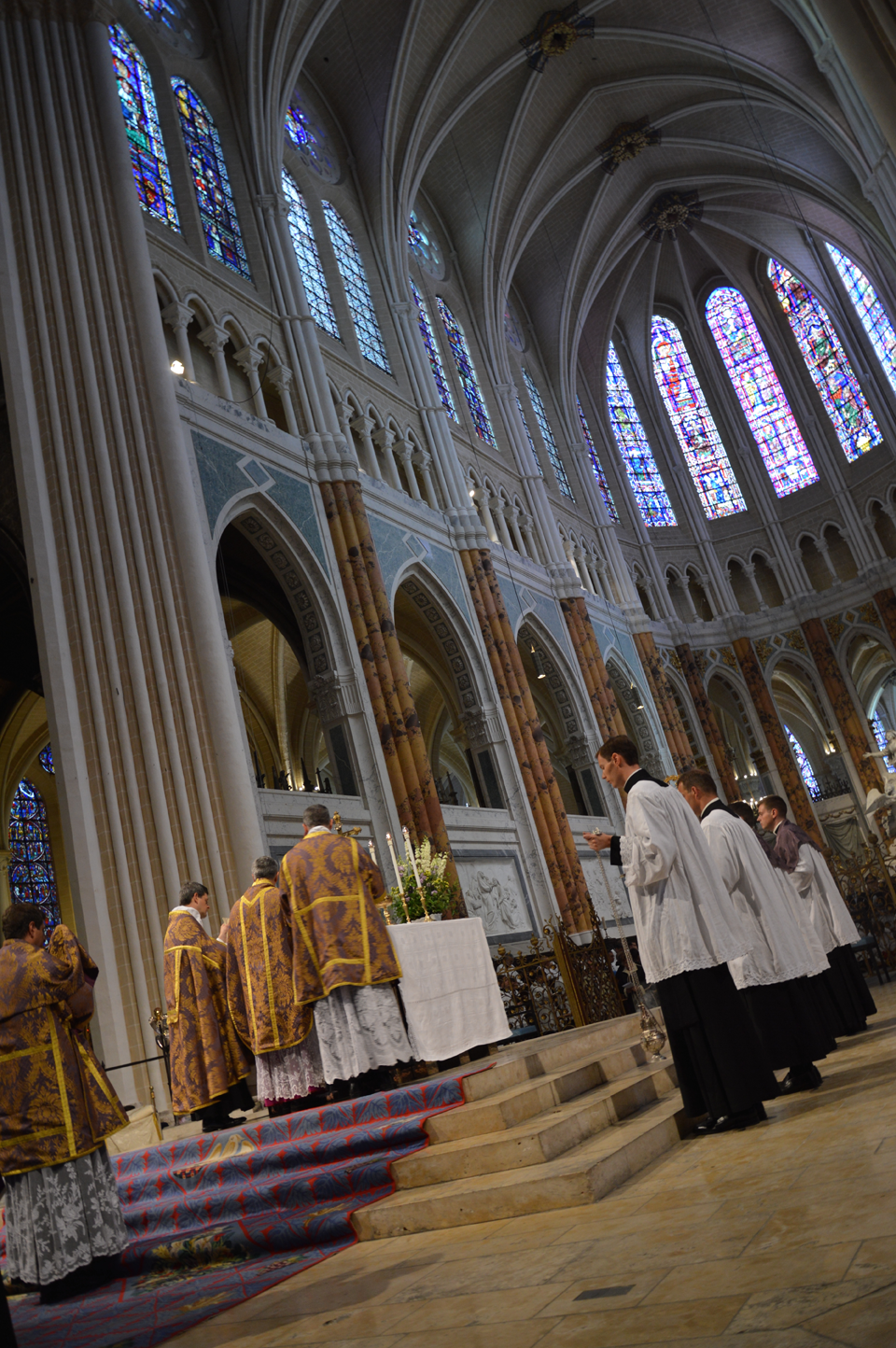
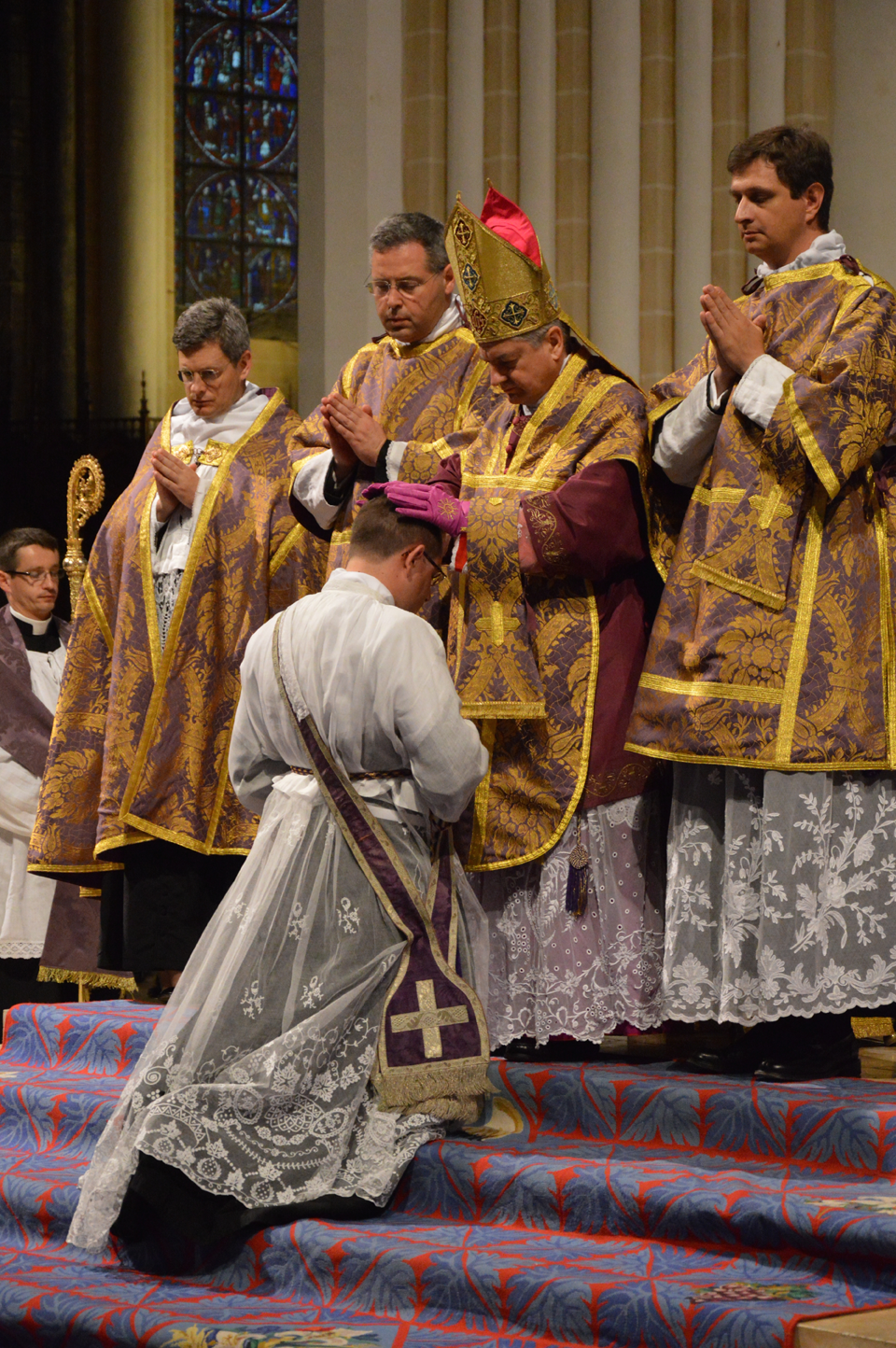
This Saturday, June 28, on the vigil of the Feast of Saints Peter and Paul, His Excellency Marc Aillet, Bishop of Bayonne, Oloron & Lescat (France), celebrated the ordination of three new French priests for the Fraternity of St. Peter (FSSP): Fr. Jean de Massia, Fr. Olivier de Nedde and Fr. Thibault Paris.
The ceremony took place for the first time in the magnificent Cathedral of Chartres, still in restoration (the restoration of the choir is now complete).
The humor website Cracked.com just published an article called “7 Awesome Buildings That Look Like They’re Designed by Kids”. One of these (#5) is a small Gothic chapel near the French city of Nantes, the Chapelle de Bethléem. In the course of a restoration done between 1993 and 1995, the decision was made to replace the lost pinnacles at the corners of the building, and the statues on them; a sculptor named Jean-Louis Boistel was then allowed to create a thematic sculptural program for each pinnacle. So for example, the “pinnacle of memory” has statues of the Four Evangelists.
The symbols of St. Matthew, Luke and John on the pinnacle of memory. Image from the chapel’s website.
This is not the why the chapel was noted in the Cracked article, however. This is:
Yes, that is Gizmo from the movie Gremlins. And of course, if you feed him after midnight....
Gizmo and the bad Gremlin share the “pinnacle of the reckless” with a character from a Japanese anime popular in France in the 1990s, a good and heroic robot called Goldorak.
The program of the “pinnacle of origins” includes a rather unique representation of “nothingness” or “the void”, understood as a rival to God inasmuch as it wants to destroy what God has created, but will be defeated by God.
One would assume that there could only be one church in the world which has a representation of the xenomorph from the Alien movies... but one would be wrong. Paisley Abbey in Scotland was decorated with one at almost the same time as the Chapelle de Bethléem. (This appears to be the baby alien when it makes its altogether memorable entrance... or rather, exit.)
For a time the famous astronaut on the door of the New Cathedral in Salamanca looked liked his arm was bitten off during an encounter with a xenomorph...
I just stumbled across the website of Valaam Monastery, a Russian Orthodox foundation located on a large island in Lake Ladoga, the largest lake in Europe, to the north of St. Petersburg and the Karelian Isthmus. The monastery established a photographic studio in the 1850’s, and has evidently amassed an enormous archive; the website has a special section dedicated to photography, with links to eleven different collections. In addition to a section of historical images, the works of a number of talented individual artists are highlighted, including two members of the community. Here is just a tiny selection, made more or less at random; the site is very much worth perusing. Valaam is also the home of a special kind of liturgical music, and the website provides a number of links to recordings. (h/t P.A.G.)
This is the sixth article in an ongoing series. The previous parts can be read here: part 1, part 2, part 3, part 4, part 5.
In rhetoric, the term “prolepsis” refers to giving something a name before that name properly belongs to it. In Genesis 3:20 it is stated that Adam “called the name of the woman Eve, because she was the mother of all the living,” even before the birth of their first child. (The name “Eve” and “life” are etymologically related in Hebrew.) Likewise, Genesis 14:14 states that Abraham pursued the captors of his nephew Lot “as far as (the city of) Dan”, even though the city was then called Laish, and only given the name Dan when the tribe of the same name seized it, as recorded in Judges 18:29.
The sacrificial language of the Offertory, “receive… this immaculate victim … we offer Thee, Lord, the chalice … receive this offering” is an example of prolepsis, referring to the Sacrifice before what is actually sacrificed is present, namely, the Body and Blood of Christ. The literal Latin equivalent of prolepsis is “anticipation”, and it was dislike of this anticipation of the Sacrifice that ultimately led to the radical overhaul of the Offertory in the Novus Ordo. Fr Aidan Nichols writes about this beautifully in his book Lost in Wonder: Essays on Liturgy and the Arts. (pp. 40-41; chapter 3 “Eucharistic Theology and the Rite of Mass.”)
Though disliked by people with tidy Germanic minds, the anticipation of the Anaphora… is a frequent feature of historic liturgy. It is even more pronounced in the Byzantine Rite… as the dedicated bread and wine are transferred to the altar at the Great Entrance, the choir sings ‘Let us … now lay aside every earthly care, so that we may welcome the King of the universe, who comes escorted by invisible armies of angels’, even though that ‘King’ only ‘comes’ in the sense that the dedicated gifts are now brought in so that they may be offered in the Holy Sacrifice… to the worshipping mind of the Byzantine Christian they are, however, already images of the Lord’s body and blood, and, proleptically, the King does come with them, since he will come in them at the Consecration. Liturgical time is not ordinary time…
The proleptic use of the term “sacrifice” and related concepts before the actual Sacrifice takes place is extremely ancient, being found first of all in the Canon of the Mass itself. In the Te igitur, the priest asks God “to accept and bless these gifts, these offerings, these holy, unblemished sacrifices.” (“haec dona, haec munera, haec sancta sacrificia illibata.” The word “munus” can also mean “sacrifice.”) It is also found in a great number of the Secrets of the Mass, which before the Offertory was fixed as a part of the rite, served as the only kind of Offertory prayers. At the Third Mass of Christmas, the Secret says “By the new birth of Thy only-Begotten Son, sanctify, o Lord, the sacrifices offered (oblata); and cleanse us from the stains of our sins.” “Oblata” is the past participle of the highly irregular verb “offerre – to offer”, and refers to that which will be offered in the action of the Canon as if it were already offered. This, despite the fact that Latin has a common future passive participle which might have be chosen, to say “…sanctify the sacrifices which will be offered.” (The form in this case would be “offerenda.”)
There are many other examples which might be drawn from the Secrets of various Masses written in all periods. With them should also be included the very title of the Secret commonly found in the ancient sacramentaries, maintained by the Ambrosian Rite, and restored to general use in the Missal of Paul VI, namely, “Super oblata – the prayer over the things that have been offered,” where it might just as well have been called “Super offerenda – over the things which will be offered.” There is no warrant for imagining that the proleptic use of the past tense form “sacrificed” or any similar terms indicates a belief that the Eucharistic Sacrifice, or some other adjunct sacrifice, took place before the Canon. The presence of such language in the Offertory simply extends backwards by a few minutes a traditional way of speaking which has been almost universally a part of Christian worship from the most ancient times.
There is also, however, a broader meaning of the term “prolepsis”, which is given by the Roman rhetorician Quintilian in The Institutions of Oratory. (Book 9, chapter 2, 16-18)
Anticipation, or, as the Greeks call it, prolepsis, whereby we forestall objections, is of extraordinary value in pleading; it is frequently employed in all parts of a speech, but is especially useful in the beginning. However, it forms a genus in itself, and has several different species. (After listing some of the specific types of prolepsis) … And, most frequent of all, there is preparation, whereby we state fully why we are going to do something or have done it. Anticipation may also be employed to establish the meaning or propriety of words, …
In the first article in this series, I cited an essay by Bruce D. Marshall, who points out that the theological writers of the Scholastic period paid much more attention to the question of the Real Presence than they did to that of the Sacrifice of the Mass. While “the sacrificial character of the Eucharist had never been contested in the Western church, (or the Eastern, for that matter) at the time when Bonaventure and Aquinas wrote”, the Real Presence had been “a regular subject of theological dispute in the West for several hundred years”. (Rediscovering Aquinas and the Sacraments: Studies in Sacramental Theology, p.42; edd. Matthew Levering and Michael Dauphinais; Liturgy Training Publications, 2009)
For this reason, we find that in his Book of Sentences, the principle theology textbook of the High Middle Ages, Peter Lombard devotes but a single article to the question of the Sacrifice of the Mass. (Lib. IV, dist. 12.5) Both St. Bonaventure and St. Thomas Aquinas, in their commentaries on the Sentences (the medieval equivalent of a doctoral thesis), do not comment on this article, although they refer to it in passing elsewhere. Marshall describes the situation thus: “Thomas, it seems, does not so much deliberately ignore the sacrificial side of the Eucharist as follow an established pattern that does not see this as a problem needing special attention.” (ibid.)
On the other hand, prominent heresies about the Real Presence have arisen at several points in the Church’s history. At the very beginning of the Scholastic period, Berengarius of Tours (999-1088) caused a huge controversy by attacking St Paschasius Radbertus’ teachings on the Real Presence, an attack for which he was condemned, imprisoned and forced to retract. St Norbert, who founded the Premonstratensian Order in 1119, famously combatted and extirpated the heresies of Tanchelm, which included the complete denial of the Real Presence. In the following generation, St. Bernard identified among the errors of Peter Abelard “his opinion…on the Sacrament of the altar,” summed up as the ninth on the list of the latter’s heresies. (Epistle 188.2; cf. 189.2) Less than 30 years after the death of St. Thomas Aquinas, the Dominican John of Paris, considered by his contemporaries one of the greatest theologians at the University of Paris, tentatively proposed that belief in transubstantiation was not de fide, and put forth a theory of “impanation,” looking back to some of the ideas of Berengarius’ followers. In our own times, Pope Paul VI found it necessary in the encyclical Mysterium Fidei to reassert the Council of Trent’s teaching on transubstantiation, and reject by name the new heresies of “transignification” and “transfinalization”, as well as the proposition that “Christ the Lord is no longer present in the consecrated hosts which remain once the celebration of the sacrifice of the Mass is finished.” (parag. 11)
Now although the Offertory prayers predate the Scholastics, we may fairly say that their position in the liturgy of the Mass was consolidated in the Scholastic period, the era in which the missal would displace the use of the earlier sacramentaries, lectionaries and graduals. The medieval missals have various forms of the Offertory, some simpler and some more complex, but to take the most widely used example, that of the Roman Missal refers to “sacrifice” in various ways, but never uses the term “bread.” The most commonly used Offertory prayer Suscipe sancta Trinitas is found in many medieval missals that have none of the other Roman prayers, and also makes no reference to bread.
This constant use of “sacrifice” without “bread” is a prolepsis in the broader sense given by Quintilian; it establishes the proper meaning of terms, excluding in anticipation any idea that the liturgical act of offering offers bread. This declares in advance, against the many Eucharistic heresies past and present, what the Canon does not do. It is then left it to the Canon itself, the older part of the Mass of the Faithful, to declare right before the consecration what it does do, namely, make present “for us the Body and Blood ... of the Lord Jesus Christ.”
A leaf of an early Premonstratensian Missal, ca. 1150, with the Offertory prayer Suscipe sancta Trinitas on the lower part of the left hand column, and the common forms of the Preface on the right. (Bibliothèque nationale de France, Département des manuscrits, Latin 833)
Fr. Brian Gannon, pastor of St. Theresa’s Church in Trumbull, CT, (5301 Main Street) will celebrate Solemn Mass in the Extraordinary Form on the Feast of Sts. Peter and Paul, Sunday June 29th, at 2:30pm. This will be Fr. Gannon’s first public celebration of the Extraordinary Form, and the first time in over 40 years that such a Mass will be said at this church. The deacon for the Mass will be Fr. Shawn Cutler, the parochial vicar; a reception, hosted by the parish's young adults group, will follow in the school gym.
Benediction at St. Theresa’s after the recent Corpus Christ procession.
We have received this news from a parishioner of the Ordinariate Church of St Luke in Bladensburg, Maryland:
St. Luke’s Church in Bladensburg, Maryland, which came into the Catholic Church in October, 2011, will be moving into the District of Columbia this autumn. Upon moving, St Luke’s will become the first congregation of the Ordinariate of the Chair of St. Peter in the nation’s Capital.
The Archdiocese of Washington has arranged for the Ordinariate community to relocate to the Church of the Immaculate Conception, located at 1315 8th Street, NW (at the corner of 8th and N Streets, NW) in the fast-growing Shaw neighborhood of Washington, DC. The beautiful church, which is celebrating its 150th anniversary this year, is listed on the National Register of Historic Places. The interior is well-suited to Ordinariate worship, and features a fine organ, an altar rail, and an eastward-facing high altar.
Immaculate Conception’s location offers the Ordinariate community a remarkable opportunity to continue its liturgical and evangelical work in the very heart of the DC metro area.
This coming Saturday, June 28th, the Pastor of St Luke’s Church, Fr. Mark Lewis, will celebrate a Low Mass at Immaculate Conception at 10:00 AM. Following the Mass, Fr. Mark will lead a tour of the church and host a question-and-answer session with members of the legacy DC-area Ordinariate discernment groups and anyone else who is interested in learning more about the Ordinariate.
Many of our readers have undoubtedly already heard about the pastoral letter issued on the feast of Corpus Christi by the Most Rev. Thomas J. Paprocki, Bishop of Springfield, Illinois, with the auspicious title “Ars celebrandi et adorandi”. His Excellency makes several very good points in the letter, which can be read in full at the website of the diocese. Most notable is his direction to restore to the main sanctuary of the church any tabernacle which had been moved to a side chapel that was too small or lacking in prominence within the building.
...in order that more of the faithful will be able to spend time in adoration and prayer in the presence of the Eucharistic Lord, I direct that in the churches and chapels of our diocese, tabernacles that were formerly in the center of the sanctuary, but have been moved, are to be returned as soon as possible to the center of the sanctuary in accord with the original architectural design. Tabernacles that are not in the center of the sanctuary or are otherwise not in a visible, prominent and noble space are to be moved to the center of the sanctuary; tabernacles that are not in the center of the sanctuary but are in a visible, prominent and noble space may remain.
Bishop Paprocki rightly notes that the removal of tabernacles to side chapels on the analogy of what is done at St Peter’s in Rome (and many other churches in Europe) is quite incorrect, inasmuch as the Sacrament Chapel of St Peter’s is more than large enough to accommodate all those who wish to pray there, while the Eucharistic chapels in some churches today are repurposed supply closets. Just as important, His Excellency “strongly encourages” the clergy to keep churches open, in order that the faithful may more readily be able pray.
This deep-seated desire to be in the presence of the Lord resounds in the heart of every person, even if they cannot at first name this desire for what it truly is. We should therefore do all that we can to help them encounter the Lord who waits for them to seek and find him. In this regard, I strongly encourage keeping our churches open to the public in so far as can be done with the safety of people and the building in mind. Pope Francis spoke about this in his Apostolic Exhortation on the Joy of the Gospel, Evangelii Gaudium: “The Church is called to be the house of the Father, with doors always wide open. One concrete sign of such openness is that our church doors should always be open, so that if someone, moved by the Spirit, comes there looking for God, he or she will not find a closed door.” (no. 47)
He also offers this very nice explanation of the reason why genuflecting is more appropriate gesture before the tabernacle.
To genuflect means, literally, “to bend the knee.” In the ancient world the knee symbolized the strength of a man. If a man is struck in the knee, he stumbles and falls; his strength is taken from him. When we genuflect before the Lord, our strength is not taken from us; rather, we willingly bend our strength to the Lord and place ourselves humbly in his service. When we bend our knee to the Lord of heaven and earth we should hear the words of the Psalmist ever in our hearts, “Lord, I am your servant,” remembering that before the Lord every knee must bend (Psalm 116:16; cf. Philippians 2:10).
Let us pray that more bishops will follow Bishop Paprocki’s example in encouraging similar norms within their dioceses.
For those who are within striking distance of New York City, there is an exhibition of sacred art at the NYU Catholic Center, 238 Thompson Street, this week. Entitled One Faith: East and West it features works of by working artists such as Ken Woo, John C. Traynor, Dony Mac Manus, Sister Eliseea Papaciòc, Carl Fougerousse, Ladislav Zaborsky, Linus Meldrum, Ioan Gotia and Clemens Fuchs (whose work was recently featured on this site). The exhibition includes sculpture, stained glass and paintings in a range of naturalistic, iconographic and gothic styles. After this week it goes on tour and moves Steuvenville, OH in the Fall and thereafter leaves the US and goes to Beijing and Moscow and finally returns to NYC in a year's time.
There is a series of lunchtime and evening talks at the center about sacred art and the works on show at the exhibition by the curator, Jennifer Healy. For information go to http://onefaithexhibition.org/. The Facebook page has the same name as the exhibition - One Faith: East and West.
This exhibition is organized by the Language & Catechetical Institute located in Gaming, Austria. All proceeds will fund student scholarships for young Catholics from Eastern Europe, China, and Russia. (www.lciaustria.org)and sponsored by Our Sunday Visitor.
Here is a newly completed wood polychrome and gilded processional cross made by Frenchman Philippe Lefebvre. I love the balance of naturalism and subtle abstraction that he has incorporated into this.
In Mediator Dei, Pius XII said, you may recall: 'Modern art should be given free scope in the due and reverent service of the church and the sacred rites, provided that they preserve a correct balance between styles tending neither to extreme realism nor to excessive "symbolism," and that the needs of the Christian community are taken into consideration rather than the particular taste or talent of the individual artist.'
He is telling us that the Christian artist must represent natural appearances and through the medium he chooses reveal also the invisible truths of the human person ('symbolism'). There is wide scope for individual interpretation of how this might be done, even when working within the forms of an established tradition. It is incumbent upon each artist to find the balance that appeals to people of his day. This may mean working precisely in the way of the past, or adapting and building on the past in order to achieve this end and create something new. In doing so he must avoid the errors of straying too far in either direction, towards extreme naturalism ('realism') or abstraction.
When I see this work by Philippe it strikes a chord with me - it is almost as though it is a three-dimensional Fra Angelico.
Courtesy of Fr. Samuel F. Weber, O.S.B., Director of the Benedict XVI Institute for Sacred Music and Divine Worship, the Most Rev. Salvatore Cordileone, Archbishop of San Francisco, has graciously agreed to share with the readers of New Liturgical Movement a portion of the conference he gave to seminarians of St. Patrick’s Seminary, Menlo Park, on February 12, 2014, entitled “Doing the ‘Pastoral Thing’ Will Always Be Harder, but Right.” The portion reproduced below is where the Archbishop addresses liturgical issues.
* * *
“Doing the ‘Pastoral Thing’ Will Always Be Harder, but Right”
The Most Reverend Salvatore Cordileone
Some of the directives in these documents [Sacrosanctum Concilium and The General Instruction of the Roman Missal] have been observed in the life of the Church on the local level, but others have been ignored or misunderstood. So I would like to cite some passages to give some examples of where we need to focus our efforts to make our worship more in line with what the Church is asking us to do.
First of all, Sacrosanctum Concilium states at n. 36:
… the use of the Latin language is to be preserved in the Latin rites. But since the use of the mother tongue, whether in the Mass, the administration of the sacraments, or other parts of the liturgy, frequently may be of great advantage to the people, the limits of its employment may be extended. This will apply in the first place to the readings and directives, and to some of the prayers and chants …
So we can see that it was not the mind of the Council to abolish the use of Latin in the liturgy by any means; quite the contrary. But a more generous use of the vernacular was allowed in order to engage the people in the liturgy more conscientiously. It later has this to say about music (n. 116):
The Church acknowledges Gregorian chant as specially suited to the Roman liturgy: therefore, other things being equal, it should be given first place in liturgical services. But other kinds of sacred music, especially polyphony, are by no means excluded from liturgical celebrations, so long as they accord with the spirit of the liturgical action.
Again here, the intention of the Council was quite contrary to abolishing the Church repertoire of sacred music from her worship. The General Instruction of the Roman Missal repeats this passage from Sacrosanctum Concilium at number 41, and then goes on to add: “Since faithful from different countries come together ever more frequently, it is fitting that they know how to sing together at least some parts of the Ordinary of the Mass in Latin, especially the Creed and the Lord’s Prayer, set to the simpler melodies.” In 1974, Pope Paul VI even issued a little booklet, Iubilate Deo, containing these more classic chants and sent it to all the bishops of the world in order to help implement this vision. And how appropriate it is for us here in the Bay Area, where every Sunday in many of our parishes, and certainly in Masses at the diocesan level, people from different cultural and language backgrounds come together to worship.
We have to remember that, in addition to its practical purpose as a means of communication, language also has a symbolic value. When I was installed as the Bishop of Oakland, the first reading for the Mass was in Tigrinya. Never heard of it? Neither had I before then. Tigrinya is the language of Eritrea. Now, with all of the bishops and priests present there (older priests!), more people in the Oakland Cathedral that day would have understood the first reading if it had been in Latin than in Tigrinya. But Tigrinya had a symbolic value: the East Bay prides itself on its cultural diversity (as we all do here in the Bay Area), and there is a small but vibrant community of people from Eritrea living there, who have their own priest with their own rite. It was a powerful symbol of the universality of the Church which is quite visible here on the local level.
Likewise, Latin – which I once heard the late Cardinal Hickey refer to as the Church’s “old vernacular” – has both a practical and symbolic value. The practical value is that it is the common patrimony of all Catholics, and so a way that people of different languages can worship together, using texts and formulas that have been preserved from antiquity. But it also has a symbolic value: precisely because it is our common patrimony, belonging to all Catholics of all cultures and languages – indeed, it is constituent of our common Catholic culture – it teaches us that the liturgy is not ours to with as we will. No, the liturgy is a given; it is our job to celebrate it well and faithfully, not tinker with it for the sake of “creativity” or “self-expression.” This once again is a matter of succumbing to the culture of narcissism. We hear much talk today about “servant leadership.” To have credibility, we have to model that first and foremost at the liturgy: we are the servants of the liturgy, not its creators. This takes a great deal of discipline, restraint and humility on the part of the liturgical ministers, and most especially the celebrant.
Let’s hear more from Sacrosanctum Concilum about music in the liturgy, this time about the use of instruments (n. 120):
In the Latin Church the pipe organ is to be held in high esteem, for it is the traditional musical instrument which adds a wonderful splendor to the Church's ceremonies and powerfully lifts up man’s mind to God and to higher things. But other instruments also may be admitted for use in divine worship ... This may be done, however, only on condition that the instruments are suitable, or can be made suitable, for sacred use, accord with the dignity of the temple, and truly contribute to the edification of the faithful.
A very important instruction on sacred music issued in 1967, Musicam Sacram, repeats this passage from Sacrosanctum Concilium, and then adds the following:
63. In permitting and using musical instruments, the culture and traditions of individual peoples must be taken into account. However, those instruments which are, by common opinion and use, suitable for secular music only, are to be altogether prohibited from every liturgical celebration and from popular devotions.
Any musical instrument permitted in divine worship should be used in such a way that it meets the needs of the liturgical celebration, and is in the interests both of the beauty of worship and the edification of the faithful.
64. The use of musical instruments to accompany the singing can act as a support to the voices, render participation easier, and achieve a deeper union in the assembly. However, their sound should not so overwhelm the voices that it is difficult to make out the text; and when some part is proclaimed aloud by the priest or a minister by virtue of his role, they should be silent.
It is true that, given the broader sense of enculturation of the liturgy that we have today, it is much more common to utilize other instruments which in some cultures are associated with worship in the mindset and practice of the people. Nonetheless, the basic liturgical principles enunciated here are timeless, and still apply as much today as they did the day they were written, namely: (1) the primary purpose of instrumentation is to support the singing of the assembly, and therefore it should not overpower the voices of the people, both in terms of volume (the number of instruments employed should therefore not be exaggerated) and of style (showy musical embellishments more appropriate to a performance should be avoided); (2) instruments commonly associated with secular use must be incorporated in such a way as to be consistent with the sacred character of the liturgy, and not simply reproduce the profane in a sacred context; and (3) there nonetheless remain some instruments that, by their very nature, cannot be suitably adapted into a sacred context.
In the Parish Context
Now, some people might say that this is all fine and dandy, but it’s irrelevant because it’s not what’s happening in our parishes. Well, if you see a discrepancy between what is in the pages of the Church’s documents and what is going on in our parishes’ liturgies, it’s not because the documents are wrong!
This is where the three approaches can be so easily illustrated. The ideologue will simply start mandating changes without talking to people, seeking to understand them, and, most importantly, teaching them. He’s in charge, so he does what he wants, and even if what he wants is what the Church says we should be doing, he alienates people. The lazy priest simply lets things drift off on their own, and get further and further away from what the Church teaches about how we are to worship. This, too, will inevitably begin to affect how and what his people believe, and so weaken their faith. But the pastoral priest will educate his people about what the Church teaches, what the Council really had in mind for authentic liturgical reform; he will begin to introduce changes gradually, probably targeting one principal Sunday Mass to build it up as the one with special solemnity. He also will not take anything away from his people; he will keep the contemporary music at the other Masses, and teach the musicians how to do it well. In this way, he will facilitate liturgical renewal organically. And it can be done. I’ve seen it done. I know pastors who inherited a parish in shambles (in one of them, the kids’ swing set was in the pastor’s back yard!), and, by approaching it precisely this way, they have completely transformed their parishes: the Masses are full, there are long lines for confessions, the full spectrum of ministries abound – even including the teaching of Natural Family Planning – and people are on fire for their faith.
This won’t happen with the ideologue or the slouch. When the ideologue discovers that the high school kid is having a great time banging away at the drums at Mass, he’ll tell him to take a hike. Never mind that this was his one connection to the Church, and maybe even hope for keeping out of trouble. Of course, the slouch will just let it continue, maybe even encourage it, and pretend as if it’s enjoyable. The true pastor will befriend the young man, guide him as to how he can use his instrument in a way that supports the singing rather than drown it out, and begin to sensitize the musicians to their proper role. When the young man graduates and leaves for college, there is an opportunity to make a subtle change of direction.
This pastoral, organic approach is what we are trying to model here at St. Patrick’s Seminary. Gregorian chant is to have the first place in music for worship; one day a week and one Sunday a month is hardly “first place.” But it’s a start in educating you in this rich patrimony of the Church. If you are going to implement what the Church is asking us to do, you first need to understand it and appreciate it so that you have the vision; you then need to learn how to do it in a pastoral way. But if you don’t have the vision, it will never happen. This is an institution dedicated to the formation of Catholic priests; how could anyone consider it unreasonable that it wants to educate you in Gregorian chant? You are – God willing – going to be Catholic priests! Catholic priests should not know Gregorian chant?
At the same time, you all need to be familiar with classic hymnody. There is a certain repertoire of hymns that all Catholics should know. You need to know this repertoire and appreciate it yourself, if you are going to inculcate it in the people of your parish. And, yes, it is true that, at the majority of our parishes’ Masses, it’s contemporary music that is used. You need to know how to use that well; you need a lot of discernment here. There is just simply a lot of bad music out there; you need to know how to distinguish bad music from good. And you also have to pay attention to the words, because there is also a lot of bad theology. For example, a lot of popular contemporary Church songs use the phrase, “we are the body of Christ.” That is not Catholic theology, and it is not scriptural. St. Paul says that we are “one body in Christ.” “We are the body of Christ” says that this is our body to do with as we will. Sound like a familiar argument? There we see narcissism reeling its ugly head again. There is one song that even explicitly endorses narcissism. The refrain goes like this: “Behold the Body of Christ, Jesus our Savior and Life! Rejoice O people of God! We are the Body of Christ!” You have all studied logic, so do the syllogism: major premise – behold the body of Christ; minor premise – we are the body of Christ; conclusion – let us behold ourselves. But if we are one body in Christ, with him as our head and we the members of the body under him our head, that is something quite different. We are under his authority and dominion. It’s his Church, and he gave her to us for our sanctification, not to do with as we will.
In addition to paying attention to the quality of the music and the words, you also have to be sensitive to the liturgical season of the year. What the Church really envisions us doing at Mass is singing the propers at the entrance, at the preparation rite, and at Communion. In fact, the General Instruction of the Roman Missal lists the options, in order of preference, this way (n. 48; cf. nn. 74 and 87):
(1) the antiphon from the Roman Missal or the Psalm from the Roman Gradual as set to music there or in another musical setting; (2) the seasonal antiphon and Psalm of the Simple Gradual; (3) a song from another collection of psalms and antiphons; (4) a suitable liturgical song … approved by the Conference of Bishops or the diocesan Bishop.
Notice how the lowest preference is the one that is almost always done. This can’t be changed overnight, but it is possible to pick hymns and songs conducive to the season, and perhaps even to the given entrance and Communion antiphon from the Roman Missal for the given Mass. Besides the ones with bad theology, there are also a lot of contemporary songs that are straight from Scripture, especially the psalms. There will be times that you can find a wellknown contemporary song that is taken from the same psalm (or other Scripture passage) as one or both of the antiphons from the Mass of that day.





.jpg)
.jpg)
.jpg)





