
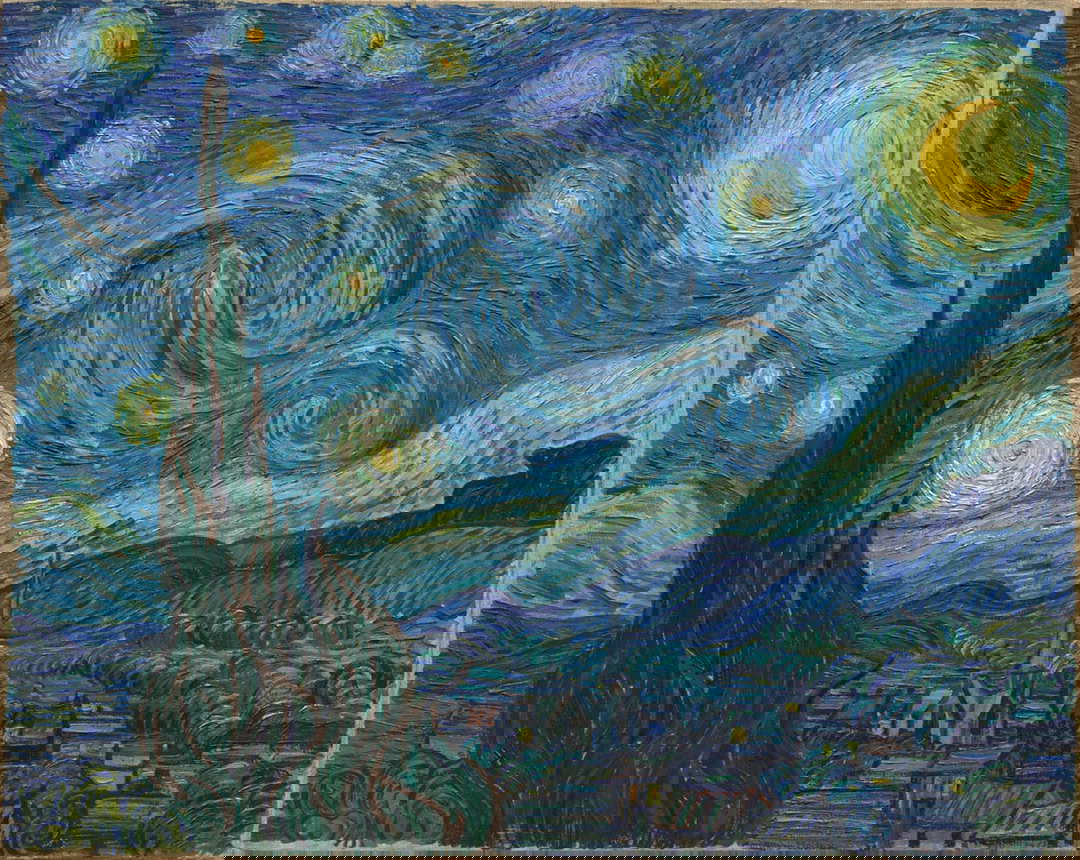
After Brother Sun, St. Francis turns to other lights in the sky:
Laudato si, mi Signore, per sora Luna e le stelle:in celu l’ài formate clarite et pretiose et belle.
Which I translate as:
Praised be You, my Lord, through Sister Moon and the stars,in heaven you formed them bright and precious and beautiful.
In the Canticle of the Sun, Francis follows the gender of the noun in Italian to determine whether he addresses a creature as brother or sister. Objects that have a masculine noun are called “brother” and objects that have a feminine noun are called “sister.” Since luna (moon) is feminine in gender, Francis calls the moon his sister.
He also calls the moon and stars bright, precious, and beautiful. We have translated the word clarite, from which we derive the English word “clear,” as “bright,” because that is its meaning, but the word can also suggest a kind of perfection, like a diamond’s clarity. Francis, in other words, is describing the moon and stars as jewels in the sky. One wonders if the Saint is contrasting his worldview before his conversion, when he delighted in the finer things of life (like clothes and maybe jewels), to his current view of the world, now seen through the eyes of God.
Saint Francis does not mention the night by name, but it is obviously implied by the nocturnal celestial objects that he wants to praise God. The night can have negative metaphorical meaning. As the deprivation of light, it can symbolize a deprivation of goodness, understanding, or grace. That is why St. John of the Cross called his period of spiritual dryness the “dark night of the soul.”
St. John of the Cross
The night can also be a frightening thing on a more practical level. The temperature drops (which in winter can be life-threatening), and the darkness not only makes it difficult to travel but provides cover for nocturnal predators like wolves and tigers and as well as human predators like highway robbers and burglars. To this day, most violent crimes, such as murder and rape, are committed at night. Add to this folklore about witches, vampires, and ghosts, and you can see why the night was so feared by our ancestors.
On the other hand, the night has also enjoyed a good reputation. The moon and stars are indeed beautiful, and in an age free of light pollution, the constellations were especially spectacular on a cloudless night. Thanks to Aristotle, ancient and medieval Europeans thought of heavenly bodies as perfect in every way, from their shape to their orbits. Contrary to a popular misconception, geocentrists took no pride in thinking of the earth as the center of the universe, for if the heavens were the realm of perfection, the earth was the realm of imperfection. If the moon is a perfect sphere, the earth is a muddy mess.

Moreover, Christian artists liked to think of the moon as a symbol of the Blessed Virgin Mary and the stars as the Saints, just as the sun was a metaphor for God. Since the moon reflects the light of the sun and has long been associated with femininity, it is the perfect symbol for the Mother who bore and perfectly reflects the Light of the world. And one medieval hymn for a saint praises the day of his death as the moment when “he moved up to the constellations” (migravit sidera).
Although Saint Francis does not allegorize the heavenly bodies, his praise of their natural qualities provides the kind of appreciation for nature that opens up to such symbolism, and it helps us move beyond the moon and the stars to the Love that moves them.
This article appeared as “Beauty of the Night” in the Messenger of St. Anthony 127:5, international edition (May 2025), p. 37. Many thanks to its editors for allowing its publication here.




