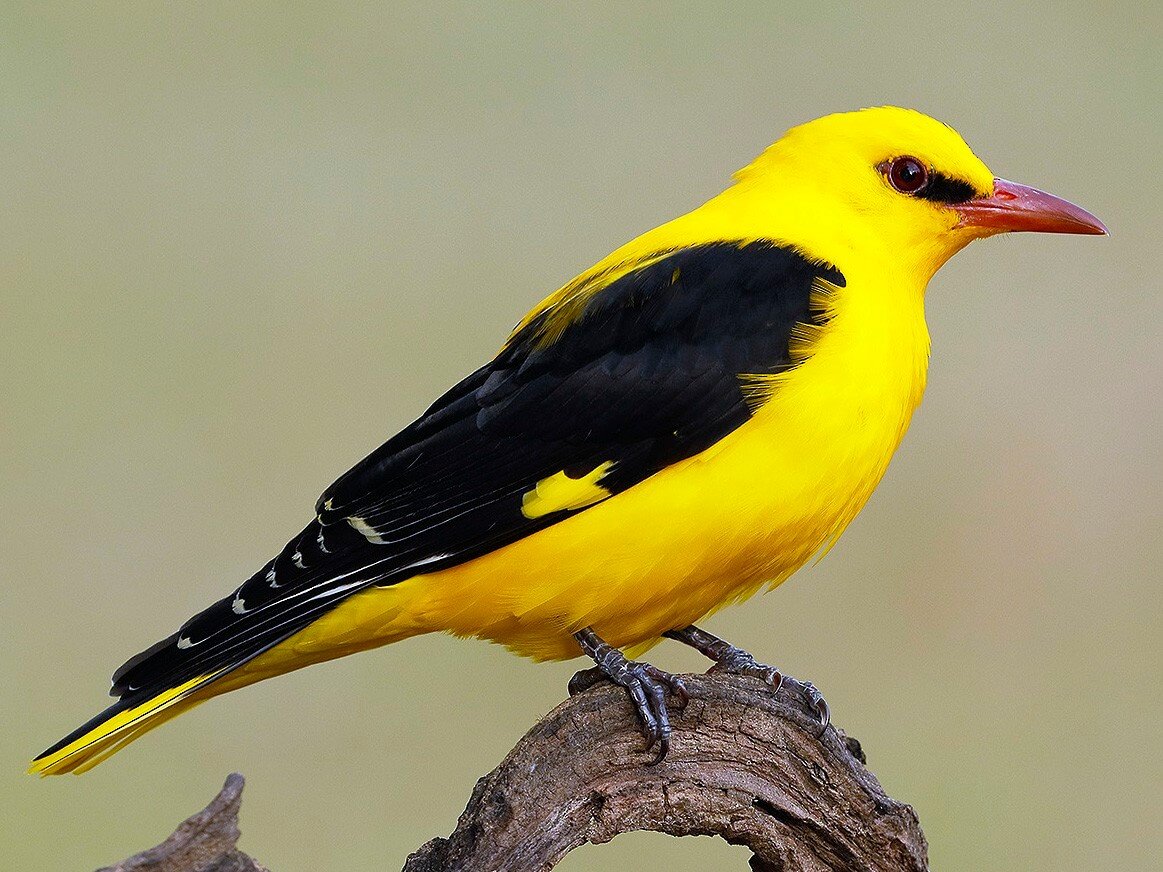
We continue to learn from Fr. Francis X. Weiser, this time regarding the ancient customs of Pentecost.
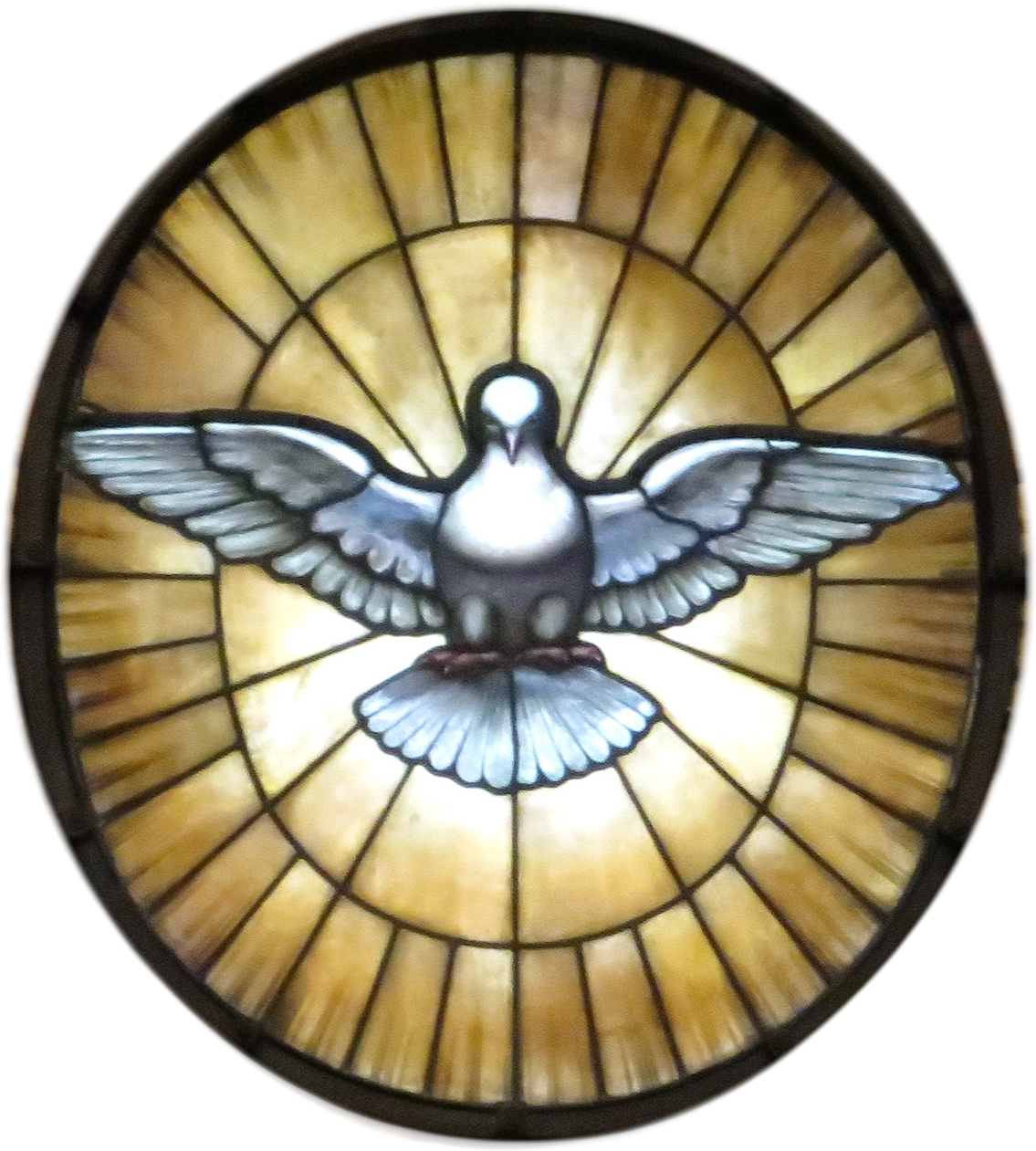
Holy Ghost Dove
From the earliest centuries of the Christian era
preachers and writers have mentioned the dove as a symbol of the
Holy Spirit. This symbolism, of course, was inspired by the
Gospel report of Christ's baptism. (Luke 3, 21-22) The dove, as a
symbol of the Holy Spirit, may be seen in churches, on priestly
vestments, on altars, tabernacles, sacred utensils, and in many
religious paintings.
In medieval times the figure of a dove was widely used to enact
in a dramatic way the descent of the Holy Spirit on Pentecost
Sunday. When the priest had arrived at the sequence, he sang the
first words in a loud and solemn voice: Veni Sancte Spiritus
(Come, Holy Ghost). Immediately there arose in the church a sound “as of a violent wind blowing.” (Acts 2, 2) This noise was
produced in some countries, like France, by the blowing of
trumpets; in others by the choirboys, who hissed, hummed, pressed
windbags, and rattled the benches. All eyes turned toward the
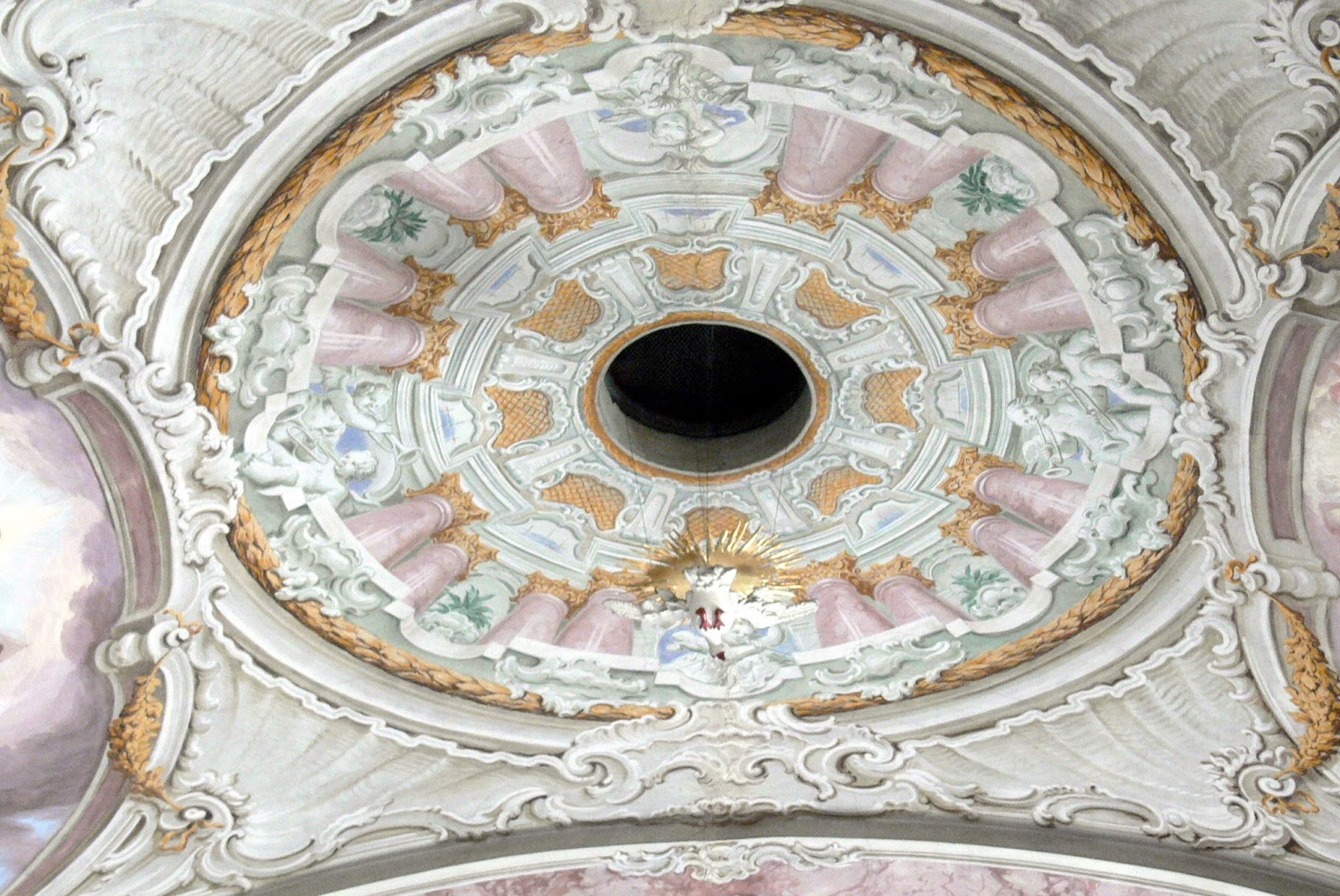
ceiling of the church where from an opening called the “Holy
Ghost Hole” there appeared a disc the size of a cart wheel, which
slowly descended in horizontal position, swinging in ever-widening circles. Upon a blue background, broken by bundles of
golden rays, it bore on its underside the figure of a white dove.
Meanwhile, the choir sang the sequence. At its conclusion the
dove came to rest, hanging suspended in the middle of the church.
There followed a “rain” of flowers indicating the gifts of the
Holy Spirit, and of water symbolizing baptism. In some towns of
central Europe people even went so far as to drop pieces of
burning wick or straw from the Holy Ghost Hole, to represent the
flaming tongues of Pentecost. This practice, however, was
eventually stopped because it tended to put the people on fire
externally, instead of internally as the Holy Spirit had done at
Jerusalem. In the thirteenth century in many cathedrals of France
real white pigeons were released during the singing of the
sequence and flew around in the church while roses were dropped
from the Holy Ghost Hole.
Like all such religious pageants this dramatic addition to the
liturgy of Whitsunday was attacked and ridiculed by the Lutheran
reformers. Among other instances there is a report from the town
of Biberach in Germany describing how in 1545 children broke the
Holy Ghost Dove of the local church and carried the pieces in a
mock procession through the streets.
A fairly general custom in medieval times, and one still
practiced in many sections of central and eastern Europe, is the
use of artfully carved and painted wooden doves, representing the
Holy Spirit. Usually this figure is suspended over the dining
table. Often it is encased in a globe of glass, into which it has
been assembled with painstaking effort, a constant reminder for
the members of the family to venerate the Holy Spirit. [Editor's note: I have tried to find one of these through internet and eBay searches, but have had no luck. Anyone else?]
Other Customs
Like Easter night, the night of Pentecost is
considered one of the great “blessed nights” of the year. In many
sections of Europe it is still the custom to ascend hilltops and
mountains during the early dawn of Whitsunday to pray. People
call this observance “catching the Holy Ghost.” Thus they express
in symbolic language the spiritual fact that only by means of
prayer can the divine dove be “”caught” and the graces of the Holy
Spirit obtained.
In rural sections of northern Europe superstitions ascribe a
special power of healing to the dew that falls during Pentecost
night. To obtain these blessings people walk barefoot through the
grass on the early morning of the feast. They also collect the
dew on pieces of bread which afterward are fed to their domestic
animals as a protection against disease and accidents. In many
places, all through Whitsunday night can be heard the noise of
shooting (Pfingstschiessen) and cracking of whips
(Pfingstschnalzen). In pre-Christian times this observance
was held to frighten harmful powers away from home and harvest;
in Christian times it assumed the character of a salute to the
great feast.
The modern version of the ancient spring festival (maypole and
May Queen) is connected with Pentecost in many sections of
Europe. The queen is called “Pentecost Bride” (Pfingstbraut).
Other relics of the Indo-European spring festival are the games,
dances, and races held at Whitsuntide. This tradition used to
be most popular everywhere in the Middle Ages, and still is in
central Europe. In England, Pentecost Sunday was a day of horse
races, plays, and feasting (Whitsun ale). In Germany, too, people
would hold banquets (Pfingstgelage) and drink “Pentecost beer.” Finally, there exists a Christian version of ancient nature lore
in the custom of blessing flowers, fields, and fruit trees on the
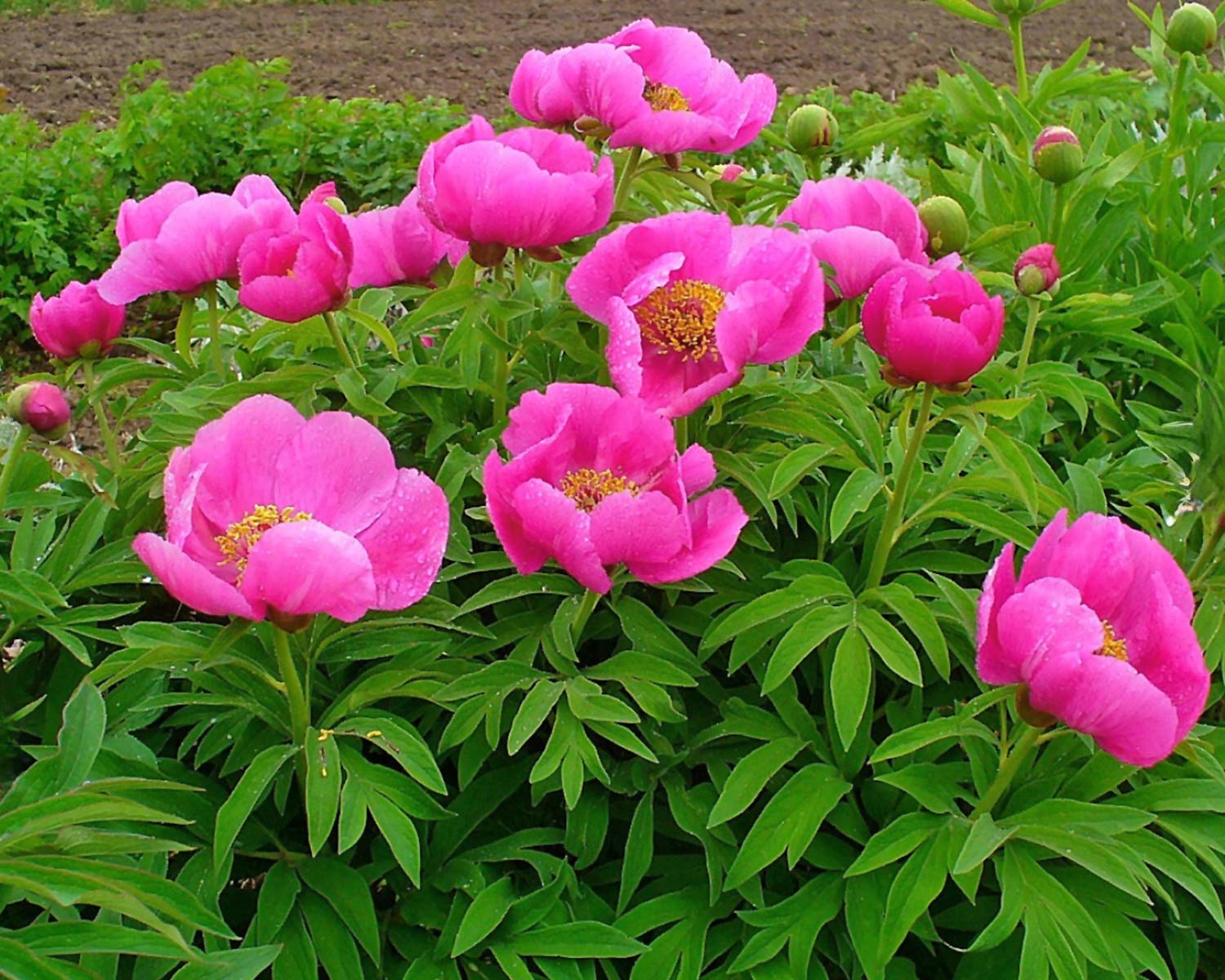
Vigil of Pentecost. In German-speaking countries the red peony
(paeonia officinalis) bears the name Pfingstrose (Rose of
Pentecost), and the oriole (oriolus oriolus) is called
Pfingstvogel (Pentecost bird).