
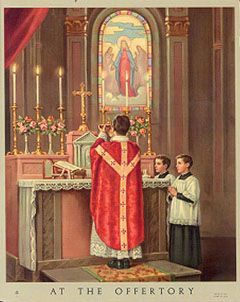
Having surveyed the Offertory Rite in the 1962 Roman Missal and its theological rationale last week, we turn now to the Offertory Rite in the 1970 Roman Missal.
Modern Revision
Several liturgists of the twentieth century were either unaware or unimpressed with the explanations offered in our last post. They deplored the Offertory’s sacrificial language, its alleged clericalization, its silent recitation, and its medieval Gallican origin, which in their opinion destroyed the “noble simplicity” of the Roman Rite. Some even wanted the washing of the hands and the addition of water to the wine to be eliminated. And most saw the prayers as redundant since they touch upon several themes that are in the Canon. [1] Regarding the latter critique, what these liturgists failed to appreciate was how these prayers were structured to form anticipatory parallels with the Canon, and to develop several themes that are either in the Canon inchoately or not present at all. The result, writes Michael Fiedrowicz, is “a locus theologicus of the highest degree: [the Offertory’s] prayers and rites contain a theology of sacrifice…[that] is unambiguously articulated.” [2]
Vatican II’s Sacrosanctum Concilium makes no mention of the Offertory Rite, but a note from the Conciliar Liturgical Commission circulating at the time states:
The rite of the offertory is to be arranged in such a way that the participation of the people is more prominent. The priest’s prayers, which tend to express a private or singular piety, are to be reviewed; the prayer over the offerings is to be said aloud. [3]
The language is somewhat confusing. For example, how are the priest’s prayers, which frequently have in mind other people, both living and dead, “singular”?
Whatever the answer, the 1967 missa normativa (prototype of the Novus Ordo) went much further in its edits, eliminating almost all sacrificial language, the prayer to the Holy Spirit (Veni Sanctificator), and the Trinitarian prayer Suscipe Sancta Trinitas. An earlier drafted even omitted all offertory language as well, presumably conceiving of the Rite as nothing more than a “preparation of the gifts.” Pope Paul VI, however, insisted that the word offerimus (“we offer”) be incorporated into the two new prayers for the bread and wine, the so-called Berakah prayers (“Blessed are You, Lord God of all creation”). The prayer In spiritu humilitatis and the Orate fratres / Suscipiat were also retained, both of which have sacrificial language. And the name of the Secret was changed to Oratio super oblata, “The Prayer over the Offerings,” a name that presupposes something has indeed been offered.
Interestingly, the new rubrics ignore the wish of the Conciliar Liturgical Commission to have an audible Offertory, stating that the prayers are to be recited secreto (quietly) and may be said aloud only if there is no singing. (GIRM #141-2)

Finally, the beautiful prayer about human dignity (Deus qui humanae substantiae) was removed from the Ordinary. Writing about this decisions decades later, McEvoy and Lebech were astonished that the liturgical reforms uncoupled “human dignity from the mystery at the heart of the liturgy,” [4] especially “given the rise to prominence of the concept of human dignity with the human rights tradition after the Second World War.” They express the hope that “the prayer will be restored in its Tridentine integrity to the liturgy at some point in the future.” [5]
Reception
With its combination of pro- and non-offertory elements, the Novus Ordo Offertory has given rise to vastly different interpretations.
Fr. Dennis Smolarski, S.J., is the author of the popular book How Not to Say Mass. Writing over thirty years after the promulgation of the new Missal, he advises his fellow celebrants:

Do not offer the gifts during their preparation – in particular, do not lift them high in the air. The 1969 Order of Mass significantly changed what formerly occurred between the Creed and the eucharistic prayer. In the current Order of Mass the gifts are received, prepared, and formally placed on the altar by the priest after he briefly blesses God in thanksgiving for God’s gifts. Formerly, we “offered” bread and wine to God, but now we realize that offering anything other than Christ is theologically inappropriate…. At this point of the Mass we do NOT OFFER – that will be done during the eucharistic prayer. [6]
Smolarski cites in his favor the fact that the new rubrics omit the gestures of offering, namely, of raising the host and the chalice to eye level. But Smolarski does not account for the language of offering in the prayers that remain or were added, nor does he attempt to reconcile his brazen claim that one should only offer Christ to God with the prayer In spiritu humilitatis, in which the priest offers himself to God—or, for that matter, with the biblical command that inspired the prayer. (see Rom. 12, 1)
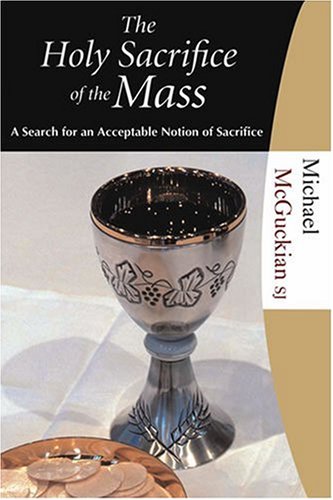
At the other end of the spectrum is Fr. Michael McGuckian, S.J., who applauds the new Offertory for the opposite reason, namely, that it is more sacrificial on the strange grounds that less is more: “the language of [the] 1969 [Missal] is less overtly sacrificial, but is, if anything, more deeply so.” [7] McGuckian loves the Old Testament three-act model of sacrifice so much that he applies it in a fundamentalist manner to the Mass. To his thinking, if the Offertory corresponds to the laity slaying the victim, then Christ must be “really and truly present during the Offertory,” [8] before the priest’s consecration of the bread and wine; [8] and if the Canon corresponds to the second act, then it is not about Christ’s Passion and Death but His intercession in Heaven. McGuckian deplores the Tridentine rite as the “lowpoint” of the Offertory in Western liturgy for no other reason than that the procession of gifts by select lay folk is absent in it, [9] blissfully unaware of the fact that a presentation of gifts is not outlawed in the 1570 Missal and indeed occurred in some parts of Europe before the liturgical reforms.
Conclusion
Pace Smolarski, the Novus Ordo affirms, by virtue of the few prayers that it has, that the presentation of the gifts is also an offering to God. On other hand and pace McGuckian, it does so minimally, without any blessings of the oblata, offertory gestures, or clear theological articulation.
The difference between the two Offertories reminds me of the difference between the robust mission statements of unapologetically Catholic colleges such as Thomas Aquinas College, which vow to “pass on the great intellectual patrimony of our civilization and the wisdom of the Church’s greatest thinkers, and to do so in complete fidelity to the Church and her Magisterium” versus the statements of CINO (Catholic In Name Only) universities that mumble something vague about educating the person “within the Jesuit, Catholic tradition.” The latter state nothing heretical but conduce to a climate of heresy and apostasy and, not surprisingly, heresies and apostasies tend to abound at such institutions. Similarly, the Novus Ordo’s Offertory Rite lands on the side of the Angels but an inch away from the divide, and, not surprisingly, misunderstandings of its nature are legion.
At the same time, I believe that it behooves us who attend a traditional Latin Mass to kindle in our hearts a fuller appreciation of the laity’s role in the Offertory. I personally am tempted to think of this portion of the Mass as an interlude: after I have handed over my donation and perhaps sung a verse or two of a hymn, I tend to zone out until the next priestly prompt. A rather poor showing for a member of “a chosen generation, a royal priesthood, a holy nation”! (1 Peter 2, 9) Instead, I should be heeding the words of Pope Pius XII:
An earlier version of this article appeared as “The Offertory: Preparation of the Gifts or a Sacrifice to God?” in The Latin Mass magazine 34:3 (Fall 2025), pp. 42-46. Many thanks to the editors of TLM for allowing its publication here.
The conclusion that the people offer the sacrifice with the priest himself… is based on the fact that the people unite their hearts in praise, impetration, expiation and thanksgiving with the prayers or intention of the priest, even of the High Priest himself, so that in the one and same offering of the victim and according to a visible sacerdotal rite, they may be presented to God the Father. [10]
Notes
[1] See the excellent article by Manfred Hauke, “The Offertory as a Challenge to Liturgical Reforms in History,” in The Sacrifice of the Mass, ed. Matthew Hazell (Smenos, 2023).
[2] The Traditional Mass: History, Form, & Theology of the Classical Roman Rite, trans. Rose Pfeifer (Angelico Press, 2020), 257-58.
[3] Acta Synodalia I.2.121-22, cited in Hauke, 146.
[4] James McEvoy and Mette Lebech, “Deus qui humanae substantiae dignitatem: A Latin Liturgical Source Contributing to the Conceptualization History of Human Dignity,” Maynooth Philosophical Papers 10 (2020), 117-33, 123-24.
[5] Ibid., 130-31.
[6] Dennis C. Smolarski, SJ, How Not to Say Mass: A Guidebook on Liturgical Principles and the Roman Missal, Revised Edition (Paulist Press, 2003), 75-76, 77, original emphasis and capitalizations.
[7] Fr. Michael McGuckian, S.J., The Holy Sacrifice of the Mass (Hillenbrand, 2005), 74.
[8] Ibid., 126.
[9] Ibid., 68.
[10] Pius XII, Mediator Dei (1947), 93.




