
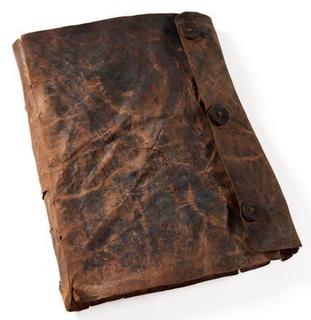
The Faddan More Psalter
If you want to read a book full of historical and liturgical surprises, pick up a copy of Connie Marshner’s 2024 Monastery and High Cross: The Forgotten Eastern Roots of Irish Christianity (Sopia Institute Press).
We have always known that St. Patrick was sent to Ireland by the Pope, not to bring the Gospel to the Emerald Isle for the first time but to tend a Christian flock already there (of course, he also did a great deal of evangelizing once he arrived). But the question still remains: who were these pre-Patrick Christians?
Marshner’s book, which is an expansion of her Masters thesis in Gaelic literature, provides an answer. The volume opens with the tale of an astonishing discovery. In 2006, an Irishman was digging up peat when he came upon a leather-covered book. The Faddan More Psalter, as it is now known, was written about AD 800. The content (the Psalms) are in Latin text of the Vulgate, the script is Gaelic, but the cover is distinctively Egyptian in style—and, inside the cover were fragments of papyrus!
If the thesis of Monastery and High Cross is correct, then we can consider the Faddan More Psalter a metaphor for early Irish Christianity as a whole: a mixture of Continental, local, and—most surprisingly, Middle Eastern elements. That mixture, incidentally, remained in Ireland until the Anglo-Norman invasion in the twelfth century, which was begun partially on the pretext of bringing the Irish Church more into line with the practices of Rome.
To understand the forgotten Eastern roots of Irish Christianity, let us begin by outlining some of the differences between the Faith in Ireland and on the Continent. The early Irish Church celebrated Easter on a different date; it did not have daily private Mass; it practiced antiphonal singing long before the rest of the West adopted the practice; it was more monastic than diocesan (in part because diocesan headquarters are typically in cities and Ireland had none until the Vikings forced their way in); Irish churches, some of which had an iconostasis (!), were so small that only the priest and his ministers were inside for the Mass while the deacon and congregation were outside; Irish monasteries were more eremitical (hermit-like) than cenobitic (communal); Irish art was unlike any other in Europe; and scholarship, knowledge of the Greek language, and Marian devotion were more advanced in Ireland than anywhere else in the West.

Not your typical Western monastic dwelling: the beehive cells of Skellig Michael, Ireland
Adding to this picture are puzzling artifacts. Besides the Faddan More Psalter, Irish archeologists have discovered objects from Egypt, North Africa, and the Byzantine Empire, including the skull of a Barbary ape. It is also curious that Celtic Crosses frequently depict St. Antony and St. Paul the Hermit, the founders of the Desert Fathers in Egypt, and that there is a fourth-century inscription in County Cork that reads “Pray for Olan the Egyptian”—recall that St. Patrick did not arrive in Ireland as a missionary until 432. We also have Irish manuscripts that contain texts found nowhere else except parts of the Middle East. And there is a Chi Rho monogram carved into a stone in northeast Ireland that is of the same design as that found in second-century Coptic and Armenian sources.

The stone on which is inscribed in Ogham (the earliest form of Irish writing), “Pray for Olan the Egyptian”
All this evidence points to an Eastern influence in general and a Coptic influence in particular, so much so that one of Marshner’s chapter sections is entitled, “The Nile Flows into the Shannon.” Celtic art, like we see in the seventh-century Book of Kells, has elements in common with fifth and sixth-century Coptic manuscripts, including curvilinear interlacing around letters, red dots, and fish or dolphins bearing a cross. The Book was also illuminated with color dyes from around the world, including lapis lazuli from Afghanistan.

From the Book of Kells
Ireland’s famous High Crosses are a particularly interesting example of Eastern influence. The pre-Christian Irish did not cut stone or carve stone, let alone use stone for monumental statuary. But from the seventh to the twelfth century, Celtic Crosses became common in Ireland, western Scotland, and even parts of France, where Irish missionaries were active.
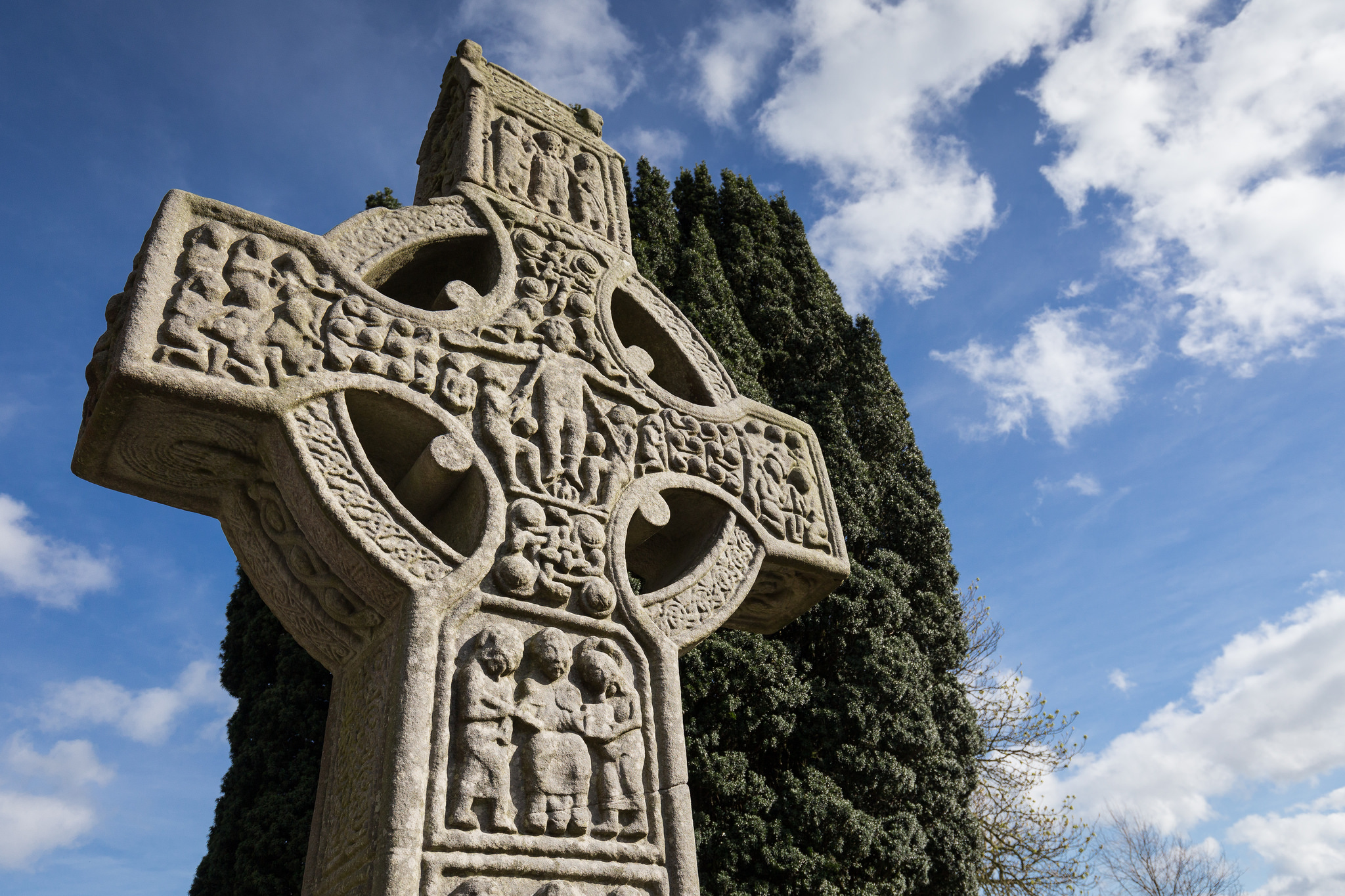
The Celtic Cross of Monsterboice
The crosses are an amalgamation of different Eastern practices. The very idea of having a stone sculpture came from Armenia: the Byzantine Empire did not have a tradition of sculpture, and in the West the practice died out with the fall of the Roman Empire in AD 476. The only Christian nation that had stone sculptures was Armenia, and apparently this easternmost fringe of the former empire shared its tastes with the westernmost fringe.

Chrismal with stauroteca
Celtic Crosses are distinctive because of the circle that surrounds the intersection of the arms. The pattern is most likely from Jerusalem. Pilgrims took home with them chrismals from the Holy City, small vessels that could contain chrism oil or even the Precious Blood. Some of these were in the shape of a cross with a stauroteca, a star-studded shield in the middle containing a portrait of Christ. A fifth or sixth-century Egyptian textile depicts this shield significantly enlarged—in other words, a Celtic cross (see below).

As for the carved markings, what is on the cross is significant as well as what is not on it. What is on it, as previously mentioned, are Desert Father Saints such as Antony and Paul the Hermit. Also included are typically Eastern choices, such as the Alpha and Omega and biblical scenes prefiguring the Crucifixion: Daniel in the lion’s den and the three youths placed in the fiery furnace. And what is not on these crosses is the Lamb of God, for the Byzantine Empire had outlawed depictions of Christ as a lamb.
Escape from persecution was probably the main motive for this Hiberno-Coptic connection. We know that orthodox priests and monks fled Egypt during the reign of Arian Emperors and later during the reign of Julian the Apostate (361-363), who denounced ascetics. They also fled en masse after the Islamic Arab conquest of Egypt in 642. It is quite possible that Ireland was one of several destinations for these periodic waves of refugees. We also know that Armenian clerics dwelt in Ireland for a while in the 600s and that the ninth-century Litany of Pilgrim Saints speaks of “seven monks of Egypt in the desert of Ulster.” Although there is no historical corroboration of this claim, it was enough to inspire the Coptic Orthodox Church to found a Seven Coptic Monks Church in Galway a couple of decades ago.
To compose Monastery and High Cross, Connie Marshner drew from an impressive array of scholarship, but her prose is not exactly that of a typical scholar:
“You might be saying to yourself at this point, ‘Connie, are you crazy? Aren’t we talking about the Dark Ages when nobody went anywhere more than five miles from where they were born? Isn’t it ridiculous to think penniless monks went thousands of miles from home?’ To which I say, ‘Hang on to your hat!’” (46).
The book also has useful call-outs on different topics, but they sometimes contain irrelevant digressions. After describing Andrew Ekonomou’s Byzantine Rome and the Greek Popes, she adds that Ekonomou has a “more varied biography than most academics: a former state prosecutor in Georgia, he is senior counsel at the American Center for Law and Justice” (25). Good for Ekonomou, but how does this contribute to my understanding of Catholic Ireland?
For a book with so many discussions about individual artifacts, I was surprised that it did not contain any illustrations or images. Monastery and the High Cross would have been greatly enriched by photographs, for as they say, each is worth a thousand words.
Marshner has subtitled her work the “forgotten Eastern roots of Irish Christianity,” but it would be more accurate to call it “the neglected roots.” As Marshner’s own footnotes attest, scholars have known for at least a century that the East influenced Celtic Christianity. Monastery and High Cross does not so much propose a brand-new thesis as assemble a series of theses and corroborate them with recent findings like that of the Faddan More Psalter.
Nor does the volume present a tidy picture of Eastern influence, either with respect to how it came to be or what was being shared. We do know not always know, for example, whether the path was indirect—from the East, through Mozarabic Spain or Gallican France, to Ireland—or direct. And if it was direct, we do not always know the origin country: Egypt, Syria, Armenia, etc. Monastery and High Cross successfully makes its case that Celtic Christianity has Eastern roots, but it leaves us with more questions than answers. It is Marshner’s hope that her book “may pique the interest of future scholars who will be able to do more justice to the topic” (xiii), and mine too.
This review originally appeared in The Latin Mass magazine 35:1 (Spring 2026), pp. 58-59. Many thanks to its editors for allowing its publication here.




