Friday, February 20, 2026

A Prayer from Ash Wednesday

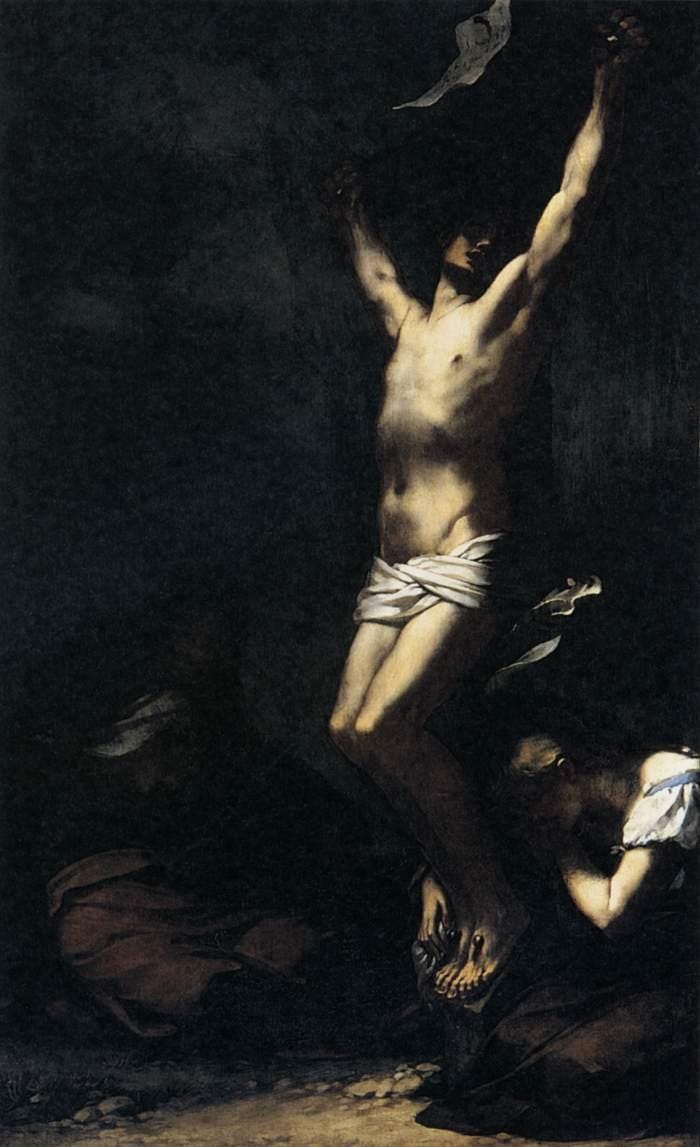
The Torment of St. Anthony, Michelangelo
Lost in Translation #161

I cannot resist the temptation to take a brief hiatus from our examination of the Ordinary of the Mass to mull upon a remarkable prayer from the Blessing of Ashes. After all have received their ashes on Ash Wendesay, the priest prays:

Concéde nobis, Dómine, praesidia militiae christiánae sanctis inchoáre jejuniis: ut contra spiritáles nequitias pugnatúri continentiae muniámur auxiliis. Per Christum Dóminum nostrum.
Which I translate as:
Grant to us, O Lord, to begin with holy fasts the post of Christian warfare: that, as we do battle with spiritual evils, we may be protected by the help of self-denial. Through Christ our Lord.
Although this prayer is also in the 1970 Missal, spiritual combat is not a favorite theme among more progressive Catholics, who disdain this imagery as too aggressive or bellicose. And yet, spiritual combat is no mere metaphor: it is a reality sown into the DNA of Christian life. It is an essential part of St. Paul’s theology, (see Eph. 6, 11; 12) and it features prominently in the writings of the Church Fathers and medieval Doctors, such as St. Augustine and St. Hildegard of Bingen (and yes, women are called to be spiritual “shield-maidens,” as Tolkien might say, as well).
The Conversion of St. Augustine, Fra Angelico
It is curious that the 1970 Missal retains a reference to our “holy fasts,” since the mandatory Fast was eliminated in 1966, and since the Novus Ordo makes no other reference to fasting in its orations during Lent. The 1962 Missal, on the other hand, prays for a holy fast almost day of the week in its prayers.
The Collect asks that we may be protected from spiritual evils by the help of continentia, which is usually translated as “self-denial.” Continentia entails self-denial, but it is more. On the verge of his conversion, St. Augustine prayed for “chastity and continence, but not yet,” afraid of giving up the dirty little pleasures with which he had grown so comfortably accustomed. (Conf. 8.7.17) Continence is a regaining of mastery over self, an ability to be self-contained (with God’s grace, of course) over the tug of the appetites; it is more self-control than self-denial. The 2011 ICEL translation comes admirably close when it translates continentia as “self-restraint.”
Finally, according to the economy of the prayer, continence becomes a defensive weapon against demonic assault, a shield or an armor. We enter into the Great Fast, as the Preface of Lent declares, to “curb our vices, elevate our minds, and bestow virtue and reward.” And in the words of the Secret for the First Sunday of Lent, we solemnly offer God “the sacrifice of the beginning of Lent, beseeching [Him], that by refraining from flesh at our meals, we may refrain from harmful pleasures.” In other words, we refrain from licit pleasures (there is nothing wrong with consuming the flesh of a warm-blooded animal) in order to take charge over pleasures that lean into the illicit (gluttonous habits, etc.). Such is the power of continence for which we pray as we enter into the annual Boot Camp of spiritual combat.

Thursday, February 19, 2026

Sacred Music Study Day in Menlo Park, California, April 18

On Saturday, April 18th, St Patrick’s Seminary in Menlo Park, California, will host the third annual Sacred Music Study Day – co-sponsored with the Archdiocese of San Francisco and the Catholic Institute of Sacred Music – drawing together singers from all over northern California for an all-day Catholic choral festival.

The event features:
  • Two tracks for singers: advanced or beginner/intermediate
  • Rehearsals featuring music you can take home to your congregations: a Mass ordinary, Eucharistic hymns, approachable and beautiful choral music
  • The opportunity to learn music we can sing together at Mass
  • Tips on teaching/learning note-reading in rehearsals
  • Workshops offering tips on developing and teaching healthy vocal technique
  • Solemn Mass, sung by participants, celebrated by His Excellency, Salvatore J. Cordileone, Archbishop of San Francisco
  • Catechesis on the role of sacred music in the spiritual life
  • An opportunity to go to confession
  • Lunch, refreshments, and fellowship with area musicians
The event is designed especially for parish music directors, parish choir members, cantors and clergy; singers and music directors of all ability levels will find the event enriching and worthwhile. The presenters are:
  • His Excellency, Salvatore J. Cordileone Archbishop of San Francisco
  • Dr. Jennifer Donelson-Nowicka Director, Catholic Institute of Sacred Music
  • Dr. Christopher Berry, Assistant Professor, Catholic Institute of Sacred Music
For the full schedule and registration information, please visit the website:

Durandus on the Thursday after Ash Wednesday

On the preceding day (Ash Wednesday), all are invited to repentance; and because penance consists in three things, namely, prayer, fasting and almsgiving, on the three days, the liturgy treats of these three, with prayer first, on this Thursday, and for this reason, the introit begins with the words, “When I cried out to the Lord.”

Introit When I cried out to the Lord, He heard my voice from those who approach me, and He humbled them, Who is before the ages and remaineth forever. Cast Thy thought upon the Lord, and He will sustain thee. Ps. Hear my prayer, o God, and despise not my pleading; give Thou heed to me, and hear me. Glory be... When I cried out...
Introitus, Ps. 54 Dum clamárem ad Dóminum, exaudívit vocem meam ab his, qui appropinquant mihi, et humiliávit eos, qui est ante sáecula et manet in aeternum: jacta cogitátum tuum in Dómino, et ipse te enutriet. Ps. Exaudi, Deus, oratiónem meam, et ne despéxeris deprecatiónem meam: intende mihi et exaudi me. Gloria Patri... Dum clamárem...

Now a man may pray sometimes for himself, sometimes for another. Therefore, to show how much prayer made for another on one’s behalf avails, there follows the Epistle, “Ezechiah grew sick unto death,” (Isaiah 38, 1-6), in which the Church puts King Ezechiah forth as an example, who, by the prayer made for himself, obtained from the Lord that fifteen years be added to his life. And so that the Church may also show how greatly prayer for another avails, the Gospel “When Jesus entered Capharnaum” is read (Matt. 8, 5-13), about the centurion who prayed the Lord that his servant might be saved, and obtained this. (William Durandus, Rationale Divinorum Officiorum, VI, 29)
An image from the Paris Psalter, a decorated psalter made in Constantinople in the mid-10th century, now at the Bibliothèque national de France in Paris. On the left side, the prophet Isaiah visits King Ezechiah as he lies on his sickbed, as narrated in today’s epistle; on the right, Ezechiah prays as he looks at the personification of Prayer. The canticle which follows this lesson, Isa. 38, 10-20, is sung in the Roman Office at Lauds of Tuesday, and in the Office of the Dead.

Wednesday, February 18, 2026

Liturgical Notes on Ash Wednesday

It is a universal custom of all historical Christian rites not to fast on the day of the Lord’s Resurrection, even in Lent and Holy Week. The original Roman Lent of six weeks therefore comprised forty-two days, but only thirty-six days of fasting, which St Gregory the Great describes as “the tithe of the year.” (Hom. XVI in Evang.) The Roman Missal preserves a reminder of this in the Secret for the Mass of the first Sunday of Lent, which speaks of the “sacrifice of the beginning of Lent.”

Not long afterwards, however, perhaps by Gregory himself, the four days preceding the first Sunday were added to the fast to bring the number of days to exactly forty, the length of the fast kept by the Lord Himself, as well as by the prophets Moses and Elijah. This extension of Lent back to Ash Wednesday, which was once commonly known as “in capite jejunii – at the beginning of the fast”, is a proper custom of the Roman Rite, attested in the earliest Roman liturgical books of the century after St Gregory. It was copied by the Mozarabic liturgy, but never by the Ambrosian, and indeed, the Milanese traditionally make a point of eating meat on this day. In the Eastern rites, Great Lent begins on the Monday of the First Week, two days before the Roman Ash Wednesday.

A Greek icon of the Transfiguration from the second half of the 15th century. The Gospel of the Transfiguration, Matthew 17, 1-9, is read on the Ember Saturday of Lent in reference to the forty-day fast of Christ, which is mentioned on the previous Sunday (Matthew 4, 1-11) and of the two Prophets who appeared alongside Him at the Transfiguration, Moses and Elijah, both of whom appear in the readings of Ember Wednesday.(Public domain image from Wikimedia Commons.)
The Breviary of St Pius V and its medieval predecessors also preserve a memory of the fact that Ash Wednesday is a later addition. Although the fast begins on that day, the proper features of the Lenten Office (the hymns, chapters, versicles etc.) only begin to be sung at Vespers of Saturday before the First Sunday. This is also reflected in the traditional nomenclature of the three days after “Ash Wednesday (Feria IV Cinerum)”, which are called “post cineres – after the ashes,” rather than the first Thursday, Friday and Saturday of Lent. In the titles printed in liturgical books, and in the prayers of the Mass, the use of the Latin word for Lent, “Quadragesima,” only begins on the first Sunday. (An apparent exception is the Secret of the Friday “post cineres”, which contains the words “observantiae quadragesimalis”, but this is a revision of the Tridentine editors; the original reading was “observantiae paschalis.”)

The blessing and imposition of ashes was originally a rite for those who were assigned to do penance publicly during Lent for grave or notorious sins, an extremely ancient discipline and practice of the Church. The extension of this custom to all the faithful began in the later part of the 10th century, and was solidified by the end of the 11th, when Pope Urban II prescribed it at the Council of Benevento in 1091. The rite of “expelling” the public penitents from the church on Ash Wednesday, and receiving them back on Maundy Thursday, remained in the Pontifical for centuries after it had faded from use; another trace is the prayer “for the penitents” among the Preces said at Lauds and Vespers in penitential seasons. Many medieval uses also added a special commemoration of the public penitents to the suffrages of the Saints; in the Sarum Use, it was said as follows at Lauds:

Aña Convertímini ad me in toto corde vestro, in jejunio et fletu, et in planctu, dicit Dóminus.
V. Peccávimus cum pátribus nostris. R. Injuste égimus, iniquitátem fécimus.
Oratio Exaudi, quaesumus, Dómine, súpplicum preces, et confitentium tibi parce peccátis: ut páriter nobis indulgentiam tríbuas benignus, et pacem.

Aña Be ye turned to me with all your heart, in fasting, and in weeping, and in mourning, sayeth the Lord.
V. We have sinned with our fathers. R. We have acted unjustly, we have wrought iniquity.
Prayer Graciously hear, we beseech Thee, O Lord, the prayers of Thy supplicants, and pardon the sins of those who confess to Thee: that Thou may kindly grant us both pardon and peace.

The expulsion of the public penitents, in an illustration from a 1595 edition of the Roman Pontifical. (Reproduced by permission of the Pitts Theological Library, Candler School of Theology at Emory University)
In the Missal of St Pius V, the blessing of the ashes is introduced by a chant which is called an antiphon in the rubrics, but is structured like an introit. The blessing itself consists of four prayers, the sprinkling of the ashes with holy water, and their incensation, after which they are imposed on all present, while two antiphons and a responsory are sung. The rite concludes with a brief prayer, and then the Mass begins.

In the Middle Ages, the Ash Wednesday ceremony generally included a procession as well. Historically, processions are regarded as penitential acts by nature; this is the reason why even those of Candlemas and the Rogations were traditionally done in penitential violet, although the Mass of the former and the season of the latter require white vestments. (See note below.)

In the year 1143, a canon of St Peter’s named Benedict wrote the following brief description of the Ash Wednesday ceremony in his treatise on the rituals of Rome and the Papal court, now known as the Ordo Romanus XI. “The ‘Collect’ (i.e. gathering is held) at St Anastasia, where the Pope comes with the whole curia; and there is he dressed, and all the other orders go up to the altar. There the Pope gives the ashes, and the primicerius sings with the schola the Antiphon Exaudi nos, Domine. When the (ritual at the Collect church) is finished, the Pope and all the others go bare-footed in a procession to Santa Sabina, followed by the primicerius with the schola, as they sing (the antiphon) Immutemur habitu. When they reach the church, the subdeacon lays aside the (processional) cross, and goes to the altar during the litany (of the Saints)… the Pope sings the Mass without the Kyrie, because of the Litany”, (i.e., it has already been sung at the end of the Litany.)

Later descriptions of this ceremony, such as the various recensions of the Ordinal of Innocent III (1198-1216), mention that the ashes were made at the church of St Anastasia by burning the palms left over from the previous year’s Palm Sunday, a common custom to this very day. During the Papal residence in Avignon, however, many long-standing traditions of the Papal court dropped out of use and were never revived; thus, the procession is not included in the pre-Tridentine Missal of the Roman Curia, the antecedent of the Missal of St Pius V.

A penitential procession led by St Gregory the Great, from the Très Riches Heures du Duc du Berry, by the Limbourg brothers, 1412-16.
Note: The ancient processions of the Roman Rite, all of which were once regarded as obligatory at major churches, were those of Candlemas, Ash Wednesday, Palm Sunday and the Rogation Days. Corpus Christi was added last, as the culmination of the liturgical year; the white vestments used at the procession indicate its purely celebratory character, wholly appropriate to the nature of the feast. However, it should be noted that the procession is not even mentioned in the Missal, nor is any particular music prescribed for it; of course, the Litany of the Saints, the penitential prayer par excellence, is not sung, and the procession is done after the Mass, rather than before it.

A Letter Exchange on the Last Council and the Liturgical Reform

The following letter exchange took place between me and a gentleman whose personal details have been edited out.

Dear Dr. Kwasniewski,

I am a high school theology teacher and also lead Bible studies. The life of the Church, the Scriptures, and Holy Mass are all integral to my daily life. I find all issues related to liturgy to be terribly confusing. There are so many different narratives out there that one could lose one’s mind trying to figure out which one is correct, or if any is correct. There is the fine work done by many of you at New Liturgical Movement, among others. One could also find a different view point from rad trads, or a liberal view from people at the Pray Tell blog. So, lots of passionate views by highly educated people who feel they are interpreting Vatican II in the right way. (Unless they reject the council altogether, which is another story.)

My question, then, is: Where to begin, and whom do I trust? Having read Vatican II and Sacrosanctum Concilium on a number of occasions, as well as in class work, it seems that some reform was certainly called for. How, then, can some people completely dismiss the council and the directives that were given? I have friends who do that quite often, while referring to the council as simply “pastoral.” Yet, I am sympathetic with these people because of some of the unfortunate innovations that occurred after the council. So, for me at least, while I like the reverence and use of Latin in the TLM, I still prefer the Novus Ordo. It seems to me that there must be some place of meeting between the two, while being faithful to both the received liturgical tradition of the Church and the reforms called for by SC. What do you think?

Sincerely yours,
A Curious Catholic

***
Dear Sir:

I completely understand your predicament, as it parallels how I felt at a certain juncture. We are living in a confusing age, and a certain diversity of opinions is not only to be expected but should be tolerated, even (at times) welcomed, as we try to work things out as best we can, in the absence of strong and able leadership at the higher levels of the clergy.

This much seems beyond any doubt: the reforms to the liturgy from 1964 to 1970 went far beyond anything that the Council Fathers ever had in mind or anything that Sacrosanctum Concilium could possibly justify. This has been so thoroughly documented and demonstrated that it’s no longer an open question.

Those who defend Bugnini and the Consilium are forced, then, simply to say, “Well, that’s true, but they did the bold thing – the thing that had to be done – and the Pope recognized it and approved it.” On the other hand, those who question Bugnini’s and the Consilium’s principles will say, “We’re not surprised at the disaster that has befallen the Church, since you cannot break with the organic tradition of the liturgy and not expect to introduce massive amounts of chaos and malaise.”

None of this touches on the question of sacramental validity, which is to be presumed and can be readily defended on theological grounds; but certainly the question of the prudence of the changes and their defensibility is fair game. The attempt to shut down that conversation has failed, particularly when it became apparent that Joseph Ratzinger, one of the greatest theological luminaries of the twentieth century, and truly “the pope of the liturgical question,” was more than willing to participate in it himself.

Moreover, it really is the case that both John XXIII and Paul VI spoke of the Council as pastoral in nature and as an attempt to interpret and respond to modern man. In 1988, Cardinal Ratzinger said the following in an address to the bishops of Chile:

“The Second Vatican Council has not been treated as a part of the entire living Tradition of the Church, but as an end of Tradition, a new start from zero. The truth is that this particular Council defined no dogma at all, and deliberately chose to remain on a modest level, as a merely pastoral council; and yet many treat it as though it had made itself into a sort of “super-dogma” which takes away the importance of all the rest.”

Consequently, it was possible for the Council to get some things right and others not so right, since we are not dealing with unalterable dogmas that must be believed, or anathematized errors that must be shunned. The simple fact that the Council says “we should do X” doesn’t mean that, some decades later, we can’t legitimately argue that X wasn’t the best response, or that it wouldn’t make more sense to do Y or Z today. Indeed, this kind of situation has occurred many times in the history of the Church, which gives us other examples of councils (think of the Lateran councils) whose reforms didn’t always work or, in some cases, weren’t even attempted.

It seems to me that the Pray Tell perspective is generally untenable because it exalts progressivism at the expense of tradition, which is a fundamentally uncatholic way of thinking and judging. Rorate Caeli represents a consistent traditionalism that considers safe, sound, and sacred that which has always (or nearly always) been done by everyone (or nearly everyone) everywhere (or nearly everywhere). New Liturgical Movement is a meeting ground for various interests, announcements, and hypotheses, but always within a general commitment to the normativity of tradition. One will not stray far from the truth if one endeavors to remain faithful to the Magisterium while seeing tradition as a non-negotiable good that should always be privileged.

You raise an interesting question about Vatican II’s request for a reform of the liturgy. As you know, the Council insisted that no change be made unless the good of the Church certainly required it (SC 23). Far more changes were made than were ever certainly required, and the floodgates were opened for abuses. Even from a sociological-anthropological point of view, everyone knows that a gigantic and tradition-bound body can only absorb change slowly and stepwise, unless one wants to provoke rupture and confusion – which is exactly what happened. It could have been, and was, predicted ahead of time.

It seems clear that Benedict XVI’s intention was that the two “forms” would peacefully coexist for a long enough time to allow a restart of organic development, but I will admit that it’s difficult in practice to see how this would have actually taken place, and I am not aware of many traditionalists who want to see the old rite modified, for reasons explained in one of my recent books, Close the Workshop. In any case, it seems that “full, conscious, and active participation” was the primary reason given for reform, and I think it is not difficult to argue that the TLM in fact allows for a superior fulfillment of this desideratum.

Yours in Him,
Peter Kwasniewski

Dear Dr. Kwasniewski,

About four years ago I emailed you, out of the blue, with some questions about Vatican II, the old Mass and the new Mass. I have spent the past four years reading as much as I can while also observing and praying over my own experiences attending Mass. I have devoted considerable time reading authors that would typically be published on Pray Tell, and while I agree with some of what they argue, mainly the need of some reform, I simply cannot understand their unwillingness to see that a number of the experiments that occurred after the Council did not benefit the People of God. Examples would be the loss of chant, the abandonment of ad orientem, and the complete neglect of Latin.

When I attend the old rite, I fully appreciate the elements in it that are clearly lacking in the new rite. For me, there is a real attraction to it. However, here’s my one concern. I don’t want to be involved with any part of the Church that rejects the Second Vatican Council. While I think there is plenty of healthy dialogue that can go on concerning the implementation of Sacrosanctum Concillium, I am wary of those who reject elements of the Council. I firmly support the teachings on religious liberty, Nostra Aetate, Unitatis Redintegratio, and Lumen Gentium. My question to you is, can I embrace the pre-Conciliar Missal while also embracing the Vatican II in full?

God bless you,
A Curious Catholic

***
Dear Sir:

It’s very good to hear from you again. I no longer read Pray Tell, as I found that the perspective of Fr. Ruff in particular was exceedingly irresponsible. He speaks as if Vatican II amounted to a carte-blanche to overturn anything and everything in order to retool the Church for modern evangelization. Even if one might admire the apostolic motivation of this view, we can see that it has failed in so many ways.

Where there is flourishing new life in the Church, it has tended to align itself with so-called conservative or traditional constituencies. We can see this most obviously in the clergy, religious life, and marriages: young clergy tend, on the whole, to be interested in recovering traditions that were lost; religious orders that are growing or maintaining their numbers are the ones unembarrassed or even eager about Catholic tradition; and the marriages that are bringing new life into the Church and the world are those that are faithful to the indissoluble unitive and procreative finalities of marriage as a life-giving and life-sacrificing covenant.

You raise a difficult and challenging question – namely, about the doctrinal content and subsequent reception of the Second Vatican Council. Unavoidably, the Council is controversial, because, on the topics you mentioned (and others), it staked out positions that are not always obviously in harmony with preceding magisterial teaching. For example, there are clear tensions (which is not yet to say absolute contradictions) between Leo XIII’s encyclical Libertas Praestantissimum and Vatican II’s Dignitatis Humanae, or between Pius XI’s encyclical Mortalium Animos and Vatican II’s Unitatis Redintegratio, or between Pius XII’s Mystici Corporis and Vatican II’s Lumen Gentium.

Because the Council was intended as a pastoral response to modern times, as both John XXIII and Paul VI repeatedly said, it did not engage the highest level of magisterial authority – that is, it did not issue de fide pronouncements or anathemas on errors, which are considered infallible exercises of the Magisterium. At most, as the Nota praevia indicates, it intended to restate teachings already known to be true from their presence in the doctrinal heritage of the Church.

The conciliar documents were presented as a restatement of the Catholic Faith in modern language, and to that extent, they may be responsibly criticized, although the Council’s validity as an ecclesiastical gathering cannot be disputed, nor can the documents be dismissed out of hand. They must not be placed on an untouchable pedestal. Indeed, there is a great irony (as again Ratzinger pointed out) in the fact that the so-called “progressives” feel free to dispute and dismiss the more obviously authoritative canons and decrees of the Council of Trent, where we find the words de fide and anathema on practically every page, while they pillory anyone who so much as questions the prudence or adequacy of any formulation in Vatican II. Surely there is here a strange inversion and confusion.

Thus, everything depends on what is meant by “embracing Vatican II in full.” Whatever is clearly in line with the perennial Magisterium we should embrace; anything that seems in tension with it we may accept on condition that it be in harmony (which we may or may not be able to see ourselves); and we may suspend assent to false interpretations or extrapolations that have caused great harm to the Mystical Body of Christ. What I have just summarized is the view of Bishop Athanasius Schneider, such as can be found in his book Christus Vincit: Christ’s Triumph Over the Darkness of the Age, which I highly recommend for its clarity and serene common sense.

We must also be prepared to acknowledge that the state of the world today, sixty years after the close of the Council, is vastly different than it was back then, and that the burning issues that animated the prelates of the 1960s are no longer ours; moreover, that certain solutions, such as the recovery of tradition, are proving to be more effective in reaching, converting, and nourishing postmodern man than any of the programs aimed at “modern man” as conceived circa 1970. Thus, it may also simply be the case that Vatican II, whatever its status might be, has already simply ceased to be of much relevance, and therefore is no longer worth all the anguish and laborious exegesis it once occasioned.

It seems to me that the sooner bishops and cardinals recognize this dramatic shift, the sooner they can respond to the actual needs and desires of the People of God, and hear what the Spirit is saying to the churches today.

Yours in Christ,
Dr. Kwasniewski

Tuesday, February 17, 2026

Medieval Art and Liturgical Objects at the Musée de Cluny in Paris (Part 3): Reliquaries

For this third set of Nicola photographs of an exhibition recently held at the Musée de Cluny in Paris, titled “The Middle Ages of the 19th Century - Creations and Fakes in the Fine Arts”, the focus is on medieval reliquaries, and modern ones inspired by them. The first piece, which is the result of work done in four different periods, exemplifies how the influence of medieval art endured in later times. 

A reliquary cross made at the end of the 12th century (1180-1200), mounted on a base made in the 14th, with a corpus of the 16th, assembled into its current form in the 19th. 

A reliquary plaque made in the German city of Hildesheim, copper in champlevé and enamel, 1160-70.

A reliquary of the column of the Flagellation, made in Venice in the mid 15th-century.

A reliquary statue of St Anne, made in Germany in 1472. Anne is shown holding a small coffer, smell figures of Jesus and Mary to either side. This motif, known as a “selbdritte – she herself (i.e. Anne) is the third” was very popular in late medieval Germany.

Two reliquaries of a rather unusual design, with a small tower resting on top of a box, were both made in the area of Basel, Switzerland, in the later 15th or early 16th century, and later partly reworked.

Composer Andrew Dittman Releases New Collection of Sacred Music

Noble and Accessible, Ever Ancient, Ever New

I am delighted to announce the release of new sacred music by American composer Andrew Dittman called The Kyrial. The settings are generally familiar melodies from Latin chants of the Ordinary of the Mass (Kyrie, Agnus Dei, Pater noster etc), adapted to the English language, and given an Anglican flavour through four-part harmonies that are evocative of traditional Anglican chant.

Andrew has been choirmaster at The Chapel of the Cross Reformed Episcopal Church since 2013, and composes sacred music for weekly liturgical performance. His work is rooted in traditional forms and sung in English and Latin. He draws on a range of influences, including plainchant, Renaissance and Baroque counterpoint, creating compositions that are both timeless and approachable. Like Paul Jernberg, who composes for the Roman Rite and Roman Hurko, who composes for the Byzantine Rite, Dittman represents a new generation restoring sacred music to its proper place.

Historically, high culture and popular culture were not divided – composers like Mozart and Beethoven drew from a shared cultural font rooted in the sacred, resonating with both aristocracy and ordinary people. To restore this unity, we need fresh creativity in traditional forms of music that is both timeless and speaks to the current age, with sacred music within the liturgy reclaiming its role as the pinnacle of artistic expression. Andrew exemplifies a return to this ideal.

The collection is called The Kyrial and is available on Spotify, Amazon or Pandora. You can also listen to his work on YouTube at youtube.com/@aldittman

Monday, February 16, 2026

A New Resource for Lent from Paraclete Press

Christ in Our Midst: Daily Lenten Reflections Through Scripture and Gregorian Chant

Paraclete Press has recently released a new devotional resource for Lent and Easter called Christ in Our Midst: Daily Lenten Reflections Through Scripture & Gregorian Chant. Each day from Ash Wednesday to Low Saturday, the book provides a reflection based on readings from the Scripture and a piece of Gregorian chant used in the liturgy (following the post-Conciliar Rite; some of the chants are repeated through the whole week, others are specific to the day). The chant is given in Latin with its musical notation, and an English translation; for each piece, a QR code is printed in the book which gives access to a recording of it by the Gloria Dei Cantores Schola. There also space given to write down one’s personal reflections in response to questions that based on the reflection. One can access an excerpt of the book, the pages for Palm Sunday, here: https://s3.amazonaws.com/supadu-imgix/paracletepress-us/pdfs/excerpts/9798893480283.pdf

Sunday, February 15, 2026

Quinquagesima Sunday 2026

Truly it is worthy and just, right and profitable to salvation, that we give Thee thanks always and in every place, Lord, Holy Father, almighty and eternal God, and bowing down, beseech Thy majesty with devotion, that looking upon the small measure of our earthly fragility, Thou may not reprove us in Thine anger for our wickedness, but in Thy boundless clemency purify, instruct and console us. For since without Thee we can do nothing that may please Thee, Thy grace alone shall grant to us, that we live in a salutary manner. Through Christ our Lord, through whom the angels praise Thy majesty... (An ancient preface for Quinquagesima Sunday)

The Virgin Mary suckling the Baby Jesus, surrounded by the Cardinal Virtues (to either side) and the Theological Virtues (above.) Fresco made in 1393 by the Florentine painter Cenni di Francesco di Ser Cenni, in the city hall of the town of San Miniato. (Image from Wikimedia Commons by Sailko, CC BY-SA 3.0.)
Vere dignum et justum est, aequum et salutáre, nobis tibi semper et ubíque gratias ágere, Dómine, sancte Pater, omnípotens aeterne Deus, et majestátem tuam cernua devotióne exoráre, ut módulum terrénae fragilitátis aspiciens, non in ira tua pro nostra pravitáte nos arguas, sed immensa clementia purífices, erudias, consoléris. Quia, cum sine te nihil póssumus fácere, quod tibi sit plácitum, tua nobis gratia sola praestábit, ut salúbri conversatióne vivámus. Per Christum, Dominum nostrum. Per quem majestatem tuam laudant Angeli...

Saturday, February 14, 2026

Medieval Art and Liturgical Objects at the Musée de Cluny in Paris (Part 2)

This is the second post in our series of Nicola’s photographs of an exhibition recently held at the Musée de Cluny in Paris, titled “The Middle Ages of the 19th Century - Creations and Fakes in the Fine Arts”, a display of medieval works next to modern ones inspired by them, and some forgeries as well. Here we have an interesting mix of vestments, textiles, reliquaries, and vessels, but we begin with two paintings which include medieval liturgical objects in them. 

A still-life by the French painter Blaise Alexandre Desgoffe (1830 – 1901), ca. 1890, titled “Still Life with a Reliquary of St Henry and various medieval artworks.” Desgoffes was a highly regarded specialist in the still-life genre, and very interested in medieval art: the objects represented here are all in the medieval collection of the Louvre.

Ornaments from the Musée de Cluny, by Joseph Bail, 1886
A chalice originally made perhaps in Catalonia, sometime from roughly 1325-50, restored in the 19th century in Paris.
A reliquary with part of the arm bone of the Apostle St James the Less, made for the church dedicated to him in Liège, Belgium, in 1889. The firm that produced this, Joseph and Georges Wilmotte, working on a design by the architect Jean-Baptiste Bethune, won a silver medal for it at the Paris Exposition that same year.

“Those Who Shone Forth in the Ascetic Life”

Rejoice, faithful Egypt; rejoice, holy Libya; rejoice, o chosen Thebaid; rejoice, every place, and city, and land that nourished the citizens of the kingdom of heaven, and raised them in self-discipline and toil, and showed them forth to God as men perfect in their desires. They were revealed as those who give light to our souls; these very same, by the glory of their miracles, and the wonders of their deeds, shone forth to our minds, unto every corner of the world. Let us cry out to them, “All-blessed fathers, pray that we may be saved!”

Scenes from the Lives of the Desert Fathers, or “Thebaid”, by Blessed Fra Angelico, 1420; now in the Museum of Fine Arts in Budapest.
Χαῖρε Αἴγυπτε πιστή, χαῖρε Λιβύη ὁσία, χαῖρε Θηβαῒς ἐκλεκτή, χαῖρε πᾶς τόπος, καὶ πόλις, καὶ χώρα, ἡ τοὺς πολίτας θρέψασα τῆς Βασιλείας τῶν οὐρανῶν, καὶ τούτους ἐν ἐγκρατείᾳ καὶ πόνοις αὐξήσασα, καὶ τῶν ἐπιθυμιῶν τελείους ἄνδρας τῷ Θεῷ ἀναδείξασα. οὗτοι φωστῆρες τῶν ψυχῶν ἡμῶν ἀνεφάνησαν, οἱ αὐτοὶ τῶν θαυμάτων τῇ αἴγλῃ, καὶ τῶν ἔργων τοῖς τέρασιν, ἐξέλαμψαν νοητῶς, εἰς τὰ πέρατα ἅπαντα. Αὐτοῖς βοήσωμεν· Πατέρες παμμακάριστοι, πρεσβεύσατε τοῦ σωθῆναι ἡμᾶς.

On the Saturday before Great Lent begins, the Byzantine Rite commemorates “All of the God-bearing Fathers and Mothers Who Shone Forth in the Ascetic Life.” This text, from Vespers of the preceding day, beautifully recalls the origins of monasticism and the ascetic life in the deserts of Egypt and north Africa. The “Thebaid” to which it refers is one of the provinces into which Egypt was divided by the reforms of the Emperor Diocletian in the later 3rd century; this province had its capital at Thebes, the impressive ruins of which are now within the city of Luxor, including some of the most famous ancient temples. Likewise, the first Ode of Matins for this day begins with the words “Let us all sing together in spiritual songs, of those who shone forth in asceticism, our godly Fathers, whom Egypt, Libya and the Thebaid bore, and every place and city and land.”

One of the most influential writings on Western monasticism is John Cassian’s Institutes, which refer very frequently to the Egyptians as the models of monastic life, as, for example, at the beginning of the third book, in which he speaks of “the perfection and inimitable rigor of the discipline of the Egyptians.” Likewise, when St Benedict’s Rule commands that the entire Psalter should be said in the Office within a week, since “we read that our holy forefathers promptly fulfilled (this recitation) in one day,” he is referring to the common practice of the early ascetics. As the Fra Angelico painting above, and various others like it show, the Western Church never forgot the origin of the ascetic and monastic life; and the motif of the “Thebaid” serves to recall all religious of whatever sort to the ideal expressed by the words of Christ, “Be ye therefore perfect, even as your Father who is in heaven is perfect.”

Pope St Leo the Great writes in his fourth sermon on Lent that very few have the strength to remain continually in a spiritual condition such as the feast of Easter ought to find them in, and with the relaxation of the more strict observance of Lent, and the general cares of this life, “even religious hearts must grow dirty with the dust of this world.” Therefore, the forty days exercise of Lent was instituted by Divine Providence, so that the devotions and fasts of Lent might purify us of the sins which we have committed in the rest of the year. The Byzantine Rite therefore concludes its Fore-Lent with a commemoration of those Saints who did have such strength, and by embracing the ascetic life, lived as it were a continual Lent, invoking their intercession on behalf of the whole Church on the eve of the Great Fast.

Friday, February 13, 2026

A New Webpage about Cardinal Dante, with Pictures of Papal Ceremonies

Back in 2014, we shared notice of an e-book about the famous Enrico Cardinal Dante, who served as papal master of ceremonies from 1947 until his death in 1967. The book was originally put together by a Polish scholar, and contained a large number of original documents concerning Dante’s career, and photographs of many of the ceremonies he organized. Today I received notice that the book is no longer available in its original form, but that the material it contained is being made available through the Polish website Caeremoniale Romanum, at the following URL:

https://caeremonialeromanum.com/en/project-information-enrico-dante/

Images reproduced courtesy of Caeremoniale Romanum: two rare color photographs of a papal Mass celebrated by Pope St John XXIII, with Dante as the master of ceremonies.
Mons. Dante (far left) at his episcopal consecration, with Pope John 

The Per ipsum

Lost in Translation #160

After the Per quem haec omnia, the priest concludes the Canon with:

Per ipsum, et cum ipso, et in ipso, est tibi Deo Patri omnipotenti, in unitáte Spíritus Sancti, omnis honor et gloria… per omnia saecula sæculórum. ℟. Amen.
Which I translate as:
Through His very self and with His very self and in His very self, all honor and glory belongs to You, God the Father Almighty, in the unity of the Holy Spirit, through all ages of ages. ℟. Amen.
The phrasing of the Per ipsum is inspired by Romans 11, 36:
Quis enim cognovit sensum Domini? aut quis consiliarius ejus fuit?
aut quis prior dedit illi, et retribuetur ei?
Quoniam ex ipso, et per ipsum, et in ipso sunt omnia: ipsi gloria in saecula. Amen(Rom. 11, 34-36)
Which the Douay-Rheims translates as:
For who hath known the mind of the Lord? Or who hath been His counsellor?
Or who hath first given to Him, and recompense shall be made Him?
For of Him, and by Him, and in Him, are all things: to Him be glory for ever. Amen.
In this passage, St. Paul is concluding a theologically dense reflection on salvation history and the cryptic role that Israel plays in it. He ends by stating that since God is the Creator of all (and we cannot say the same about ourselves), we should resign ourselves to the fact that He knows what He is doing even though we cannot fully understand His plan, and that we should glorify him. The triple expression – ;“of Him,” etc. – is primarily in reference to the Father (with a possible Trinitarian echo) and to the beginning, middle, and end of creation. All things have their origin in God; all things continue to exist by virtue of God; and all things have God as their end (the original Greek eis auton or “unto Him” more clearly expresses this idea than the Vulgate’s in ipso).
Although the Per ipsum also has creation in mind (because of the way that it follows the Per quem), it is different in a number of respects, not least of which is that the triple expression is in reference to the Son rather than the Father. We may therefore consider the prayer an example of spiritual eructation; but in this case it is not so much the content that is the object of rumination but a kind of grammar of ascent, a mode of thinking about the transcendent mysteries. [1]
Let us now turn to the different parts of the prayer. (We shall leave the very end and the Minor Elevation for another day.)
Per ipsum, et cum ipso, et in ipso
The prayer refers to the Son of God with the demonstrative pronoun ipse rather than is. Whereas the latter simply means “he,” the former is more emphatic and can be translated as “he himself,” “he the very one,” “he in person,” etc. And by making the sign of the cross each time he says ipse with the Host over the Precious Blood (as the rubrics instruct him to do), the priest adds an actual demonstration to a demonstrative word, almost literally pointing to the Person about whom he is speaking.
The prepositions are also telling. For Fr. Pius Parsch, the three expressions are not “mere amplifications but serve to reveal our most intimate relationship with Christ.” “Through” reminds us that He is our Mediator; “with” that He is the Person to whom we must unite as His mystical body; and “in” that we unite with Him “by the living union of grace.” [2] Fr. Jacques Olier has a beautiful reflection on the theme of unity in this prayer. “It is not enough,” he writes,
to pray with Jesus Christ and in His company…. it is necessary actually to be in unity with Jesus Christ, and to act before God in the power and in the grace of His Spirit, which cannot exist in us separately from His love. It is necessary, as Our Lord says, that we should be in Him, as He is in His Father. [3]
While Parsch and Olier think of the prepositions in relation to us, Fr. Nicholas Gihr stays closer to the original meaning of the text and views the prepositions in relation to the Father and the Holy Spirit. The First and Third Divine persons are honored through the Second “inasmuch as the God-man offers Himself on the altar.” The Father and the Holy Spirit also receive all honor and glory along with the Son, and they also receive it in the Son, for “all three Divine Persons by reason of the unity of their essence are eternally in each other, and, consequently, the veneration of one is not to be separated from the veneration of the other two.” [4]
Est tibi Deo Patri…glória
In Latin, there are three ways to indicate possession: a possessive pronoun (“It is His honor”), a genitive of possession (“The honor of God”), and a dative of possession (“To God is the honor”). The first two emphasize the possessor while the third emphasizes the fact of possession. If I say “it is His honor” or if I am speaking about “the honor of God,” I am saying that the honor is God’s and no one else’s. But if I say “To God is the honor,” I am saying that it is His and that He has other things as well.
Another difference between the genitive of possession and the dative of possession is that the former can sometimes indicate mere legal possession while the latter is more robust, implying a more personal relationship with or enjoyment of the thing possessed. Subsequently, it is sometimes called the “sympathetic dative.”
With these considerations in mind, we speculate that the Per ipsum suggests that all honor and glory belong to God the Father in a special way insofar as He has a unique relationship with them, and that He possesses many other things besides.
Pius Parsch views this ending as fraught with eschatology, and given that every Mass is a foretaste of the Wedding Feast of the Lamb, it is difficult to disagree:
This doxology is a presage of a scene that may take place at the end of time….Christ our Lord comes into the presence of His heavenly Father to announce that the work of the redemption has been accomplished: “My Father, the redemption of the human race has been consummated. The breach between Thee and mankind has been closed. Through Me, and with Me, and in Me, is unto Thee, Father, in the unity of the Holy Ghost, all honor and glory”…. It will be one of those magnificent liturgical moments, such as St. John pictures in the Apocalypse ; it will be the closing scene in the drama of salvation. [5]
But there is one problem. As we have seen with the Greater Doxology (the Gloria in excelsis), and as one can see with the Minor Doxology (the Gloria Patri), most doxologies are in the subjunctive mood: that is, they proclaim that glory should be given to God, not assert that glory already belongs to God. The Per ipsum, on the other hand, is in the indicative rather than the subjunctive: All honor and glory belongs to God right now and not just at the end of time. In the words of Fr. Josef Jungmann:
It is not by chance that this encomium… has the indicative form (est) instead of the subjunctive or “wishing” form. Here, where the Church is gathered, right in front of the altar on which the Sacrament reposes, gathered indeed to offer the Body and Blood of Christ in reverence – here God does actually receive all honor and glory. [6]
Perhaps the best way to reconcile these differing viewpoints is to recall the New Testament distinction between chronos (regular, sequential time) and Kairos, the time when God acts. Like all liturgy, the Eucharistic action is a moment not within chronos but Kairos, and as such there is no past or future but only present. In Kairos, the end is not nigh; the end is now.
Notes
[1] “Ascent” is not a typo. Although I am alluding to Newman’s grammar of assent, I am referring to a way of thinking by which we more easily ascend from quotidian realities up to the divine mysteries.
[2] Pius Parsch, The Liturgy of the Mass, trans. Frederic C. Eckhoff (St. Louis, Missouri: Herder, 1940), 254.
[3] Jean-Jacques Olier, The Mystical Meaning of the Ceremonies of the Mass, trans. David J. Critchley (Brooklyn: Angelico Press, 2024), 108.
[4] Nicholas Gihr, The Holy Sacrifice of the Mass: Dogmatically, Liturgically and Ascetically Explained, 5th ed., (St. Louis, Missouri: Herder, 1918), 692.
[5] Parsch, 254.
[6] Josef Jungmann, S.J., The Mass of the Roman Rite: Its Origins and Development, vol. 2 (New York: Benzinger Brothers, 1951), 266.

Thursday, February 12, 2026

Medieval Art and Liturgical Objects at the Musée de Cluny in Paris (Part 1)

Our Ambrosian Rite expert Nicola de’ Grandi recently visited the Musée de Cluny in Paris, so called because it is housed in a building that was once the Parisian residence of the abbot of Cluny. This museum has an extremely important collection of medieval art, and probably is best known as the home of a famous set of six tapestries called The Lady and the Unicorn; there are, of course, a huge number of very beautiful liturgical objects in the collection as well. The museum recently hosted an exhibition titled “The Middle Ages of the 19th Century - Creations and Fakes in the Fine Arts”, a display of medieval works next to modern ones inspired by them, and some forgeries as well. I previously posted some pictures of this exhibition taken by another friend, but Nicola managed to photograph pretty much the entire thing, so this will extend over several posts.

We begin with a 19th-century reproduction of the one of the most famous objects in the Louvre’s medieval collection. The nucleus of the original is a vase made in the 2nd century of a kind of stone called porphyry, from the Greek word for “purple.” This material was high prized by the ancient Romans, partly because purple was the color of royalty, partly because it is very rare, found in only one place in Egypt; it is also extremely hard and heavy, making it difficult and expensive to work with and transport. The vessel had been at the abbey of St Denis outside Paris for many years, lying disused in a chest, when it was discovered by the abbot Suger (1080 ca. - 1151), better known to the world as the inventor of Gothic architecture. The abbot had the vessel mounted with metal pieces, made partly of silver and gold, in the form of an eagle, so it could be used as a vessel for the washing of hands during solemn Mass.

A clock made in 1835, modelled on the façade of Notre-Dame de Paris as it was before the restorations of Eugène Viollet le Duc began in 1844.
A pyx for the Blessed Sacrament made in 1887...
modelled on this original made in Limoges ca. 1200.
A jeweled chalice and paten set made between 1868 and 1890...
copied from this set made before the year 962 at the abbey of St Maximin in Trier, commissioned by a bishop of Toul named Gauzelin, for the abbey of Bouxières-aux-Dames.
  

Wednesday, February 11, 2026

The Hours of Charles of Angoulême (Part 2): The Passion Cycle and Calendar

This is the second set of images from a particularly high quality book of Hours made for Charles, count of the French city of Angoulême (1459-96), and father of King Francis I (r. 1515-47). (Bibliothèque nationale de France, Lat. 1173); the first part was published on Monday. Just under half of the volume, folios 59-115, is taken up with a very long series of prayers and meditations on the Passion, in both Latin and French, interspersed with twelve images that show episodes from the washing of the disciples’ feet at the Last Supper to the supper at Emmaus. These were originally created as engravings by a German printmaker named Israhel van Meckenem, which were then colored in by the main artist, Robinet Testard (fl. 1470 - 1519). Below them I include the twelve pages of the calendar.

As is typical of the late Gothic period, Meckenem’s images are quite complicated, with a lot of figures in a fairly limited amount of space, and very often more than one episode squeezed into the background. Here we see Christ washing St Peter’s feet in the foreground, with the Last Supper inside the building on the right, and in the upper left, the agony in the garden, with the crowd of soldiers entering the garden through the gate. (If you click the image to enlarge it, you can see that the figure of St John in front of the Lord at the table is very imperfectly drawn as the result of trying to compress too many figures into too small a space.)
The kiss of Judas and the arrest of Christ, with St Peter attacking the high priest’s servant at the lower left.

Christ appears before Pilate, who is dressed more or less as a typical urban magistrate of the period; at the lower left, a soldier is seen grabbing St Peter’s collar, as the serving girl looks on, and at the upper left, we see the soldiers mocking the Lord.

The flagellation, and at the upper left, Christ before Herod.
The crowning with thorns, and at the upper left, the soldiers hitting the Lord.

A Visit to the Rectory of Vancouver Cathedral

On a trip last fall to give lectures in Vancouver, I was kindly hosted by the staff of the rectory of the cathedral. During my stay, I took a few photos of some items that will be of interest to many readers of NLM. First, the rectory from the street:

In the hallway at the top of the stairs on the way to the small private chapel is found a rather beautiful alcove with a statue of the Sacred Heart (click to enlarge any image):

The small chapel itself is well appointed for the offering of the traditional Mass, a regular occurrence there:

A parlor nearby features one of the finest statues I’ve ever seen of St. Peter Julian Eymard:
Hanging on the wall, a portrait of Christ, with the inscription “I desire mercy.”

Tuesday, February 10, 2026

An American Diocese Institutes Lenten Stational Churches

My thanks to Kathy Pluth, whose excellent work on hymns I have often cited, for bringing this item to my attention. The Diocese of Bridgeport, Connecticut, which comprises the southwest corner of the state, has instituted a daily Lenten pilgrimage, following the very ancient modeled of the Roman station churches. In this video, His Excellency Frank Caggiano, who has led the diocese since July of 2013, announces that the stations will be held every evening at a different church on the weekdays and Saturdays, starting on Ash Wednesday at the cathedral of St Augustine.

Rome was, of course, not by any means the only place that kept stational observances; e.g., we ran a series in 2019 by Henri de Villiers on those of Paris. There is no reason why other dioceses cannot follow suit and institute a similar custom themselves, and as a reminder, it is not even necessary to have them every day. (The Parisian church only kept them on Mondays, Wednesdays and Fridays of Lent.) We congratulate Bishop Caggiano for this fine initiative, and very much hope that it will be widely copied - feliciter!

Learn Wall Painting in the Gothic Style of Matthew Paris and the School of St Albans

Artists, This Will Equip You To Get Commissions

Here is a recommendation for painters: if you want to get commissions, you need more than the ability to supply individual paintings in your chosen style. You need to be able to paint walls. My recommendation for style in contemporary churches is a new manifestation of the School of St Albans. Read more about why here.

Virgin and Child, by Matthew Paris, English, 13th century. The artist has included himself venerating the Mother of God and adoring Christ
And here’s a recommendation for patrons, those choosing and paying for art for churches: if you want to have an impact on the liturgical engagement of your congregations through art – something which is vital for the revival of Catholic culture – the most cost-effective way is to introduce a planned full schema of art, floor to ceiling, on the apse or back walls of the sanctuary. Ideally, this would be like the iconostasis in a Byzantine church, except as a wall painting behind the altar.
Fresco by Martin Earle, English, 21st century

Artists can now learn how to do this by taking the Writing the Light wall painting program and icon drawing program under Master iconographer George Kordis. This is a two-year, part-time hybrid program (a combination of online and in-person workshops) – see a recent post about it here. The program focuses on the Greek style of iconography, but students who want to make the School of St Albans style their own should supplement it with personal study of past works by artists such as Matthew Paris. The key is to imitate that style until it becomes your natural artistic expression. This process of copying with understanding is how, for example, artists of the High Renaissance such as Michelangelo and Raphael made the ancient Greek ideal their own. They systematically copied Greek and Roman statues as part of their training, as well as drawing and painting from life. So artists who wish to make the Gothic style their own should learn the skills of their craft – Writing the Light will teach them this – as they study both from life and works of past Masters in the Gothic style. It will need students with ability and drive initially, but it is most certainly possible.

Patrons, another challenge for you: consider sponsoring a talented artist from your church to develop these skills through Writing the Light. You can read more at WritingtheLight.com.

What is the School of St Albans?

The School of St Albans is the style of English illumination in the late Romanesque and early Gothic period, particularly the work of the 13th-century monk Matthew Paris, based at St Albans Abbey in Hertfordshire, England. The style can be seen in manuscripts like the Westminster Psalter and in wall paintings that still survive in English churches.

This is a style that relies on the description of form with line, and is restrained in its use of tonal and color variation. These limitations help eliminate the sentimentality of naturalism, which is the blight of so many modern artists.

True to the Gothic spirit, by which classical sources were integrated into cultural expressions. Paris drew and painted not only sacred art for books like psalters and illustrations of the lives of saints, but also figures such as Plato and Socrates. He was also influenced by the renewed interest in the philosophy of Aristotle, and thus a keen observer of nature who drew many studies of plants and animals.

Why the School of St Albans?

When in discussing the reestablishment of beautiful sacred art in the Roman Catholic Church, part of what we have to think about is choosing a style from the past and using it as a starting point from which it is believed a characteristic style for today will emerge. Some look at the Baroque, some at iconography. My thought is that we look at this period. The suggestion for the name of the art of this period – the School of St Albans – originally came from a student in a class of mine over 10 years ago now.

My experience as a teacher is that Roman Catholics do seem to take to this style naturally and make it their own, even in a single class. You can see the work my students did in a past week-long workshop several years ago in this blog post.

When we studied images from this period, the students engaged with them much more readily – they liked them more than Eastern icons and seemed to understand them more instinctively. As a result, some quickly developed a feel for what they could change without straying outside the tradition they were working in. In contrast, most who had not seen it before found the style of Eastern icons slightly alien. In iconography classes, they had no instinctive sense of what they could change while remaining within the tradition. This meant we had to copy rigorously to avoid introducing errors. It was a bit like learning words in a language by rote, without understanding their meaning. This is not always such a bad thing – copying with understanding is an essential part of learning art – but at some point the student must apply his understanding in new ways. This latter point seemed to be reached more quickly by these Roman Catholic students when working in the Gothic style than in the iconographic style.

Can This Style Work on a Large Scale?

The style will be most familiar to readers as seen in illuminated manuscripts by Matthew Paris; generally, these are miniatures. Some have questioned whether this style would work on a large scale. I have always thought that it could be adapted to work on the walls of modern churches.

Original medieval wall paintings have been uncovered at St Albans Cathedral. I made a trip there to see them in 2018. The paintings are pale, but as we can see, they are done on a large scale and follow this same basic style – form described by line, with simple coloration. The photographs include St Amphibalus (a convert of St Alban) baptizing converts – note full immersion! – and Euclid and Herman the Dalmatian (a medieval philosopher), above.

Whether or not you are convinced that it is right to use this style today, we can certainly conclude that the artists of the period considered it appropriate for floor-to-ceiling frescoes (this church has a high ceiling). I would encourage patrons and artists to look at these and think about how they could reproduce this style in our churches. I think that it allows for large areas to be covered relatively easily and appropriately.

More recent articles:

For more articles, see the NLM archives: