

The Torment of St. Anthony, Michelangelo
Lost in Translation #161
I cannot resist the temptation to take a brief hiatus from our examination of the Ordinary of the Mass to mull upon a remarkable prayer from the Blessing of Ashes. After all have received their ashes on Ash Wendesay, the priest prays:
Concéde nobis, Dómine, praesidia militiae christiánae sanctis inchoáre jejuniis: ut contra spiritáles nequitias pugnatúri continentiae muniámur auxiliis. Per Christum Dóminum nostrum.
Which I translate as:
Grant to us, O Lord, to take up our positions in Christian warfare with holy fasts: that, as we do battle with spiritual evils, we may be protected by the help of self-denial. Through Christ our Lord.
Although this prayer is also in the 1970 Missal, spiritual combat is not a favorite theme among more progressive Catholics, who disdain this imagery as too aggressive or bellicose. And yet, spiritual combat is no mere metaphor: it is a reality sown into the DNA of Christian life. It is an essential part of St. Paul’s theology, (see Eph. 6, 11; 12) and it features prominently in the writings of the Church Fathers and medieval Doctors, such as St. Augustine and St. Hildegard of Bingen (and yes, women are called to be spiritual “shield-maidens,” as Tolkien might say, as well).
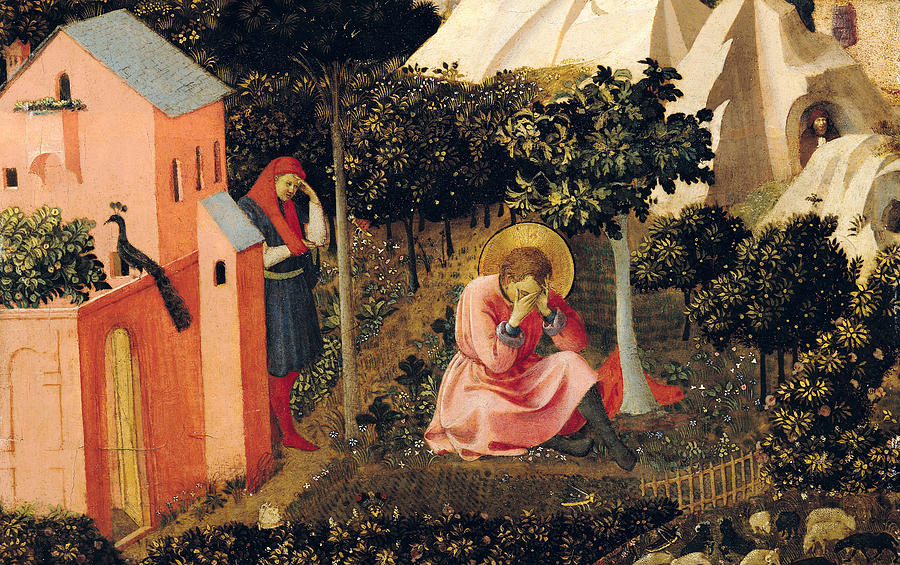
The Conversion of St. Augustine, Fra Angelico
It is curious that the 1970 Missal retains a reference to our “holy fasts,” since the mandatory Fast was eliminated in 1966, and since the Novus Ordo makes no reference to fasting in its other orations during Lent. The 1962 Missal, on the other hand, prays for a holy fast almost every day of the week in its prayers.
The Collect asks that we may be protected from spiritual evils by the help of continentia, which is usually translated as “self-denial.” Continentia entails self-denial, but it is more. On the verge of his conversion, St. Augustine prayed for “chastity and continence, but not yet,” afraid of giving up the dirty little pleasures with which he had grown so comfortably accustomed. (Conf. 8.7.17) Continence is a regaining of mastery over self, an ability to be self-contained (with God’s grace, of course) over the tug of the appetites; it is more self-control than self-denial. The 2011 ICEL translation comes admirably close when it translates continentia as “self-restraint.”
Finally, according to the economy of the prayer, continence becomes a defensive weapon against demonic assault, a shield or an armor. We enter into the Great Fast, as the Preface of Lent declares, to “curb our vices, elevate our minds, and bestow virtue and reward.” And in the words of the Secret for the First Sunday of Lent, we solemnly offer God “the sacrifice of the beginning of Lent, beseeching [Him], that by refraining from flesh at our meals, we may refrain from harmful pleasures.” In other words, we refrain from licit pleasures (regardless of what PETA tells you, there is nothing wrong with consuming the flesh of a warm-blooded animal) in order to take charge over pleasures that lean into the illicit (gluttonous habits, etc.). Such is the power of continence for which we pray as we enter into the annual Boot Camp of spiritual combat.




