

Lost in Translation #150
The first two stanzas of St. Francis of Assisi’s Canticle of the Sun (which we began examining last week) are:
Altissimu, omnipotente bon Signore, Tue so le laude, la gloria e l’honore et onne benedictione.Ad Te solo, Altissimo, se konfano, et nullu homo ène dignu te mentouare.
Which I and others translate as:

Most High, Almighty, good Lord, Yours are praise, glory, honor, and every blessing.To You alone, Most High, do they belong, and no man is worthy of mentioning You.
Saint Francis begins his song about creation with praise of the Creator, for creation owes all its goodness to its Creator. Two themes emerge: the transcendence of God and the lowliness of man.
The key thing to understand about the God of Abraham, Isaac, and Jacob is that He is not the highest point in the pyramid of existence: He is above the pyramid altogether. As C.S. Lewis writes: “If there was a controlling power outside the universe, it could not show itself to us as one of the facts inside the universe – no more than the architect of a house could actually be a wall or staircase or fireplace in that house.” [1] Just as an architect utterly transcends the house that he makes and is made of an entirely different stuff than a house, so too does God utterly transcend His creation and has an Essence entirely different from that of His creation.
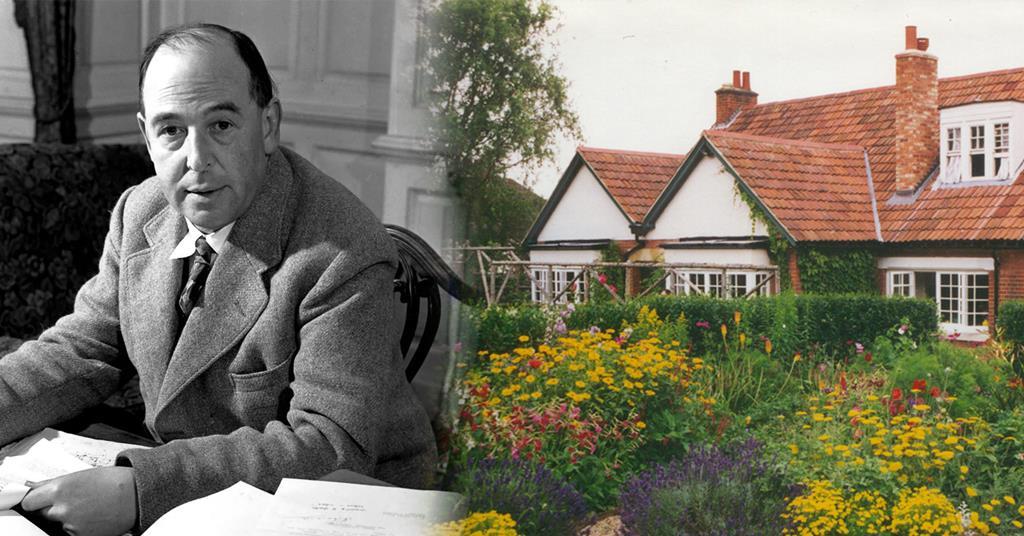
C.S. Lewis and his house
That said, divine transcendence does not mean divine distance. As St. Augustine notes, God is closer to us than we are to ourselves: He is secretissimus et praesentissimus, most hidden and most present. [2] Unlike the architect who can walk away from and forget about the house that he built, God remains utterly present to His creation at all time; if He forgot about it for one moment, it would cease to exist. And creation abounds with God’s fingerprints, eloquently pointing back to its Creator. Again Augustine comes to mind. “Tell me of my God, since you are not He,” the Bishop of Hippo dramatically says to all creatures. “Tell me something of Him.” And they cried out in a great voice: “He made us!” Augustine adds that “their answer was their beauty.” [3]

From the book Gus Finds God
In his Canticle, Saint Francis indicates God’s transcendence with the words “Most High” (which he uses twice) and “Almighty” and by ascribing to God all praise, glory, honor, and blessing. This glorious, Supreme God is then contrasted with measly man, who is not even worthy of mentioning God. (Francis may have in mind the Jewish convention of never uttering the holy name of God, YHWH, a name too lofty to pass over sinful human lips.) It is a curious paradox: man can know that he has a Creator, but his own creatureliness and sinfulness make him unworthy to talk about Him.
And yet that is precisely what Francis does in this canticle. Unworthy though he is, he knows that he has been redeemed and given the gift of Faith which enables him to know, love, and serve his Creator. And he does so because giving God all praise and admitting one’s own lowliness is paradoxically liberating and exhilarating. Francis’ posture in the Canticle once more calls to mind Augustine, who begins his Confessions with:
Great art Thou, O Lord, and greatly to be praised; great is Thy power, and of Thy wisdom there is no number. And man desires to praise Thee. He is but a tiny part of all that Thou hast created. He bears about him his mortality, the evidence of his sinfulness, and the evidence that Thou dost resist the proud: yet this tiny part of all that Thou hast created desires to praise Thee. Thou dost so excite him that to praise Thee is his joy. For Thou hast made us for Thyself and our hearts are restless till they rest in Thee. [4]
This article appeared as “Holy Creation” in the Messenger of St. Anthony 127:3, international edition (March 2025), p. 21. Many thanks to its editors for allowing its publication here.
Notes
[1] Mere Christianity.
[2] Confessions 1.
[3] Confessions 10.6.9.
[4] Confessions 1.1.1




