Let us give thanks to the Lord for all the benefits, mercies and blessings which He has bestowed upon us over the course of the year of grace 2025...
Oremus. Deus, cujus misericordiae non est númerus, et bonitátis infinítus est thesaurus: piíssimae Majestáti tuae pro collátis donis gratias ágimus, tuam semper clementiam exorantes; ut, qui peténtibus postuláta concédis, eosdem non déserens, ad praemia futúra dispónas. Per Christum, Dominum nostrum. Amen.
Let us pray. O God, of Whose mercies there is no number, and of Whose goodness the treasure is infinite, to Thy most gracious majesty we render thanks for the gifts bestowed upon us, ever imploring Thy clemency, that as Thou dost grant the petitions of them that ask, Thou may never forsake them, and prepare them for the rewards to come. Through Christ, our Lord. Amen.
Deus, qui inter summos sacerdótes fámulum tuum Benedictum ineffábili tua dispositióne connumerári voluisti: praesta, quáesumus; ut, qui Unigéniti Filii tui vices in terris gerébat, sanctórum tuórum Pontíficum consortio perpétuo aggregétur. Per eundem Christum, Dóminum nostrum. Amen.
God, Who in Thy ineffable providence, did will that Thy servant Benedict should be numbered among the high priests, grant, we beseech Thee, that he, who on earth held the place of Thine Only-begotten Son, may be joined forevermore to the fellowship of Thy holy pontiffs. Through the same Christ, Our Lord. Amen.
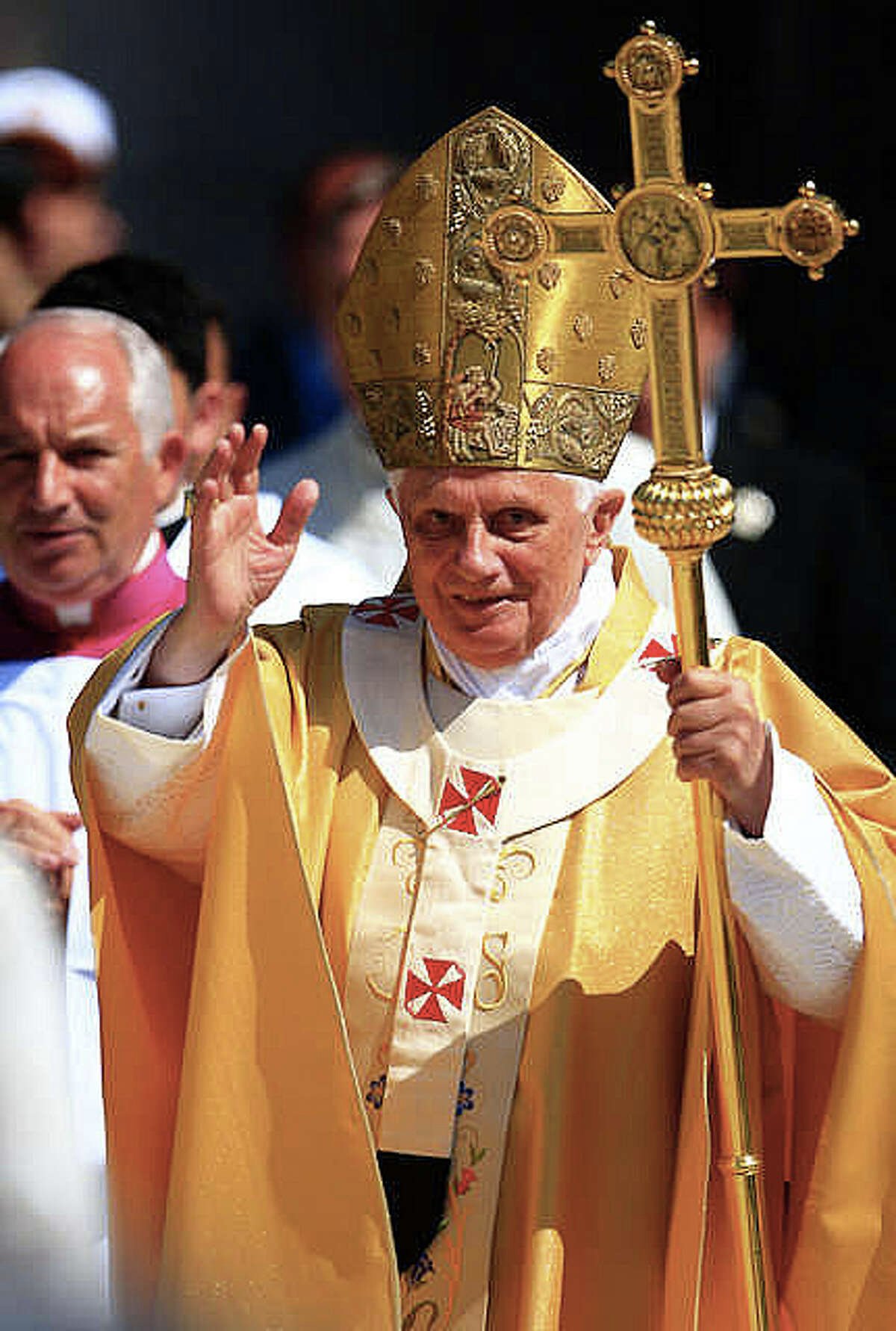
As we pray for the eternal repose of His Holiness Pope Benedict XVI, who died three years ago today, let us also remember with gratitude the gift of his papacy, his graciousness and good humor, his many wise and well-considered writings, his paternal love especially for priests and religious, but of course above all, his restoration to the Church of the incomparable treasure of the traditional Roman Rite, an act which will continue to bear great spiritual fruit and lead the way for much-needed reform. “What earlier generations held as sacred, remains sacred and great for us too, and it cannot be all of a sudden entirely forbidden or even considered harmful.”
Joseph Ratzinger serving an open-air solemn Mass in the town of Buchfelln in 1947, when he was 20. Tradition will always be for the young!
We continue Luisella Scrosati’s series on the orientation of Christian worship with her fifth part, “Le singolarità della basilica costantiniana di San Pietro”, originally published in Italian on the website of La Nuova Bussola Quotidiana on November 30, and reproduced here by permission of the editors. (Read Part 1; Part 2; Part 3; Part 4)
The rule of praying towards the east, which determined the orientation of churches, had some exceptions. This is neither surprising nor scandalous. It has already been mentioned that the east-west axis was sometimes not feasible, either because the buildings already existed and were converted for religious use, or because new buildings had to take into account the presence of roads and other factors that made traditional orientation impossible.
Karl Otto Nußbaum argued (see Part 4) that Italy, and Rome in particular, had no traces of oriented prayer, at least until the eighth century. On the contrary, Monsignor Stefan Heid has shown that evidence of such exists both archaeologically and literarily.
The churches of Rome deserve special attention, particularly the Constantinian Vatican Basilica. Guillaume Durand (1230-96), bishop of Mende, who lived for many years in Rome in the service of Clement IV and Gregory X, stated in his Rationale Divinorum Officiorum (V, 2, 57) that “although God is everywhere, nevertheless the priest at the altar and in divine offices must pray towards the east, by order (ex institutione) of Pope Vigilius.”
He explained more precisely that in those churches where the entrance was located to the west, and therefore the priest celebrated facing the apse, he had to turn towards the faithful for the liturgical greeting (Dóminus vobiscum); if, on the other hand, the entrance was located to the east, it was not necessary for him to turn towards the faithful, since he already had them in front of him.
The reference to Pope Vigilius indicates that, as early as the sixth century, prayer in Rome was also directed towards the east. The expression ex institutione does not necessarily indicate that he was the first to establish this rule. According to Heid, it is possible that the provision arose from the fact that this rule was not universally followed, not so much because someone celebrated “towards the people,” but rather because some priests celebrated facing the apse, and therefore with their backs to the faithful, even when the entrance was to the east. It is also unclear whether Pope Vigilius’ provision was addressed to the churches of Rome or the churches of Gaul.
It seems clear, however, that Vigilius wanted prayer to be directed towards the east, regardless of where the entrance (and therefore the nave) was located; and it seems rather unlikely that he gave this instruction in opposition to a previous tradition, rather than to restore a practice that was no longer understood and was partly disregarded, in Rome or in Gaul.
In fact, in the wooden door (5th century) of the early Christian basilica of Santa Sabina on the Aventine Hill, we find a panel depicting the Parousia. The woman, placed between Saints Peter and Paul, symbolizes the Church in prayer, recognizable by the position of her hands, awaiting her Lord and facing the sun, the east. This important relief testifies that the orientation of prayer and its meaning were also well established in Rome.
Complicating the understanding of liturgical orientation in the ancient basilicas of Rome is the fact that they contained a singular “pole” of orientation, namely the tombs of the martyrs. Churches had to be built in such a way as to combine the orientation of prayer with the possibility of celebrating super corpora martyrum.
If we consider the basilica of St. Peter in the Vatican from the Constantinian era, we can note some peculiarities. It is well known that the basilica had (and has) its façade facing east; on the western side there was a mosaic apse, with the traditional depiction of the Traditio legis in the center, that is, Christ, between Saints Peter and Paul, offering the scroll of the new law to the former. A few meters from the apse, where the altar is normally located, was the Trophy of Gaius, a small funerary aedicule indicating the location of the tomb of the Apostle Peter, protected by a marble structure with a pergula, almost a sort of early Christian canopy. The structure was about 3 meters wide and high and 1.80 meters deep. The aedicule appeared lower because the new flooring had raised the level by 35 centimeters, thus incorporating part of the Trophy, which now rose just over a meter above the floor.
It is not at all clear where the altar was located, nor whether it was fixed, but it is more than likely that, due to the extreme importance of the presence of Peter’s tomb in the basilica, celebrations were held not towards the east but towards the monument, thus ending up accidentally facing west. To hypothesize a celebration towards the east, in the architectural context of Constantine’s basilica on Vatican Hill, would have meant turning one’s back on Peter’s tomb; it is therefore understandable that the focal point of the liturgical celebration was the tomb of the Apostle.
There is no shortage of evidence to support the idea that the travertine slab of the first aedicule was used as an altar; the celebration would thus have taken place inside the shrine that incorporated the Trophy, right above the tomb of the Apostle. The importance of the celebration super corpus should not be underestimated, as evidenced by the clash between the presbyter Vigilantius and St. Jerome. Among the practices in use in the fifth century that were challenged by the presbyter was the custom of offering the Holy Sacrifice over the bones of the martyrs. In Contra Vigilantium 8, Jerome asks rhetorically whether perhaps the popes were wrong to offer sacrifices to the Lord above the venerable bones of Peter and Paul – thus supporting the hypothesis that, at the time, in the Vatican basilica, the celebration took place inside the shrine itself and not simply in its vicinity.
Whatever the case, in the fifth century it was not possible to celebrate towards the east in St. Peter’s because of the location of the Confession. It was only with the elevation of the altar that both the super corpus celebration and the correct orientation could be preserved.
An interesting hypothesis is that Pope Vigilius’s decision, mentioned above, may have been motivated by the need to correct incorrect prayer orientations, which arose from the fact that the pope himself celebrated facing west in the Vatican basilica. The misunderstanding of why, in St. Peter’s, the pope had to celebrate in the opposite direction to the traditional one may have led others to celebrate towards the west in churches with an east-facing façade.
I happened to stumble across this video which was posted on YouTube just a couple of days ago, which contains all the proper chants for the Midnight Mass of Christmas according to the Use of Sarum. The recording was made by the Tallis Scholars many years ago, but this video gives the full score of eaxh part. In addition to the regular parts of the Kyriale, (including a troped Kyrie, which was standard in Sarum), it also includes a brief lesson before the Epistle, Isaiah 9, 2 & 6-7, which is sung with a series of tropes, and a sequence. I plan on updating this post with the full text later, but for now, you can read the text of the former in Latin and English at this link, and the sequence in English here.
In the Roman Martyrology, the second entry after that of St Thomas of Canterbury reads as follows: “At Jerusalem, (the birth into heaven) of St David, King and Prophet.” David is not among the handful of Old Testament Saints to whom there is any historical devotion in the West, but his feast is extremely ancient in the East. In one of the oldest liturgical books of the Rite of Jerusalem, he is commemorated in a joint feast with St James, the Holy City’s first bishop, and assigned to December 25th; this indicates that this observance is even older than the adoption of Christmas as a separate feast in the East, which happened towards the end of the fourth century. It was soon moved, however, first to the 26th, then to the 28th; in the modern Byzantine Rite, it is kept on the Sunday after Christmas, whatever its date may be, and St Joseph has been added to it. (See Liturgy and Byzantinization in Jerusalem, by Dr Daniel Galadza, table 4.5; Oxford, 2017)
In the Roman Rite supplement for the Latin Patriarchate of Jerusalem issued in 1935, his feast is kept as a double major, and has its own proper Mass. English translations of the texts, and some recordings of its chant parts, most of which come from other Masses, are given below. The Mass is celebrated with commemorations of St Thomas of Canterbury and the octave of Christmas.
The Introit is that of the Fourth Sunday after Easter, with the extra Allelujas of the Easter season removed. This was obviously selected to celebrate David’s role as the author of the Psalms; Psalm 97, from which it is taken, also figures prominently in the Roman Divine Office of Christmas. “Sing to the Lord a new song, for the Lord hath done wondrous things; before the sight of the nations He hath revealed His justice. Ps. His right hand hath wrought for Him salvation, and His arm is holy. Glory be... Sing to the Lord...”
The Collect: God, almighty Father, who by the mouth of David made hymns to be sung in Thy Holy Spirit; grant, we ask, that by his intercession, we may be able to worthily make the sacrifice of praise. Through our Lord...”
The Epistle, 1 Samuel 16, 4-13, recounts David’s election as the new king of Israel in place of Saul, through the anointing administered to him by the prophet Samuel.
The Anointing of David, 1555, by Paolo Veronese. In this typically overcrowded Mannerist composition, there are fourteen people to either side of the central figures of Samuel and David, reminding us of the three groups of fourteen into which St Matthew divides the ancestors of Christ named at the beginning of his Gospel. That this is a deliberate reference is demonstrated by the presence of three women, as there are three women mentioned in the Genealogy, Rahab, Ruth, and the wife of Uriah, i.e. Bathsheba. (Image from Wikimedia Commons, CC BY-SA 3.0)
The Gradual is taken from the first Mass of a bishop and martyr, even though David himself fits neither of these categories, since he is mentioned in it by name. “I have found David my servant: with my holy oil I have anointed him. For my hand shall help him: and my arm shall strengthen him. V. The enemy shall profit nothing against him: nor shall the son of iniquity hurt him.” Psalm 88 from which both it and the Communio are taken is also sung at Matins of Christmas.
The Alleluja is taken from the book of Judges, 5, 3, which is very rarely cited anywhere in the liturgy, and appears to be unique to this Mass. “Hear, O ye kings, give ear, ye princes: It is I, it is I, that will sing to the Lord, I will sing to the Lord the God of Israel.”
Of the various Gospel passages that mention King David, Matthew 22, 41-44, seems to have been chosen for this Mass because in it Christ, whose Birth is celebrated a few days before, obliquely asserts His own divinity. The Messiah must come from the house of David, yet David himself calls him “the Lord”, which would make no sense if the former were no more than a distant descendent. The liturgy of the Christmas octave is very much concerned to assert that the Child who is born in Bethlehem is not a mere mortal, but God Himself revealed in the Incarnation for our salvation.
“At that time: the Pharisees being gathered together, Jesus asked them, saying, ‘What think you of Christ? whose son is he?’ They say to him, ‘David’s.’ He saith to them, ‘How then doth David in spirit call him Lord, saying: The Lord said to my Lord, Sit on my right hand, until I make thy enemies thy footstool?’ ”
The Offertory is taken from the First Sunday of Advent. “To thee have I lifted up my soul; in thee, o my God, I put my trust; let me not be ashamed; neither let my enemies laugh at me: for none of them that wait on thee shall be confounded.”
The Secret: God, who are moved by humbling and appeased by satisfaction, look with kindness upon the contrite and humbled heart of Saint David, that by his example, we, being filled by the spirit of compunction, may be able worthily to offer Thy sacrifice. Through Our Lord... ”
The Communio is also taken from the first mass of a martyr and bishop, another clearly appropriate choice for this feast. “Once have I sworn by my holiness: His seed (i.e. Christ) shall endure for ever. And his throne as the sun before me: and as the moon perfect for ever, and a faithful witness in heaven.”
The Post-Communion: “Lord God, whose only-begotten deigned to be the son of David, , grant we ask, that we by the participation on the his mystery, we may be joined by adoption to the sons of the King of kings by adoption. Through the same...” This also obviously reflects the Christmas season.
The Byzantine Divine Office has an enormous number of proper texts for each feast, and for many days of the temporal cycle. (In the liturgical seasons which are equivalent to the Roman times after Epiphany and Pentecost, most of the proper of the season is repeated on an eight-week rotation.) Two of these texts, which are called the Troparion and the Kontakion, are then repeated as the specific liturgical day requires at the Divine Liturgy, which has far fewer variable parts than the Roman Mass does. Here are the troparion and kontakion of King David, Joseph the Betrothed, and James, the brother of Lord and first bishop of Jerusalem, which unite the Saints in a very clever way for their joint commemoration.
The Troparion Proclaim, o Joseph, the good and wondrous tidings to David, the father (i.e. ancestor) of God; Thou didst see the Virgin with child, thou didst adore with the Magi, thou gavest glory with the shepherds, divinely warned by the angel. Beseech Christ God that our souls may be saved.
The Kontakion Today the divine David is filled with rejoicing, and Joseph brings forth praise with James, for having received a crown by their kinship with Christ, they rejoice, and in hymns exalt Him that is ineffably born on earth, and cry out: O Merciful One, save them that praise Thee!
A constant feature of revolutions in the liturgical sphere is the encounter between novelty and antiquity, the convergence between progressivism and archeologism.
In the recent book dedicated to the practice of Communion in the hand, Il cibo dei Serafini. Comunione sulla mano, sì o no? [The Food of the Seraphim: Communion in the Hand, Yes or No?], an attempt was made to show how this phenomenon came about precisely through a misunderstanding of the meaning of ancient sources, interpreted in the light of ideological convictions completely foreign to that context, resulting in a new ritual form that has very little to do with the Church of the early centuries, but much to do with more modern heterodox ideas.
Something similar has also happened with regard to the orientation of prayer and sacred buildings. This misunderstanding was reinforced by a great scholar, Karl Otto Nußbaum (1923-1999), professor of liturgy at the University of Bonn and author of a highly erudite two-volume book published in 1965, Der Standort des Liturgen am christlichen Altar vor dem Jahre 1000. Eine archäologische und liturgiegeschichtliche Untersuchung [The Position of the Celebrant at the Christian Altar before the Year 1000. An Archaeological and Liturgical-Historical Investigation].
Nußbaum recognized that the first Christian churches were built on an east-west axis, with the apse or façade facing east, but he came to the incredible conclusion that “when proper religious buildings appeared, there were no precise rules determining which side of the altar the celebrant should stand on. He could stand either in front of or behind the altar.”
In practice, for Nußbaum, the almost universal orientation of churches did not necessarily indicate an equally universal orientation of prayer and, therefore, of the location of the celebrant, who could freely stand in front of or behind the altar, facing either east or west. According to him, when the apse was located to the east, the priest could celebrate either towards the people or towards the east; however, when the entrance faced east, the priest always faced the people, with the altar between the celebrant and the assembly. It was only from the sixth century onwards that things changed and the priest ended up between the altar and the assembly, facing the apse.
Reviewing Nußbaum’s book in the journal of the Faculty of Theology of the University of Innsbruck, Zeitschrift für katholische Theologie (no. 88, 1966), another great expert on the history of liturgy, the Tyrolean Josef Andreas Jungmann, a member of the Liturgical Commission during the Second Vatican Council, had no hesitation in declaring that “the often-repeated assertion that the early Christian altar presupposed as a rule that it should face the people is a legend.” A scathing criticism.
In fact, Nußbaum did not conclude in favor of celebrations facing the people on the basis of unequivocal archaeological or written data, but on the basis of highly questionable interpretations of some of this data. For example, the existence of the cathedra and the steps for the presbytery in the apse would, for him, be proof of the celebration versus populum. But this location (see Part 2), provides indications about the first part of the Divine Liturgy, dedicated to singing and listening to the Word of God, which took place from an ambo usually located between the nave and the presbytery, but does not testify to anything relating to the liturgy of sacrifice itself.
Another example of a free interpretation: he believed that the church of Kalat Siman, built on the site where St. Simeon Stylites lived, 30 kilometers from Aleppo, was an example of celebration towards the people, although the archaeological remains do not allow the altar to be located with precision, and although the most likely hypotheses place the altar very close to the apse wall, suggesting that the celebrant had to stand on the west side of the altar, facing east.
It is quite evident that Nußbaum’s interpretation of the archaeological data is strongly influenced by prejudice, which, among other things, clouded his view of the numerous written testimonies according to which the orientation of prayer was an established fact, and even attributed to the teaching of the Apostles themselves. Suffice it to consider his reading of the presence of the remains of two churches in Abu Mena, Egypt: although both have their apses facing east, he believed, without any solid evidence, that in one the liturgy was celebrated facing east and in the other facing west. Or to the interpretation that the orientation of churches, particularly the basilicas in Rome and North Africa, with their facades facing east, was evidence of a celebration facing the people.
But what was this prejudice?
The logical justification given by Nußbaum for systematically giving priority in his theory to the versus populum celebration is that it was “the original form of the Eucharist.” Nußbaum believes that the early Christians participated in the Liturgy of the Word in the temple, but celebrated the Eucharistic banquet in their homes. When the two forms of worship were finally united, it was customary for the presider to stand behind the sacred table, facing the people like an orator in front of an assembly. (Uwe M. Lang, Facing the Lord. Orientation in Liturgical Prayer, 2006, p. 45)
And so we return to where our investigation began: the myth of the domestic church (which I discuss here) and of tables as communal tables (see here, here, and here). Once they had places of worship, the early Christians would (on this theory) have celebrated facing the people, because the Eucharist had been celebrated in homes as a fraternal meal in memory of the Lord. The Lord’s command at the Last Supper – “do this in memory of me” – would have been understood as the perpetuation of the convivial model, in which, of course, all the diners face each other. Only later, when the convivial model was joined by, and then superseded by, the sacrificial model, did the celebrant end up turning his back on the people.
The problem with this interpretation is that, although it is now widespread in the common imagination, it is not based on solid evidence. Instead, the evidence points to an understanding of the Eucharist as a sacrifice (and therefore also as a sacrificial meal) from the beginning, testifying to buildings dedicated to worship and not to common dining rooms, and to actual altars and not to dining tables.
Similarly, there is a great deal of evidence confirming that the orientation of the Church’s prayer since the early centuries was towards the east and was by no means ‘free’. The exceptions, as we shall see, can be explained by specific circumstances that have nothing to do with a celebration facing the people.
In the Missal of St Pius V, the feast of the Holy Innocents is celebrated in violet vestments, rather than the red used on all the other feasts of Martyrs. It is also the only feast on which the Gloria in excelsis is omitted, and with it, the Te Deum in the Divine Office; furthermore, the Alleluia at Mass is replaced with a Tract, and Benedicamus Domino is said in place of Ite, missa est, as in Advent and Lent. This custom is attested in the 9th century by Amalarius of Metz, who writes in his treatise On the Ecclesiastical Offices, citing a rubric in his copy of the Gradual, “ ‘The day is passed, as it were, in sadness.’ The author of this Mass wishes us to be joined to the souls of the devout women who mourned and wept at the Innocents’ death.” (book 1, 47) He also attests that the feast of the Innocents was kept with an octave, as were those of St Stephen the First Martyr and St John the Evangelist. (book 4, 37 in fine).
The Massacre of the Innocents, by Tintoretto, 1582-87, from the Scuola Grande di San Rocco in Venice.
Towards the end of the twelfth century, Bishop Sicard of Cremona notes that in addition, the “festive vestments”, i.e. the dalmatic and tunicle, were not worn on this day, and that these signs of mourning were observed because the Innocents, dying before the Resurrection of Christ had opened the gates of heaven, “went down to hell”, (i.e. the Limbo of the Fathers), but also “to represent the sadness of the mothers.” (Mitrale 9.8) He also says (which Amalarius does not) that the feast was not kept with these signs of mourning if it occurred on a Sunday, “because of their future glorification” in heaven.
Writing about a century later, William Durandus rejects Sicard’s idea that these customs refer to the Innocents’ descent to the Limbo of the Fathers, since if that were the case, the same would have to be observed with St John the Baptist. He does agree with Amalarius, citing his words very closely, and then explains that “the songs of joy” (i.e. the Gloria, Te Deum and Alleluia) are sung if the feast falls on Sunday, and always sung on its octave, “to signify the joy which they will receive on the eighth day, that is, in the resurrection. Although they did go down to (the Limbo of the Fathers), nevertheless they will rise with us in glory; for the octaves of feasts are celebrated in memory of the general resurrection, which they signify.” This is exactly the custom prescribed by the Missal of St Pius V and its late medieval antecedents. Durandus also knows of the custom “in many churches” that the dalmatic and tunicle were not worn, but this is not followed by the Tridentine Missal. (Rationale Divinorum Officiorum VII, 42, 11-12)
The Collect of the Innocents traditionally reads as follows: “O God, whose praise the Innocent Martyrs on this day confessed, not by speaking, but by dying, mortify in us all the evils of the vices; that our life also may proclaim in its manners Thy faith, which our tongues profess.” The phrase “mortify in us all the evils of the vices (omnia in nobis vitiorum mala mortifica)”, which has been removed in the Novus Ordo, refers to the traditional interpretation of the last line of Psalm 136 (137), in which the Psalmist curses the “daughter of Babylon” that had sent the children of Israel into exile: “Blessed be he that shall take and dash thy little ones against the rock.” For obvious reasons, this passage was used by the early Church’s critics as an example of evil behavior purportedly sanctioned by the Bible, as also by heretics who rejected the Old Testament, such as the Marcionites and Gnostics.
The Masses of the Holy Innocents and Pope St Sylvester I, in the Sacramentary of St Denis, (folio 26v), second half of the 9th century; Bibliothèque nationale de France, Département des Manuscrits, Latin 2290
The 3rd century biblical scholar Origen, whose massive corpus of Scriptural interpretation (now mostly lost) was devoted in large measure to answering such critics, explains the meaning of this passage in a spiritual sense as follows.
(T)he little ones of Babylon (which signifies ‘confusion’) are those troublesome sinful thoughts which arise in the soul, and he who subdues them by striking, as it were, their heads against the firm and solid strength of reason and truth, is the man who dashes the little ones against the stones; and he is therefore truly blessed. God may therefore have commanded men to destroy all their vices utterly, even at their birth, without having enjoined anything contrary to the teaching of Christ.” (Contra Celsum, 7.22)
This explanation is accepted and elaborated upon by several of the Latin Fathers. St Hilary refers to “vices – vitia” eight times in his Treatise on this Psalm; he would also seem to be the first to associate the rock against which the vices are dashed in their “infancy” with the rock which St Paul says was Christ. (1 Corinthians 10, 4). He is followed in this by St Jerome in his 22nd Epistle, written to his spiritual daughter Eustochium, and by St Augustine (Enarratio in Ps. 136). Hilary and Jerome in particular were quite familiar with the Greek Fathers, and especially the famous Origen. Continuing this tradition, St Gregory the Great writes in his Commentary on the Penitential Psalms, “We dash our little ones upon the rock, when we mortify illicit impulses (or ‘passions’) as they arise, by directing the mind towards the imitation of Christ. For it is written ‘But the rock was Christ.’ ”
Of course, the actual children who died in Bethlehem at the hands of King Herod’s soldiers do not represent our vices, and their death does not represent the mortification of our vices. The parallel between the Psalm and the Gospel lies in the fact that in both cases, Christ brings redemption and glory out of an event full of horror and sadness, as He will later do with His own death. In the Old Testament, this is realized only in a spiritual and allegorical way; in the New Testament, the story of the Incarnation, it is realized in the very flesh in which Christ is born and dies as a man, and which He shares with the other sons of Bethlehem. The curse of the Psalm becomes an exhortation to virtue, the words that precede it, “blessed shall he be who shall repay thee thy payment which thou hast paid us,” replaced by Christ’s command, “Bless them that curse you.” The murder of the Innocents in Bethlehem, a sin that cries to Heaven for vengeance, will bring them to glory in Heaven, after the murder of another Innocent opens its gates and effects the redemption of the human race.
This may also be the reason why the Roman Rite developed the custom, which is unique to it, of referring to these children as “the Holy Innocents”, since they did not live long enough to commit any sin, and never lost or struggled to keep the innocence which adults must preserve or regain by the mortification of the vices. In other rites, they are referred to simply as a “children” or “infants.” In the Epistle of their Mass, Apocalypse 14, 1-5, St John the Evangelist, whose feast is kept the previous day, sees that “a Lamb (also a symbol of innocence) stood upon Mount Sion, and with him an hundred forty-four thousand, having his name, and the name of his Father, written on their foreheads. … these were purchased from among men, the firstfruits to God and to the Lamb: And in their mouth there was found no lie; for they are without spot before the throne of God.” Medieval authors in the West, having no idea of the true size of Bethlehem at the time of Christ’s birth, often assumed on the basis of this reading that their number must have been 144,000, but the Byzantine tradition says they were 14,000. (The whole population of the city today is just over 25,000.)
A Greek icon of the Massacre of the Innocents, ca. 1580
Various liturgical scholars, including Fr Frederick Holweck, the author of the Catholic Encyclopedia article on the Holy Innocents, have noted that before the reform of St Pius V, their feast was kept at the middle rank of “Semidouble” in the Use of Rome, rather than the highest rank of Double. None of them, as far as I can tell, has noted that it was the only Semidouble feast kept with an octave. These terms derive from the custom of semidoubling the antiphons in the Office, i.e., not singing them in full, but only intoning them before each psalm or canticle. This may seem rather odd to us now, but was historically far more common than doubling, which became the norm less than 70 years ago. Since both doubling and the keeping of octaves were traditionally reserved for the greatest solemnities, this anomaly may also have been thought of as a sign of mourning.
Holweck also states, incorrectly, that the pre-Tridentine Breviary sang the hymns of Christmas at the Office of the Innocents; in point of fact, the Common hymns of Several Martyrs were used. The Pian Breviary, which is in most regards extremely conservative, introduced two new proper hymns for the feast, stanzas from the Epiphany hymn of the 5th century poet Prudentius; the first three of these are sung at Matins, and the other two at Lauds, to be repeated at Vespers. The latter hymn has become famous in connection with a story about St Philip Neri. He lived for many years at the Roman church of San Girolamo della Carità, right across the street from the Venerable English College, many of whose young students died as martyrs in England under Queen Elizabeth I. He used therefore to greet them with the first line of the hymn “Salvete, flores Martyrum! – Hail ye flowers of the martyrs!”
Salvete flores martyrum, / Quos lucis ipso in limine / Christi insecutor sustulit, / Ceu turbo nascentes rosas.
All hail, ye little Martyr flowers, / Sweet rosebuds cut in dawning hours! / When Herod sought the Christ to find / Ye fell as bloom before the wind.
Vos prima Christi victima, / Grex immolatorum tener, / Aram sub ipsam simplices / Palma et coronis luditis.
First victims of the Martyr bands, / With crowns and palms in tender hands, / Around the very altar, gay / And innocent, ye seem to play.
Jesu, tibi sit gloria, / Qui natus es de Virgine, / Cum Patre et almo Spiritu, / In sempiterna saecula. Amen.
All honor, laud, and glory be, / O Jesu, Virgin-born to thee; / All glory, as is ever meet / To Father and to Paraclete.
Amen. (English translation by Msgr. Hugh Thomas Henry and J. M. Neale.)
In its habitual conservatism, the Roman Breviary has fully proper offices for only two of the Apostles, Ss Andrew and Paul. Most of the others take all the chant propers from the common, and even St Peter himself has proper responsories at Matins, but no proper antiphons. The same is true of St John the Evangelist, whose feast we keep today, even though he is one of the titular saints of the cathedral of Rome.
The upper part of the façade of St John in the Lateran; in the middle are statues of Christ and the two Saints John, the Baptist and the Evangelist. (Image from Wikimedia Commons by NikonZ7II, CC BY-SA 4.0, cropped.)
Of course, many proper offices were created for the Apostles, some of which were more widely adopted than others. One of the most common is a set of very beautiful antiphons for Matins of St John, which are attested in most of the oldest sources for the cathedral office, although it seems they were less widely diffused among the monks. Unlike those of St Andrew, which are drawn from his hagiography, or those of St Paul, many of which are Scriptural, these antiphons are mostly drawn from the writings of the Fathers, although some of them do refer to specific events in the traditional legend of St John.
The text of the first three is taken directly from St Isidore of Seville’s book “On the birth and death of the Fathers”, chapter 72.
Aña 1 Joannes Apostolus et Evangelista, virgo est electus a Domino, atque inter ceteros magis dilectus. ~ John the Apostle and Evangelist, was chosen as a virgin by the Lord, and more beloved among the others. (This also refers to an argument made by St Jerome in his treatise Against Jovinian (I. 26), who had spoken against the superiority of virginity over marriage.)
Aña 2 Supra pectus Domini Jesu Christi recumbens, Evangelii fluenta de ipso sacro Dominici pectoris fonte potavit. ~ Resting upon the breast of the Lord Jesus Christ, he drank the streams of the Gospel from the sacred font of the Lord’s breast.
The Last Supper, 1324, by Ugolino di Nerio (1280-1330)
Aña 3 Quasi unus de paradisi fluminibus, Evangelista Joannes verbi Dei gratiam in toto terrarum orbe diffudit. ~ Like one of the rivers of Paradise, the Evangelist John poured out the grace of the Word of God in all the earth.
The next two are taken in their specific wording from a homily of St Bede for St John’s feast. (VIII in die natali S Joannis) The fourth antiphon refers to a very ancient story, already known to Tertullian (de Praescript. 36, ca. 200 A.D.), that St John came to Rome after the deaths of Ss Peter and Paul, and in the reign of the emperor Domitian, was put into a vessel of boiling oil, but he came out cleaner and healthier than he went in. This is also cited by St Jerome in his treatise Against Jovinian.
Aña 4 In ferventis olei dolium missus Joannes Apostolus, divina se protegente gratia, illæsus exivit. ~ The Apostle John, put into the vat of boiling oil, came out unharmed by the protection of God’s grace.
The traditional story goes on that after this failed attempt to kill him, John was sent into exile on the island of Patmos, where he received the visions recorded in the book of the Apocalypse.
Aña 5 Propter insuperabilem evangelizandi constantiam exsilio relegatus, divinæ visionis et allocutionis meruit crebra consolatione relevari. ~ Because of his invincible constancy in preaching the Gospel, being sent into exile, he merited to be conforted by the frequent consolation of divine vision and address.
After the death of Domitian, he is released from his exile, and returns to Asia Minor to visit the churches. This antiphon seems not be traceable to a specific literary source.
Aña 6 Occurrit beato Joanni, ab exsilio revertenti, omnis populus virorum ac mulierum, clamantium et dicentium: Benedictus qui venit in nomine Domini. ~ As the blessed John returned from exile, all the people, men and women, came to meet him, crying out and saying, “Blessed is he who comes in the name of the Lord.”
The text of the next antiphon comes partly from a sermon on the Lord’s Supper, subtitled “To the brothers dwelling in the desert”, and falsely attributed to St Augustine. (All three of these are quoted in Jacopo da Voragine’s Golden Legend.) When St John is very old, and has long outlived all the other Apostles:
Aña 7 Apparuit caro suo Joanni Dominus Jesus Christus cum discipulis suis, et ait illi: Veni, dilecte mi, ad me: quia tempus est ut epuleris in convivio meo cum fratribus tuis. ~ The Lord Jesus Christ appeared to his dear John with his disciples, and said to him, “Come to me, my beloved friend; since it is time for you to dine in my banquet with your brothers.”
Aña 8 Expandens manus suas ad Dominum, dixit: Invitatus ad convivium tuum, venio, gratias agens, quia me dignatus es, Domine Jesu Christe, ad tuas epulas invitare, sciens quod ex toto corde meo desiderabam te. ~ Stretching out his hands to the Lord, He said, “Invited to your feast, I come, giving thanks that you have deigned to invite me to your banquet, o Lord Jesus Christ, knowing that I longed for you with all my heart.”
The Ascension of St John, painted by Giotto ca. 1315 in the Peruzzi Chapel in the Franciscan basilica of the Holy Cross in Florence.
Aña 9 Domine, suscipe me, ut cum fratribus meis sim, cum quibus veniens invitasti me: aperi mihi januam vitæ, et perduc me ad convivium epularum tuarum: tu es enim Christus, Filius Dei vivi, qui præcepto Patris mundum salvasti: tibi gratias referimus per infinita sæculorum sæcula. ~ Lord, receive me, that I may be with my brothers, with whom you have come to invite me; open to me the door of life, and lead me to the feast of your banquet; for you are Christ, the son of the living God, who at the command of the father saved the world; we give you thanks through the endless ages of ages.
We are very grateful to Mr Kevin Tierney for sharing with NLM this insightful essay on the failure of Traditionis Custodes, which I am sure our readers will find especially interesting in light of the upcoming extraordinary consistory. You can find more of his excellent writing on his Substack; He is also on Twitter at https://twitter.com/CatholicSmark
When the cardinals gather in Rome in January at the invitation of Pope Leo XIV, they will discuss, among other things, the sacred liturgy. While not explicitly named, everyone understands that, in this conversation, some of them will raise the topic of Traditionis custodes. To speculate, the ensuing discussion will likely center on how to preserve it while eliminating its worst aspects, such as the rescript that revoked the bishops’ right to regulate the liturgy in their dioceses. I think instead that the cardinals should discuss not how to mend Traditionis custodes, but how to end it.
While normally this discussion centers on why people prefer the TLM vs the Novus Ordo, I’d like to look at the legislation itself, and the culture in which that legislation came into being. A striking thing about Traditionis custodes (hereafter TC) was that the plan had a single point of failure. By his own words, Pope Francis promulgated TC to bring about liturgical uniformity within the Roman Rite, because only liturgical uniformity could faithfully honor the Second Vatican Council. (“This unity I intend to re-establish throughout the Church of the Roman Rite.”) Since the bishop is the moderator of the liturgy in his diocese, Francis entrusted this task to the bishops… who mostly ignored it. This led to Francis changing Church law regarding the liturgy, removing the authority of the local bishop (in the Roman Rite) to regulate the sacred liturgy, and instead putting it in the hands of the head of the Dicastery for Divine Worship, whom he could more easily pressure into eliminating the TLM on a case-by-case basis. In doing so, he exposed TC’s single point of failure.
Dangerous counter-revolutionaries threatening the unity of the Faith!
A single point of failure is an engineering concept where an entire system succeeds or fails based on one point. Many times, a single point of failure is ignored because of all the complex dynamics involved in a system, or the number of data points involved. When that one point fails, the entire system crashes, normally leading to long term disaster. For this reason, the first thing any smart design of a system does is abandon a single point of failure, by either adding redundancy (a backup) or diffusing the risk (distributing the cost of failure between points.)
Pope Francis proved that the person of the Roman Pontiff is TC’s single point of failure. As Diane Montagna revealed, when he asked the bishops for their opinion, the majority told him what he wanted to do was a bad idea. Francis responded to this by bypassing every norm of implementing a law, and demanding that it take immediate effect. He moved a change into a live environment, not knowing if it would work. When it was clear that it would not work, he doubled down on the single point of failure, by making enforcement dependent almost entirely on who is Pope. With the end of a pontificate, the desire to keep enforcing TC would be entirely in the hands of a successor, whose priorities might be very different. I think we have seen this with Leo. While some bishops have attempted to continue to implement the decree, Leo has shown himself far more amenable to the TLM’s continued existence. While some might say that Leo can fix this situation by being less oppressive, this does not change the fundamental reality of TC: few want it, and even fewer are invested in its success.
The second reason it should be rescinded is that TC fails to achieve its stated goal. The decree and the documents implementing it claim that a powerful sign of unity will be fostered in the Church because of these actions. I would simply ask the reader to look at the dioceses where this approach has been emphasized. Are Detroit and Charlotte centers of unity and visible communion? Are their bishops united with their pastors and laity? Are those bishops known for being well liked by their brother bishops? To ask these questions is to answer them.
The third reason TC should end is there is no realistic way to get to Yes. When you introduce a change into the world, you must have a way you can measure if it is successful, at which point you can say that “Yes, this worked” or “No, it didn’t.” At what point can you say that TC worked? Does anyone believe, in 2025, that the TLM is going to be abolished? If not, what are the options for getting to that point? The first option would be even greater centralization or a brute force ban of the TLM, options which, whatever their chance of success, just add even more pressure onto that single point of failure. The second would be a mass purging of bishops, and appointing outright yes-men in their place. This would destroy the authority of even bishops sympathetic to TC, and introduce into the dynamic a lot of bishops deprived of their jurisdiction, who would nonetheless still be admired by the faithful, while central authority would be held in contempt. Ecclesiastically speaking, bad things happen in that situation.
Faced with this reality, there will be a temptation to take measures which will turn the temperature down. The rescript could remain in place, but just ignored. Bishops would receive automatic approval to keep having the TLM celebrated, or Rome could drop that part entirely. The rescript could be removed, returning the issue to the bishops entirely. While all of these would be welcomed as short-term measures, they do not address the long-term instability of TC. Most bishops still do not want this decision, and are fine with leaving it to their priests. They either do not care about the TLM, or they want it preserved and encouraged. The younger a priest is, the more conservative he is, and the more at peace he is with the continued existence of the TLM, and not just in America.
Instead of trying to make a dying project work, the cardinals – and the Church at large – have a chance to introduce a new question: instead of trying to check off long desired ideological goals that have no relevance to today’s Catholics, what can we do to make it easier for Catholics to follow Christ?
Truly it is worthy... as we consider the birth of the blessed Stephan, who was both levite and martyr, and who set forth for us venerable examples of faith, of holy courage, of stewardship and outstanding chastity, of preaching and of marvelous constancy, of confession and patience. And therefore worthily with the feast of his passion does he before all others follow the birth of Thy Son, of whose everlasting glory he came forth as the first martyr. Through (the same) Christ our Lord, through whom the angels praise Thy majesty... (An ancient preface for the feast of St Stephen the First Martyr.)
The Ordination of the First Deacons, 1511, by the Venetian painter Vittore Carpaccio (1460/65 - ca. 1525). Now in the Gemäldegallerie in Berlin.
VD: Beati Stephani levitae simul et martyris natalitia recolentes, qui fidei, qui sacrae militiae, qui dispensationis et castitatis egregiae, qui praedicationis mirabilisque constantiae, qui confessionis ac patientiae nobis exempla veneranda proposuit. Et ideo nativitatem Filii tui merito prae ceteris passionis suae festivitate subsequitur, cuius gloriae sempiternae primus martyr occurrit. Per eundem Christum, Dominum nostrum...
In the days of the Venetian Republic, one of the most important aspects of the city’s religious life was a group of large and prestigious confraternities known as the “scuole grandi – the great schools.” These associations engaged in a wide variety of devotional and charitable activities, and each of them had a large hall on which these activities were centered. There was also a number of lesser schools, one of which was dedicated to St Stephan, and frequented by men in the wool trade. The painting shown above is one of five which this school commissioned from the painter Carpaccio in honor of their patron. The schools were all suppressed when the Republic was overthrown by Napoleon, and the possessions stolen and scattered; the fourth of the series, which depicted the trial of St Stephen, was lost.
Many Venetian artists excelled at representing texture in their paintings, and loved to show rich embroidered cloths like the dalmatics in the painting above, or the garment of the man looking up at Stephen in the next one. But they tended to be weak on their drawing, and as a result, their lines are often rather hazy. (Michelangelo, very much a product of the Florentine school which excelled at drawing, is reported to have said of the Venetian artist Titian that he would be a superb painter if he would just learn how to draw.) Carpaccio, however, is a master of both drawing and perspective, which is how he is able to use the rather fantastic architectural elements in the background to create an enormous sense of space.
Here are the remaining three: the Preaching of St Stephen, now in the Louvre.
The Disputation of St Stephen, now in the Brera Gallery in Milan.
The Martyrdom of St Stephen, now in the State Gallery in Stuttgart. Notice the clever way Carpaccio emphasizes the collective participation in the martyrdom by giving us several figures wearing red cloth.
In the Canticle of the Sun, Saint Francis moves from the sun, moon, and stars to Brother Wind, the air, and the weather:
Laudato si, mi Signore, per frate Uento
et per aere et nubilo et sereno et onne tempo,
per lo quale, a le Tue creature dài sustentamento.
Which I translate as:
Praised be You, my Lord, through Brother Wind,
and through the air, cloudy and serene,
and every kind of weather through whom you give sustenance to Your creatures.
Survivalists talk about the so-called the Rules of Three. It is extremely difficult to survive three months without companionship, three weeks without food, three days without water, three hours in a harsh environment, and three minutes without air.
The wind and the air, filled as they are with oxygen, provide life for all creatures on earth. But they have also been loaded from time immemorial with theological significance. In the Bible, there is often an equivalence between wind and spirit: indeed, in Hebrew, Greek, and Latin, they are the same word – ruah, pneuma, and spiritus, respectively. In the Book of Genesis, the spirit of God moves over the waters when God creates the heavens and the earth, and the “spirit” here can either be a wind or the Holy Spirit. At the first Pentecost, it is both, for the Holy Spirit manifests Himself on that occasion as a mighty wind; indeed, one of the titles of the Holy Spirit is the Breath of God. And when Jesus imparts the Holy Spirit on the Apostles after He rises from the dead, He does so by breathing on them:
And He said to them: “Receive ye the Holy Ghost. Whose sins you shall forgive, they are forgiven them; and whose sins you shall retain, they are retained” (John 20, 22-23).
Furthermore, in Saint Francis’ day and up until the 1960s, the Roman Rite of Baptism required the priest to perform ritual acts of breathing. The “insufflation” was when he breathed three times on the baptismal water and said to Almighty God: “Do You with Your mouth bless these pure waters: that besides their natural virtue of cleansing the body, they may also be effectual for purifying the soul.” The “exsufflation,” on the other hand, was when the priest breathed three times on the baptismal candidate and said to the devil: “Go out of him...you unclean spirit, and give way to the Holy Spirit, the Paraclete.”
Finally, besides the Holy Spirit, wind can symbolize the human soul: “And the Lord God formed man of the slime of the earth: and breathed into his face the breath of life, and man became a living soul” (Gen. 2, 7).
Saint Francis next praises the air as cloudy and serene. For me, these words conjure up the picture of a bright blue sky populated by puffy white clouds, the kind that can look like all manner of animals and faces.
In the past century we have learned not to take the air for granted. Industrial pollution of the atmosphere has led to smog, acid rain, lead poisoning, and according to scientific consensus, climate change, with carbon dioxide emissions creating a greenhouse effect that leads to more extreme weather.
And weather is possibly the theme of Saint Francis’ final object of praise in this stanza. I say “possibly” because the standard English interpretation of the word Francis chose, tempo, is “every kind of weather.” But a more direct translation of tempo is simply “season.” Is Francis praising rain, drought, sleet, and snow, or spring, summer, fall, and winter? In some respects, it does not matter, for it is indeed through the seasons, which consists of different kinds of weather, that God gives sustenance to all His creatures. And for that we are grateful.
This article appeared as “Brother Wind” in the Messenger of St. Anthony 127:6, international edition (June 2025), p. 21. Many thanks to its editors for allowing its publication here.
The following excerpts are taken from book VI, chapter 13, 17-27, of William Durandus’ great liturgical commentary, the Rationale Divinorum Officiorum, his explanation of the three Masses of Christmas. As is his wont, our friend is more than a little prolix and repetitive in this section, and so I have paraphrased him in several places. The traditional story with which he begins, that the feast of Christmas was instituted by Pope Telesphorus, who reigned ca. 126-137, is not historically correct; the feast was instituted at Rome, but about two centuries later. The division of sacred history into four eras of which he speaks, before the Law, under the Law, under Grace, and in peace, is a commonplace in the writings of St Augustine.
Pope Telesphorus established that three Masses are to be sung on this day, to show that the birth of Christ saved the fathers of three eras, namely, those before the law, under the law, and after the law. The first is sung around midnight to show that they who were before the law were not enlightened by any law, and that the bread which is daily sacrificed and eaten on the altar, namely Christ, was born in Bethlehem in the middle of the night, as Luke says, whence also the book of Wisdom (18, 14-15), “while all things were in quiet silence, and the night was in the midst of her course, (Thy almighty word leapt down from heaven)”, which is clearly about the birth of the Lord. … (This text is also the introit of the Sunday within the octave of Christmas.)
The same pope established that in this Mass the angelic hymn Gloria in excelsis should be solemnly sung to remind us that the angels sang it on that night when they announced Him to the shepherds, as the Gospel says (Luke 2, 13-14), “And suddenly there was with the Angel a multitude of the heavenly host praising God and saying glory to God in the highest and on earth peace to men of goodwill.”
(This next paragraph refers to a custom which is attested in some early Roman lectionaries, and in many medieval uses of the Roman Rite, by which the Mass of the vigil of Christmas, and the three Masses of the feast, had a reading from Isaiah right before the Epistle: 62, 1-3 on the vigil; 9, 2 & 6-7 at the midnight Mass; 61, 1-3 at the dawn Mass; 52, 6-10 at the day Mass. This custom is not evidence of the regular presence of an Old Testament reading that later dropped out.)
Immediately before the epistle is read a prophecy… for those things which are said in the Gospel would not be believed unless they had been foretold in the Old Testament. The two lessons are read without interval, one from a prophecy and the other from the Apostle, because Christ is born for the two peoples who are to be joined in (the breaking down of) a wall. (Eph. 2, 14) The column of the Apostles rests upon the base of the prophets, and through both the birth of Christ is harmoniously preached. … however, some do not read any prophecy, signifying that the old things have passed away, and all things are made new (2 Cor. 5, 17), which is to say, the figure ceases because the truth has come. (cf. S. Thomas Aquinas, ST III, Q. 83. a. 2; this part of the Summa is Thomas’ contribution to the genre of liturgical commentary.)
Part of a page of Missal according to the use of Augsburg, Germany, printed in 1510. In the left column are the Gospel and Offertory of the dawn Mass of Christmas; in the right column, the introit, collect, and the beginning of the prophecy of Isaiah from the day Mass.
The second Mass is said at sunrise, at the beginning of the day, when Christ was adored by the shepherds in the crib, and this was done first of all to show that the holy fathers and prophets who were under the written law had a little knowledge of God bit, but not so great as we have now. Therefore, it begins from the promise which was made to the ancients in the old law, “today a light shall shine in the House of the Lord.” …
But the third Mass, which is celebrated in the brightness of the day, at the third hour, when the day of our redemption has shown upon us with greater festivity, refers to the time of grace in which a great light descended from heaven, “which enlightens every man who comes into this world.” (Jo. 1, 9) … the epistle and the gospel are concerned with the eternal generation, whence it says in the former, “Thou art my son, this day have I begotten thee,” … and in the latter, “in the beginning,” as if to say, “at the beginning of creatures was the word.”
The introit of the dawn Mass of Christmas: Lux fulgébit hodie super nos, quia natus est nobis Dóminus, et vocábitur Admirábilis, Deus, Princeps pacis, Pater futúri saeculi: cujus regni non erit finis. Ps. 92 Dóminus regnávit, decórem indútus est: indútus est Dóminus fortitúdinem, et praecinxit se. Gloria Patri... Lux fulgébit... (A light shall shine upon us this day, for the Lord is born to us: and He shall be called Wonderful, God, Prince of peace, Father of the age to come: of Whose reign there shall be no end. Ps. The Lord hath reigned, He is clothed in beauty; that Lord is clothed in strength, and hath girded Himself. Glory be... A light shall shine...)
The first Mass is concerned with the eternal generation. The second is about the promise made to the ancients, which is why it says, “A light will shine in the house of the Lord,” not “shone” or “shines.” The third is about the truth demonstrated to us, which is why it says, “A child is born to us, and a son is given to us.” The one uses the future tense to indicate the promise, the other uses the past tense to indicate the fulfillment of that promise. And because the eternal generation was hidden from us, as Isaiah says (53, 8), “Who shall tell of his generation?”, therefore the Mass about the eternal generation is said in the deep of the night.
The ancient fathers to whom the promise was made were certain of the Lord’s incarnation, but not as much as the fathers of the New Testament to whom the truth was shown, and for this reason the Mass which concerns the promise made to the ancients is sung as the dawn begins to shine, when there is only a little light. … But because the truth is clear in the times of the New Testament, the Mass which is about the demonstration of that truth is sung in the bright light.
Therefore, the first Mass pertains to the eternal generation, that which comes from the Father without a mother; the second to the generation in time, that which is from the Mother without a father; in the third, both are joined together, the eternal generation and the temporal.
The Adoration of the Christ Child, with God the Father, 1535-36, by the Italian painter Battista Dossi (ante 1500 - 1548.)
Nevertheless, it should be noted that in the Mass which is about the eternal generation is read the Gospel about Christ’s humanity, namely, “A decree went forth from Caesar Augustus” (Luke 2, 1-14), but in the other, which is about the truth shown to us, is read the gospel about His divinity, namely, “In the beginning was the word” (John 1, 1-14), to indicate that from the time when the humanity was united to the divinity, the divinity itself was not without the humanity, nor will it ever be. …
The text of the third Mass sounds forth the wonderful deeds of the Word of God, which was “in the beginning” and began to be flesh, as is read in the Gospel. This Word is the Child who according to the prophet has been born to us, as we sing in the introit, and this is the new song of which the prophet speaks in the verse, “Sing to the Lord a new song.” This is also that saving word of which the gradual says, “All the ends of the earth have seen the salvation of our God…” This is the great light which came down into the womb of the virgin, “which enlightens every man who comes into this world…”, finally, He is also that rich and mighty king to whom the offertory says, “Thine are the heavens and thine is the earth.”
Offertorium, Ps. 88 Tui sunt caeli, et tua est terra: orbem terrárum et plenitúdinem ejus tu fundasti: justitia et judicium praeparatio sedis tuae. (Thine are the heavens, and Thine is the earth; the world and its fullness Thou hast founded; justice and judgment are the foundation of Thy throne.)
What may we bring Thee, o Christ, since Thou hast appeared upon the earth as man for our sake? For each of the creatures made by Thee bringeth its thanksgiving to Thee: the Angels bring a hymn, the heavens a star, the wise men their gifts, the shepherds their amazement, the earth a cave, the desert a manger; and we, the Virgin Mother. O God before the ages, have mercy on us! (A hymn for Vespers of Christmas in the Byzantine Rite.)
On behalf of the publisher and writers of New Liturgical Movement, I wish all of our readers a Merry Christmas, and every blessing from the Child that is born unto us! By the prayers of the Holy Mother of God and all the Saints, may God grant the world peace in the coming year.
At that time, there went out a decree from Caesar Augustus, that the whole world should be enrolled. This enrolling was first made by Cyrinus, the governor of Syria. And all went to be enrolled, every one into his own city. And Joseph also went up from Galilee, out of the city of Nazareth into Judea, to the city of David, which is called Bethlehem, because he was of the house and family of David, to be enrolled with Mary his espoused wife, who was with child. And it came to pass, that when they were there, her days were accomplished, that she should be delivered. And she brought forth her firstborn son, and wrapped him up in swaddling clothes, and laid him in a manger; because there was no room for them in the inn.
The Adoration of the Shepherds, ca. 1565/75, by the Italian painter Lelio Orsi (1511-87)
And there were in the same country shepherds watching, and keeping the night watches over their flock. And behold an angel of the Lord stood by them, and the brightness of God shone round about them; and they feared with a great fear. And the angel said to them, “Fear not; for, behold, I bring you good tidings of great joy, that shall be to all the people. For, this day, is born to you a Saviour, who is Christ the Lord, in the city of David. And this shall be a sign unto you: you shall find the infant wrapped in swaddling clothes, and laid in a manger.” And suddenly there was with the angel a multitude of the heavenly army, praising God, and saying, “Glory to God in the highest, and on earth peace to men of good will!” (Luke 2, 1-14, the Gospel of the Midnight Mass of Christmas.)
R. Hodie nobis caelorum Rex de Virgine nasci dignatus est, ut hominem perditum ad caelestia regna revocaret: * Gaudet exercitus Angelorum: quia salus aeterna humano generi apparuit. V. Gloria in excelsis Deo, et in terra pax hominibus bonae voluntatis. R. Gaudet exercitus Angelorum: quia salus aeterna humano generi apparuit. V. Gloria Patri, et Filio, et Spiritui Sancto.
R. Hodie nobis caelorum Rex ... (The first responsory of Christmas Matins, sung by the schola of the Fraternity of St Peter’s seminary in Bavaria.)
R. Today the King of heaven deigned to be born of a Virgin for us, that He might bring back to the kingdom of heaven man who was lost.
* The host of Angels rejoiceth, because eternal salvation hath appeared to the human race.
V. Glory to God in the highest, and on earth. peace to men of goodwill. The host of Angels... Glory be to the Father, and to the Son, and to the Holy Ghost. Today...



_01.jpg)


__99659.1541619784.gif?c=2)



.jpg)






.png)