The Exciting and Beautiful Re-Ordering of St Mary’s Cathedral, Aberdeen, Scotland
All Roman Catholics should take note of what is happening at St Mary’s Cathedral in Aberdeen: the creation of a sacred space where art and architecture work together with a deep understanding of how both support worship. Drawing on both the Roman and Byzantine traditions, the reordering integrates imagery, materials, and form into a single Eucharistic vision – one rooted in the Church’s heritage, yet particular to its place. When complete, the harmony achieved here will, I believe, make St Mary’s a destination of pilgrimage for generations, and a model that churches of the Roman Rite elsewhere would do well to study closely.

 |
Above: mock-ups of the proposed re-ordering; below: the cathedral as it is now. |

Read more about this project, and see images of the proposed art and reordering, at www.beautyforgod.org. The images of the proposed reordering come from this website. The key elements are:
A redesigned altar, ambo (lectern), and bishop’s chair crafted from Scottish elm and stone
A new tabernacle in wood, metal, and stone as the devotional focal point behind the altar
A new painted mural on the East Wall by award-winning artist Martin Earle
A new sanctuary floor with colored granite from across North-East Scotland
Conservation of the Rose Window
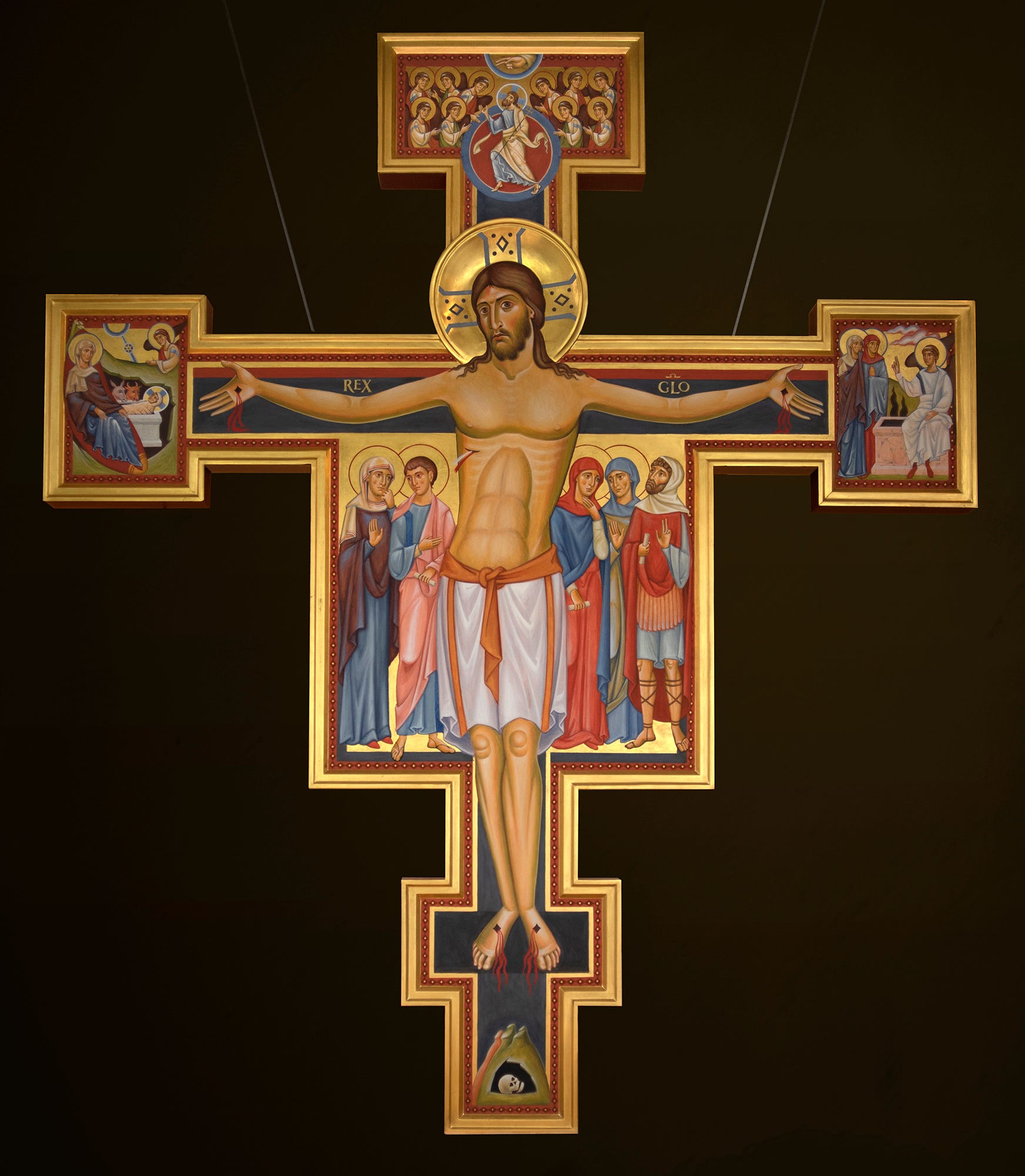
I came to know Bishop Hugh of Aberdeen, who commissioned this work, during his years as abbot of Pluscarden, a community of Catholic Benedictine monks which is in the diocese of Aberdeen, and of which I am an oblate. (The abbey has a daughter house in Petersham, Massachusetts, also named St Mary’s.) Abbot Hugh was called to the episcopate by Pope Benedict in 2011. I am delighted to see what he has planned here. Many years ago, he commissioned a double-sided San Damiano crucifixion from me, which still hangs in the abbey. More recently, when he asked me to repeat the commission for St Mary’s in Aberdeen, I told him I was unable to take it on, but recommended Martin Earle as the best artist I know for such a commission. And what a spectacular job he did!
Many of you will already know Martin’s work (martinearle.com). He is an English Catholic iconographer who works in fresco, egg tempera, gilding, wood and stone carving, and mosaic. The nine-foot hanging Crucifix he completed for St Mary’s – the first phase of this grand vision – was awarded the Grand Prize in the Catholic Art Institute’s international sacred art competition in Chicago in 2023. Phase 2 now builds upon that foundation.
When I talked to Martin about it, he was at pains to emphasize how a team is working together on this project. First of all, he spoke of Bishop Hugh’s vision and initiative in bringing it about. Then Martin worked with fellow UK artist Jim Blackstone (dunstanicons.com, another old friend of the Scala Foundation), on the design of the wall painting. He also told me how important it was to work closely with the architect, David Chouman (dcarchitect.co.uk), who leads and coordinates all the moving parts in the project, and even the stone masons who worked hard to comb the diocese for suitable and interesting stone to create the inlaid pattern work on the floor, altar, and ambo.
Emphasizing the team is important. In a project like this, all these people contribute creatively to the final outcome. The lesson here is that such a commission is rarely simply the vision of one person.

At the heart of the new composition on the east wall behind the altar will be a large-scale wall painting of Pentecost. The design creates a single vertical axis that visually connects Christ on the cross, Our Lady, the tabernacle, and the altar, which represents the Body of Christ and bears the Agnus Dei on its front face. High up on the wall, the Trinitarian symbolism of the design at the center of the rose window crowns the whole. Notice how the arc of the arrangement of the Apostles echoes that of the lower curve of the rose window, creating a resonance between the artistic and architectural forms. The tabernacle doors bear the image of the Annunciation, echoing, albeit on a smaller scale, the typical imagery of the Royal Doors of the iconostasis in the Byzantine tradition, which are opened during the Divine Liturgy to reveal the altar. A procession of sheep moves toward the tabernacle, recalling the famous mosaic program at San Clemente in Rome, and integrating naturally with the Agnus Dei below it on the front of the altar.
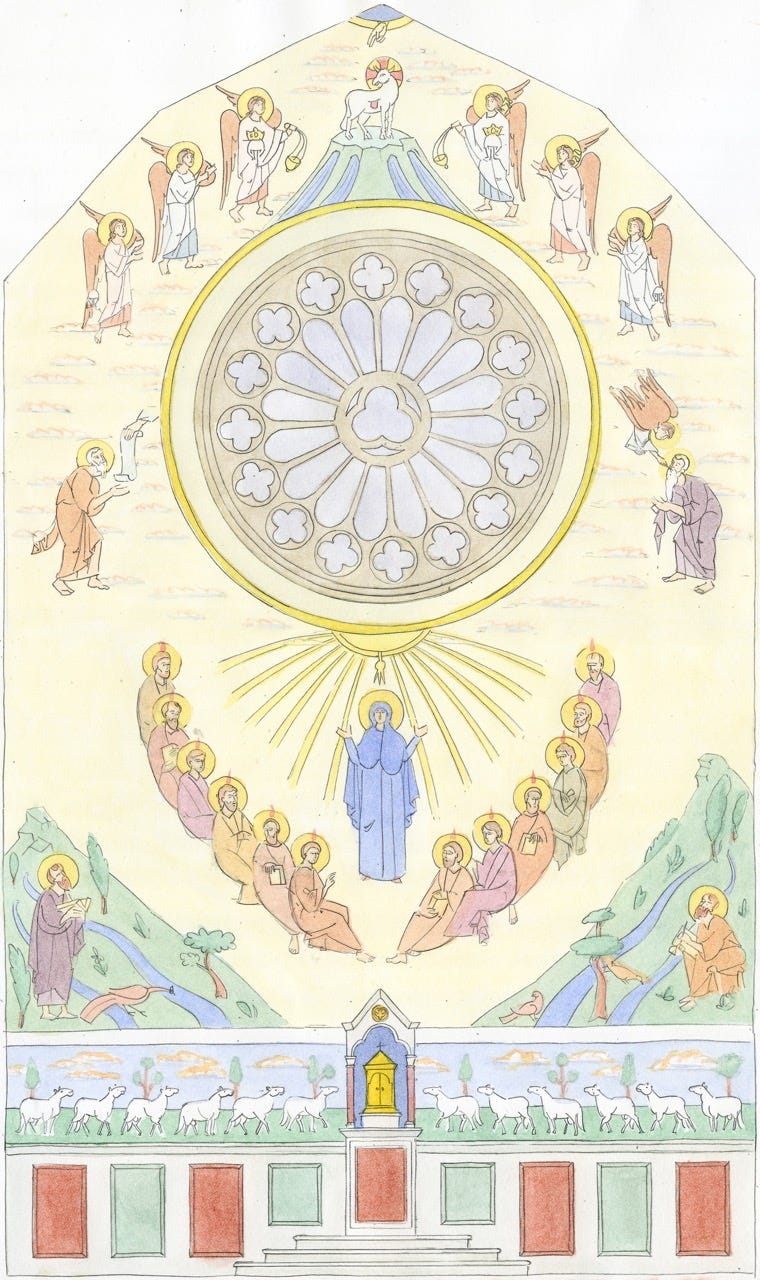
Considering the composition in more detail (and drawing heavily here on the write up on the website, beautyforgod.org), we begin to see how it mirrors the Liturgy itself – making visible what happens invisibly when the Word is proclaimed, and the Eucharist is celebrated. We begin with the Church on earth, gathered at Pentecost: Mary at the center, the Apostles around her, the descent of the Spirit visually linked to the Crucifix above the altar, and Christ’s final giving up of his Spirit. Moving upward, we see the heavenly liturgy: the Lamb of God standing on the mountain from which flow the four rivers of Paradise, angels ministering around him, and the hand of the Father blessing from above. The depiction of the Lamb on the heavenly mountain is reminiscent of the Ghent Altarpiece, where the Adoration of the Mystic Lamb unites the heavenly and earthly realms in a single act of worship. By such visual devices, the point is made By such visual devices, the point is made that the earthly liturgy does not stand alone – it is the Church’s participation in the ideal and unceasing worship of her heavenly worship, so that what is offered at the altar below and what is offered before the Throne above are not two acts of worship but one: the single, unbroken sacrifice of the whole Church, in heaven and on earth..
The Prophets and Apostles frame this mystery. Isaiah receives the burning coal; Ezekiel eats the scroll – each prefiguring the Eucharist and the proclaimed Word. Paul and John carry the mission forward after Pentecost, and one could say that rivers of grace flow through their books, nourishing the faithful as the lambs below process toward the tabernacle.
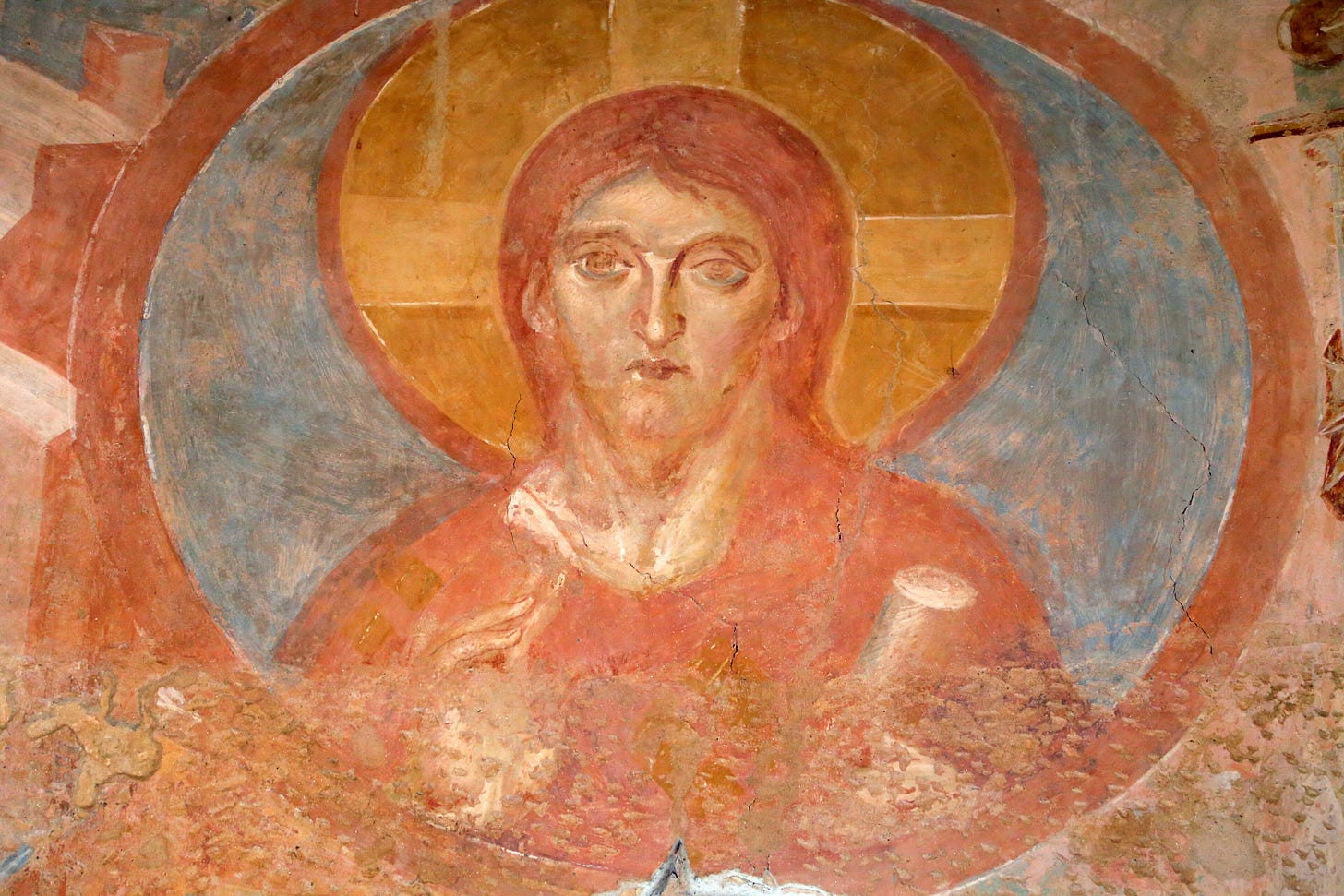 |
| An Italo-Byzantine fresco of Christ from perhaps the 9th century. AD) Image from Wikimedia Commons by Sailko, CC BY 3.0. |
What emerges, taken as a whole, is a layout that is distinctly Roman and Eucharistic in its logic, yet one that will be familiar to anyone who has prayed before the image program of a Byzantine Catholic or Orthodox church, in which we see angels, prophets, apostles, Our Lady and Our Lord (both in glory and suffering), ordered to the same theological and liturgical principles. This makes the design not merely an image appropriate for Aberdeen, but also genuinely Catholic in the fullest sense.
The reordering also addresses the architecture itself. The bishop’s cathedra will be moved from its current position in the center. The floor will be laid in different colors of Aberdeen granite, a fitting material for a city known as the Granite City, and one that speaks also of the permanence of the Rock upon which the Church itself is built.

When complete, the harmony of art and architecture at St Mary’s will, I believe, make the cathedral a worthy site of artistic pilgrimage for generations.
As a postscript, for those who think that the strong visual emphasis on Christ suffering on the cross is much more a Roman than a Byzantine presentation: it is true that the traditional schema of the Eastern iconostasis plays down emphasis of Christ on the cross visually is the sense that it is of a small size compared to what we seen in Roman Rite churches. However, the cross is typically placed centrally and at the apex of the iconostasis, thereby ordering the whole schema in the mystery of redemption. Further, the emphasis in the liturgy on the importance of the cross in our redemption is stressed very strongly in other ways: by playing down the size of the cross visually, the impact of the sacrifice, the passion, death, and resurrection as re-presented on the altar becomes stronger; and through the repetition of troparia (liturgical hymns that emphasize the Holy Cross. Both approaches are sound, differing in emphasis in the means by which the same end is achieved.
I am also reminded of the brilliant book by the Chair of Theology at Notre Dame University, Khaled Anatolious, who is Melkite Catholic (one of the Byzantine Catholic churches), called Deification Through the Cross: An Eastern Christian Theology of Salvation.




