Looking upon our thoughts and offenses, we sacrifice to Thee, o Lord, no bloody victims, but with humble prayers we offer Thee the Body of the eternal Priest. Remember therefore, o Lord, what He underwent for us Who bore our sins, and do Thou put on us the stole of justice, that none may take his place at Thy supper without the wedding garment, and the banquet of the New Covenant may flourish with the joys of heaven. Far from it be the guile whereby the evil disciple was deceived. May all have true faith, certain hope, and pure charity, that our conscience may not be condemned by these spiritual sacraments, but rather, cleaned of all vices through the sweetness of Thy peace and charity, we may call out to Thee from this earth: Our Father... (The introduction to the Lord’s Prayer at the Mozarabic Mass of Holy Thursday.)
A fresco of the Last Supper painted ca. 1245-55 in a chapel of the cathedral of St Mary in La Seu d’Urgell, Catalonia, Spain. Image from Wikimedia Commons by Ángel M. Felicísimo, CC BY 2.0.
Ad Orationem Dominicam Cogitatiónes et delicta nostra cernentes, non cruentas tibi, Dómine, víctimas immolámus, et simplícibus votis tibi sempiterni Sacerdótis corpus offérimus. Memoráre ítaque, Dómine, quid pro nobis pertúlerit, qui peccáta nostra portávit. Indue ergo nos justitiae stola, ut in coena tua sine veste nuptiáli nullus accumbat, gaudiisque caeléstibus novi testamenti convivium flóreat. Procul absit dolus, quo deceptus est malus ille discípulus. Sit ómnibus fides vera, spes certa et cáritas pura, ut spiritálibus sacramentis non damnétur conscientia, sed per pacis caritatisque tuae dulcédinem ab ómnibus emundáti vitiis, ad te proclamémus e terris: Pater noster...
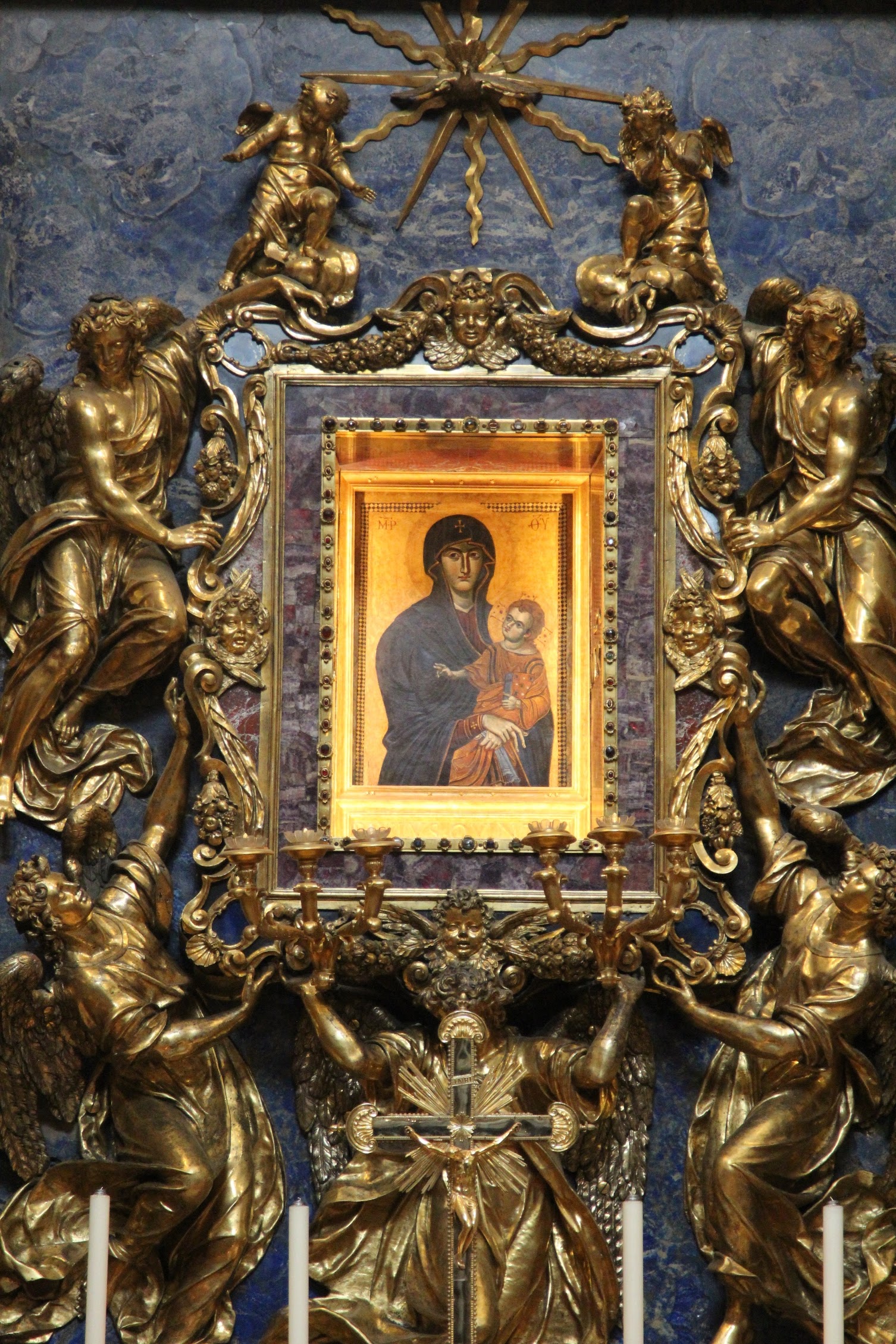
The icon of the Virgin Mary, known as the “Salus Populi Romani”, in the reredos of the Borghese chapel of the basilica of St Mary Major. (Image from Wikimedia Commons by Fallaner, CC BY-SA 4.0)
The station of Spy Wednesday is held at St. Mary Major, also the station church of the four Ember Wednesdays; as in the Embertides, and the Wednesday of the fourth week of Lent, there are two readings before the Gospel. The first of these is Isaiah 63, 1-7, preceded by a part of verse 62, 11. [1]
Thus sayeth the Lord God: Tell the daughter of Sion: Behold thy Savior cometh: behold his reward is with him. Who is this that comes from Edom, with dyed garments from Bosra, this beautiful one in his robe, walking in the greatness of his strength? I, that speak justice, and am a defender to save. Why then is your apparel red, and your garments like theirs that tread in the winepress? I have trodden the winepress alone, and of the gentiles there is not a man with me: I have trampled on them in my indignation, and have trodden them down in my wrath, and their blood is sprinkled upon my garments, and I have stained all my apparel. etc.
The Fathers of the Church understood this passage as a prophecy of the Passion of Christ, starting in the West with Tertullian.
The prophetic Spirit contemplates the Lord as if He were already on His way to His passion, clad in His fleshly nature; and as He was to suffer therein, He represents the bleeding condition of His flesh under the metaphor of garments dyed in red, as if reddened in the treading and crushing process of the wine-press, from which the laborers descend reddened with the wine-juice, like men stained in blood. (adv. Marcionem 4, 40 ad fin.)
This connection of these words with the Lord’s Passion is repeated in very similar terms by St. Cyprian (Ep. ad Caecilium 62), who always referred to Tertullian as “the Master”, despite his lapse into the Montanist heresy; and likewise, by Saints Cyril of Jerusalem (Catechesis 13, 27) and Gregory of Nazianzus (Oration 45, 25.)
The necessary premise of the Passion is, of course, the Incarnation, for Christ could not suffer without a human body. Indeed, ancient heretics who denied the Incarnation often did so in rejection of the idea that God Himself can suffer, which they held to be incompatible with the perfect and incorruptible nature of the divine. St. Ambrose was elected bishop of Milan in the year 374, after the see had been held by one such heretic, the Arian Auxentius, for twenty years. We therefore find him referring this same prophecy to the whole economy of salvation, culminating in the Ascension of Christ’s body into heaven, thus, in the treatise on the Mysteries (7, 36):
The angels, too, were in doubt when Christ arose; the powers of heaven were in doubt when they saw that flesh was ascending into heaven. Then they said: “Who is this King of glory?” And while some said “Lift up your gates, O princes, and be lifted up, you everlasting doors, and the King of glory shall come in.” In Isaiah, too, we find that the powers of heaven doubted and said: “Who is this that comes up from Edom, the redness of His garments is from Bosor, He who is glorious in white apparel?”
In the next generation, St. Eucherius of Lyon (ca. 380-450) is even more explicit: “The garment of the Son of God is sometimes understood to be His flesh, which is assumed by the divinity; of which garment of the flesh Isaiah prophesying says, “Who is this etc.” (Formulas of Spiritual Understanding, chapter 1) Therefore, like the Mass of Ember Wednesday, this Mass begins with a prophecy of the Incarnation as the church of Rome visits its principal sanctuary of the Mother of God, in whose sacred womb began the salvation of man.
The Risen Christ and the Mystical Winepress, by Marco dal Pino, often
called Marco da Siena, 1525-1588 ca. Both of the figures of Christ in
this painting show very markedly the influence of Michelangelo’s Last Judgment.
This is also the day on which the church reads the Passion according to St Luke, who has a special association with the Virgin Mary. Most of what the New Testament tell us about Her was recorded in his writings, including almost all of the words actually spoken by the Her; this fact lies behind the tradition that St. Luke painted a picture of the Virgin, which is figuratively true even if it were not literally so. It is his account of the Passion that tells of the meeting between Christ and a group of women on the way to Mount Calvary, (chapter 23, 27-30); although he does not say that Mary was among them, art and piety have long accepted that it was so. The special devotion of the Servite Order to the Seven Sorrows of the Virgin has both a proper rosary (as the Franciscans have a rosary of the Seven Joys) and a special form of the Via Crucis, called by them the Via Matris; in both, the fourth sorrow is the encounter between Christ and His Mother as He bears the Cross.
The Seven Sorrows of the Virgin Mary, by Albrecht Durer, ca. 1496. The lower middle panel show the Virgin fainting as Her Son passes by Her on the street on the way to Mount Calvary.
For the ceremonies of Holy Thursday, the station was of course kept at the cathedral of Rome. On this day, in addition to celebrating the Mass of the Lord’s Supper, the Pope would preside over the reconciliation of the public penitents, and bless the holy oils, both rituals proper to the office of a bishop. Likewise, the washing of the feet (known as the Mandatum from the first antiphon sung during the rite) is done on this day, a ritual not exclusive to bishops, but traditionally performed by religious superiors upon their subjects, as Christ Himself did. The gospel sung at both the Mass and the Mandatum is taken from St. John (chapter 13, 1-15), since the three Synoptic accounts of the Lord’s Supper have been read earlier in the week. In a later period, the church came to be dedicated also to him along with St. John the Baptist, and it is he whose account of the Passion will also be read on the following day, on which the Church refrains from the celebration of Mass in mourning for the death of the Savior.
Finally, the station of Good Friday is kept at the basilica of the Holy Cross ‘in Jerusalem.’ This denomination comes from the tradition that when St. Helena, Constantine’s mother, built the church to house the relics of the True Cross discovered by herself in the Holy Land, the ground first was covered with earth brought from the city of the Lord’s Passion. As the Bl. Ildefonse Schuster writes in his book on the liturgical traditions of Rome, The Sacramentary, the choice of station fulfills the words of Christ Himself, “it cannot be that a prophet perish out of Jerusalem.”
A reliquary with pieces of the True Cross from the relic chapel of Holy Cross in Jerusalem.
Holy Saturday will be included in an article to be published next week on the stations of the Easter Octave.
[1] As noted by my colleague, the indefatigable Matthew Hazell, the Consilium removed this reading completely from the post-Conciliar lectionary, since, as they said, “it smacks of anger and revenge.” (Apparently, they were too tired to read it all the way to the end, “I will remember the tender mercies of the Lord, the praise of the Lord for all the things that the Lord our God hath bestowed upon us.”) Because we can only restore the liturgy to the vigor which it had in the days of the Holy Fathers by abolishing their teachings...
At the end of February, I published an article about the use of the Penitential Psalms in Lent, in which I mentioned that they were generally said at the beginning of the season, at the ceremony by which the public penitents were symbolically expelled from the church, and again on Holy Thursday, when they were brought back in. These ceremonies were particularly elaborate in the Use of Sarum, but similar rites were observed in a great many other places. Here then is the promised description of the rite of the reconciliation of the public penitents, taken from WG Henderson’s 1882 edition of the Sarum Processional.
An illustration from a Sarum Processional of the Ash Wednesday procession; the captions reads “The station on the day of ashes, when the bishop expels the penitents.” The ash-colored banner is seen up top. Reproduced from Henderson’s edition.
After None of Holy Thursday, the bishop or his substitute goes to the west door of the church, wearing a red silk cope, and accompanied by two deacons, led by the same “ash-colored” banner used in the procession of Ash Wednesday. The penitents await them in the narthex. If the bishop himself performs the ritual, the archdeacon, also in silk cope, stands near the penitents and delivers a rather lengthy address to the bishop, of which I give here only the beginning.
“The time is present, venerable bishop, prayed for by the afflicted, meet for the penitent, desired by those in tribulation. Your sons are present, father, whom their true Mother the Church bore unto God with joy; but again, She mourns with new grief every day that at the devil’s suasion, they became corrupt, and wretched, and exiled. For these, all who have happily remained in Her bosom do humbly pray, and who have remained strong in their faith under the protection of divine clemency. Spare them today, father, and with all the force of thy goodness, let that fountain of David be open to us (Zach. 13, 1), and flow forth unto the cleansing of the woman with the issue of blood, reproving none, rejecting none, excluding none. For although no season lacketh the riches of divine mercy, still, now is the forgiveness of sins more abundant through indulgence, and more copious the acceptance of those reborn through grace. …”
The bishop then intones three times the first word of an antiphon, “Venite, Venite, Venite! – Come! Come! Come!”, beckoning to the penitents with his hand as he does, as if to invite them into the church. One of the two deacons, standing near the penitents, says “Let us kneel”; the other, standing near the bishop, says “Rise.” This is all done a second time, then the bishop repeats “Venite” a third time, at which the choir finishes the antiphon “(Come) ye sons, hear ye me, I will teach you the fear of the Lord.” The whole of Psalm 33 from which it is taken is sung, with the antiphon repeated after each verse. In the meanwhile, priests conduct the penitents by hand to the archdeacon, who brings them to the bishop, who then brings them into the church.
An illustration from a 1595 edition of the Roman Pontifical, showing the reception of the public penitents on Holy Thursday. (Courtesy of the Pitts Theological Library, Candler School of Theology at Emory University.)
When all have entered the church, and the clergy have processed into the choir, they kneel, and say the seven Penitential Psalms; these are accompanied as usual by the antiphon Ne reminiscaris, Kyrie eleison, the Lord’s prayer, and a series of versicles, followed by three prayers. Here is the third one.
“O Lord, Holy Father, almighty and eternal God, who deigned to heal our wounds, we Thy lowly servants and priests humbly beseech and ask of Thee, that Thou may deign to incline the ears of Thy compassion to our prayers, and be moved by confession at (this) penance; and forgive all crimes, and remit every sin; and grant these Thy servants, o Lord, forgiveness in accord with their humble prayers, rejoicing in place of grief, life in place of death; so that those who have come to so great a hope of the height of heaven, trusting in Thy mercy, may merit to come to the goods of Thy peaceable promise and the gifts of heaven.”
He then turns to the penitents, and makes the sign of the Cross over them, saying: “We absolve you by the authority of the blessed Peter, prince of the Apostles, to whom was given by the Lord power to bind and loose; and in so far as any accusation falleth to you, and forgiveness thereof to us, may God almighty be unto you life and salvation, and the merciful forgiver of all your sins.” He gives the usual blessing “May almighty God bless you…”, and the Mass of the Lord’s Supper begins.
The following excerpts are taken from book VI, chapter 70 of William Durandus’ commentary on the liturgy, the Rationale Divinorum Officiorum. Greatly as we reverence his work, our friend is, like many medieval authors, an incorrigible digresser; furthermore, some of the features of the Mass of Spy Wednesday, one of the most beautiful of the entire year, were arranged a bit differently in the missal he knew. I have therefore reordered and paraphrased the text in various places, to make the train of his thought clearer, and to correspond to the Missal of St Pius V. The reader may also find useful this article from two years ago which explains the text of this Mass in detail, especially in regard to the reading from Isaiah 62 and 63 as a prophecy of the Incarnation.
Wednesday is the day on which the Lord was sold by Judas, because He willed not only to suffer for us, but also to be sold, so that He might deliver us from the selling by which our first parent sold us to the devil through the eating of the forbidden fruit, whence Isaiah says (52, 3), “You were sold for free, and you shall be redeemed without money.” Likewise, many sell themselves to the devil for momentary pleasure, just as Adam sold himself for the eating of the forbidden fruit. Therefore, the Sun of justice was sold for our salvation on Wednesday, the day on which the visible sun was formed for the light of the world. (Gen. 1, 14-19)
The Betrayal of Judas, as depicted by Giotto in the Scrovegni Chapel in Padua, Italy, 1304-06.
Now the Lord prayed kneeling, as is said in today’s Gospel (the Passion according to St Luke, 22, 1 – 23, 53). Therefore, in the introit, the Church invites that “in the name of Jesus every knee be bent, of those in heaven”, because He repaired their ruin, “of those on earth”, because He delivered them, “and of those below the earth”, because He led them from the pit in which there was no water, as Zachariah says (9, 11). It is sung in the third tone because of the three things which are invited to bend the knee.
There follows, “and let every tongue confess that our Lord Jesus Christ is in the glory of God the Father.” This is taken from the Apostle (Phil. 2, 11) …
Introitus In nómine Jesu omne genu flectátur, caelestium, terrestrium et infernórum: quia Dóminus factus est oboediens usque ad mortem, mortem autem crucis: ideo Dóminus Jesus Christus in gloria est Dei Patris. Psalmus Dómine, exaudi oratiónem meam: et clamor meus ad te veniat. In nómine Jesu…
Introit (Phil. 2, 10; 8 and 11) In the name of Jesus let every knee bend, of those that are in heaven, on earth, and under the earth: because the Lord hath become obedient unto death, but the death of the Cross. Therefore, the Lord Jesus Christ is in the glory of God the Father. Psalm 101, 2 O Lord, hear my prayer, and let my cry come to thee. In the name of Jesus…
It can also be said that two things are necessary for us, namely, prayer and patience, according to that which the Lord says, “Pray for those who persecute and slander you.” (Matt. 5, 44) We are invited to these two things in the introit: to prayer, when it says, “in the name of Jesus let every knee be bent”; and to patience, by the Savior’s example, regarding whom it is added, “Christ has become for us obedient unto death,” etc. For one is not obedient in tribulation if he does not willingly tolerate it.
Two lessons are read, because on this day the Lord was betrayed for two peoples and by two peoples; and in some churches, they kneel at both of them, because He is adored by both people … and because the first Man incurred two deaths, namely of the flesh and of the soul, and Christ has delivered us from both.
In the first reading (Isa. 62, 11; 63, 1-7), “Say to the daughter of Zion: Behold, thy savior cometh,” … The Angels said (for the incarnation remained hidden from some of them), “Who is this who cometh from Edom?”, that is, from the earth, “with stained garments”, that is, with the members of the body, which are the garments of divinity, “stained purple with blood from Bosra.”
Bosra is a city in Moab, whose name means “strong” or “fortified”, … but its name is transferred to Jerusalem, which once the Lord strengthened by His help, but the inhabitants having become Moabites… they tainted the garments of the king with the purple of blood. He answered, “I who speak justice, and fight forth unto salvation.” And they said, “Why then is thy garment red?”, as if to say, Why have you been bloodied by the pressing of the Cross, if you speak justice? But he answers, “I have trodden the wine press alone”, that is, for all, so that all may be delivered, “and from the nations there is no other man with me.”
The Risen Christ and the Mystical Winepress, by Marco dal Pino, often called Marco da Siena, 1525-1588 ca. Both of the figures of Christ in this painting show very markedly the influence of Michelangelo’sLast Judgment.
And just as the Savior laid down His soul for the redemption of our souls, so also He subjected his body (to death) for the redemption of our bodies; for which reason the first lesson treats of His body, reddened by his own blood, where it says, “Who is this who comes from Edom?”, etc. And because solely from His mercy the Lord suffered for us, therefore the prophet in the person of the Church concludes that reading by saying, “I will remember the mercies of the Lord, the praise of the Lord for all things which the Lord hath rendered unto us.”
After the reading is sung the gradual, “Turn not thy face”, in which He himself prays that through the passion He may come to glory. But because He prayed for a long time in agony, as is said in the Gospel (22, 43), therefore the Offertory and the Communio are taken from the Psalm (101) which is entitled “the prayer of the poor man while he was in anguish”…
Graduale Ne avertas faciem tuam a púero tuo, quoniam tríbulor: velóciter exaudi me. V. Salvum me fac, Deus, quoniam intravérunt aquae usque ad ánimam meam: infixus sum in limo profundi, et non est substantia.
Gradual, Ps 68, 18; 2-3 Turn not thy face away from thy servant: for I am in trouble, swiftly hear me. V. Save me, o God, for the waters have come in even unto my soul. I am stuck fast in the mire of the deep, and there is no sure standing.
The epistle is also from Isaiah (53, 1-12), “O Lord, who hath believed”, in which He is described in the same fashion in which He is represented by the evangelist in the passion…
After the epistle there follows the tract, and in an unusual way (i.e. without a gradual preceding it), because the Church mourns and weeps more deeply than usual… the tract signifies weeping, and therefore on Good Friday only tracts are said. The gradual signifies penance, and because the Lord was not crucified on this day, but only sold, therefore a gradual is also said (i.e. after the first reading).
This tract is sung according to an Old Latin text which reads uses the word “frixorium – a frier”, where St Jerome’s version has “cremium – brushwood.” Below, Durandus interprets the image of bones in a frier to signify the refinement of man’s interior strengths.
Tractus Dómine, exaudi oratiónem meam, et clamor meus ad te veniat. ℣. Ne avertas faciem tuam a me: in quacumque die tríbulor, inclína ad me aurem tuam. ℣. In quacumque die invocávero te, velóciter exaudi me. ℣. Quia defecérunt sicut fumus dies mei, et ossa mea sicut in frixorio confrixa sunt. ℣. Percussus sum sicut faenum, et aruit cor meum, quia oblítus sum manducáre panem meum. ℣. Tu exsurgens, Dómine, miseréberis Sion, quia venit tempus miserendi eius.
Ps. 101, 2-5; 14 O Lord, hear my prayer, and let my cry come to thee. ℣. Turn not away thy face from me: in the day when I am troubled, incline thine ear to me. ℣. In whatsoever day I call upon thee, hear me speedily. ℣. For my days are vanished like smoke, and my bones have been fried as in a frier.
℣. I am smitten as grass, and my heart is withered, because I forgot to eat my bread. ℣. Thou shalt arise, o Lord, and have mercy on Sion: for the time hath come to have mercy on it.
Since we have sinned according to the five senses of the body, the tract has five verses, because of the five wounds of Christ, or because He shed His blood five times: first, in the circumcision; second, at the prayer (in the garden); third, at the scourging; fourth, in the crucifixion; fifth, when He was pierced by the spear. In the same tract, the human race asks for help and confesses the failing which it incurred from the sin of the first parent, saying, “because my days have failed like smoke.” For the life of man is but a day, and the night thereof is death, but this life is cut short and fails because of the pride of the first parent, which is symbolized by the smoke. There follow the words, “My bones were fried in a fryer.” Bones are the interior strengths… and the frier is threefold, namely, the recalling of sins, compassion for one’s neighbor, and meditation on the future judgment; in these the good man is fried. The tract closes, like the lesson, with the mercy of the Lord; whence the last verse is, “Thou arising, o Lord, shall have mercy.”
The Communion is “I was mixing my drink with weeping,” which is to say, the drink of the passion, when His sweat became like drops of blood running down onto the earth. (Luke 22, 44; this is also taken from an Old Latin text of the Psalms.)
Communio, Ps 101 Potum meum cum fletu temperábam, quia élevans allisisti me: et ego sicut foenum arui: tu autem, Dómine, in aeternum pérmanes: tu exsurgens miseréberis Sion, quia venit tempus miseréndi eius. (I tempered my drink with weeping, for thou hast lifted me up and cast me down, and I am withered like grass. But thou, O Lord, remainest forever; thou shalt arise, and have mercy on Sion, for the time is come to have mercy on it.

.jpg)