
The duomo of Milan as it stands today is the result of a project which began in 1386, to replace the two cathedrals which had hitherto served the see of St Ambrose. The “winter church”, as it is still called in Ambrosian liturgical books, was the smaller of the two, dedicated to the Virgin Mary, and used from the Third Sunday of October, the feast of its Dedication, until Holy Saturday; it stood where the modern cathedral stands, but was nowhere near as large. The larger “summer church”, which was demolished in 1543, stood on the opposite end of the modern Piazza del Duomo, and was dedicated to St. Thecla, for which reason her name is included in the Canon of the Ambrosian Mass.
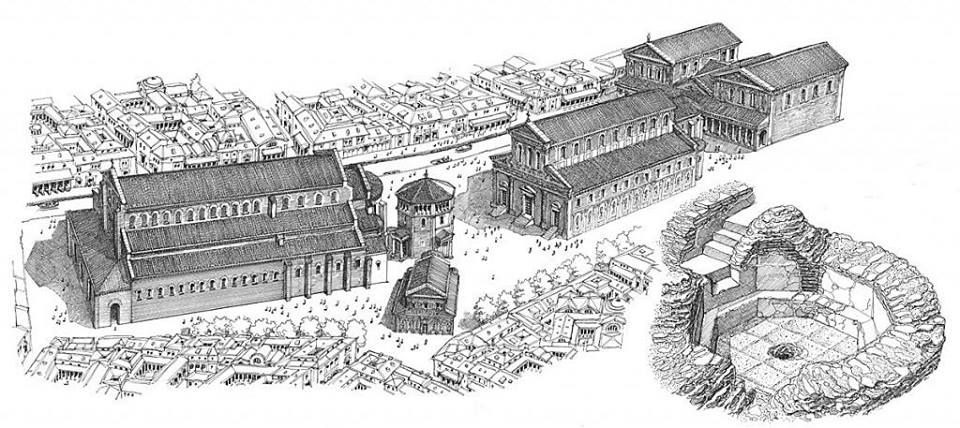 |
| A reconstruction of the cathedral complex of Milan, with the summer church of St Thecla on the left, and the winter church of the Virgin Mary at the right. The octagonal structure in front of St Thecla is the baptistery of St John; the smaller structure beneath it is the baptistery of St Stephen. At the lower right is a partial reconstruction of the interior of the baptistery of St John. |

Antiphon I In Thee, o Lord, do we hope, let us not be confounded forever; in Thy justice deliver us, and rescue us, that we may not perish.
Antiphon II Lord, for the multitude of our sins, we are not worthy to look upon the height of heaven: destroy us not unto the end with our sins.
Antiphon III Lord, if Thou shalt be wroth against us, what helper shall we find, or who will have mercy upon our infirmities? Thou didst call the woman of Chanaan and the Publican to repentance, and receive Peter as he wept; receive also our repentance, o Merciful One, and save us, o Savior of the world.
Antiphon IV With Thy unassailable wall surround us, o Lord; and with the arms of Thy might protect us always; deliver, o God, of Israel, those who cry out to Thee.
Antiphon V Hear, o Lord, the voices of Thy servants that cry to Thee, and say, ‘Lord, have mercy on us!’, and with the arms of Thy might protect us always; deliver, o God, of Israel, those who cry out to Thee.
Each version of the litany of the Saints is introduced by three Kyrie, eleisons, three repetitions of “Domine, miserere – Lord, have mercy”, three of “Christe, libera nos - Christ, deliver us”, and three of “Salvator, libera nos – o Savior, deliver us.” The names of the Saints are then sung by the cantors, to which all others answer, repeating the names and adding “intercede pro nobis.” (“Sancta Maria. – Sancta Maria, intercede pro nobis.”) In the Roman Rite, the list of the Saints is always the same, although local Saints may be added by immemorial custom; in the Ambrosian Rite, the Saints named in the litany change from one occasion to another. |
| St Ambrose, 1465-70, by the Sienese painter Giovanni di Paolo (1403 ca - 1482) |
On this day, after the Virgin Mary, the three Archangels are named, followed by St John the Baptist as the last prophet, and St Joseph as the last patriarch; the Apostles Peter, Paul, Andrew, Thomas and Barnabas, who is traditionally said to be the founder of the see of Milan and its first bishop; the protomartyr Stephen, followed by the local martyrs Nazarius and Celsus, Protasius and Gervasius, Victor, Nabor and Felix, then two Easterners, George and Theodore (both soldiers, as were the three named before them); Faustinus and Jovita, the patrons of nearby Brescia, and Aquilinus; the virgin martyrs Thecla, Agnes and Pelegia; then Galdinus, Charles Borromeo, and Ambrose, who always conclude the litanies in the Ambrosian Rite. The litany ends with three repetitions of “Exaudi, Christe. R. Voces nostras. Exaudi, Deus. R. Et miserere nobis.”, (Hear, o Christ, our voices. Hear o God, and have mercy on us.), and three Kyrie eleisons.
The second collect: O God, who causest all things to benefit those who love Thee; grant to our hearts a disposition of inviolable charity; that desires conceived from Thine inspiration may not be able to be changed by any temptation. Through our Lord...
The second collect: O God, who causest all things to benefit those who love Thee; grant to our hearts a disposition of inviolable charity; that desires conceived from Thine inspiration may not be able to be changed by any temptation. Through our Lord...
The processional antiphons for the return to the winter church.
Antiphon I We have sinned, o Lord, we have sinned: spare our sins and save us. Thou who governed Noah upon the waves of the flood, save us, and Thou who called Jonah back from the depth with a word, deliver us. Thou who stretched for Thy hand to Peter as he sank, come to our aid, o Christ, son of God.
Antiphon II Let Thy right hand lift us up straight, whom the weight of sins boweth down, et because we have fallen to the earth, may we be lifted up o Lord, by Thy mercy.
Antiphon III Lord, incline Thine ear and hear us; look down from heaven, and hear out groaning, and deliver us, o Lord, from the hand of death.
The litany concludes with the following formula each day:
Kyrie, eleison (six times)
V. Agnus Dei, qui tollis peccata mundi, miserere nobis.
R. Gloria Patri. Sicut erat.
V. Agnus Dei, qui tollis peccata mundi, miserere nobis.
R. Sucipe deprecationem nostram, qui sedes ad dexteram Patris.
V. Agnus Dei, qui tollis peccata mundi, miserere nobis.
Kyrie, eleison (six times)
V. Agnus Dei, qui tollis peccata mundi, miserere nobis.
R. Gloria Patri. Sicut erat.
V. Agnus Dei, qui tollis peccata mundi, miserere nobis.
R. Sucipe deprecationem nostram, qui sedes ad dexteram Patris.
V. Agnus Dei, qui tollis peccata mundi, miserere nobis.
R. Kyrie, eleison. Kyrie, eleison. Kyrie, eleison.
R. Benedicamus Domino. R. Fidelium animae.




